Paper commentary
eDMD: Endpoint Distribution Matching for Few-Step Diffusion Distillation
- Problem Multi-step DMD trains its fake model on intermediate predictions, which can leave a nonzero correction even after the student's final output already matches the teacher.
- Method It also replaces single teacher predictions on the final low-noise interval with short multi-step guided trajectories, and samples intermediate noise levels from a calibrated density.
- Results On Qwen-Image-2.1, eDMD reached 14.691 HPSv3++ against 14.212 for DMD2 and 13.787 for TDM, with peak selection within 600 updates.
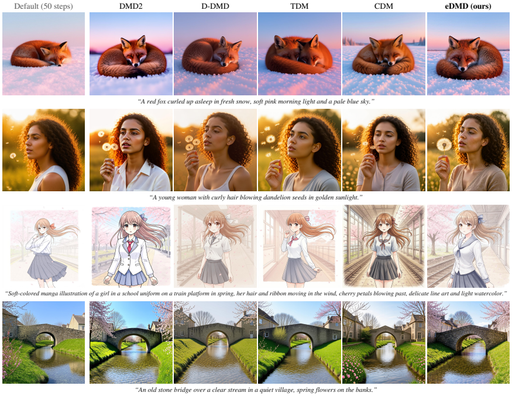
Figure 4 .Qualitative results on FLUX.2-klein-4B.Leftmost: teacher (50 steps,w= 4); others: 4-step students at the checkpoints of Tab. 1; shared prompt and noise per row. Best viewed zoomed in: on fine structures such as fur, hair, and grass,eDMDpreserves richer details and fewer artifacts, yielding more natural textures than existing methods.
Original paper · CC BY 4.0 · Tong Zhao, Xianfang Zeng, Yucheng Han, Ruoyu Wang, Mingkun Lei, Gang Yu, Chi Zhang · eDMD: Endpoint Distribution Matching for Few-Step Diffusion Distillation · Original paper figure · Extracted the figure area from page 8 of the original PDF.Why the fake model's reference matters in multi-step DMD
In DMD, the student moves along the difference between the teacher's denoiser and the denoiser of a fake model that is trained online on the student's own samples, so the fake model decides the reference the student is compared against. A one-step student has a single output, so the fake model naturally learns the distribution that the matching objective cares about.
A multi-step student produces several intermediate predictions, and these generally follow different distributions, so the choice of what the fake model is trained on becomes a central design question.
DMD2 trains one shared fake model on predictions collected from different denoising steps, which amounts to learning a mixture of intermediate and final prediction distributions. TDM builds stage-dependent references from intermediate denoising states and matches distributions within each noise interval. Both designs tie the matching objective to intermediate distributions, while the goal of distillation is the distribution of the final output.
Intermediate predictions need not match the teacher's corresponding distributions even when the final outputs already do, so constraining them can interfere with final quality. The analysis therefore asks whether the correction can stay nonzero after the final output has reached the teacher's distribution.
An endpoint reference for the fake model
eDMD trains a single shared fake model exclusively on the student's final outputs and uses that same model to supply the correction at every denoising step. The method keeps the teacher-versus-fake structure of DMD and changes only which distribution the fake model represents.
The DMD gradient is the difference between the teacher's denoiser and the fake denoiser, applied to the sample through the student's Jacobian, weighted by the noise level. \\[ \\nabla_\\theta \\mathrm{KL}(q_\\tau \\| p_\\tau) = -\\frac{(1-\\tau)^2}{\\tau^2}\\, \\mathbb{E}\\big[(D_p(y,\\tau)-D_q(y,\\tau))\\,\\partial \\hat{x}/\\partial\\theta\\big] \\] where D_p is the teacher denoiser, D_q the fake denoiser, y the noised sample at level tau, and xhat the student's clean prediction.
Under exact conditional denoisers, the correction splits into a teacher enhancement term from guidance, an endpoint matching term that compares the teacher with the student's final distribution, and a reference residual caused by the gap between the fake model's reference and the endpoint distribution. Corollary 1 then says that when the final-step query is an open set at an interior level, a zero correction forces the final output distribution to equal the teacher's, and conversely.
Each intermediate step can be updated locally from its own clean prediction and query noise, or through back-propagation over the later steps of the rollout.
Stronger teacher targets for the final low-noise interval
A single guided teacher prediction at each sampled level can average over several plausible outputs and lose fine detail.
The trajectory is used only as a training target, so it adds teacher evaluations during training and leaves student inference cost unchanged. Under uniform step selection, the fraction of queries that fall in this interval is 12.4% on SD3-Medium and 19.3% on FLUX.
The calibrated query density is estimated once per teacher and grid before training, from teacher samples alone, by measuring how much the teacher's predictions drift across noise levels. For each landing level, 256 training prompts with two noise pairs per prompt are used, and the sampled density is proportional to exp of minus the projected drift, so queries concentrate where the teacher is more consistent.
On SD3-Medium the calibrated density concentrates near the landing level, with mean query level 0.913 against 0.945 for uniform at s = 0.900, while on FLUX.2-klein-4B it stays nearly uniform, at 0.978 against 0.979 at s = 0.967.
Results on Qwen-Image-2.1 and on the four backbones
The four backbones are SD3-Medium, FLUX.2-klein-4B, FLUX.2-klein-9B and Qwen-Image-2.1, each distilled into a 4-step student without real images. Training used the 191,500 CDM prompts for 2,000 updates on SD3-Medium and FLUX.2, and prompt-enhanced rewrites for 600 updates on Qwen-Image. Evaluation generated 1,000 images from 200 DrawBench prompts with five seeds per prompt, and the peak checkpoint was chosen by HPSv3++ over raw and EMA weights every 100 updates.
It also leads on DPG-Bench and HPSv2.1 across those three teachers, and on HPSv3, PickScore and ImageReward on both FLUX.2 models.
On Qwen-Image-2.1, the 4-step eDMD student reached 14.691 HPSv3++, against 14.212 for DMD2 and 13.787 for TDM, and the paper reports it leads the 4-step students on all seven metrics. The Qwen-Image comparison scores prompt-enhanced rewrites against the original prompts, uses guidance scale 1 for all methods, and selects peaks within 600 updates, so it is a different protocol from the SD3-Medium and FLUX.2 runs.
Figure 4 compares the students on FLUX.2-klein-4B with a shared prompt and noise per row, alongside the teacher sampled for 50 steps.
What each component contributes
The component ablations remove the endpoint reference (w/o E), the precise teacher (w/o PT) or the calibrated query density (w/o Q) from the full method, and retrain from scratch on SD3-Medium and FLUX.2-klein-4B. Figure Table 3 lists these runs alongside the full model and the peak selection protocol.
Removing the endpoint reference gives the largest overall degradation among the component ablations on both models, with HPSv3++ of 10.122 against 11.171 for the full model on SD3-Medium and 11.095 against 12.699 on FLUX.2-klein-4B. Without PT the HPSv3++ values are 11.026 on SD3-Medium and 11.667 on FLUX.2-klein-4B, and without Q they are 10.798 and 12.507, so the precise teacher and the query density each lower the peak by a smaller amount than the endpoint reference does.
Because removing a component lowers the score, the result supports keeping that component; it does not show that the removed component is the only source of the gain.
Checks on the endpoint reference beyond the main runs
Adding an endpoint fake to the TDM re-implementation, while keeping its student objective and rollout, raises its peak HPSv3++ by 0.61 on SD3-Medium, 1.45 on FLUX.2-klein-4B and 0.53 on FLUX.2-klein-9B. The gains persist at both 1k and 2k updates, which suggests the reference effect is not specific to eDMD.
When only the final step is updated, HPSv3++ plateaus at 7.5 to 8.4 from 700 to 2k updates on FLUX.2-klein-4B, against 12.1 at 1k and 12.7 at 2k for the full method.
Training cost of the added components
On 16 Ascend 910B2C NPUs, the median per-update time for eDMD is 8.3 s on SD3-Medium, 17.6 s on FLUX.2-klein-4B and 53.6 s on FLUX.2-klein-9B. Over 2,000 updates, excluding evaluation, this corresponds to 4.6, 9.8 and 29.8 hours, and the query calibration takes 5.4, 15.8 and 33.7 minutes.
On SD3-Medium, eDMD surpasses the peaks of the TDM re-implementation and DMD2 within about 1.8 hours, and matches the D-DMD peak in the same time.
Limits of the evidence
Peak checkpoints are chosen and evaluated on the same 200 DrawBench prompts, so a held-out check was run over 1,000 random 100/100 prompt splits.
On SD3-Medium the raw HPSv3++ at 2k updates is 10.82 and the raw and EMA scores are close to the best baseline peak of 10.84, so the advantage at that budget is small. The run-to-run spread of 0.074 on SD3-Medium and 0.11 on FLUX.2-klein-4B is comparable to some of the ablation gaps.
The theory covers exact conditional denoisers, and the experiments use the four named backbones and DrawBench-1000 only. The Qwen-Image comparison uses prompt-enhanced rewrites, PAG on the teacher, and a 600-update budget, so its numbers do not share the protocol of the SD3-Medium and FLUX.2 runs.
Paper info
- Authors
- Tong Zhao, Xianfang Zeng, Yucheng Han, Ruoyu Wang, Mingkun Lei, Gang Yu, Chi Zhang
- Venue
- arXiv · Preprint
- First published
- 2026-11-12
- Added
- 2026-11-14
- Updated
- 2026-11-12
- Version
- v1
- arXiv
- 2611.17194
- Category
- cs.CV
- Original paper terms
- CC BY 4.0
- What we show
- Paper info, commentary and permitted figures from the original paper
AI commentary is a separate explanation from the original paper and may contain errors. The original paper and figures follow each source's terms of use and any rights noted separately.
Abstract
Distribution matching distillation (DMD) has emerged as a leading paradigm for distilling diffusion models into few-step students, where an auxiliary fake score model tracks the student's distribution and the discrepancy between the teacher and fake predictions drives the student toward the teacher. In multi-step distillation, although only the student's final output is delivered, existing methods train the fake model on intermediate states or across all denoising steps. Consequently, the student's update signal becomes entangled with intermediate distributions, which can distort the matching direction and remain nonzero even after the student's final outputs already match the teacher distribution. To resolve this mismatch, we propose Endpoint Distribution Matching Distillation (eDMD), which trains a single shared fake model exclusively on the student's final outputs and uses it to correct every denoising step. Our theoretical analysis proves that this endpoint reference guarantees that the distribution matching term vanishes if and only if the student's final output distribution matches the teacher's, regardless of intermediate distributions. Beyond the fake reference, we further strengthen teacher supervision through a precise teacher (PT) that replaces single-step guided predictions with short multi-step trajectories on the final noise interval, paired with a calibrated query density for intermediate steps. Experiments on SD3-Medium, FLUX.2-klein (4B and 9B), and Qwen-Image-2.1 demonstrate that eDMD consistently outperforms existing distribution matching methods for 4-step generation.
Quote from the paper
Tong Zhao, Xianfang Zeng, Yucheng Han, Ruoyu Wang, Mingkun Lei, Gang Yu, Chi Zhang (2026). eDMD: Endpoint Distribution Matching for Few-Step Diffusion Distillation. arXiv:2611.17194v1. https://arxiv.org/abs/2611.17194v1
BibTeX
@misc{zhao2026edmd,
  title = {{eDMD: Endpoint Distribution Matching for Few-Step Diffusion Distillation}},
  author = {Tong Zhao and Xianfang Zeng and Yucheng Han and Ruoyu Wang and Mingkun Lei and Gang Yu and Chi Zhang},
  year = {2026},
  eprint = {2611.17194},
  archivePrefix = {arXiv},
  url = {https://arxiv.org/abs/2611.17194v1}
}