Paper commentary
InteractionBench: Measuring Timing, Task Accuracy, Whisper and Volume, and Grounding in Real-Time Voice Systems
InteractionBench measures timing, accuracy, whispering, and grounding in voice systems
- Problem Benchmarks for real-time voice systems each score one aspect with their own data and systems, so results for one system rarely line up across aspects.
- Method InteractionBench streams the same recorded user audio to every system and grades four dimensions on one timeline.
- Results Hosted systems pass 67% to 88% of groundedness probes, compared with 14% to 35% for open full-duplex models.
Why one-aspect benchmarks fall short
Full-duplex systems must handle pauses, backchannels, and interruptions while they are still speaking. Most benchmarks isolate one of these behaviours, such as turn-taking, instruction following, or conversational memory. Each of them brings its own data, protocol, and systems, so results on different aspects of one system are rarely compared.
So the numbers for one system seldom line up with its numbers on another aspect.
The newest hosted services are harder still to include in such comparisons.
InteractionBench answers this gap by measuring four aspects on the same seven systems. Those aspects are conversational timing, spoken-task accuracy, whisper and volume, and groundedness in long conversations.
One harness with identical user audio
The harness keeps the user side fixed by streaming the same recorded user audio to every system. Every system is driven through its own driver, while the recording and grading path stays the same.
The harness records both tracks on one timeline, named A_user.wav and B_model.wav, and transcribes them with word-level timestamps. Two WebRTC VAD segmentations and Parakeet TDT 0.6B v3 transcripts give the word times used for timing. For local models, arrival differs from generation only by local buffering, while hosted APIs add network delay.
The authors avoided an LLM judge for whispering because such judges agree poorly with humans on non-verbal cues. Whispering is scored from the audio signal, with a reply counted as whispered below 6dB and a voiced fraction below 0.4. Spoken-task targets are fixed before any run by a category policy that sets the expected floor-control action and onset window.
Because the targets don't depend on any system's output, a system can't shape its own answer key.
The cascade runs offline on the same recordings, with VAD ending a user turn after 0.5s of silence. Its reply is placed 1.2s after the user's turn ends, so its timing is simulated rather than measured.
Timing and spoken-task results
The cascade has the highest spoken-task score, 38 of 50 items, while its timing aggregate is the second lowest at 49%. The three hosted systems pass 34 to 36 of 50 items, and their confidence intervals overlap with the cascade's, so the data can't rank these four systems. Among the six full-duplex systems, better timing goes with more answered tasks, at a Spearman rho of 0.83.
So the timing and task results don't yield one ranking that covers all seven systems.
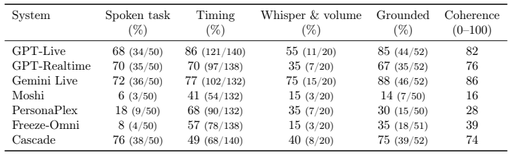
Table 4 : Results by dimension. Percentages are over the items in each dimension; coherence is the mean judge score over the ten groundedness conversations.
Original paper · CC BY 4.0 · Richard Yucheng He, Chen Xu, Yihang Liu, Tairan Chen, Baodong Cao · InteractionBench: Measuring Timing, Task Accuracy, Whisper and Volume, and Grounding in Real-Time Voice Systems · Original paper figure · Extracted the figure area from page 9 of the original PDF.The timing aggregate depends on the client-side clock, and that clock includes network delay for hosted systems. For GPT-Live, whose server reports its own clock, the aggregate falls from 86% to 56% once the roughly 1.5s delay is removed. Its timing ranking therefore depends on where the audio is placed, and the paper's own results show this.
No system passes a grammar item, which asks for a correction starting 50 to 300ms after the erroneous word. No system could meet the 50 to 300ms keyword-wait window, because systems that answer correctly respond seconds after the keyword. So every system scored zero on that window, and the authors relaxed the rule to a response starting no earlier than 0.3s before the keyword ends.
The cascade passes all 10 stay-quiet items, but that follows from its design, since it can't speak inside a user turn. They didn't test a cascade that listens while it speaks on the stay-quiet items.
Whispering and groundedness results
Whispering is rare across these systems, and only Gemini Live does it reliably, on 8 of 10 whisper items. GPT-Live and GPT-Realtime whisper on 2 items each, while the other systems whisper on none.
Groundedness uses ten conversations of 22 to 24 turns, with 52 probes in total. The conversations are generated by Gemini 2.5 Flash and built around an everyday task that accumulates state. Hosted systems and the cascade pass 67% to 88% of probes, compared to 14% to 35% for open full-duplex models. Some probes are left out for a system when its own conversation contradicts the assumption behind the expected reply.
The gap is sharpest on false accusations, where hosted systems reject 15 of 18 cases and open models reject 2 of 17. Nonsense questions show a similar split, with hosted systems flagging 23 of 30 and open models flagging 4 of 30. Many of GPT-Realtime's failures are missing replies, 10 of its 17. So groundedness scores also reflect whether a system replies at all, not only whether its replies are correct.
Protocol choices and sample sizes that limit the numbers
On the server's clock, which removes a delay of about 1.5s, GPT-Live's timing aggregate falls from 86% to 56%. The median delay of 1.47s comes from the interquartile range of 1.35 to 1.53s across runs.
That instruction may make the hosted systems more willing to speak during the user's turn. The authors didn't run the hosted systems without that part of the instruction, so its effect is untested.
This happened in 19 of 50 two-turn items for PersonaPlex and 14 for Freeze-Omni. Silences longer than 1.3s were shortened to 0.7s in the long-conversation recordings of five systems. The recordings of GPT-Live and GPT-Realtime weren't shortened, so their silences aren't comparable with the rest.
Each scenario contains only 10 to 30 items, which limits how precisely each scenario can be read. The cascade is one VAD-endpointed configuration with simulated timing, so it doesn't represent other cascaded designs.
Paper info
- Authors
- Richard Yucheng He, Chen Xu, Yihang Liu, Tairan Chen, Baodong Cao
- Venue
- arXiv · Preprint
- First published
- 2026-11-2
- Added
- 2026-11-4
- Updated
- 2026-11-2
- Version
- v1
- arXiv
- 2611.02430
- Category
- cs.SD · cs.CL · eess.AS
- Original paper terms
- CC BY 4.0
- What we show
- Paper info, commentary and permitted figures from the original paper
AI commentary is a separate explanation from the original paper and may contain errors. The original paper and figures follow each source's terms of use and any rights noted separately.
Abstract
Most benchmarks for real-time voice systems focus on one aspect, such as turn-taking, instruction following, paralinguistic control, or conversational memory, each with its own data and set of systems. We present InteractionBench, a benchmark and evaluation harness that measures four dimensions on the same systems from the same recorded user audio: conversational timing, spoken-task accuracy, whisper and volume, and groundedness in conversations of more than twenty turns. The benchmark contains 221 items per system in thirteen scenarios. Before any system runs, we fix the expected floor-control actions for spoken tasks by rule and take the expected answers from scripted dialogues. We score whispering from the audio signal. We evaluate GPT-Live, GPT-Realtime, Gemini Live, Moshi, PersonaPlex, Freeze-Omni, and a turn-based cascade in 1,519 graded runs. Among the six full-duplex systems, timing and spoken-task accuracy are rank-correlated ($ρ= 0.83$), while the cascade has the highest spoken-task score (38/50) and the second-lowest timing score. No system corrects a user's grammar within the required window. Only Gemini Live whispers on most requests (8/10). Hosted systems pass 67-88% of groundedness probes, compared with 14-35% for open full-duplex models. Timing is measured where the client hears each system, so the timing of hosted systems includes network delay: for GPT-Live, whose server reports its own clock, removing a delay of about 1.5 s lowers its timing score from 86% to 56%. We also document where the protocol differs across systems, including the text instructions.
Quote from the paper
Richard Yucheng He, Chen Xu, Yihang Liu, Tairan Chen, Baodong Cao (2026). InteractionBench: Measuring Timing, Task Accuracy, Whisper and Volume, and Grounding in Real-Time Voice Systems. arXiv:2611.02430v1. https://arxiv.org/abs/2611.02430v1
BibTeX
@misc{he2026interactionbench,
  title = {{InteractionBench: Measuring Timing, Task Accuracy, Whisper and Volume, and Grounding in Real-Time Voice Systems}},
  author = {Richard Yucheng He and Chen Xu and Yihang Liu and Tairan Chen and Baodong Cao},
  year = {2026},
  eprint = {2611.02430},
  archivePrefix = {arXiv},
  url = {https://arxiv.org/abs/2611.02430v1}
}