Paper commentary
MixHop: Higher-Order Graph Convolutional Architectures via Sparsified Neighborhood Mixing
- Problem A standard graph convolution layer applies one neighborhood-averaging step, so it cannot represent differences between a node's one-hop and two-hop neighbor features.
- Method MixHop concatenates one block per adjacency power, each with its own weight matrix, so every layer mixes features gathered at several hop distances, and it uses Group Lasso to choose how wide each block should be.
- Results The learned MixHop architecture reached 80.8±0.58 test accuracy on Pubmed under the Planetoid split.
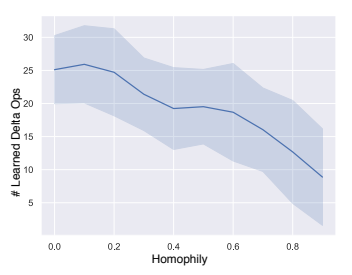
Figure 3 : Amount of model capacity devoted to learning delta operators at different levels of homophily.
Original paper · CC BY 4.0 · Sami Abu-El-Haija, Bryan Perozzi, Amol Kapoor, Nazanin Alipourfard, Kristina Lerman, Hrayr Harutyunyan, Greg Ver Steeg, Aram Galstyan · MixHop: Higher-Order Graph Convolutional Architectures via Sparsified Neighborhood Mixing · Original paper figure · Extracted the figure area from page 6 of the original PDF.Why averaging neighbors falls short
The vanilla GCN left-multiplies the features by a symmetrically normalized adjacency matrix with self-connections, so each layer replaces a node's representation with a weighted average over its neighborhood. The authors read this as a neighborhood-averaging operator, and they argue that the simplifications behind it limit what the layer can express.
The authors formalize the target as a Delta Operator, a subtraction between features collected at different hop distances. Their two-hop definition asks whether a model can realize an injective mapping f applied to the difference between the one-hop term \\(\\sigma(\\hat{A}X)\\) and the two-hop term \\(\\sigma(\\hat{A}^2X)\\), for any adjacency matrix, feature matrix and activation.
The motivating case is a person whose immediate friends mostly speak one language while friends-of-friends speak another, and a filter that contrasts one-hop and two-hop neighbors would capture that pattern.
Theorem 1 states that the vanilla GCN cannot represent two-hop Delta Operators. The proof takes the linear-activation case with identity features and equal layer widths, so the output reduces to a power of the adjacency matrix times a single product of weight matrices. Applying this to a graph with a single edge between two vertices forces the two corresponding rows of that product to be equal, and since the choice of vertices is arbitrary, all rows become equal, which caps the output rank at one.
How the MixHop layer mixes hop distances
A MixHop layer replaces the single propagation step with a concatenation over a set P of integer adjacency powers, where each block applies its own weight matrix and an activation to the power of the adjacency applied to the layer input. The formula is \\(H^{(i+1)} = \\Vert_{j\\in P}\\, \\sigma(\\hat{A}^j H^{(i)} W^{(i)}_j)\\), where the double bar denotes column-wise concatenation.
Choosing P equal to {1} gives back the original graph convolution layer, and the zeroth power is the identity matrix.
Each layer therefore holds |P| separate weight matrices, and by default they share one width, so the capacity is split evenly across the adjacency powers. The authors describe dataset-specific widths learned by sparsifying regularizers as slightly outperforming these default settings.
The layer computes each power by repeated right-to-left multiplication of the features with the adjacency matrix, so the powers themselves are never formed. With the adjacency stored as a sparse matrix with m non-zero entries, one layer costs O(jmax × m × si), where jmax is the largest element of P and si is the feature dimension of the layer input.
Under the assumptions that jmax is much smaller than m and the feature dimensions are much smaller than m, an l-layer model takes O(lm), which matches the vanilla GCN.
Output layer and the Group Lasso width search
The output layer splits the final hidden columns into blocks of size c and combines them with weights that are a softmax over scalars qk, and a softmax then gives the class probabilities. The model parameters are fit by minimizing a cross-entropy loss measured only on the labeled nodes.
Searching the widths by hand is multiplicatively more expensive for MixHop than for a vanilla GCN, because each layer width must be divided among the adjacency powers, so the authors use a lasso regularization instead. The procedure first trains a wide network with 200 dimensions for each adjacency power at each layer and applies L2 Group Lasso to each column of each weight matrix, which pushes whole columns toward zero.
At the peak validation accuracy, the L2 norm of each column is measured and a threshold is chosen so that the shrunken model has the same size as the baseline with P equal to {1}; columns below the k-th percentile are then removed. The last stage replaces the Group Lasso with standard L2 regularization and restarts training.
What the representation proofs establish
A two-layer MixHop model with P equal to {0, 1, 2} is shown to represent the two-hop Delta Operator. In the first layer, the zeroth-power block is set to zero while the first- and second-power blocks are set to identity matrices, so the first-layer output contains the one-hop and two-hop features. In the second layer, the zeroth-power weight is a stack of an identity block and a negative identity block, which yields the signed difference of the one-hop and two-hop terms, and the other second-layer blocks are set to zero.
The general definition asks whether a network can produce any fixed linear combination of the powers of the adjacency applied to the features, with arbitrary coefficients. The vanilla GCN cannot represent this general mixing, which follows directly from the two-hop result. A MixHop model with P equal to {0, ..., m} can represent it by using only zero-hop weights in the second layer, with the coefficients placed on the identity blocks.
The generalized form defines linear combinations of features, which includes subtraction, rather than specifying differences explicitly as the two-hop definition does.
Results on synthetic graphs with varying homophily
The synthetic family has 10 graphs with homophily from 0.0 to 0.9 in steps of 0.1, and homophily is the chance that a new edge connects nodes with the same label. Each graph has 5000 nodes, node features are drawn from overlapping multi-Gaussian distributions, and the train, test and validation splits are of equal size.
All models score higher as the homophily of the synthetic graph increases. At low homophily, the text states that MixHop performs significantly better than the most competitive baseline, though the comparison is shown only in a figure. GAT scores lower than the feature-only MLP control, and the authors suggest that the attention mechanism of GAT relies heavily on homophily in node neighborhoods.
The authors count the delta operators learned at each homophily level, which measures how much of the model capacity goes to feature differences between neighbors at different distances. At low homophily the model uses 2.5X of its model capacity on learning delta operators compared with higher homophily, and the authors read this as nodes that cluster with like-labeled neighbors needing fewer meaningful feature differences.
Citation datasets with Planetoid splits
Planetoid splits use 20 labeled nodes per class, and the citation datasets are Citeseer, Cora and Pubmed with 3,327, 2,708 and 19,717 nodes respectively. The vanilla GCN row is copied from prior work, while the MixHop rows are the authors' own runs with the same model capacity.
The learned MixHop architecture reached 71.4±0.81 on Citeseer, 81.9±0.40 on Cora and 80.8±0.58 on Pubmed. The ± values are standard deviations over 50 runs with different random initializations.
For Citeseer, the learned architecture equals the default one, so the two rows report the same results.
Results on random splits with 100 labels per class
The random splits use 100 nodes per class during training, and the baselines are a 2-layer MLP, Chebyshev, the vanilla GCN, GAT and both MixHop architectures. The authors attribute these gains to MixHop pulling linear combinations of features from farther distances, which lets it extract signal when labels are sparse.
For Pubmed, the text reports a learned-architecture test accuracy of 83.9%, while Table 3 lists 83.8±0.44 for the same model and split.
Learned widths differ by dataset
The learned Cora architecture gives zero columns to the zeroth adjacency power in the second layer, so the second layer ignores the node's own features. The Pubmed architecture keeps nonzero widths for all three powers in both layers, with the second layer using smaller widths than the first.
The discussion says that all three real datasets ended with different final architectures and that this confirms the hypothesis that different graphs prefer different architectures. The same section says Citeseer prefers the default equal split, and the Table 1 note also states that the Citeseer learned architecture is equivalent to the default, so the statement that all three datasets differ conflicts with those reports.
Limitations
The citation-dataset results are sensitive to initializations, so the authors run each model 100 times, sort by validation accuracy and report the test accuracy for the top 50 runs. The O(lm) running-time statement depends on the feature dimensions and jmax being much smaller than m, so it is not a bound for arbitrary feature widths or large powers.
The representation results are existence results under the stated settings, such as linear activations and identity features in the vanilla GCN proof, and they do not show that training finds these settings.
The architecture search depends on a threshold chosen so the shrunken model matches the baseline size, and on a multistage procedure whose 200-dimension starting width is fixed. Experiments cover only the synthetic family and the three citation datasets, and the authors name the GAT framework as a possible extension without testing it.
Paper info
- Authors
- Sami Abu-El-Haija, Bryan Perozzi, Amol Kapoor, Nazanin Alipourfard, Kristina Lerman, Hrayr Harutyunyan, Greg Ver Steeg, Aram Galstyan
- Venue
- arXiv · Preprint
- First published
- 2019-4-30
- Added
- 2026-11-5
- Updated
- 2019-6-19
- Version
- v3
- arXiv
- 1905.00067
- Category
- cs.LG · cs.SI · stat.ML
- Original paper terms
- CC BY 4.0
- What we show
- Paper info, commentary and permitted figures from the original paper
AI commentary is a separate explanation from the original paper and may contain errors. The original paper and figures follow each source's terms of use and any rights noted separately.
Abstract
Existing popular methods for semi-supervised learning with Graph Neural Networks (such as the Graph Convolutional Network) provably cannot learn a general class of neighborhood mixing relationships. To address this weakness, we propose a new model, MixHop, that can learn these relationships, including difference operators, by repeatedly mixing feature representations of neighbors at various distances. Mixhop requires no additional memory or computational complexity, and outperforms on challenging baselines. In addition, we propose sparsity regularization that allows us to visualize how the network prioritizes neighborhood information across different graph datasets. Our analysis of the learned architectures reveals that neighborhood mixing varies per datasets.
Quote from the paper
Sami Abu-El-Haija, Bryan Perozzi, Amol Kapoor, Nazanin Alipourfard, Kristina Lerman, Hrayr Harutyunyan, Greg Ver Steeg, Aram Galstyan (2019). MixHop: Higher-Order Graph Convolutional Architectures via Sparsified Neighborhood Mixing. arXiv:1905.00067v3. https://arxiv.org/abs/1905.00067v3
BibTeX
@misc{abuelhaija2019mixhop,
  title = {{MixHop: Higher-Order Graph Convolutional Architectures via Sparsified Neighborhood Mixing}},
  author = {Sami Abu-El-Haija and Bryan Perozzi and Amol Kapoor and Nazanin Alipourfard and Kristina Lerman and Hrayr Harutyunyan and Greg Ver Steeg and Aram Galstyan},
  year = {2019},
  eprint = {1905.00067},
  archivePrefix = {arXiv},
  url = {https://arxiv.org/abs/1905.00067v3}
}