Paper commentary
Measuring Preferred Representation in AI-generated Images with Community Scorers
Community Scorers learn how specific communities want to be represented in images
- Problem Common metrics check prompt match, realism or aesthetics, but none asks how a community wants to be shown. Single-issue checks also miss preferences that span many dimensions.
- Method Community Scorers are per-community evaluators. Each one is a Phi-4-Multimodal model fine-tuned with LoRA to predict a designated community lead's ratings of generated images.
- Results On DWF-N, Community Scorers reach Kendall's τ of 0.50, compared with 0.34 for LLaVAScore, the strongest off-the-shelf baseline.
Why generic metrics miss community preferences
AI image generators often misrepresent marginalised communities, and the harm reaches beyond the pictures themselves. Most automated metrics check image–prompt alignment, realism, or aesthetics. None of these metrics directly asks how a community wants to be shown. Other tools target single issues, such as anatomical errors, skin tone, gender, or cultural artefacts.
People's preferences often move beyond a single dimension, so single-issue checks can miss the social world of a culture.
Community participation could close this gap, but it has rarely shaped the measurement itself. Earlier human-centred work involves communities in defining evaluation datasets, annotating data, or manually evaluating produced images. A recent approach builds automated judges from interviews with community members, yet it still needs researchers in critical bridging roles.
Those bridging roles limit how far such methods can scale to many communities.
They separate systematisation, which is how the concept is defined, from operationalisation, which is how it is measured. A community first systematises its preferred representation by building a Community Library, rather than having researchers define it. The authors give authority to speak for the community to a designated community lead, following Coyne's authority model.
Turning a community library into a scorer
A Community Scorer turns one community's library into an evaluator that scores new AI-generated images. Each library entry pairs a real photograph with a text prompt, a set of visual tags and a geographic region. Each library holds 400 photographs, grouped into 3 to 5 named themes such as education and employment. Bounding box labels mark the human or material elements that matter for the community's representation.
The scorer must judge AI-generated images, which are distributionally distinct from real photographs. The authors therefore build the Community Preference Dataset from library prompts, sampling 100 of them uniformly across themes. Each sampled entry's prompt, visual tags and region are joined into one augmented prompt before generation. Imagen-4-Ultra, GPT-Image-1 and Stable Diffusion 3.5 Large Turbo each generate one image per prompt.
This produces M = 300 samples per community, which the authors chose to balance data needs against the lead's effort. The designated community lead rates each image from 1 (very poor) to 5 (very good), and raters see the original prompt rather than the augmented one.
Each community contributes its own library and its own designated lead, so every scorer keeps that community's standards separate. The lead acts under the authority model proposed by Coyne, speaking as the collective voice of the community. The three communities are BLV, DWF-S and DWF-N, spanning the Global North and South. The authors split each community's DCP into a 70/30 training and validation split.
Phi-4-Multimodal, fine-tuned with LoRA on the training split, serves as each Community Scorer.
Building the Community Preference Dataset
The training images start from prompts drawn out of the Community Library, which are extended before generation. Each library entry gets an augmented prompt built by concatenating its text prompt, its set of visual tags and its region. This grounds the generated images in the contexts the community has defined as important to its preferred representation.
The authors sampled 100 prompts randomly from the library, spread uniformly across community themes. Each prompt went to three models, Imagen-4-Ultra, GPT-Image-1 and Stable Diffusion 3.5 Large Turbo, producing one image per prompt and model. The three models were picked because their output quality varies, so the dataset covers the full quality range.
This yields M = 300 samples per community, a number that balanced the data a scorer needs against the effort of the community lead.
The designated community lead rates each generated image on a five-point scale from 1 (very poor) to 5 (very good). The lead judges how well each image aligns with preferred representation, given the original prompt. The authors show raters the original prompt, not the augmented one, because the ratings should reflect preferred representation rather than prompt match.
Ratings are pointwise and holistic, because community leads found comparisons across representational failures hard to separate from image quality. The five-point scale balanced expressiveness against workload.
A single designated community lead rates each community, following the authority model proposed by Coyne. Leads built their authority through substantial consensus work before rating, so the ratings carry the priorities negotiated with the wider community. The analysis showed that the annotator's judgements were reasonably coherent, though ratings contain some stochasticity.
The authors removed images with deformed bodies before the lead saw them, so the scorers aren't reliable on those images. The authors judged this trade-off right, given their responsibility to the communities and their focus on good representation.
The training objective then asks the Community Scorer to approximate the lead's ratings on the Community Preference Dataset. The optional context C, drawn from the Community Library, supplies explicit signals that ground the scorer. The authors instantiate the scorer as a multimodal large language model, chosen for reasoning over images and text.
Fine-tuning the evaluator on community ratings
The Community Scorer is trained to approximate the designated community lead's ratings of AI-generated images in the Community Preference Dataset. The scoring function is trained on DCP and can optionally take additional context C drawn from the Community Library. The training objective minimises a loss L over expected pairs of generated image, prompt and rating, and L depends on how ϕ is instantiated.
The authors instantiate ϕ as a multimodal large language model because it can reason jointly over images and text. The MLLM also evaluates representational qualities that are contextual and hard to split into fixed attributes. Low-Rank Adaptation (LoRA) fine-tunes the model on each community's DCP training split, while the base model's weights are kept fixed.
The DCP training split is 70 percent of the data, and the remaining 30 percent forms the validation split. The training split fits the scorer, and the validation split selects the best checkpoint based on QWK. Prompt details and hyperparameters are given in Appendix E, which the authors reference rather than describe in the main text. The fine-tuned scorer is later compared against zero-shot baselines to isolate the effect of community-specific fine-tuning from general MLLM reasoning.
Validation follows two routes: predictive validity against community ratings, and consequential validity through content filtering. Experiments cover three disability communities: BLV, DWF-S and DWF-N, spanning the Global North and South.
Agreement with community ratings
The research team wrote 40 generic prompts for each community, independently of the Community Library's prompts. Those prompts and their images stay disjoint from the training data, though their themes overlap with the Community Library. The baselines are CLIPScore, HPSv2, LLaVAScore, VQ2, CAIRE, and a zero-shot Phi-4 judge. Most baselines output unbounded real-valued scores, so Kendall's τ carries the comparison alongside QWK.
Community Scorers reach the highest τ on all three communities, at 0.22 for BLV, 0.35 for DWF-S, and 0.50 for DWF-N. On DWF-N, the Community Scorer reaches 0.50, compared to 0.34 for LLaVAScore, the strongest off-the-shelf baseline. The authors attribute this to missing community-specific context, since general reasoning doesn't capture these standards.
A paired bootstrap test with 1000 resamples compares Kendall's τ on the same held-out images. Against the zero-shot Phi-4 generic scorer, the Community Scorer improves significantly on every community. The Δτ gains are 0.28 on BLV, 0.40 on DWF-S, and 0.50 on DWF-N. All three gains survive Bonferroni correction at α = 0.05/3. Against LLaVAScore, the Community Scorer's τ is consistently higher, with Δτ of 0.07, 0.15, and 0.16.
These gaps don't reach significance after Bonferroni correction, probably because the per-community sample sizes are small.
Figure 2 plots QWK against the amount of training data, averaged over 5 random seeds. Community Scorers improve as training data grows, while zero-shot Generic Scorers remain poorly aligned.
How much community data is needed
Figure 2 plots QWK between Community Scorers and community ratings against the amount of training data. The Community Scorer improves consistently as the training set grows, while the zero-shot Generic Scorer stays poorly aligned. Each point averages five random seeds, which vary the model parameter initialisation. The authors describe alignment as improving monotonically with the community-provided training data.
Even small amounts of fine-tuning data give large gains over the zero-shot Generic Scorer.
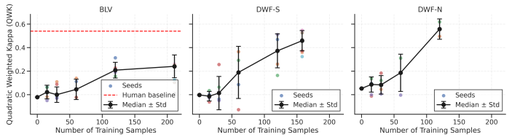
Figure 2 :Alignment improves with community supervision.We report QWK between Community Scorers and community ratings on the held-out set as a function of training data size. Community Scorers improve consistently with more data, while zero-shot Generic Scorers remain poorly aligned. Experiments are run with 5 random seeds controlling variability due to model parameter initialisation. The dashed BLV reference is within-lead repeat agreement (QWK 0.54).
Original paper · CC BY 4.0This matters because collecting data is costly for marginalised communities, so limited but targeted input is valuable. The 300 samples per community came from ablation curves, where scorer performance converged around 300 ratings. In one community that did not supply the full amount, scorer performance was unreliable. Training uses a 70/30 split, and the validation part selects the best checkpoint based on QWK.
The dashed BLV reference line marks within-lead repeat agreement at QWK 0.54, which serves as an upper-bound reference. The authors collected extra BLV ratings so they could estimate that bound by comparison with human agreement. The authors still present the Community Scorer as a scalable proxy and a strong foundation for later methodological work.
The zero-shot Scorer underperforms across all communities, so general-purpose reasoning alone doesn't capture community standards.
Content filtering with community scorers
Content filtering uses one fixed prompt, several candidate images, and a threshold of 4, chosen on the validation set. Each image-prompt pair is scored by the evaluator, and images scoring at or above the threshold are retained. The authors ran this on the generic-prompt holdout set, so every evaluated image was unseen during training. Candidate images came from the same three generation models used for the Community Preference Dataset.
Downstream quality is measured by the proportions of good and bad images in the retained set, using the community lead's ratings. Good images are rated 4 or 5, and bad images are rated 1 or 2.
The Generic Scorer retains 95 to 100% of images, so it rejects bad content at almost no rate. The Community Scorer cuts bad-image retention to 20 to 50%, while good-image retention stays at 69 to 90%. The filter therefore trades some good images for fewer bad ones, and the authors call this trade-off the cost of modestly lower good-image retention.
McNemar's exact test on paired retain or reject decisions at threshold 4 shows fewer bad images passed for every community. The good-image drop is significant for BLV and DWF-N, while DWF-S narrowly misses the corrected threshold with p equal to 0.016.
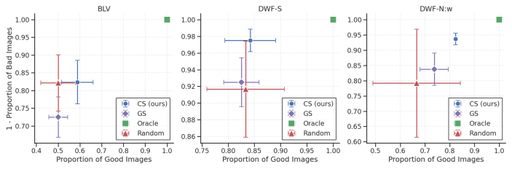
Figure 3 :Community Scorers improve retained-pool composition.Proportion of good and bad images retained by an automated evaluator after manual screening. Good images correspond to designated community lead ratings of 4 or 5, and bad images to ratings of 1 or 2, computed over all images that pass the automated filtering stage. GS and CS stand for Generic and Community Scorer.
Original paper · CC BY 4.0 · Melanie F. Pradier, Camilla Longden, Anja Thieme, Rita F. Marques, Nari Johnson, Sidhika Balachandar, Xinnuo Xu, Linda Y. Wen, Martin Grayson, Katja Hofmann, Cecily Morrison, Daniela Massiceti · Measuring Preferred Representation in AI-generated Images with Community Scorers · Original paper figure · Extracted the figure area from page 9 of the original PDF.Figure 3 shows the good and bad proportions in the retained pool after manual screening. The composition shift matches the retention numbers, with fewer bad images among the images kept. Fine-tuned Community Scorers reduce the fraction of negatively rated images across communities, whereas zero-shot generic scorers give limited or inconsistent gains.
The qualitative analysis, drawn from the best fine-tuned evaluator for one community, shows rejected images often stereotypical, misleading, or low-quality.
Limitations
The scores come from one designated community lead per community, not from a panel of raters. Community leads rated on a five-point scale, using pointwise ratings instead of pairwise comparisons. The authors ran the intra-rater agreement check for only one community. Ratings carry some inherent stochasticity, which the paper acknowledges.
Held-out prompts draw on the same themes as the Community Library. The authors didn't test extrapolation to wholly novel semantic contexts. The study covers three disability communities: BLV and DWF-S in Kenya, and DWF-N in the US. The upper performance bound was estimated for one community, BLV, only. A substantial gap still remains between automated metrics and human–human agreement.
For one community that lacked the full 300 ratings, scorer performance was unreliable.
Diversity and safety aren't measured in this work. The authors manually removed images with deformed bodies before community leads rated them. They didn't validate the scorers as detectors of extreme harms. Per-community sample sizes were modest. The Community Scorer's gains over LLaVAScore weren't significant after Bonferroni correction.
Phi-4-Multimodal was the only evaluator model they tested.
Paper info
- Authors
- Melanie F. Pradier, Camilla Longden, Anja Thieme, Rita F. Marques, Nari Johnson, Sidhika Balachandar, Xinnuo Xu, Linda Y. Wen, Martin Grayson, Katja Hofmann, Cecily Morrison, Daniela Massiceti
- Venue
- arXiv · Preprint
- First published
- 2026-11-11
- Added
- 2026-11-13
- Updated
- 2026-11-11
- Version
- v1
- arXiv
- 2611.16093
- Category
- cs.LG
- Original paper terms
- CC BY 4.0
- What we show
- Paper info, commentary and permitted figures from the original paper
AI commentary is a separate explanation from the original paper and may contain errors. The original paper and figures follow each source's terms of use and any rights noted separately.
Abstract
AI-generated images often misrepresent historically marginalised communities, with real-world consequences beyond the images themselves. However, conventional metrics fail to measure how communities want to be represented in AI-generated images. To address this, we introduce the concept of preferred representation. Building on previous work, we propose a measurement instrument that operationalises this concept through a Community Scorer - a model that evaluates a specific community's preferred representation in AI-generated images. We interrogate the validity of Community Scorers on three diverse disability communities that span the Global North and South. The results show that Community Scorers align significantly better with community ratings compared to other widely used text-to-image metrics. We then demonstrate the usefulness of these scorers in a downstream content filtering task. We release the Community Preference Dataset to enable others to optimise how Community Scorers can be scaled for culturally specific evaluation of AI-generated visual media.
Quote from the paper
Melanie F. Pradier, Camilla Longden, Anja Thieme, Rita F. Marques, Nari Johnson, Sidhika Balachandar, Xinnuo Xu, Linda Y. Wen, Martin Grayson, Katja Hofmann, Cecily Morrison, Daniela Massiceti (2026). Measuring Preferred Representation in AI-generated Images with Community Scorers. arXiv:2611.16093v1. https://arxiv.org/abs/2611.16093v1
BibTeX
@misc{pradier2026measuring,
  title = {{Measuring Preferred Representation in AI-generated Images with Community Scorers}},
  author = {Melanie F. Pradier and Camilla Longden and Anja Thieme and Rita F. Marques and Nari Johnson and Sidhika Balachandar and Xinnuo Xu and Linda Y. Wen and Martin Grayson and Katja Hofmann and Cecily Morrison and Daniela Massiceti},
  year = {2026},
  eprint = {2611.16093},
  archivePrefix = {arXiv},
  url = {https://arxiv.org/abs/2611.16093v1}
}