Paper commentary
Programming Prescience: Issues in Human Construction of Forecasting Bots
Interviews reveal how builders struggle to program forecasting bots
- Problem Builders of AI forecasting bots lacked reliable ways to test changes to their bots. Backtests can leak future information, and evaluation costs money, so builders rarely checked whether their bots actually improved.
- Method The authors interviewed 15 prizewinning builders from a recent AI forecasting tournament. They then coded the transcripts by open coding until saturation and clustered the codes into themes.
- Results Elaborate bots were among the less competitive ones in the sample. One bot that aggregated 54 predictions was weaker than simpler bots, suggesting added complexity does not always pay off.
Why building a forecasting bot is hard
Language models now reach competitive performance with a human crowd on forecasting questions. Schoenegger et al. also found that people given an AI during forecasting tasks outperformed people working alone. If AI joins forecasting, humans will have to build and evaluate the bots, and that work departs from ordinary human forecasting. A bot builder must help the bot research across source pools that the bot can reach less easily than a person can.
Tuning is also hard, since bot output can run long and must be turned into concrete changes.
Prior HCI work on uncertainty visualization and time series tools doesn't describe how forecasting AI gets built. Metaculus surveyed bot builders, but its focus was the technical challenges and the strategies behind the best bots. This paper instead asks which challenges and bottlenecks capable builders meet when they design a forecasting bot.
The authors interviewed 15 builders, all prizewinners in a recent AI forecasting tournament. The tournament splits a shared pool of $50k, and top performers can make upwards of $5k. The interviews aimed to show what builders try to build, where they get ideas, and which workarounds they devise.
Sampling prizewinning builders
Every participant had to be a recent prize winner, over 18, and willing to discuss their AI system. The authors chose prizewinners because they were more likely to have deployed a working bot and tried substantial strategies. The shared prize pool was $50k, and top performers could make upwards of $5k. The final sample of 15 participants all identified as male, and six lived outside the US.
Five participants reported six months of programming experience, while two had over 2 years.
Each co-interview ran for up to an hour over Zoom, with two authors present for all but two interviews. Participants first walked the authors through one bot prediction for a single question from a recent tournament. In the second half, the authors probed for bottlenecks, testing methods, and ideas for future tools. The authors excluded any information that participants didn't want to share, and each participant received a $100 gift card.
The first author ran open coding until saturation, and then the team clustered the codes into themes by frequency and differences across transcripts.
Table 1 lists the rank bucket and prior coding and forecasting experience for each participant who chose to share them. Participant P11a and P11b joined the tournament as a team, so the authors interviewed them together.
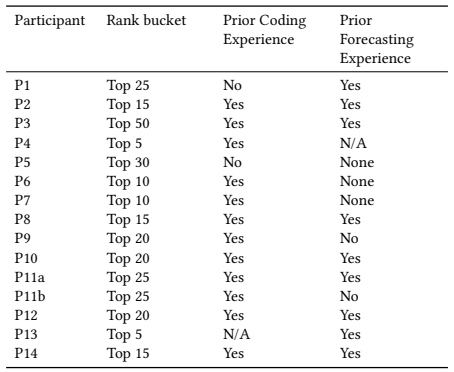
Table 1 : A table showing the details of participants who chose to share additional information about their tournament rank, prior coding and forecasting experience. We show bucketed participant ranks ([1–5], [6–10], [11–20], etc) to obfuscate identity.
Original paper · CC BY 4.0 · Priya Dhawka, Benjamin Wilson, Andrew Head · Programming Prescience: Issues in Human Construction of Forecasting Bots · Original paper figure · Extracted the figure area from page 4 of the original PDF.Research: bots can't reach the best data
Every bot started by hunting for context, and the default template handled that step with the AskNews API. The template also set the bot to act as a professional forecaster and to average several model outputs by mean or median. Builders could swap in the LLM of their choice, while the research setup stayed inside the template. P4 tied large gains over the market to research that is very strong, citing a claimed 10 times edge.
On one question, P4's bot put 90% on 29 cities after loading the page, requesting a screenshot and counting 29 dots. The bot then traced the page's author to LinkedIn, found a job change, and lowered its estimate that the page would update soon.
Access was the bottleneck, because much data sits in interactive dashboards that search tools don't index. P10 noted that there is often no canonical URL for the exact source a forecast needs. Some sources were restricted, and P3's plywood example led to Home Depot as a candidate source. P3 warned that Home Depot's API is hard to reach, and scraping it could get a builder banned.
Even the GraphQL interface was poorly documented, so bots would need a long time to learn it. Builders responded by giving AIs browser control to take screenshots, as P10 and P13 did. Several builders queried APIs directly, and P3 reverse engineered APIs into a local database the bot could query.
Builders anchored base rates on community predictions and on prediction markets such as Kalshi and Polymarket. P13 started the bot from a community prior and updated it with news output, weighing how strong that prior was. The platform later disabled the community anchor, so that bot predictions would face cases with no available consensus.
Anchoring on markets was hard, since P13 noted that questions rarely matched in wording or resolution criteria.
Reasoning: aggregation and simplicity
Builders borrowed forecasting habits, and many bots approximated the Delphi protocol by aggregating several predictions. Aggregation ranged from 2 to 54 predictions, with some bots using medians or weighted averages. P2 reached decent performance with a single model, so aggregation was common but not essential. The default template already built in a basic form of Delphi, so many bots started with aggregation.
P8 kept individual predictions from biasing each other, which is central to the Delphi protocol.
P1's bot turned 54 individual predictions into one output distribution through interpolation. That bot prompted 6 bots to predict 3 outcomes across low, mid and high world scenarios, then refined them further. These were among the less competitive bots in the sample, which suggests complexity does not always pay off. P5's bot averaged 8 predictions weighted by confidence, but models clustered their scores between 50 to 80.
P4 said that every time they tried something fancy, the result was worse than letting the base model run. Other techniques, including tool calls, Monte Carlo simulations and prompt optimizations, rarely led to substantial gains. P12 found that weighted averages and other models gave little improvement over the baseline. P12's approach roughly doubled or tripled token use without doubling or tripling scores.
The best bots still used aggregation, fact checking and agentic search, so the authors argue for caution rather than avoidance.
P11 conjectured that bots need a degree of flexibility to perform well. Many of the adjustments builders described could limit that flexibility. The authors recommend a default skeptical stance toward changes, rather than avoiding complexity entirely.
Evaluation: review replaces systematic tests
Most builders relied on reviewing their bot's outputs, which was the most common way to evaluate a bot. Review spiked during early development, when P5 kept rerunning the bot and reading its output. Review was often triggered by anomalies, such as P13 checking answers that differed sharply from the community prediction. Logs could be large, since P4 generated 10MB of logs per prediction.
Backtesting was rare, and only P6 and P3 described it. P8 cached partial results from the pipeline, but didn't integrate that cache into a backtesting flow. Backtests can leak future information, because P3's archived article copy carried information that tainted predictions. The LLM didn't explicitly use that leaked information, yet it still tainted the predictions.
Cost also limits testing, since P6 estimated that a rigorous eval would call for about $100. P13 estimated 3 euros per question for their bot. Small question sets limit what results can show, and P5 evaluated against 17 questions and called the results incredibly noisy. Even P6 described results from 30 to 100 questions as really noisy.
Community predictions also became less reliable for testing, because AI-generated forecasts shaped them, according to P1. P1 argued that the same LLM tends to give similar answers to similar questions, so its forecasts can echo one another.
What tools and process could change
Builders could gain from deep research agents that search sources further than their current bots do. Services that make specialized information discoverable and easily parseable could help bots with data that search tools miss. Builders already worked around this by querying APIs and scraping web content, and one built a personal dataset for their bot.
Small issues can raise errors or push a prediction in the wrong direction. P11 noted that prediction problems can slip past standard error notification tools. One opportunity is generating test questions that exercise a bot's machinery before deployment and surface unusual predictions. Mantic AI is building a test set of questions that maximally differentiate forecasters.
P1 wanted a similar discriminative set for regular testing, so they could find the highest-leverage parts of their bot faster. Cheap evaluation is still possible, since P6 ran a reduced-complexity model on 30 to 100 questions at about $1 per question.
The authors expect people to stay necessary for reading sources that are easy for a person to access but hard for a bot. Participants found community predictions hard to reuse, because the bot's question and the market's wording differed. The authors speculate that people could judge which information transfers from predictions on related questions.
They also speculate that humans and AI must make sense of AI suggestions for improving a bot together. Deciding what to act on depends on a person's appetite for changing their bot.
Limits of the sample and setting
The sample leans toward builders with prior coding experience, which shapes the range of experiences the study captures. All 15 participants identified as male, and 5 of them reported only 6 months of programming experience. Future work could examine how builders with less forecasting and coding experience approach the task differently.
Participants couldn't intervene in their bot's forecasting process, because the competition rules didn't allow it. That restriction likely shaped which strategies the builders could implement during the tournament. Questions were written so that bots would produce a prediction, which doesn't always match real forecasting conditions. The authors list this setup as a limitation of using AI in a forecasting competition.
Future work could study bot design in high-stakes settings such as financial trading and election forecasting. The authors also propose asking how tournament structure and financial incentives shape bot design. They suggest checking whether strategies generalize to prediction markets and to bots deployed on live markets. On the audience side, the paper proposes studying how end users engage with AI-assisted forecasts.
That work would focus on trust and accountability in journalism and election forecasting, where fact-checking is essential.
Paper info
- Authors
- Priya Dhawka, Benjamin Wilson, Andrew Head
- Venue
- arXiv · Preprint
- First published
- 2026-11-9
- Added
- 2026-11-11
- Updated
- 2026-11-9
- Version
- v1
- arXiv
- 2611.12834
- Category
- cs.HC · cs.AI
- Original paper terms
- CC BY 4.0
- What we show
- Paper info, commentary and permitted figures from the original paper
AI commentary is a separate explanation from the original paper and may contain errors. The original paper and figures follow each source's terms of use and any rights noted separately.
Abstract
AI models' growing capacity for complex reasoning has made them attractive tools for forecasting, or the systematic prediction of the future based on past and present data. However, should AI forecasting systems be adopted, human builders will shoulder the work of building and evaluating them. In this paper, we explore what this work looks like with a qualitative interview study with 15 builders of forecasting bots, sampled from among successful participants in a recent AI forecasting competition. Our analysis surfaces the challenges around (1) tuning a bot to acquire factual research, (2) implementing coherent reasoning, and (3) understanding how well one's bot actually does. During their work, builders frequently introduced complexity that did not pay off, and tested in ways that were opportunistic and piecemeal. Our detailed account of their challenges helps clarify what problems should be targeted in upcoming innovations in process, tools, and human-AI teaming for forecasting.
Quote from the paper
Priya Dhawka, Benjamin Wilson, Andrew Head (2026). Programming Prescience: Issues in Human Construction of Forecasting Bots. arXiv:2611.12834v1. https://arxiv.org/abs/2611.12834v1
BibTeX
@misc{dhawka2026programming,
  title = {{Programming Prescience: Issues in Human Construction of Forecasting Bots}},
  author = {Priya Dhawka and Benjamin Wilson and Andrew Head},
  year = {2026},
  eprint = {2611.12834},
  archivePrefix = {arXiv},
  url = {https://arxiv.org/abs/2611.12834v1}
}