Paper commentary
Homological Barriers to Stable Learning of First-Order Nash Equilibria
Topology rules out stable learning of all first-order Nash equilibria
- Problem Looped first-order Nash equilibrium sets cannot be stably attracted by any continuous dynamics.
- Method The authors use a quadratic zero-sum game whose equilibrium set is a six-edge loop.
- Results The authors prove that a compact target with nonzero positive-degree Čech cohomology cannot be uniformly attracted on a compact contractible space. The barrier also holds for small approximate-FONE targets under small perturbations.
Why stable learning of FONE gets stuck
First-order Nash equilibria (FONE) are the fallback when global Nash equilibria are hard to compute or may not exist. A FONE profile is one where no player can improve its payoff to first order along a feasible direction. Min-max and non-concave game studies treat FONE and related stationarity notions as solution targets and algorithmic benchmarks.
Those studies mostly ask whether such points can be computed or reached, not whether a dynamics can keep the whole set as a stable attractor.
The authors ask whether one continuous dynamics can fix every FONE point and also draw all starting points to the full FONE set. They argue the obstacle is topological rather than algorithmic, because it comes from the topology of the target set. Those cycles of projected stationary points can appear even for affine fields. Their explicit example is a quadratic zero-sum game on a box whose FONE set is a diagonal boundary cycle plus an isolated point.
The cycle carries the barrier, while the isolated point contributes no first homology.
What the master barrier forbids, and why nonzero cohomology blocks it
A sequence of maps is pointwise-fixed and uniformly attracting to a compact target A when every map leaves each point of A unchanged. Uniform attraction asks that, for every open neighborhood U of A, one composed iterate Ψ_N sends the whole compact space K into U. The single iterate must work for all starting points at once, because a step count that depends on each start doesn't give the required inclusion.
Pointwise convergence alone therefore falls short of this uniformity, even though it is the weaker condition people often assume. Theorem 4.2 says that if A is compact, K is compact and contractible, and the positive-degree Čech cohomology of A is nonzero for some q ≥ 1, no such sequence exists.
The proof assumes such a sequence exists and takes an open neighborhood U of A. Because each map fixes A pointwise, the composed iterate Ψ_N also fixes A pointwise. Viewing Ψ_N as a map from K into U, the inclusion of A into K followed by Ψ_N equals the inclusion of A into U. Contravariance then makes the restriction from U to A factor through the cohomology of K, which vanishes in positive degrees because K is contractible.
Since the Čech cohomology of A is the direct limit over its neighborhoods, the vanishing forces the cohomology of A to be zero, which contradicts the hypothesis.
Table 1 lists the algorithm families the master barrier covers, including continuous-time gradient play and projected GDA on K. Extragradient and optimistic methods on K×M are covered through the finite-memory corollary, and time-varying step sizes on K are covered as nonautonomous dynamics. Discontinuous or randomized methods, and algorithms that move along FONE(G), fall outside the barrier.
The authors also show that Lyapunov stability with pointwise attraction implies the uniform attraction the theorem needs. A strict Lyapunov certificate, a continuous function that strictly decreases off the target, can't exist for such a target either.
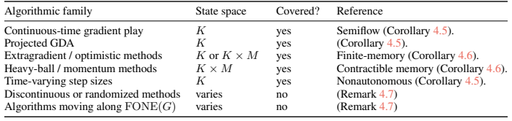
Table 1 : Algorithmic interpretations of the master barrier in Theorem 4.2.
Original paper · CC BY 4.0 · Ashkan Soleymani, Gabriele Farina, Patrick Jaillet, Georgios Piliouras · Homological Barriers to Stable Learning of First-Order Nash Equilibria · Original paper figure · Extracted the figure area from page 4 of the original PDF.A boundary cycle in a projected-gradient gadget
The quadratic gadget puts its loop on the boundary of the cube, which avoids the interior forcing seen in the scalar warm-up. The warm-up is a degree-6 nonconcave-nonconcave scalar game whose FONE set is the unit circle together with the origin, so its first homology is Z. A closed curve of interior stationary points forces an extra interior critical point, which the authors show with a lemma on the disk.
The scalar game uses payoff h squared times k, and the factor k removes all stationary points except one interior point.
The gadget uses the potential phi(z1, z2, z3) = z1 z2 - z1 z3 + z2 z3 - z2, whose gradient G is affine. The six-edge boundary cycle C runs along six edges of the cube, and the point p = (1/2, 1/2, 1/2) is the only other stationary point. The authors check the box sign conditions edge by edge, and the case split on a and c shows that PStat(G) equals C together with p.
Therefore the projected stationary set has first homology Z, because the cycle C is a polygonal circle and p is isolated.
Projected gradient descent fixes every point of this set, yet it doesn't uniformly attract to the full set. Starting points arbitrarily close to p can leave any given neighborhood of the set under this dynamics. The authors use this failure to show that the cycle, not the update rule, drives the barrier.
The authors then lift this gadget into the zero-sum game with payoff u1 = phi(x) + one half times the squared distance between x and y. The diagonal forcing term transfers the stationarity geometry from the gadget to the FONE set, which becomes the diagonal cycle together with (p, p). This lift gives the impossibility in Corollary 5.6 for the quadratic game.
Lifting the gadget into a zero-sum game
Diagonal forcing adds a squared distance term to the gadget's payoff, so the two strategies are pulled toward each other. The game sets u1(x, y) equal to phi(x) plus one half times the squared norm of x minus y, and u2 equals minus u1. Both strategies live in the cube [0,1]^3, and the payoff is quadratic and zero-sum. Unlike the warm-up game (5), this payoff is nonconcave-concave rather than nonconcave-nonconcave.
The distance term carries the stationarity geometry of the gadget onto the FONE set of the game.
Theorem 5.5 gives the exact FONE set as the diagonal copy of C together with the isolated point (p, p). The first homology of this set is Z, and by the universal coefficient theorem its first cohomology over any field F is F. The proof combines Lemma C.1 with Lemma 5.3, and the diagonal map z to (z, z) is a homeomorphism onto the FONE set.
Because the strategy cube is compact and contractible, Corollary 5.6 rules out a pointwise-fixed, uniformly attracting dynamics for the exact FONE set. The authors defer the full proofs of Theorem 5.5, Corollary 5.6 and Proposition 5.7 to Section C.5.
Degree, higher homology and robustness of the barrier
Degree two is the lowest polynomial degree at which the barrier can appear, because affine zero-sum games on boxes have FONE sets that are products of faces. Such a FONE set is contractible and has trivial first homology, so the quadratic gadget is the first case where the barrier can arise.
The authors extend the barrier to higher degrees by summing r independent copies of the gadget into a block-separable potential. Its gradient acts separately on each three-dimensional block, so the stationary set is the direct product of r copies of C ∪ {p}. The product of r cycles is an r-torus, and it is a connected component of the FONE set.
By the Künneth formula over a field, the degree-r homology of that torus is nonzero, so the barrier appears in degree r.
For the approximate case, the residual gap mO is the minimum of the max projected residual over the complement of a neighborhood O. The neighborhood O is the interior of a tubular neighborhood of the diagonal cycle together with a small ball around (p, p). The gap is positive because the residual's zero set is exactly FONE(G⋆) and it lies inside O.
For every tolerance eps below mO, the approximate FONE set contains the diagonal cycle and stays inside O. Its first Cech cohomology is then nonzero, so it can't be a pointwise-fixed uniformly attracting target on the cube.
For perturbations, the own-gradients of a game are compared against those of the base game, with a uniform gap delta. The residual then shifts by at most eta times delta, which the authors write as tau. Under the conditions tau below mO over 4 and tau at most eps below mO minus tau, the diagonal cycle still lies in the approximate set. Within a finite-dimensional family of quadratic games, a small open neighborhood of the base game keeps a nonempty interval of tolerances with nonzero cohomology, giving positive volume.
Where the barrier stops applying
The barrier needs continuous, deterministic maps on a compact contractible space, so it doesn't cover every learning method. Randomized or discontinuous algorithms fall outside it, and so do methods that converge to a selected FONE point. Methods that move along the FONE set are excluded for the same reason, since they don't fix every point of the target.
Finite memory doesn't escape the barrier when the memory target is compact and contractible and its projection is the FONE set. The authors' example of this is the target FONE(G) times the consistent memory state m star, which keeps the same cohomology as FONE(G). A method that attracts to a larger contractible extended set whose projection is FONE(G) escapes the theorem, since its attracting object has different topology.
The results are proofs and constructions rather than simulated learning runs. The barrier is a statement about what continuous dynamics can achieve, so it doesn't measure how fast any particular learner converges.
Paper info
- Authors
- Ashkan Soleymani, Gabriele Farina, Patrick Jaillet, Georgios Piliouras
- Venue
- arXiv · Preprint
- First published
- 2026-11-8
- Added
- 2026-11-10
- Updated
- 2026-11-8
- Version
- v1
- arXiv
- 2611.11693
- Category
- cs.GT · cs.LG
- Original paper terms
- CC BY 4.0
- What we show
- Paper info, commentary and permitted figures from the original paper
AI commentary is a separate explanation from the original paper and may contain errors. The original paper and figures follow each source's terms of use and any rights noted separately.
Abstract
We identify a homological barrier to stable learning of local Nash equilibria, also known as first-order Nash equilibria (FONE), in constrained non-concave differentiable games. We consider continuous deterministic learning dynamics that fix every FONE point and aim to attract all initial conditions to the full FONE set. We show that this convergence guarantee is impossible when the target set has nontrivial positive-degree cohomology, such as that arising from a loop, and the state space is compact and contractible. We exhibit this barrier in a simple non-concave quadratic zero-sum game on a box whose exact FONE set consists of a diagonal six-edge loop and an isolated point. Consequently, no such dynamics can make the full FONE set a stable global attractor. We further show that degree two is the minimal polynomial degree at which this barrier can arise and extend the construction to obtain nontrivial homology in arbitrarily high degrees. Finally, we establish that the barrier persists for sufficiently small approximate-FONE targets under small perturbations, yielding an open, positive-volume family of quadratic zero-sum games with the same homological barrier.
Quote from the paper
Ashkan Soleymani, Gabriele Farina, Patrick Jaillet, Georgios Piliouras (2026). Homological Barriers to Stable Learning of First-Order Nash Equilibria. arXiv:2611.11693v1. https://arxiv.org/abs/2611.11693v1
BibTeX
@misc{soleymani2026homological,
  title = {{Homological Barriers to Stable Learning of First-Order Nash Equilibria}},
  author = {Ashkan Soleymani and Gabriele Farina and Patrick Jaillet and Georgios Piliouras},
  year = {2026},
  eprint = {2611.11693},
  archivePrefix = {arXiv},
  url = {https://arxiv.org/abs/2611.11693v1}
}