Paper commentary
Give the Drafter a Second Chance to Guess: Parallel Reconsideration for Speculative Decoding
Parallel Reconsideration lets speculative drafters rethink their least certain guesses
- Problem Feature-level drafters for speculative decoding get one forward pass per token, so they commit to guesses they are unsure of. Many of these guesses are rejected even though the target model answers those positions decisively.
- Method Parallel Reconsideration gives the drafter extra passes at the positions where it is unsure. These passes run in parallel with the ordinary draft, and the refined candidates are added to the draft tree.
- Results On Llama-3.1-8B-Instruct at budget 48, Parallel Reconsideration reaches an acceptance length of 5.37, compared with 5.05 for EAGLE-3.1.
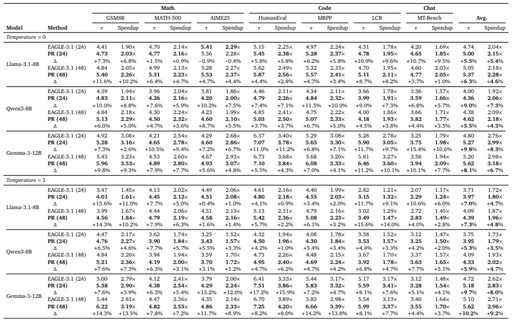
Table 1 | Acceptance length𝜏 and decoding speedup over autoregressive decoding.Parenthesized values give the total draft budget𝐵 (number of draft nodes verified per round), held equal for both methods along with the offer width, grow width, and number of draft steps.Δ rows give the relative gain of PR over EAGLE-3.1 at the same budget.
Original paper · CC BY 4.0 · Hoang Anh Duy Le, Huibing Dong, Alireza Khadem, Ziteng Sun, Xiang Song, Yizheng Huang, Soroush Radpour, Anshumali Shrivastava, Ye He · Give the Drafter a Second Chance to Guess: Parallel Reconsideration for Speculative Decoding · Original paper figure · Extracted the figure area from page 9 of the original PDF.Where a one-pass drafter loses acceptance
Speculative decoding speeds up generation because a cheap drafter proposes tokens that the target model checks in one forward pass. Feature-level drafters, such as the EAGLE family, draft every token with the same fixed budget of one forward pass through a small decoder. The drafter's per-token cost is fixed, so a single pass per token is the only compute it gets at any position.
That fixed budget becomes a bottleneck, because the drafter must commit to a guess even at positions it cannot settle in one pass.
The authors measured this on a trained EAGLE-3.1 drafter for Llama-3.1-8B-Instruct, reading two confidences at each drafted position. The drafter confidence is the top-1 probability of the drafter's own head, while the target confidence is the top-1 probability of the target's next-token distribution. Most lost acceptance therefore sits where the drafter was already unsure.
The drafter can't tell these recoverable cases apart, because its confidence is about equally low at decisive and ambiguous targets. So the drafter's uncertainty points to where it hesitates, but not to which hesitations a second pass could fix. The authors read this as a missing amount of computation, not a missing objective. Prior feature-level work refines what the drafter computes in one step rather than how much it computes.
Spending a second pass where the drafter hesitates
Parallel Reconsideration grants a feature-level drafter a second guess at the positions where it is unsure. The drafter's own uncertainty is the signal, so confident positions keep their single pass and hesitant ones get more attempts. The paper states that the added computation is nearly free, since it runs in parallel with the ordinary draft.
The reconsideration step reads the one-pass feature f0_p at position p and a learned self-query Q(f0_p) steers the second pass. The reconsidered feature is computed as f1_p = M(fc(f0_p, Q(f0_p))), and the new token is re-sampled from head(f1_p). The self-query Q maps the one-pass feature to a steering embedding that takes the place of the token embedding fused in the ordinary step.
The authors explain that a committed token embedding would push M to advance along a branch, while reconsideration must stay at p.
A reconsideration gate decides how deep each position goes, emitting a halt probability lambda_r = sigma(gate(f^r_p)) at each level r. The chance of stopping at level r is q(r) = lambda_r times the product over s below r of (1 minus lambda_s), and q(r) measures how likely a position reaches and stops at level r.
Run naively in series, each extra pass would stall the draft at position p until the reconsidered feature is computed.
Training one layer for two heads
The single decoder layer has to serve two heads at once, so training can't treat either head as a mere step toward the other. Both heads read the same feature f0p, which makes the training delicate.
Supervising only the reconsidered head degrades the one-pass head, because it overloads every token that gets reconsidered. Supervising both heads to match the target with equal weight lets gradient descent find a trivial solution, where f1p is close to f0p.
The training loss predicts a token at every depth r and scores it with cross-entropy against the target token. An entropy bonus, written as the balance term with coefficient β, keeps every depth in use. The full objective combines the one-pass loss, the weighted reconsideration losses, the gate term and the balance term, with stop-gradients.
A reconsidered child commits the key and value of its parent's halt level, so deeper positions attend over a mixed cache. To match this at serving time, each position j samples a halt depth d_j from q and commits the key and value that depth produces. The full training recipe, with its two on-policy rollouts and per-depth weighting, sits in Appendix B.
Grafting reconsidered guesses onto the draft tree
EAGLE-3.1 grows a dynamic draft tree over the steps of a round, scoring each node by its cumulative path probability. Each node's score sums the log one-pass probabilities of the tokens on its path from the root. After the gamma steps, a single global cut keeps the B highest-scoring nodes and prunes the rest. Parallel Reconsideration keeps this procedure and adds a second one that runs alongside it.
Each draft step does two jobs at once, so the gamma-step growth of Eq. (1) stays untouched. The m highest-bidding nodes of C are reconsidered in the same forward batch of M. A node's bid is its path score plus the log of one minus the top one-pass probability, which is the log probability that the draft breaks at its children. The bid therefore favors nodes the draft is likely to reach and where the one-pass guess is likely to be wrong.
The gate and the bid play complementary roles in choosing which nodes to reconsider. The bid then ranks the nodes that pass the gate, and confidence answers that ranking question.
Once a node halts, the draft scores its original and reconsidered children with one unified distribution. The mixed distribution adds to the one-pass probability the reconsidered distribution's difference, scaled by the gate's q(d_v). Because path scores sum edge log-probabilities, the edge change is added to every node beneath it. A node the bid never selects keeps the one-pass distribution, because the second term drops out.
Gains over EAGLE-3.1 at a matched budget
The comparison pits Parallel Reconsideration against EAGLE-3.1 across three target models, seven benchmarks and two sampling temperatures. Both drafters keep a single decoder layer and share the same target model, and SGLang serves each under one budget configuration. Every number comes from end-to-end runs on one H200, so the measured speedups sit below those in the original EAGLE-3 paper.
On Llama-3.1-8B-Instruct at budget 48 and temperature 0, Parallel Reconsideration averages an acceptance length of 5.37, against 5.05 for EAGLE-3.1. Its average speedup reaches 2.28×, compared to 2.18× for EAGLE-3.1, so the extra acceptance carries into wall-clock time. That amounts to a gain of 6.3% in acceptance length and 4.6% in speedup on average.
The largest per-benchmark acceptance gain in this setting reaches 11.6%, on GSM8K for Llama-3.1-8B-Instruct.
At batch size 16, Gemma-3-12B on LiveCodeBench reaches 2.14× with Parallel Reconsideration, against 2.04× for EAGLE-3.1. The paper attributes this to the target verifying the same B nodes per round, with the co-forwarded rows absorbed by the drafter's own batch.
Which components matter, and does a bigger drafter match it
It also tests whether a second decoder layer, spent on every position, can stand in for reconsideration. Parallel Reconsideration reaches 5.40 acceptance length and 2.26× speedup on GSM8K, the reference row for the ablations.
The authors explain that a committed token pushes M to advance along that branch, while reconsideration has to stay in place.
Where the reported results stop
Every speedup in this study was measured on one H200, served through SGLang. The authors say their speedups come out lower than those in the original EAGLE-3 paper. SGLang already removes many of the system bottlenecks that slow down an under-optimized autoregressive baseline. Its results therefore describe that one setting only.
At batch size 8 on LiveCodeBench, Llama-3.1-8B-Instruct reaches 1.33× with Parallel Reconsideration. That number sits below the 1.40× that EAGLE-3.1 reaches at the same batch size. The authors tested batch sizes of 1, 2, 4, 8 and 16 only. The near-free cost rests on the batched forward staying memory-bandwidth bound.
The footnote says the ideas extend to deeper or otherwise structured drafters. The reported results don't include a deeper Parallel Reconsideration drafter. The only deeper model in the comparisons is an EAGLE-3.1 baseline with two decoder layers.
Paper info
- Authors
- Hoang Anh Duy Le, Huibing Dong, Alireza Khadem, Ziteng Sun, Xiang Song, Yizheng Huang, Soroush Radpour, Anshumali Shrivastava, Ye He
- Venue
- arXiv · Preprint
- First published
- 2026-11-3
- Added
- 2026-11-6
- Updated
- 2026-11-3
- Version
- v1
- arXiv
- 2611.05724
- Category
- cs.LG
- Original paper terms
- CC BY 4.0
- What we show
- Paper info, commentary and permitted figures from the original paper
AI commentary is a separate explanation from the original paper and may contain errors. The original paper and figures follow each source's terms of use and any rights noted separately.
Abstract
Speculative decoding accelerates large language model inference with a small drafter, whose per-guess acceptance rate determines the achievable speedup. Feature-level drafters share a design choice: every token, easy or hard, is drafted under a single forward pass. Many of the tokens the target rejects are ones the drafter is itself unsure about yet the target answers decisively. To address this, we introduce Parallel Reconsideration: guided by its own uncertainty, the drafter reconsiders its hesitant guesses with extra passes that run in parallel with the one-pass draft, adding negligible latency. A co-designed training recipe and serving-time drafting algorithm append these reconsidered guesses to the original draft tree as refined candidates. Across models and benchmarks, on average, Parallel Reconsideration improves over the baselines by 5.3% to 10.2% on acceptance length and by 3.5% to 9.2% on speedup.
Figures from the paper
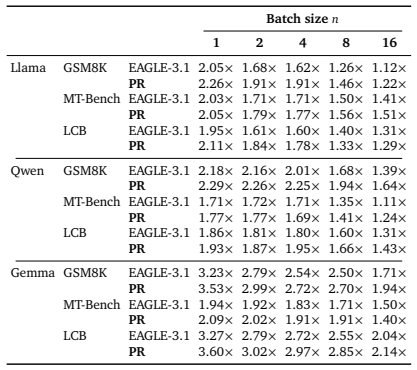
Table 2 | Speedup as requests are batched.Wall- clock speedup of EAGLE-3.1 and Parallel Recon- sideration (PR) over autoregressive decoding at a matched batch size𝑛, measured on the same serv- ing engine (𝐵=48, temperature0).
Original paper · CC BY 4.0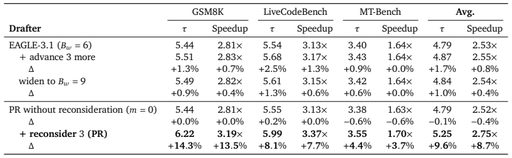
Table 4 | Reconsidering the additional nodes against drafting wider with them.Gemma-3-12B at 𝐵= 48, temperature1, reporting𝜏 / speedup. The two EAGLE-3.1 controls batch9nodes per draft step: the first takes3nodes of the previous step’s batch, matching where reconsideration draws from, and forwards each one’s best not-yet-forwarded one-pass child (a new sibling branch); the second widens the grow width outright, so all9nodes extend the current frontier, which is more drafting breadth than Parallel Reconsideration itself gets. Parallel Reconsideration with𝑚= 0runs our full serving path with no node ever reconsidered and batches the same6nodes as EAGLE-3.1; adding3 reconsidered nodes brings it to9.Δis relative to EAGLE-3.1.
Original paper · CC BY 4.0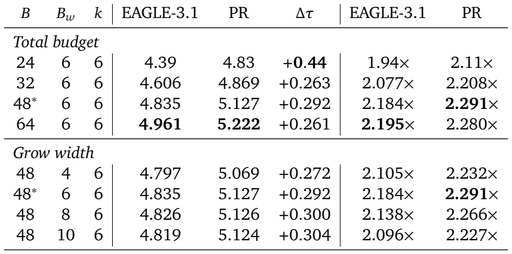
Table 5 | Sensitivity to the tree configuration.Acceptance length𝜏 and speedup over autoregressive decoding for EAGLE-3.1 and Parallel Reconsideration (PR) under identical budgets, varying one of the total budget𝐵, grow width𝐵𝑤 and offer width𝑘 at a time around our default (𝐵= 48, 𝐵𝑤 = 6, 𝑘= 6, marked∗ and repeated in each block);𝛾= 8and 𝑚= 3throughout, on Qwen3-8B, GSM8K, temperature0.Δ𝜏is PR minus EAGLE-3.1. Bold marks the best value per column.
Original paper · CC BY 4.0
Table 6 | Parallel Reconsideration on top of HASS.Acceptance length𝜏 and speedup over au- toregressive decoding on Llama-3.1-8B at temperature0, both drafters taken at the same training checkpoint and served under the tree configuration of Table 1 (𝐵= 48). Δ is the relative gain of adding reconsideration to HASS.
Original paper · CC BY 4.0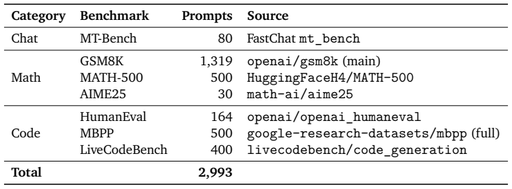
Table 8 |Evaluation benchmarks.Each is evaluated on its full set.
Original paper · CC BY 4.0Quote from the paper
Hoang Anh Duy Le, Huibing Dong, Alireza Khadem, Ziteng Sun, Xiang Song, Yizheng Huang, Soroush Radpour, Anshumali Shrivastava, Ye He (2026). Give the Drafter a Second Chance to Guess: Parallel Reconsideration for Speculative Decoding. arXiv:2611.05724v1. https://arxiv.org/abs/2611.05724v1
BibTeX
@misc{le2026give,
  title = {{Give the Drafter a Second Chance to Guess: Parallel Reconsideration for Speculative Decoding}},
  author = {Hoang Anh Duy Le and Huibing Dong and Alireza Khadem and Ziteng Sun and Xiang Song and Yizheng Huang and Soroush Radpour and Anshumali Shrivastava and Ye He},
  year = {2026},
  eprint = {2611.05724},
  archivePrefix = {arXiv},
  url = {https://arxiv.org/abs/2611.05724v1}
}