Paper commentary
Visual Object Tracking in First Person Vision
Researchers benchmark generic object trackers on first person video
- Problem Few trackers had been tested on first person video, so it was unclear whether they work off the shelf. Earlier FPV trackers only followed people, faces or hands.
- Method TREK-150 is a benchmark of 150 densely annotated video sequences from EPIC-KITCHENS. The authors run 38 generic trackers and four FPV baselines on it under the OPE protocol.
- Results Transformer trackers such as STARK and TransT rank highest on TREK-150. Despite their difficulties, trackers still benefit FPV tasks that need short-term object tracking.

Fig. 4 : Scheme of execution of the proposed FPV baseline trackers LTMU-F and LTMU-H based on LTMU [18].
Original paper · CC BY 4.0 · Matteo Dunnhofer, Antonino Furnari, Giovanni Maria Farinella, Christian Micheloni · Visual Object Tracking in First Person Vision · Original paper figure · Extracted the figure area from page 10 of the original PDF.Why per-frame detection leaves a gap
FPV pipelines that need to localise an object still rely on detection models that evaluate each video frame independently. This paradigm ignores the temporal information in object appearance and motion across consecutive frames. It also repeats the detection process in every frame, which raises the computational cost. That reduces the computational resources needed, but the bigger gain is that it keeps a spatial and temporal reference to specific object instances.
Those advances rest on new tracking principles and on benchmark datasets designed around such challenges. Yet these efforts mostly considered the third person scenario, where targets don't interact with the camera wearer. The FPV viewpoint is inherently different, so the same challenges appear with a different nature and distribution. The authors report persistent occlusion, significant scale and state changes, more motion blur and more fast motion.
Only very recent FPV pipelines have started to employ generic object trackers. Earlier FPV tracking work targeted people, faces or hands, such as EgoTracker for people and the KCF-based hand tracker. Those solutions focus on specific targets, so they are likely to fail on arbitrary objects. They were validated on custom designed datasets, which limits reproducibility and comparison with other methods.
The open question is whether today's generic trackers work off-the-shelf in FPV, or whether FPV needs its own methods. The authors argue that this gap can't be closed without a thorough study of the impact of FPV on tracking. Following the standard practice of the tracking community, they build a curated benchmark, TREK-150, from EPIC-KITCHENS.
The benchmark is meant to be reproducible and extendable, so others can evaluate their trackers against it.
What TREK-150 contains and how it differs from existing tracking benchmarks
TREK-150 is built from EPIC-KITCHENS, and it holds 150 video sequences extracted from that FPV dataset. Each sequence carries dense bounding boxes for one target object that the camera wearer interacts with. Interaction labels record whether the left hand, the right hand or both hands touch the target, using LHI, RHI and BHI. Interaction also counts when a medium such as a sponge sits between the hand and the target, which the authors treat as contact.
The interaction labels were refined manually from the output of the Hands-in-Contact (HiC) detector.
In total, TREK-150 contains 166883 hand bounding boxes, split into 82678 for the left hand and 84205 for the right hand. It also contains 77993 interaction state labels, with 24466 for the left hand, 16171 for the right hand and 37356 for both hands. Each sequence is tagged with 17 attributes describing motion and appearance changes of the target or the scene.
Thirteen of these attributes come from standard tracking benchmarks, while four are new FPV-specific attributes: High Resolution, Head Motion, 1-Hand Interaction and 2-Hands Interaction.
Compared with other benchmarks, TREK-150 has a larger number of sequences with partial occlusions (POC), scale or aspect ratio changes (SC and ARC), motion blur (MB) and illumination variation (IV). The authors attribute these differences to the first person viewpoint and to the human-object interactions that move the camera and change object appearance.
Sequences are also associated with 20 verb labels and 34 noun labels for the target category, following the EK labels. The benchmark reflects the long-tail label distribution of EK, which the authors note as a property of the data.
How trackers are scored on TREK-150
Each tracker is initialized with the ground-truth box in the first frame and runs once through the sequence under the OPE protocol. Scores come from three measures: SS for bounding-box overlap, NPS for how well the box is centred on the target, and GSR for robustness over time. A tracker can overlap the target well and stay centred, yet still lose it, so the authors read GSR separately.
Generalized success robustness reveals different rankings than SS, showing that spatially accurate trackers don't always keep their accuracy over longer periods.
The multi-start evaluation, MSE, starts each tracker from several points along the video, both forward and backward in time. Each start generates a diverse sub-sequence, so the tracker covers more of the situations that occur in the video. The scores from all sub-sequences are averaged into one overall score per sequence. The authors consider these averaged scores more robust and accurate estimates of real performance, so they use MSE to evaluate trackers over sequence attributes.
Every generic tracker runs with its publicly available code and default parameters, so the comparison isn't tilted toward trackers tuned on TREK-150. The real-time evaluation, RTE, follows the OPE setup, but a new frame is presented only after the previous execution has finished. Frames that arrive during a tracker's execution are skipped, and the last box the tracker gave is reused as the target location.
Besides SS, NPS and GSR, RTE reports processing speed in frames per second (FPS), which quantifies efficiency.
Turning detectors into trackers
The four FPV baselines turn object detectors into trackers, because off-the-shelf FPV-trained detectors are publicly available. The first two baselines, TbyD-F and TbyD-H, build on FPV-specific object detectors, and the authors tested whether they work as naive tracking baselines. The procedure memorises the initial bounding box at the first frame and runs an FPV object detector on every other frame.
The output for each frame is the detected box with the larger intersection-over-union with the previously memorised box. If the detector returns nothing, or no predicted box has an IoU greater than 0, the previously memorised box is output again.
TbyD-F runs the EK-55 trained Faster-R-CNN, while TbyD-H runs the Faster-R-CNN-based hand-object detector HiC. LTMU-F and LTMU-H combine the LTMU tracker with these same two detectors, so the authors keep generic tracking and FPV localization together. LTMU first runs a short-term tracker on a local area around the target's last position.
An online-learned verification module based on MDNet scores the patch cropped from the tracker's predicted box. When the verifier judges that the target is lost, the detector scans the whole frame for candidate locations. The candidate with the highest verifier confidence becomes the new target location and re-initialises the short-term tracker.
Which generic trackers held up on TREK-150
Transformer trackers such as STARK and TransT hold the highest positions in the rankings across all the plots. The authors suggest that the representation learning and matching approach of these trackers suits target-background discrimination in the FPV setting. Their transformer-based matching between template and search area gives a higher bounding box overlap on average, measured as SS in Figure 6(a).
The same matching also gives a better centered bounding box, measured as NPS in Figure 6(b). Trackers that build robust target models online, such as STMTrack, ECO, TrDiMP, VITAL, MDNet and ATOM, keep a longer temporal reference to objects. The STMTrack results show that a memory-network strategy, which builds a highly dynamic template representation during tracking, helps maintain a longer reference to the target.
The GSR plot in Figure 6(c) and the GSR results of Figure 7 rank the trackers differently from the SS and NPS plots. So a tracker can be spatially accurate yet fail to keep its accuracy over longer periods. Against OTB-100, overall performance of all the trackers decreases across all measures in the FPV scenario, as Figure 18 of the supplementary document shows.
The authors explain this drop by the different nature of FPV images and the lack of tracking-specific FPV data.
Deep trackers with online adaptation beat the siamese and handcrafted-feature trackers on this benchmark. Among the online methods, the transformer-based trackers worked best, which the authors see as a promising direction. The authors also tested the TbyD-F and TbyD-H baselines of Table 4 and the LTMU-F and LTMU-H versions of Table 5 against their base trackers.
Did detectors and LTMU help?
The TbyD-H baseline runs the HiC detector on each frame, which is Faster-R-CNN-based, and keeps the detection with the largest IoU to the previous box. With that previous-box rule, TbyD-H reaches an OPE SS of 0.433. With SORT association alone, the same tracker drops to an OPE SS of 0.237, so the previous-box rule carries most of the gain.
The IoU variant, however, has an OPE GSR of only 0.132, so its accuracy and robustness pull apart. TbyD-F, built on the EK-55 trained Faster-R-CNN, reaches an OPE SS of 0.390 with the same rule, and adding SORT leaves it at 0.390.
LTMU-H, which uses HiC as its re-detection module, raises DiMP-MU's OPE SS from 0.411 to 0.461. LTMU-F, which uses the EK-55 trained Faster-R-CNN, gives an OPE SS of 0.456 on the same tracker. On STMTrack, LTMU-H reaches 0.487 against a baseline of 0.464, a smaller lift than on DiMP-MU. The gain is not uniform, because STARK's OPE GSR under LTMU-F falls from 0.395 to 0.334.
The LTMU verifier, based on MDNet, checks each re-detected candidate before the short-term tracker is re-initialised.
In the HOI pipeline, each tracker is initialised with the box HiC gives in its first valid HOI detection. STARK recalls 0.248 of the interactions, the top value in that table. LTMU-H recalls 0.246 and TbyD-H recalls 0.238, so detector-only and tracker-based systems land close together. The authors read this as trackers helping short-term HOI tasks, but they tie that benefit to sequences that are not too long.
Training data and backbone choices
Training data changes the results for some trackers, while the backbone choice favors ResNet-50 across the tested methods. The authors retrained DiMP, SiamRPN++ and STARK on the FPV object detection data, using the subset of EK-55 frames with bounding boxes. The FPV set has 197229 frames and 295 object categories, against 118287 frames and 80 categories for COCO.
Training DiMP on the FPV set raised its OPE SS from 0.386 to 0.418. SiamRPN++ and STARK did not gain, and their SS dropped from 0.380 to 0.343 and from 0.340 to 0.264. The authors read this as online adapting trackers needing an offline stage in the target domain, while siamese and transformer trackers need large and diverse samples.
The authors also compared trackers trained on TrackingNet, GOT-10k and LaSOT, with the same hyperparameters and only the dataset swapped. Siamese trackers benefited most from GOT-10k, which has many object categories. DiMP-like and STARK-like trackers benefited most from LaSOT, whose long videos contain severe appearance changes. The highest FPV performance did not come from TrackingNet, the largest of the three sets, so more videos and frames aren't enough.
The backbone study tested SiamRPN++, DiMP and STARK with different CNN backbones under the OPE protocol. On SiamRPN++, SS was 0.345 with AlexNet and 0.380 with ResNet-50. DiMP reached SS 0.373 with ResNet-18 and 0.386 with ResNet-50, and STARK reached 0.492 with ResNet-50 and 0.490 with ResNet-101. ResNet-50 gave the highest tracking performance for all three methods.
These backbones were pre-trained on popular TPV tracking benchmarks, so the result doesn't cover backbones trained on FPV data.
Fine-tuning on a small split
Fine-tuning on TREK-150 itself was tested as a second route, because FPV training data is scarce. The authors randomly split TREK-150 into a training set of 100 videos and a test set of 50 videos. They fine-tuned the offline trackers SiamFC and SiamRPN++ on the 100-video split, following each tracker's original learning strategy. Fine-tuning SiamFC cut its OPE SS on the 50-video test subset from 0.311 to 0.267.
The fine-tuned SiamRPN++ fell from 0.384 to 0.348 in SS, although its NPS rose from 0.395 to 0.407. The authors read these drops as substantial overfitting caused by the simple fine-tuning.
The fine-tuning test follows an earlier experiment in which FPV detection data did not help the siamese trackers. The authors suspected that the synthetic transformations applied to still images don't change the target's appearance as severely as real object manipulation does. Their aim was to check whether learning from object appearances that change over time improves these methods.
TREK-150 wasn't designed as a large training corpus, so it cannot test that idea at scale.
The tracking data covered both TPV and FPV sources, and the deep learning tracking knowledge base was included in that conclusion.
Speed when frames are skipped
Under RTE, none of the trackers reaches 60 FPS. The authors attribute this to full HD frames that need costly crop and resize operations. SiamBAN lost 3.7% SS and SiamRPN++ lost 4.7% SS compared with OPE.
TransT and STARK lost 5.3% and 6.1% SS, but their robustness keeps their real-time results higher than those of SiamBAN and SiamRPN++. KeepTrack, PrDiMP, ATOM, KYS and ECO run slower because of heavier online learning, and they lose more accuracy in real time. The FPV baselines also drop in real time, because their FPV object detectors are demanding.
Limitations of the TREK-150 results
The results rest on one benchmark, built from 150 sequences taken from EK. The main text reports only 20 of the 42 trackers, and the remaining results sit in the supplementary document. Readers who want the full picture have to look beyond the main paper.
The FPV-specific training experiment didn't use a large FPV tracking dataset. It used EK-55 detection images turned into synthetic videos, with 197229 frames and 214878 bounding boxes. Because the authors kept the same hyperparameters, they didn't test whether other training schedules change the picture. The DiMP tracker gained from this FPV data, while SiamRPN++ and STARK didn't.
The fine-tuning comparison used a random split of TREK-150 into 100 training videos and 50 test videos. With only that split, the fine-tuned SiamFC and SiamRPN++ overfit, and their performance dropped in general. Trackers that were fine-tuned on a larger or different split could behave differently, and the paper doesn't test that. The authors conclude that FPV poses challenges that current tracking data, both TPV and FPV, doesn't fully address.
The authors say trackers can be used successfully when sequences are not too long, but they give no length threshold. The HOI benefit therefore holds only for an unspecified sequence length. Tracking over longer sequences in the HOI setting isn't tested in this study.
Paper info
- Authors
- Matteo Dunnhofer, Antonino Furnari, Giovanni Maria Farinella, Christian Micheloni
- Venue
- arXiv · Preprint
- First published
- 2022-9-27
- Added
- 2026-11-6
- Updated
- 2022-9-27
- Version
- v1
- arXiv
- 2209.13502
- DOI
- 10.1007/s11263-022-01694-6
- Category
- cs.CV
- Original paper terms
- CC BY 4.0
- What we show
- Paper info, commentary and permitted figures from the original paper
AI commentary is a separate explanation from the original paper and may contain errors. The original paper and figures follow each source's terms of use and any rights noted separately.
Abstract
The understanding of human-object interactions is fundamental in First Person Vision (FPV). Visual tracking algorithms which follow the objects manipulated by the camera wearer can provide useful information to effectively model such interactions. In the last years, the computer vision community has significantly improved the performance of tracking algorithms for a large variety of target objects and scenarios. Despite a few previous attempts to exploit trackers in the FPV domain, a methodical analysis of the performance of state-of-the-art trackers is still missing. This research gap raises the question of whether current solutions can be used ``off-the-shelf'' or more domain-specific investigations should be carried out. This paper aims to provide answers to such questions. We present the first systematic investigation of single object tracking in FPV. Our study extensively analyses the performance of 42 algorithms including generic object trackers and baseline FPV-specific trackers. The analysis is carried out by focusing on different aspects of the FPV setting, introducing new performance measures, and in relation to FPV-specific tasks. The study is made possible through the introduction of TREK-150, a novel benchmark dataset composed of 150 densely annotated video sequences. Our results show that object tracking in FPV poses new challenges to current visual trackers. We highlight the factors causing such behavior and point out possible research directions. Despite their difficulties, we prove that trackers bring benefits to FPV downstream tasks requiring short-term object tracking. We expect that generic object tracking will gain popularity in FPV as new and FPV-specific methodologies are investigated.
Figures from the paper
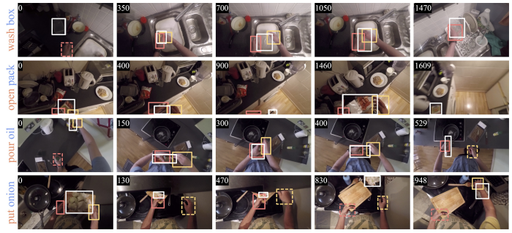
Fig. 1 : In this paper, we study the problem of visual object tracking in the context of FPV . To achieve such a goal, we introduce a new benchmark dataset named TREK-150, of which some qualitative examples of sequences are represented in this Figure. In each frame, the white rectangle represents the ground-truth bounding box of the target object. The orange and yellow boxes localize left and right hands respectively (plain lines indicate the interaction between the hand and the target). Each number in the top left corner reports the frame index. For each sequence, the action performed by the camera wearer is also reported (verb in orange, noun in blue). As can be noted, objects undergo significant appearance and state changes due to the manipulation by the camera wearer, which makes the proposed setting challenging for current trackers.
Original paper · CC BY 4.0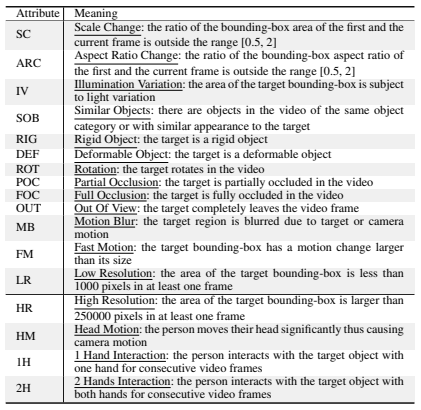
Table 2 : Selected sequence attributes. The first block of rows describes attributes commonly used by the visual tracking community. The last four rows describe additional attributes introduced in this paper to characterize FPV track- ing sequences.
Original paper · CC BY 4.0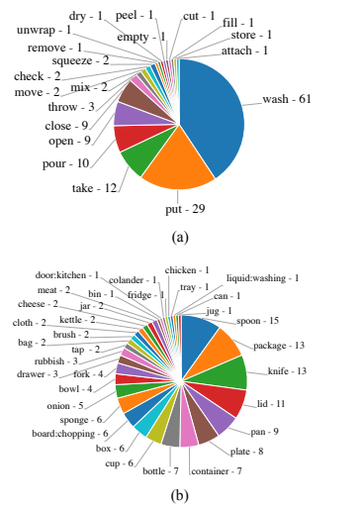
Fig. 3 : Distributions of (a) action verb labels and (b) target object categories.
Original paper · CC BY 4.0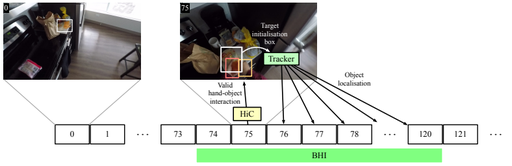
Fig. 5 : Schematic visualization of the protocol designed to execute trackers in the context of a hand-object interaction (HOI) detection task. The HOI labels provided for TREK-150 are used to consider sub-sequences of frames in which the camera wearer is interacting with the target object. In this picture, the labels BHI are employed to indicate that an interaction by both hands is happening in the frame range [74, 120]. On such sub-sequences, a systematic pipeline for HOI detection and tracking is run. The HOI detector HiC [93] is first executed in every frame to obtain a valid HOI (in this example the first valid detection is obtained at frame 75). Once such an event is determined, the tracker is initialized with the bounding box given by HiC for the object involved in the interaction. The tracker is then run on all the subsequent frames to provide the reference to such an object.
Original paper · CC BY 4.0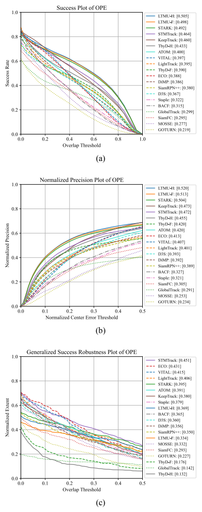
Fig. 6 : Performance of 20 of the 42 selected trackers on the proposed TREK-150 benchmark under the OPE protocol. In brackets, next to the trackers’ names, we report the SS, NPS, and GSR values.
Original paper · CC BY 4.0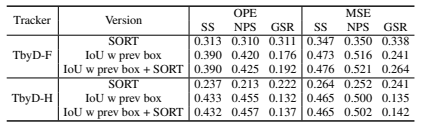
Table 4 : OPE and MSE performance of the baseline FPV- based tracking-by-detection methods TbyD-H and TbyD-F under different configurations.
Original paper · CC BY 4.0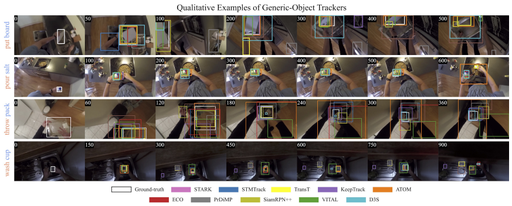
Fig. 8 : Qualitative results of some of the generic object trackers benchmarked on the proposed TREK-150 dataset.
Original paper · CC BY 4.0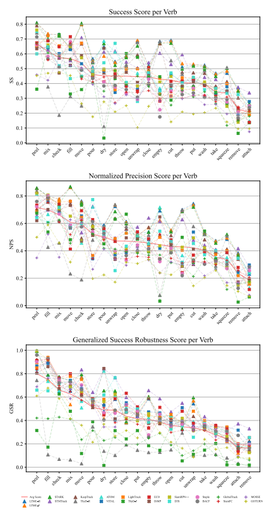
Fig. 11 : SS, NPS, and GSR performance achieved under the MSE protocol of 20 of the 42 selected trackers with re- spect to the action verbs performed by the camera wearer and available in TREK-150. The red plain line highlights the average performance.
Original paper · CC BY 4.0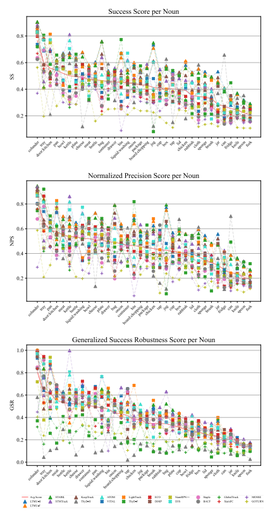
Fig. 12 : SS, NPS, and GSR performance achieved under the MSE protocol of 20 the 42 selected trackers with respect to the target noun categories available in TREK-150. The red plain line highlights the average tracker performance.
Original paper · CC BY 4.0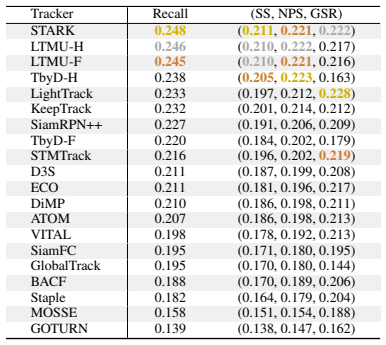
Table 6 : Results of the experiment in which 20 of the con- sidered trackers are evaluated by the Recall of an FPV HOI detection pipeline where trackers are used as localization method for the object involved in the interaction. The first column presents the results of the proposed system in which each tracker is initialized with the bounding box given by HiC in its first valid HOI detection. The last column reports the SS, NPS, and GSR results achieved by each tracker with the OPE protocol on the sub-sequences yielded by the HOI labels. Best results, per measure, are highlighted in gold, second-best in silver, third-best in bronze.
Original paper · CC BY 4.0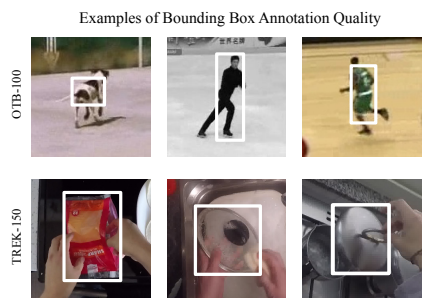
Fig. 13 : Examples of the quality of the bounding box anno- tations contained in TREK-150 in comparison with the ones available in the popular OTB-100 benchmark. TREK-150 provides careful and high-quality annotations that tightly en- close all the target objects.
Original paper · CC BY 4.0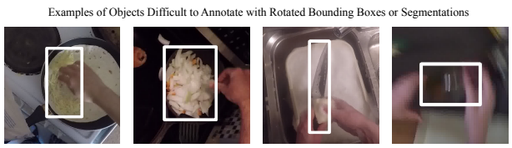
Fig. 14 : Examples of target objects contained in TREK-150 that are difficult to represent with more sophisticated represen- tations (e.g. rotated bounding box or segmentation mask). The first two images from the left show objects such as “cheese” and “onion” which prevent the determination of the angle for an oriented bounding-box, or an accurate segmentation mask. The last two images present objects which prevent a consistent definition of a segmentation mask.
Original paper · CC BY 4.0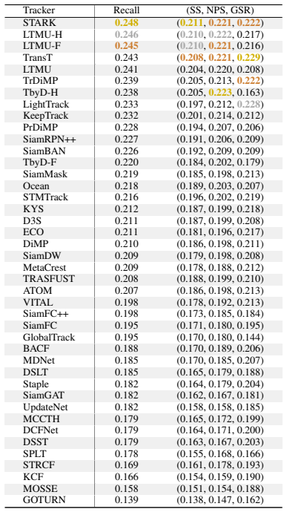
Table 7 : Results of the experiment in which trackers are evaluated by the Recall of an FPV HOI detection pipeline where trackers are used as localization method for the ob- ject involved in the interaction. The first column presents the results of the proposed system in which each tracker is initialized with the bounding box given by HiC in its first valid HOI detection. The last column reports the SS, NPS, and GSR results achieved by each tracker with the OPE pro- tocol on the sub-sequences yielded by the HOI labels. Best results, per measure, are highlighted in gold, second-best in silver, third-best in bronze.
Original paper · CC BY 4.0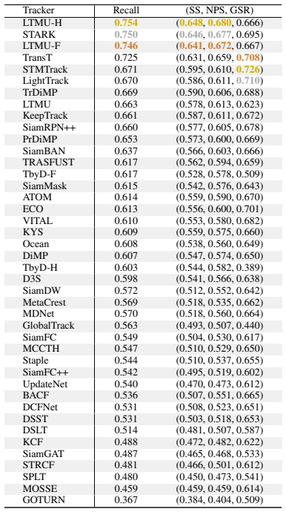
Table 8 : Results of the experiment in which trackers are evaluated by the Recall of an FPV HOI detection pipeline where trackers are used as localization method for the object involved in the interaction. The first column presents the re- sults of the proposed system in which each tracker is initial- ized with the ground-truth bounding box for the first frame labeled with the HOI. The last column reports the SS, NPS, and GSR results achieved by each tracker with the OPE pro- tocol on the sub-sequences yielded by the HOI labels. Best results, per measure, are highlighted in gold, second-best in silver, third-best in bronze.
Original paper · CC BY 4.0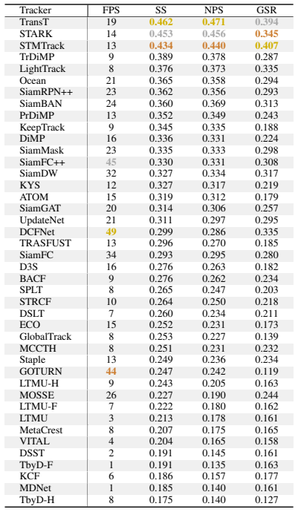
Table 9 : Performance achieved by the 42 trackers bench- marked on TREK-150 using the RTE protocol. Best results, per measure, are highlighted in gold, second-best in silver, third-best in bronze.
Original paper · CC BY 4.0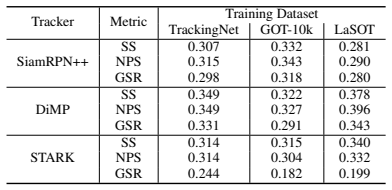
Table 10 : OPE-based performance of the deep learning- based trackers SiamRPN++, DiMP, STARK on TREK-150 after being trained separately on each of the most popular generic object TPV datasets (TrackingNet, GOT-10k, La- SOT).
Original paper · CC BY 4.0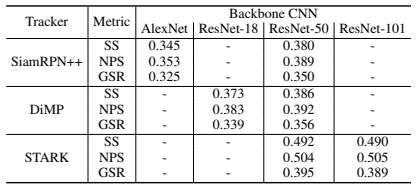
Table 11 : Performance of the deep learning-based trackers SiamRPN++, DiMP, STARK on TREK-150 when executed with different CNN backbones. The trackers have been exe- cuted under the OPE protocol.
Original paper · CC BY 4.0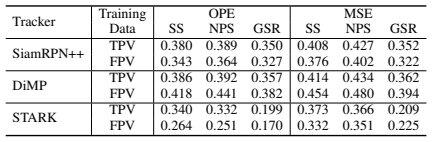
Table 12 : Performance of the deep learning trackers SiamRPN++, DiMP, STARK on TREK-150 when trained on datasets of generic object tracking (TPV) and on a large- scale dataset for FPV object detection.
Original paper · CC BY 4.0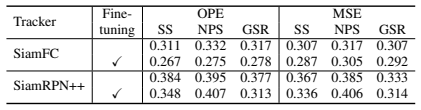
Table 13 : Performance of the offline trackers SiamFC and SiamRPN++ on a subset of 50 sequences of TREK-150 without and with fine-tuning on the remaining 100 videos.
Original paper · CC BY 4.0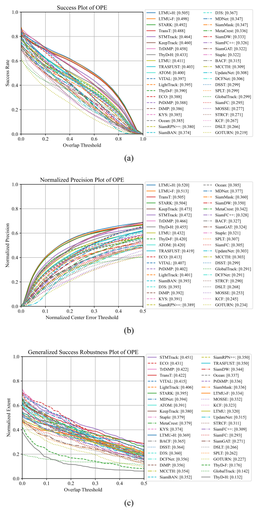
Fig. 16 : Performance of all the 42 selected trackers on the proposed TREK-150 benchmark under the OPE protocol. In brackets, next to the trackers’ names, we report the SS, NPS, and GSR values.
Original paper · CC BY 4.0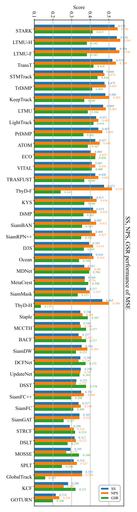
Fig. 17 : SS, NPS, and GSR performance of the 42 benchmarked generic object trackers on the proposed TREK-150 bench- mark achieved under the MSE protocol. The trackers are ordered by the average value of their SS, NPS, GSR scores.
Original paper · CC BY 4.0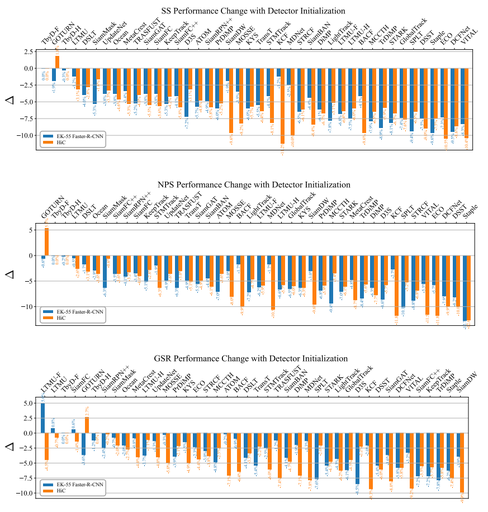
Fig. 19 : Results of the OPE-D experiment in which the bounding box for initialization is given either by the EK-55 trained Faster-R-CNN [19] or the HiC detector [93]. The performance change with respect with the ground-truth initialization is reported for the SS, NPS, and GSR metrics. In each plot, the trackers are ordered by the average performance change of the two initialization experiments.
Original paper · CC BY 4.0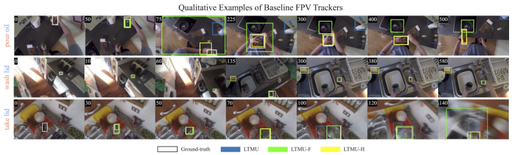
Fig. 20 : Qualitative results of the baseline FPV trackers LTMU-F and LTMU-H in comparison with LTMU.
Original paper · CC BY 4.0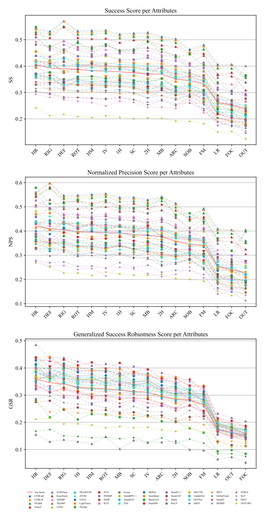
Fig. 21 : SS, NPS, and GSR performance achieved under the MSE protocol of the 42 selected trackers with respect to the sequence attributes available in TREK-150. (The results for the POC attribute are not reported because this attribute is present in every sequence). The red plain line highlights the average tracker performance.
Original paper · CC BY 4.0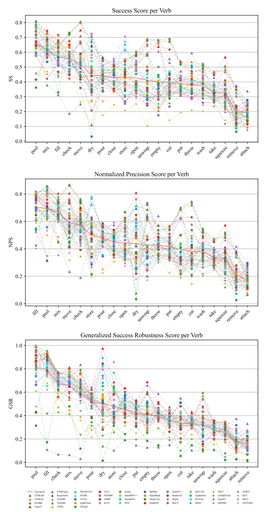
Fig. 22 : SS, NPS, and GSR performance achieved under the MSE protocol of the 42 selected trackers with respect to the sequence verbs available in TREK-150. The red plain line highlights the average tracker performance.
Original paper · CC BY 4.0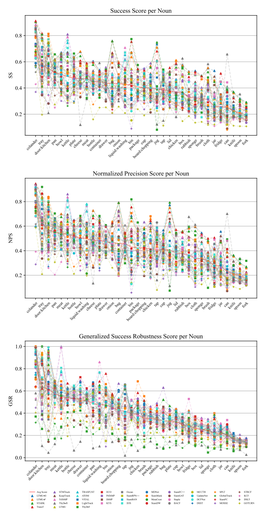
Fig. 23 : SS, NPS, and GSR performance achieved under the MSE protocol of the 42 selected trackers with respect to the target nouns available in TREK-150. The red plain line highlights the average tracker performance.
Original paper · CC BY 4.0Quote from the paper
Matteo Dunnhofer, Antonino Furnari, Giovanni Maria Farinella, Christian Micheloni (2022). Visual Object Tracking in First Person Vision. arXiv:2209.13502v1. https://doi.org/10.1007/s11263-022-01694-6
BibTeX
@article{dunnhofer2022visual,
  title = {{Visual Object Tracking in First Person Vision}},
  author = {Matteo Dunnhofer and Antonino Furnari and Giovanni Maria Farinella and Christian Micheloni},
  year = {2022},
  eprint = {2209.13502},
  archivePrefix = {arXiv},
  doi = {10.1007/s11263-022-01694-6},
  url = {https://arxiv.org/abs/2209.13502v1}
}