Paper commentary
Stand-In Effects and Pooling Amplification: Design-Based Tests of Whether Biological World Models Use Actions
Action-replacement tests can report effects that do not exist
- Problem Common checks remove the actions and see whether accuracy drops. Under autocorrelated designs, future actions stand in for unseen history, so these checks report effects that are not there.
- Method The authors draw alternative action blocks from the known design law, conditioned on the full design state, and compare the observed block with them.
- Results The e-value test stays valid in finite samples whatever the model, while replacement diagnostics reported effects in up to 249/256 replicates of a null.
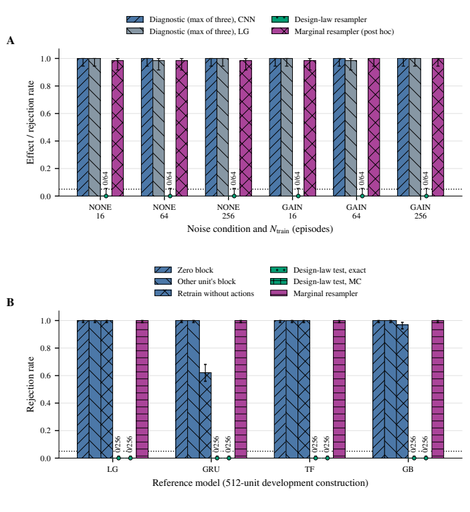
Figure 4 : The stand-in trap. (A) Pixel world whose logging policy depends on the blob’s position six steps earlier, which the models do not see; no action has any effect. For each cell (shared noise and number of training episodes;64 test episodes), the highest effect-report rate among the three replacement diagnostics for each learned model, and the contrast-tempered randomization test with the design-law resampler, which conditions on the full logged state, and with a resampler that draws actions from their marginal frequencies (post hoc, §7.2). (B) Development stand-in construction with 512 units (256 replicates), for each reference model: the three replacement diagnostics, the exact and Monte Carlo e-value tests with the design law, and a randomization test with a marginal resampler. Error bars:95%Clopper–Pearson intervals. Dotted line:𝛼=0.05.
Original paper · CC BY 4.0 · Bowen Xu, Boyu Chen · Stand-In Effects and Pooling Amplification: Design-Based Tests of Whether Biological World Models Use Actions · Original paper figure · Extracted the figure area from page 20 of the original PDF.Why replacing actions misleads
Most checks of an action-conditioned world model ask whether predictions get worse once the actions are removed. The usual replacements are zeros, another unit's actions, a shuffled sequence, or retraining without actions. The trouble starts when the design is autocorrelated, because the next stimulus then depends on the stimuli before it.
The better the model predicts, the better it learns this stand-in, and the stand-in effect grows with the predictive skill. In that construction, the future block reveals the stratum beyond what the recent window shows, so a good predictor uses it. Replacing the block by zeros or by another unit's block breaks that dependence and costs accuracy without any action effect.
Design draws preserve the dependence, which is why a randomization test built on the design law is unaffected.
In development simulations with twelve units, replacement diagnostics reported effects in up to 249/256 replicates of a null. In a pixel world where the logging policy depends on state the model can't see, the diagnostics reported an effect in 64.1% to 100% of test episodes. Retraining without actions also reported effects in up to 236/256 replicates in the stand-in family.
Across these settings, the e-value test never rejected in the stand-in family, at 0/256.
The authors also ran zero-entropy designs, where the randomization test returns e equal to 1 by construction. Even there, the replacement diagnostics reported effects in up to 254/256 replicates. So the failure depends on what the resampler conditions on, not on the choice of test alone.
A randomization test that uses the design law
The fix starts from knowing the randomization law that the design used to assign actions. The authors draw alternative action blocks from that law, conditioned on everything the design conditioned on. Under that null of no effect within the horizon, the test compares the observed block with these resampled blocks.
The world model enters only as a test statistic, so it sets the test's power but never its validity. The resampler has to condition on the full state the design used, because a simpler law reproduces the false effect. Validity is guaranteed in finite samples whatever the model, provided that conditioning holds.
The conditioning matters in practice, as a post hoc analysis of the pixel world shows. The design-law resampler, by contrast, rejected in none for the two-model average. The authors read this gap as a warning that a simpler resampler can turn a valid test into a false-positive machine.
Why pooling many sites backfires
Pooling amplification arises when many sites share one action sequence, as every pixel of a frame shares the frame's actions. The natural statistic sums the log predictive densities of the sites and bets on the total.
Over the same range the oracle's median rose from 79.0 to 157, so the pooled score moves against the true effect. Validation on the usual metrics missed this, because the error sits in a direction the sites share.
The same failure appeared in the ERK experiment, where the pooled statistic gave log E = −9576 on the positive controls. Light is known to drive the reporter in those controls, so the statistic failed on a true effect.
Tempering the pooled score without breaking validity
Tempering the pooled score changes the bet a test places, but the error rate of the test stays where the design put it. Within the randomization test, the statistic is only a choice, so a factor fixed on training data can scale the pooled log score without touching validity. The registered variant divides the pooled score by a Kish factor built from the residual correlation, estimated on training data.
The exploratory variant instead measures the design effect along the action contrast, because the contrast is what drives amplification.
When the action contrast is shared across sites, the contrast factor takes the form 1/(1 + X), where X is a weighted sum of cross-products of residuals. For a common site count n, this factor is a Kish factor with an intraclass correlation written as rho bar D, so the two tempering routes meet. The identity holds for any site counts, but its Kish reading needs a common count, since X becomes a weighted mean when counts vary across origins.
In the pixel world, the Kish factor didn't capture the correlation that matters for amplification. Contrast tempering restored power under every noise condition simulated, and it did so at the larger of the two effect sizes. Its e-values still stayed far below the oracle's, because it restored power without extracting the extra evidence that more pixels carry.
What the ERK evidence shows
The registered pooled statistic failed its ERK positive controls, and the exploratory Kish-tempered statistic then gave log E = 349 on the same test fields. The Kish-tempered statistic was selected on synthetic data before the confirmatory test was run. The confirmatory test was registered before the data were obtained, and it rejected the null on an ERK field no one involved had opened, with E ≈ 1.1×10 10.
The confirmatory result is evidence against the sharp null on a new field, conditional on the registered design and frozen-training assumptions. The working law V3 carries that condition, and the acquisition law for this field is unverified. The authors don't estimate the size of the effect with this test, and they don't claim power for CcaS or other systems.
The authors also compared the Kish factor with the contrast factor on the training fields' validation cells, using training outcomes only. The ratio of the implied contrast correlation to the Kish correlation ranged from 0.554 to 0.818 across models at ten minutes. Because every ratio sits below one, Kish tempering over-tempers somewhat and is conservative on ERK.
Limitations of the ERK and pixel evidence
The validity guarantee depends on the working design law, and for ERK that law is a reconstruction. Its exact acquisition rule isn't verified for the confirmatory field, so the result holds conditionally on that reconstruction. No theorem licenses the working laws, so the authors rely on calibration against the released command records instead.
The analysis also assumes that the observation mask and segmentation don't respond to future actions.
The tests are conservative, so they have little power for effects masked at the level of each unit. They also have little power for effects that are weak relative to the design's entropy. As a result, its e-values stayed far below the oracle's.
Those runs used reduced episode counts, so the pixel results are narrower than a full-scale study. It doesn't say which site or action responds, by how much, or through what mechanism.
Paper info
- Authors
- Bowen Xu, Boyu Chen
- Venue
- arXiv · Preprint
- First published
- 2026-11-1
- Added
- 2026-11-3
- Updated
- 2026-11-1
- Version
- v1
- arXiv
- 2611.01666
- Category
- cs.LG · q-bio.QM · stat.ME
- Original paper terms
- CC BY 4.0
- What we show
- Paper info, commentary and permitted figures from the original paper
AI commentary is a separate explanation from the original paper and may contain errors. The original paper and figures follow each source's terms of use and any rights noted separately.
Abstract
Action-conditioned world models are increasingly trained on data from randomized experiments, and whether their predictions respond to actions is usually checked by replacing or removing the actions and measuring the loss in accuracy. We show that such diagnostics report action effects where there are none: under autocorrelated designs, future actions stand in for history the model does not see, and a better model learns the stand-in better. When the design law is known, a conditional randomization test written as an e-value is valid in finite samples whatever the model, provided the resampler conditions on the full state the design used; resampling from a simpler law reproduces the false effect. We identify a second failure, specific to world models: when many sites share one action sequence (cells in a microscope field, pixels in a frame), the natural pooled score turns small model errors along the action contrast into overwhelming evidence against a true effect. In a pixel world, its median log e-value fell from $-17.3$ to $-6832$ as frames grew from 64 to 4096 pixels, while the oracle's rose. Tempering the score by a design effect estimated on training data changes the bet, not the validity. Our own preregistered analysis of optogenetic ERK experiments failed in exactly this way; a tempered statistic, selected on synthetic data and registered before the data were obtained, then rejected the null on a never-opened field ($E\approx 1.1\times10^{10}$). Every analysis is preregistered, fixed in a dated protocol before it was run, or labelled exploratory, and every reported result is generated from hashed result files.
Figures from the paper
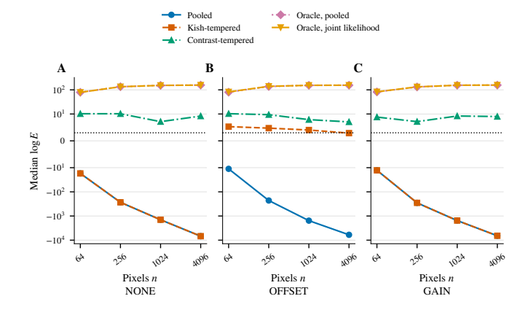
Figure 1 : Pooling amplification in a pixel world model. Medianlog𝐸 over test episodes at the larger effect size as frames grow from64 to 4096 pixels, without shared noise (A), with a frame-wide additive offset (B) and with a multiplicative gain on the blob (C). The pooled, Kish-tempered and contrast-temperedstatisticsareaveragesoverthetwolearnedmodels;theoraclesusethetruedynamics with independence pooling or with the exact joint likelihood. In A and C the Kish factor is close to one and the Kish-tempered curve coincides with the pooled one; the two oracle curves nearly coincide in every panel. Dotted line:log 20, the rejection threshold. Symmetric-log axis, linear for |log𝐸|≤10.
Original paper · CC BY 4.0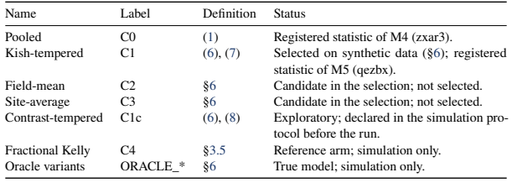
Table 1 : Statistics used in this paper. “Label” is the name in the registered and protocol documents; the paper uses the names in the first column.
Original paper · CC BY 4.0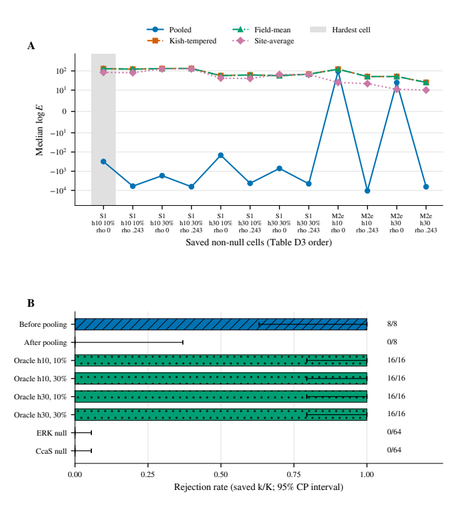
Figure 2 : Diagnosis and repair on ERK-like synthetic data. (A) Medianlog𝐸 of the pooled score and of the three repair candidates in the twelve alternative cells of the selection grid; the shaded cell is the one the selection script designated hardest (§6.2). The Kish-tempered and field-mean curves nearly coincide. The pooled score fails everywhere except without shared noise under the simple generator. (B) Rejection counts before and after the field-pooling step, for the oracle predictor in four cells, and for the pipeline under the null on ERK and CcaS commands. Error bars:95% Clopper–Pearson intervals. Symmetric-log axis in A.
Original paper · CC BY 4.0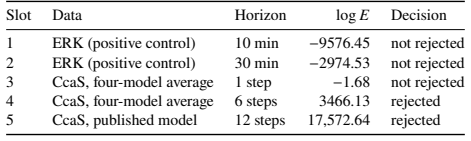
Table 2 : M4 primary results (pooled statistic, registered analysis). Natural-log e-values; reject iff 𝐸≥100.
Original paper · CC BY 4.0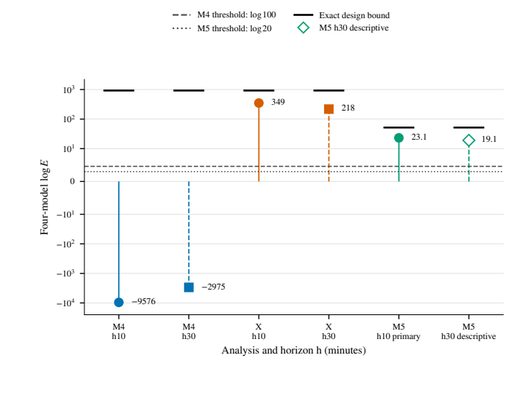
Figure 5 : The ERK evidence chain. Four-modellog𝐸 of the registered pooled statistic in M4 (nine test fields), and of the Kish-tempered statistic in the exploratory analysis X (the same fields) and in the confirmatory test M5 (one unopened field; thirty minutes descriptive only). Horizontal bars mark the exact-form design bound of each analysis (Proposition 4), a command-only comparator for these Monte Carlo e-values; dashed and dotted lines mark the rejection thresholds of M4 (𝐸≥100 ) and M5 (𝐸≥20). Symmetric-log axis.
Original paper · CC BY 4.0
Table 3 : Frozen theory documents. Hashes are SHA-256 of the bytes in the registered code archive.
Original paper · CC BY 4.0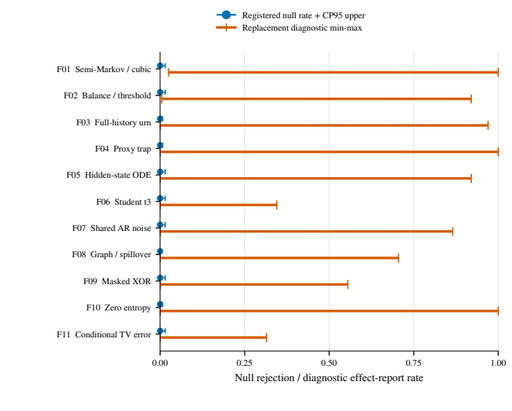
Figure 6 : Sealed challenge by family. For each of the eleven families, the null rejection rate of the pooled statistic registered for M4 with its one-sided95% Clopper–Pearson upper bound, and the range of effect-report rates of the replacement diagnostics across the family’s null cells and models. Family names are abbreviated from the challenge report (Table 5).
Original paper · CC BY 4.0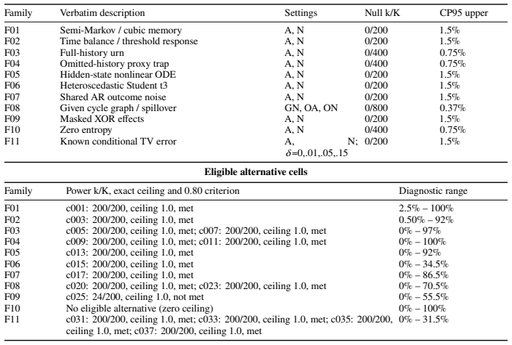
Table 5 : M3 sealed challenge by family – Descriptions and sharp-null size; Eligible alternative cells. Sources: M3_REPORT_ACCESS.json @ 4c18891d6079; M3_REPORT_9c46394.md @ 4c18891d6079; M3_SCORES_9c46394.json @ 4c18891d6079.
Original paper · CC BY 4.0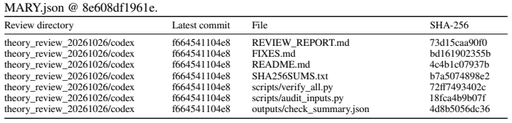
Table 14 : ERK training-field diagnostic – Correlations. Sources: FIELD_RESULTS.json @ 0911ef20df6a; POOLED_RESULTS.json @ 0911ef20df6a; ERK_DIAG_RHO_MEAN_ EXTRACT.json @ 4c18891d6079. Field Model h
Original paper · CC BY 4.0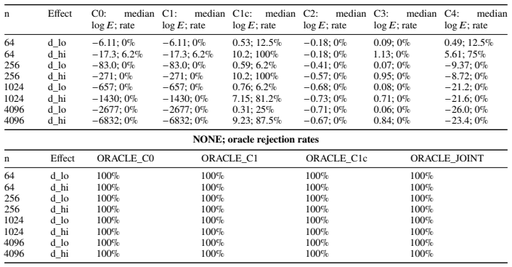
Table 18 : Pixel demonstration G1 alternatives by noise – NONE; two-model averages; NONE; oracle rejection rates. Sources: T2_alternative_performance.csv @ 004fde8f3242.
Original paper · CC BY 4.0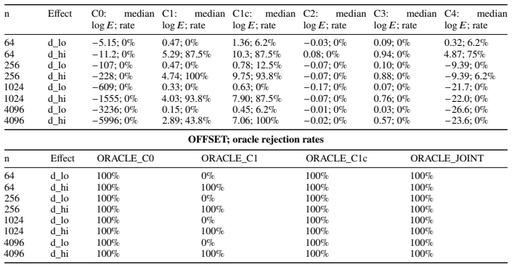
Table 19 : Pixel demonstration G1 alternatives by noise (continued) – OFFSET; two-model averages; OFFSET; oracle rejection rates. Sources: T2_alternative_performance.csv @ 004fde8f3242.
Original paper · CC BY 4.0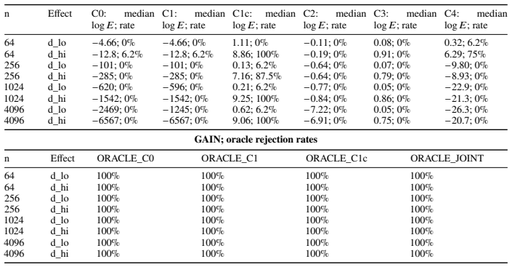
Table 20 : Pixel demonstration G1 alternatives by noise (continued) – GAIN; two-model averages; GAIN; oracle rejection rates. Sources: T2_alternative_performance.csv @ 004fde8f3242.
Original paper · CC BY 4.0Quote from the paper
Bowen Xu, Boyu Chen (2026). Stand-In Effects and Pooling Amplification: Design-Based Tests of Whether Biological World Models Use Actions. arXiv:2611.01666v1. https://arxiv.org/abs/2611.01666v1
BibTeX
@misc{xu2026stand,
  title = {{Stand-In Effects and Pooling Amplification: Design-Based Tests of Whether Biological World Models Use Actions}},
  author = {Bowen Xu and Boyu Chen},
  year = {2026},
  eprint = {2611.01666},
  archivePrefix = {arXiv},
  url = {https://arxiv.org/abs/2611.01666v1}
}