Paper commentary
Multimodal Fusion Transformer for Remote Sensing Image Classification
- Problem Transformer classifiers for hyperspectral images start from a randomly initialized classification token that the authors say often generalizes poorly, and HSI alone cannot separate same-material classes that differ in height.
- Method Builds the classification token from a patch of LiDAR, SAR, MS or DSM data covering the same region, then fuses it with HSI patch tokens through multihead cross patch attention (mCrossPA) in a transformer encoder.
- Results Reached 88.45% OA on Houston with HSI only and 89.80% OA with HSI and LiDAR, the highest mean OA among the models in that table.
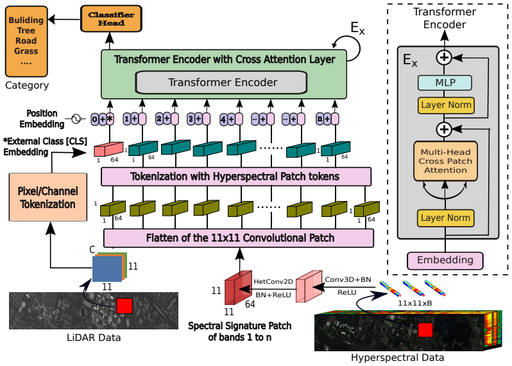
Fig. 1 : Graphical representation of the proposed multimodal fusion transformer network for HSI and LiDAR data fusion.
Original paper · CC BY 4.0 · Swalpa Kumar Roy, Ankur Deria, Danfeng Hong, Behnood Rasti, Antonio Plaza, Jocelyn Chanussot · Multimodal Fusion Transformer for Remote Sensing Image Classification · Original paper figure · Extracted the figure area from page 4 of the original PDF.Why the classification token needs another sensor
Vision transformers and similar models classify through an extra classification token that starts from random values, and the authors say this token often fails to generalize well. The authors ask whether data from another sensor can give that token useful content in place of random values.
Hyperspectral imaging provides rich spectral and spatial information, but its very high spectral resolution often limits spatial resolution, and spectral aliasing then degrades classification in complex scenes. A LiDAR patch adds elevation, which separates objects that share a spectrum but sit at different heights, such as roads and roofs built from the same cement.
SAR, multispectral and DSM data offer further views of the same region that can complement the hyperspectral data.
The authors note that CNNs capture spatial context but model long dependencies across spectral bands poorly. Recurrent networks read the bands in order, but the authors point out that they cannot be trained concurrently when samples are limited. Transformers are therefore the chosen backbone, with the external classification token as the place where the auxiliary data enters.
Datasets and evaluation protocol
The experiments use four hyperspectral scenes, the University of Houston, Trento, MUUFL Gulfport and Augsburg, each paired with auxiliary data such as LiDAR, MS, SAR or DSM. Augsburg has seven land-cover classes, and its figure caption describes randomly selected 5% training and remaining 95% test samples. Training and test samples are disjoint in the reported experiments.
Results are given as overall accuracy, average accuracy and the kappa coefficient, each reported as a mean with a standard deviation over runs. The baselines are KNN, RF and SVM as conventional classifiers, CNN1D, CNN2D, CNN3D and RNN as classical networks, and ViT and SpectralFormer as transformers.
From HSI cube and auxiliary patch to tokens
The HSI cube of size 11 × 11 × B first passes through a Conv3D layer with 3 × 3 × 9 kernels and padding (1, 1, 0), which keeps the spatial height and width unchanged. A HetConv2D layer then runs a group-wise 3 × 3 convolution with four groups and a point-wise 1 × 1 convolution in parallel, and adds their outputs element-wise, as the following equation shows.
\[ X_{out}=\mathrm{Conv2D}(X_{in},k=(3,3),s=1,g=4,p=1)\oplus\mathrm{Conv2D}(X_{in},k=(1,1),s=1,g=1,p=1) \] The Conv3D output has size 8 × 11 × 11 × (B − 8) and the HetConv2D output has size 11 × 11 × 64, with batch normalization and ReLU after each layer.
The 121 spatial positions of the feature maps are flattened into 64-dimensional vectors, and learned weights select n patch tokens from them. The weights are applied as follows. \[ X_{HWa}=\mathrm{softmax}\big(T(X_{Hflat}W_{a}^{H})\big),\qquad X_{HWb}=X_{Hflat}W_{b}^{H},\qquad X_{Hpatch}=X_{HWa}\,X_{HWb} \] The softmax runs over the 121 positions for each of the n tokens, so each HSI patch token is a weighted mixture of the flattened features after a second learned projection.
The auxiliary patch of size 11 × 11 × C passes through a Conv2D layer with kernel size 3 and padding 1, then batch normalization, a GELU and a tokenizer. The pixel tokenizer reduces the convolution output to one channel, and the channel tokenizer keeps 64 channels; both end in one 1 × 64 CLS token. \[ X_{Lconv}=T\big(\mathrm{Flatten}(\mathrm{Conv2D}(X_{Lpatch}))\big),\qquad X_{LWa}=\mathrm{softmax}\big(T(X_{Lconv}W_{a}^{L})\big),\qquad X_{LWb}=X_{Lconv}W_{b}^{L},\qquad X_{Lcls}=X_{LWa}\,X_{LWb} \] Figure 2 contrasts the two tokenizer variants.
The CLS token is placed in front of the n HSI patch tokens, giving n + 1 tokens of width 64. Learnable position embeddings are added to all n + 1 tokens, and a dropout layer with rate 0.1 follows. \[ \hat{X}_{HL}=DP\big(X_{Lcls}\oplus PE\,\|\,X_{Hpatch}\oplus PE\big) \]
How mCrossPA fuses the CLS token with HSI patches
Each encoder block has two residual sub-blocks: layer normalization followed by mCrossPA, and layer normalization followed by an MLP. The attention sub-block adds its output to its own input, and the MLP sub-block does the same for the output of the attention step.
In mCrossPA the query is the auxiliary CLS token, while the keys and values are computed from the full token matrix, which contains the CLS token and the HSI patch tokens. The attention and projection are written as follows. \[ Z=\mathrm{softmax}\!\left(\frac{QK^{T}}{\sqrt{h_d}}\right),\qquad \mathrm{CrossPA}(X_{HL})=DP(W_{l}ZV) \] The number of heads is set to 8, and the per-head dimension h_d equals the embedding dimension divided by the number of heads.
Because the query comes from the auxiliary token, its attention weights decide which HSI patch tokens the CLS token reads and in what proportion. Figure 3 shows the module for a LiDAR CLS token and HSI patch tokens.
Inside each block the residual output is formed by broadcasting the attention result to the token shape and adding the input tokens. \[ y'_{cls}=\mathrm{mCrossPA}(LN(X_{HL_{k-1}})),\qquad y_k=f(y'_{cls})\oplus[\hat{X}_{Lcls}\,\|\,\hat{X}_{Hpatch}],\qquad X_{HL_k}=y_k\oplus MLP(LN(y_k)) \] The first row of the last block's output, ycls, is fed to the classifier head.
Houston results with HSI alone and with LiDAR
With HSI only, MFT reached a mean OA of 88.45%, AA of 90.05% and kappa of 87.46%, with standard deviations of 0.28, 0.14 and 0.09. In the same HSI-only table ViT reached 83.23 OA and SpectralFormer 76.35 OA, while RF was the best conventional classifier at 74.87 OA.
With HSI and LiDAR, MFT reached a mean OA of 89.80, AA of 91.51 and kappa of 88.93, with standard deviations of 0.53, 0.40 and 0.59. ViT reached 85.05 OA in that table, and the classical networks rose substantially compared with the HSI-only case. The OA increase over the HSI-only result is 1.35%, which the paper does not describe as significantly larger than the gains of the other models.
The authors note that most traditional fusion methods scored lower with MS than with HSI alone, the opposite of the LiDAR case.
Trento, MUUFL and Augsburg results
The authors say MFT performs better than ViT on these scenes, but the improvement is not large at bigger training sizes.
Augsburg is a harder scene, and the gain from fusion is small for most models. With HS image data only, MFT reached 90.26 OA and 62.78 AA. With HSI and SAR MFT reached 90.49 OA and 60.36 AA, and with HSI and DSM it reached 90.49 OA and 64.70 AA. The authors report that the AA of 64.70 with HSI and DSM is the highest recorded among all models in all three Augsburg cases.
Patch size and tokenizer checks
A 9×9 window gives higher values on UT, MUUFL and Augsburg, but the authors say it is not satisfactory on UH with LiDAR. Windows of 13×13 and 15×15 reduce performance, which the authors attribute to the extra redundancy of larger windows.
Pixel and channel tokenization perform similarly overall, and channel tokenization narrowly exceeds pixel tokenization.
The ablations here vary only the tokenizer and the patch size, so the separate contribution of mCrossPA is not isolated by these experiments.
Parameters and FLOPs against ViT
The paper compares overall accuracy, parameter count and FLOPs against other transformer networks across six dataset settings. On Trento and MUUFL with HSI and LiDAR, MFT uses fewer parameters and FLOPs than ViT, the second-best model in accuracy. In the other settings MFT has more parameters and FLOPs, and the authors argue that the accuracy gain, such as the 8.66% OA increase over ViT with HSI and MS, justifies the trade-off.
Limitations
On Houston with HSI and LiDAR, the 1.35% OA increase is described as not significantly better than the gains of the other models. On Augsburg most models gain little from fusion, which limits what the scene shows about the fusion itself.
The advantage in parameters and FLOPs holds only on Trento and MUUFL with HSI and LiDAR; elsewhere MFT is heavier than the compared models. Gains over ViT on Trento and MUUFL are described as small at larger training sizes. The ablations cover the tokenizer variant and the patch size only. The number of selected HSI patch tokens n is kept as a symbol in the method description.
Paper info
- Authors
- Swalpa Kumar Roy, Ankur Deria, Danfeng Hong, Behnood Rasti, Antonio Plaza, Jocelyn Chanussot
- Venue
- arXiv · Preprint
- First published
- 2022-3-31
- Added
- 2026-11-6
- Updated
- 2023-6-20
- Version
- v2
- arXiv
- 2203.16952
- DOI
- 10.1109/tgrs.2023.3286826
- Category
- cs.CV · cs.LG · eess.IV
- Original paper terms
- CC BY 4.0
- What we show
- Paper info, commentary and permitted figures from the original paper
AI commentary is a separate explanation from the original paper and may contain errors. The original paper and figures follow each source's terms of use and any rights noted separately.
Abstract
Vision transformers (ViTs) have been trending in image classification tasks due to their promising performance when compared to convolutional neural networks (CNNs). As a result, many researchers have tried to incorporate ViTs in hyperspectral image (HSI) classification tasks. To achieve satisfactory performance, close to that of CNNs, transformers need fewer parameters. ViTs and other similar transformers use an external classification (CLS) token which is randomly initialized and often fails to generalize well, whereas other sources of multimodal datasets, such as light detection and ranging (LiDAR) offer the potential to improve these models by means of a CLS. In this paper, we introduce a new multimodal fusion transformer (MFT) network which comprises a multihead cross patch attention (mCrossPA) for HSI land-cover classification. Our mCrossPA utilizes other sources of complementary information in addition to the HSI in the transformer encoder to achieve better generalization. The concept of tokenization is used to generate CLS and HSI patch tokens, helping to learn a {distinctive representation} in a reduced and hierarchical feature space. Extensive experiments are carried out on {widely used benchmark} datasets {i.e.,} the University of Houston, Trento, University of Southern Mississippi Gulfpark (MUUFL), and Augsburg. We compare the results of the proposed MFT model with other state-of-the-art transformers, classical CNNs, and conventional classifiers models. The superior performance achieved by the proposed model is due to the use of multihead cross patch attention. The source code will be made available publicly at \url{https://github.com/AnkurDeria/MFT}.}
Quote from the paper
Swalpa Kumar Roy, Ankur Deria, Danfeng Hong, Behnood Rasti, Antonio Plaza, Jocelyn Chanussot (2022). Multimodal Fusion Transformer for Remote Sensing Image Classification. arXiv:2203.16952v2. https://doi.org/10.1109/tgrs.2023.3286826
BibTeX
@article{roy2022multimodal,
  title = {{Multimodal Fusion Transformer for Remote Sensing Image Classification}},
  author = {Swalpa Kumar Roy and Ankur Deria and Danfeng Hong and Behnood Rasti and Antonio Plaza and Jocelyn Chanussot},
  year = {2022},
  eprint = {2203.16952},
  archivePrefix = {arXiv},
  doi = {10.1109/tgrs.2023.3286826},
  url = {https://arxiv.org/abs/2203.16952v2}
}