Paper commentary
How Deterministic SAST and AI Security Agents Divide the Work: Coverage, Harness Policy and Cost in Snyk VulnBench 2.0
Snyk Code and AI review agents each miss different vulnerabilities in the same code
- Problem Earlier comparisons scored raw language models or tool-derived labels, not the packaged security tools teams actually run. Those labels can favor the tool that produced them.
- Method The authors run packaged harnesses on curated attacker-reachable flows and credit only findings that name both endpoints.
- Results Snyk Code matched 89 of 108 vulnerabilities and Claude Code with Opus 5 matched 85. Together they reached 101 of 108.
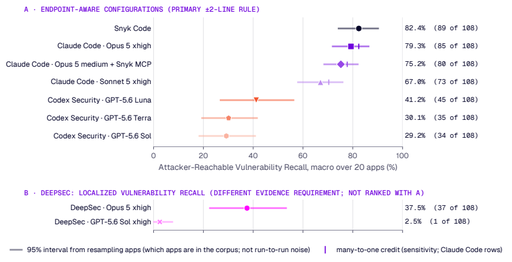
Figure 1 : Main recall results. (A) The seven endpoint-aware configurations: macro Attacker- Reachable Vulnerability Recall with the matched count. The horizontal bar is a 95% interval from resampling the 20 applications; it shows how much the score depends on which applications are in the corpus, not run-to-run variation (Snyk Code’s output was identical across three runs, Section 6). The tick on the Claude Code rows marks the score under many-to-one credit, a sensitivity check (Section 6); the Codex Security configurations gain at most 3 matches under it and are not marked. (B) DeepSec, scored with localized recall, on its own axis. The top two cannot be separated: they disagree on 28 vulnerabilities, 16 vs 12 (McNemarp= 0.57, descriptive).
Original paper · CC BY 4.0 · Liran Tal, Chris Liu, Charlotte Fereday, Sebastian Roth, Brian Clark · How Deterministic SAST and AI Security Agents Divide the Work: Coverage, Harness Policy and Cost in Snyk VulnBench 2.0 · Original paper figure · Extracted the figure area from page 9 of the original PDF.Why SAST and AI reviews are hard to compare
Teams now choose between deterministic static analyzers and AI agents that review code for security flaws. Those studies mostly called language models directly instead of scoring the packaged tools that teams actually run. Examples of such packaged tools include an agent's built-in review command and a vendor's scanning harness. Their ground truth was either derived from a tool's own output or limited to one language, which can favor the tool that produced the labels.
The authors' predecessor, VulnBench JS 1.0, measured how repeatably Claude Code found vulnerabilities in ten small JavaScript applications. Its reference set is not derived from any tool's findings, and every vulnerability carries an annotated source-to-sink flow.
The question this section raises is what an AI review finds beyond SAST, and what it misses that SAST catches. Answering it needs both engines scored on the same ground truth, under the same blind protocol.
A reference set no tool produced
The ground truth starts from curated vulnerabilities rather than from anything a scanner reported. The reference set was built from two origins, intentionally vulnerable demonstration applications and vulnerabilities seeded with an AI coding assistant.
Every entry is attacker-reachable, so outside input reaches a dangerous operation without being neutralized. Of these, 62 flow across more than one file and 46 stay within a single file. Go has 32 vulnerabilities in six applications, JavaScript and TypeScript have 30 in seven, Python has 34 in five and Java has 12 in two.
One finding is credited to at most one vulnerability, so a single report can't cover several reference entries under the primary rule. The scorer uses the frozen snapshot from the run manifest, which matches the public answer files for 19 of the 20 applications. The iguana answer file now carries a correction described in Section 7.2. A reported finding that matches no reference vulnerability sits outside the reference set and isn't necessarily wrong.
Snyk Code served as the deterministic SAST baseline, run through its command-line interface with no prompt. The authors note that the reference set may omit real vulnerabilities, so precision is reported as a lower bound.
What each configuration runs
The study scores nine configurations, and each one counts as a complete harness and model combination rather than as a model alone. Snyk Code is the deterministic baseline, and it runs through its command-line interface with no prompt at all. The Snyk Code CLI version is 1.1305.1, which the operator reported after the run. The Claude Code runs use the built-in security-review command through the Claude Agent SDK, with Claude Code 2.1.251 as the harness version.
Three Claude Code variants change the model and reasoning effort: Opus 5 at xhigh, Sonnet 5 at xhigh, and Opus 5 at medium with the Snyk MCP server. In the MCP variant, the agent must call snyk_code_scan exactly once, so it receives Snyk Code's findings but not what Snyk Code analyzed. Each Claude Code run gets the benchmark's system prompt, and the user turn is replaced by the security-review command.
The Claude Code configurations are limited to 30 turns, which is the budget the authors set for them.
Codex Security runs in its standard, report-only, full-repository mode, with GPT-5.6 Luna, Terra or Sol at xhigh effort. Codex Security uses its own built-in scan instructions, so the benchmark prompt isn't passed to it. DeepSec first runs a model-free scan stage, and then a model processes the files it selected and exports the results. The DeepSec version is 2.3.7, and the Codex Security version is 0.1.24 with plugin 0.1.79.
Because each configuration runs with its own instructions, the authors hold the reference set fixed across all of them. The authors paraphrase the vendors' built-in prompts rather than reproduce them, and they reproduce the benchmark's own prompts in an appendix.
Where the two engines overlap and where they split
Snyk Code matched 89 of 108 reference vulnerabilities, a macro recall of 82.4%, while Claude Code with Opus 5 at xhigh effort matched 85 of 108, or 79.3%. The two engines disagree on 28 vulnerabilities, with 16 matched only by Snyk Code and 12 matched only by Opus 5 xhigh. The McNemar test gives p = 0.57 for that split, which is too weak to separate the two at this corpus size.
A split that close would need a much larger corpus before it could indicate a real difference, so the result doesn't show that the two are equal.
The ceiling is where the two engines together stop adding anything. Snyk Code and Opus 5 xhigh together match 101 of 108 vulnerabilities, which equals the union of all seven endpoint-aware configurations. Snyk Code is the only endpoint-aware configuration with unique coverage, with 10 vulnerabilities that no other one matched. Under many-to-one credit that unique count falls to 5, and the best AI pair rises to 93, while the combined union still holds at 101.
Opus 5 xhigh adds 12 vulnerabilities that Snyk Code missed, and 7 of those 12 are cross-file, including IDOR and mass-assignment cases. Snyk Code adds 16 vulnerabilities that Opus 5 xhigh missed, but only 3 of those are cross-file, led by open redirect. Snyk Code matched all 11 open redirects, which is why its open-redirect coverage stands out against the AI configurations.
Snyk Code's weaker cross-file recall comes mostly from cross-site scripting.
Whether the review policy or the model drives the gap
The question is whether the built-in review policy or the model itself produces the gap in the policy classes. On the 20 reference vulnerabilities in those classes, Snyk Code matched 18, while Opus 5 at xhigh matched 9. On the other 81 vulnerabilities, Opus 5 xhigh matched 71 and Snyk Code matched 67. The authors read that pattern as the policy at work, rather than a general weakness of the model.
The authors ran a prompt-swap control: Opus 5 at the same xhigh effort, with the benchmark's default audit prompt replacing the security-review command. It ran on 19 of the 20 applications, because one application failed twice and contains none of the policy-class vulnerabilities. The control matched 16 of the 20 policy-class vulnerabilities, against 9 with the security-review command.
On the other non-React and non-Angular vulnerabilities, the control matched 71 while the command matched 69 of 78, a 2.6 percentage point gap. Per class, the control matched 9 of 11 open redirects, against 5, and 2 of 3 ReDoS cases, against none.
On the vulnerabilities where the two disagreed in the policy classes, 7 favored the control and 0 favored the command (McNemar p = 0.016, descriptive). The outcome threshold for "supported" was fixed before the per-class analysis, and the result met it. Each arm is a single run taken about a month after the main runs, so the authors can't rule out changes on the model provider's side.
The policy also carries a cost, because the control matched 93 of 105 vulnerabilities at 0.63 times the cost, against 83 for the command.
Why Codex Security loses matches to the line rule
Matching by class alone would reach 88, though that number ignores location and is only an upper bound. So the gap is mostly about where the finding points, not about whether the model saw the flaw. The paper's section 3 finds the same pattern: the three Codex Security configurations matched between 34 and 45 vulnerabilities, and much of that gap comes from the reported line.
Of the 41 cases where that location was not also a source, 39 sat above the curated sink, with a median offset of six lines.
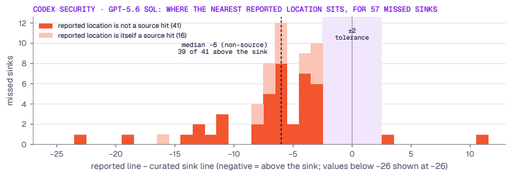
Figure 7 : Codex Security with GPT-5.6 Sol: for each of the 57 missed curated sinks with a reported location in the same file, the offset of the nearest reported location from the sink line (negative means above). Lighter bars are reported locations that are themselves a curated source, for which “above” is expected; among the other 41, 39 lie above the sink, median six lines. The shaded band is the two-line tolerance.
Original paper · CC BY 4.0Listing 1 shows a typical case in the conduit application, in the file conduit/articles/pdf.py. Codex Security with GPT-5.6 Sol reported line 10, the function header, while the curated sink sits at line 16, six lines below.
The tolerance curve in Figure 8 shows how much of this score depends on the two-line choice.
How DeepSec's file selection caps recall
DeepSec's recall is capped before its model ever runs, because a model-free scan stage decides which files the model sees.
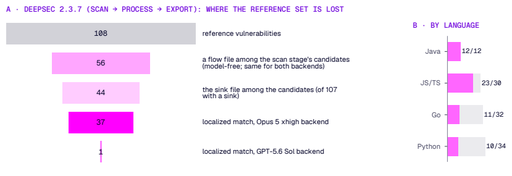
Figure 9 : Where DeepSec 2.3.7 loses the reference set. (A) Of 108 reference vulnerabilities, 56 had a flow file among the scan stage’s candidates (model-free, identical for both backends) and 44 had their sink file there; localized matches follow for each backend. (B) Candidate coverage by language family. Localized recall is DeepSec’s primary metric and is not comparable with Attacker-Reachable Vulnerability Recall.
Original paper · CC BY 4.0Neither backend matched a vulnerability whose files the scan had not selected, so the ceiling holds regardless of model. Conditional on selection, the Opus 5 backend localized 37 of 56 vulnerabilities, while the GPT-5.6 Sol backend localized 1 of 56. The records don't show whether this reflects the backend's behavior inside DeepSec or an integration problem.
So the row describes the DeepSec 2.3.7 configuration as run, and it says nothing about the model alone. Localized recall is DeepSec's primary metric, so the paper reports it separately and doesn't rank it with the other configurations.
Time and cost against coverage
Spending more on a configuration didn't buy more coverage in this study, and the time gap was the sharpest contrast. Snyk Code scanned all 20 applications in 8 minutes, while the comparable AI configurations took between 2.4 and 8.9 hours. Snyk Code and the AI configurations ran under different harnesses, so the time gap reflects the whole configuration, not the model alone.
The authors call that ratio a single observation, since token use for the same task can vary widely between runs.
Those ratios come from single runs per configuration and application, so they carry no known spread. Combining the engines carries a cost of its own, because Snyk Code and Opus 5 xhigh together report 539 findings for their 101 matches. That triage queue is part of the price of running both engines.
Whether the ranking survives other scoring rules
The ranking was tested by rescoring the same saved outputs under 20 alternative scoring rules. DeepSec is left out of this check because it reports no endpoint roles. Snyk Code and Opus 5 xhigh stayed the top two under all 20 rules, while the middle of the table moved. Kendall's tau measures how closely each rule's order agrees with the main ordering.
Macro and micro recall gave the same order for all seven endpoint-aware configurations.
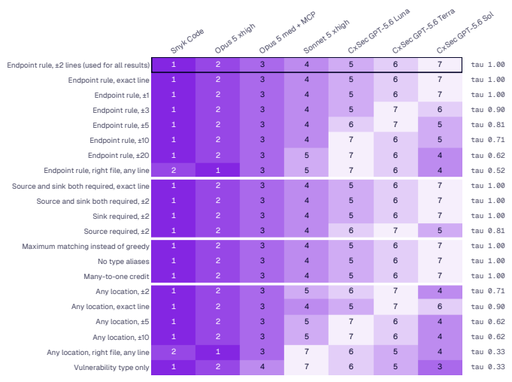
Figure 12 : Rank of each endpoint-aware configuration by macro recall under the scoring rule used for all results (outlined row) and 20 alternative rules, grouped as line tolerance, endpoint roles, matching and credit, and location-only or type-only rules. The right column gives Kendall’sτ against the outlined row. All alternatives rescore the same saved outputs; DeepSec is excluded because it reports no endpoint roles.
Original paper · CC BY 4.0Replacing greedy matching with maximum matching changed no configuration's count. Removing the reference set's alternative class names changed one match, from 34 to 33 for GPT-5.6 Sol. Under many-to-one credit, Opus 5 xhigh rose from 85 to 89 matches, equal to Snyk Code's unchanged 89. The macro order didn't change under that credit rule.
The rescoring shows which conclusions survive a change in the scoring rule. It doesn't add statistical power, and 108 reference vulnerabilities in 20 applications can't separate closely matched configurations. The alternative rules were computed by the authors' own port of the scorer. That port reproduces every recorded scoring decision of the harness.
Which conclusions this design can't settle
Run-to-run variation is the first gap, because each of the 180 cells ran once. Five failed attempts preceded a scored success in 4 of the 180 runs, and three of those had been marked not retryable. Snyk Code's repeatability was checked in two supplementary repetitions, returning byte-identical findings and the same 89 matches each time.
The reference set can omit real vulnerabilities, so measured precision is a lower bound. Section 3.6 confirms at least seven omitted vulnerabilities, and the reference set covers only 14 classes. One iguana defect is corrected in the harness, which raises Opus 5 xhigh from 85 to 86, but every result uses the frozen set.
Snyk Code helped seed the reference set only as a format and naming reference, and the authors can't verify that every seeded flaw followed the instruction to keep undetected flaws. Some seeding prompts drew on examples from a Snyk vulnerability database, which could favor Snyk Code. The seeding model for each application was not recorded, so the pull toward the AI configurations can't be tested.
Without the five applications used in Snyk demonstrations, Snyk Code matches 74 and Opus 5 xhigh matches 72 of the remaining 87, but the net direction of these biases is unknown.
The design can't separate the harness from the model, because each result belongs to a full configuration. Snyk Code is the only deterministic engine evaluated, so statements about SAST hold for Snyk Code and may not hold for other engines. Java is thin at 2 applications and 12 vulnerabilities, and how these results carry over to production code is untested.
Paper info
- Authors
- Liran Tal, Chris Liu, Charlotte Fereday, Sebastian Roth, Brian Clark
- Venue
- arXiv · Preprint
- First published
- 2026-10-28
- Added
- 2026-11-1
- Updated
- 2026-10-28
- Version
- v1
- arXiv
- 2610.38617
- Category
- cs.CR · cs.AI · cs.SE
- Original paper terms
- CC BY 4.0
- What we show
- Paper info, commentary and permitted figures from the original paper
AI commentary is a separate explanation from the original paper and may contain errors. The original paper and figures follow each source's terms of use and any rights noted separately.
Abstract
We ask what AI coding agents and AI security harnesses find that deterministic static application security testing (SAST) does not, and what they miss that SAST catches. VulnBench 2.0 is a benchmark of 108 hand-curated, attacker-reachable vulnerabilities in 20 open-source web applications in Go, JavaScript/TypeScript, Python and Java; 62 flow across more than one file. A finding is credited only if it locates the vulnerability's attacker-controlled source and its dangerous sink, each within two lines. We evaluate nine productized configurations under one blind protocol: the Snyk Code static analyzer, Claude Code's /security-review with three model and effort settings (one with the Snyk MCP server), Codex Security with GPT-5.6 Luna, Terra and Sol, and the DeepSec scanner with two model backends. Snyk Code reached 82.4% macro recall (89 of 108) and Claude Code with Opus 5 at xhigh effort 79.3% (85 of 108); they disagree on 28 vulnerabilities, split 16 to 12, too few to tell them apart. Neither engine was sufficient alone: together they reached 101 of 108, the ceiling of all seven comparable configurations combined, and the AI configurations also reported at least seven real vulnerabilities that the reference set did not contain and Snyk Code did not report. What an AI engine misses depends on its harness as much as on its model: without Claude Code's built-in review policy, the same model matched 16 instead of 9 of the 20 vulnerabilities in the classes that policy excludes or restricts (supplementary run on 19 of 20 applications); Codex Security with GPT-5.6 Sol located 80 vulnerabilities at file level but 34 at line level; DeepSec's model-free file selection kept a file from only 56 of the 108 flows. Coverage and cost were only loosely related. The harness, fixtures, reference sets and all run data are public.
Quote from the paper
Liran Tal, Chris Liu, Charlotte Fereday, Sebastian Roth, Brian Clark (2026). How Deterministic SAST and AI Security Agents Divide the Work: Coverage, Harness Policy and Cost in Snyk VulnBench 2.0. arXiv:2610.38617v1. https://arxiv.org/abs/2610.38617v1
BibTeX
@misc{tal2026deterministic,
  title = {{How Deterministic SAST and AI Security Agents Divide the Work: Coverage, Harness Policy and Cost in Snyk VulnBench 2.0}},
  author = {Liran Tal and Chris Liu and Charlotte Fereday and Sebastian Roth and Brian Clark},
  year = {2026},
  eprint = {2610.38617},
  archivePrefix = {arXiv},
  url = {https://arxiv.org/abs/2610.38617v1}
}