Paper commentary
Multi-Objective Causal Bandits: Minimal Intervention Space and Policy-Level Learning
- Problem Pairwise Pareto comparisons can miss actions that only a randomized policy over other actions dominates, so a multi-objective causal bandit learner may keep interventions that can never support the achievable Pareto frontier.
- Method Graph procedure that keeps only candidate intervention sets that can be Pareto-optimal under some compatible SCM, followed by an online UCB learner that eliminates an arm only when a convex combination of other active arms dominates it in every objective.
- Results In the three-action example, the convex-combination learner eliminated do() in every one of 50 runs, at a mean elimination round of 12,941.52 ± 1,582.26, while the pairwise-dominance ablation never eliminated it.
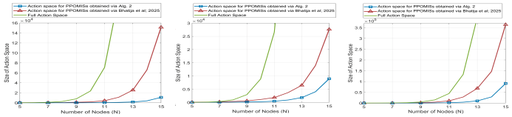
Figure 6 : Comparison of the size of the action space for random causal graphs.
Original paper · CC BY 4.0 · Muhammad Qasim Elahi, Mahsa Ghasemi, Murat Kocaoglu · Multi-Objective Causal Bandits: Minimal Intervention Space and Policy-Level Learning · Original paper figure · Extracted the figure area from page 10 of the original PDF.Why pairwise dominance is not enough
Most multi-objective bandit methods judge each action against the others one pair at a time, either through Pareto dominance of mean reward vectors or through a fixed linear scalarization. A randomized policy that mixes several actions can reach reward vectors that no single action reaches, so the set of achievable outcomes is the convex hull of the action-level mean vectors.
In a five-action illustration, every action survives pairwise comparison, yet only three of them lie on the policy-level frontier, and the other two are dominated by mixtures of the rest. The intervention do() is not on the frontier because mixing do(X1 = 0) with weight 1 minus lambda and do(X1 = 1) with weight lambda strictly dominates it for lambda between 1/4 and 1/2.
The same structural fact changes the learning problem as well: a constrained objective may be feasible and optimal only under a randomized policy, which action-level constrained methods do not represent.
Which intervention sets remain candidates
The starting point is the minimal intervention set, which is a set that no proper subset can match or beat on every reward mean for every compatible model. Graphically, a set X is minimal exactly when it lies inside the ancestors of the reward nodes in the post-interventional graph G_X. A possibly Pareto-optimal minimal intervention set is a minimal intervention set for which some compatible SCM and some intervention on it leave no other minimal set able to match its reward means in every objective.
The model class assumes that intervenable variables are discrete and that the reward nodes are binary and not intervenable. A prior characterization by Bhatija et al. (2025) identifies a set W as a candidate if the interventional border of the post-interventional graph equals W, and the authors show by counterexample that this sufficiency direction fails.
In one example, the set {X1, X3} passes that test, yet after fixing X3 an intervention on X2 matches or improves the reward on Y1 without changing the reward on Y2, so {X1, X3} is not a valid candidate.
The authors' procedure starts from the reward nodes and repeatedly adds confounded ancestors into a territory, projecting the graph after each round until no reward is confounded with its own ancestors. When that base case holds, the parents of the remaining reward nodes form the candidate set, and the union of the removed territories gives the MUCT.
The authors prove that a set W is a candidate if and only if running this procedure on the graph with W removed returns W, and a recursive enumeration then lists all candidates.
Eliminating arms against mixtures
The learner keeps an active set of arms and, for each active arm and each reward objective, builds an upper and a lower confidence bound from the empirical mean and a Hoeffding-type radius that shrinks with the number of pulls. The confidence radius uses a logarithmic term; in the horizon-dependent version it is set through a union bound over arms, objectives and rounds, and in the anytime version through a summable sequence of confidence levels.
An arm a is removed when there are nonnegative weights summing to one over the other active arms whose weighted lower bounds exceed the upper bound of a in every objective. Because the test uses mixtures of other arms, an arm can be removed even when no single other arm beats it in every objective, which pairwise elimination cannot do. Each round the learner plays the least-sampled arm among those still active, so that the confidence radii of the remaining arms keep shrinking.
How regret scales with the gaps
For each non-Pareto-optimal arm a, the elimination gap is the largest, over weights on the Pareto-optimal arms, of the smallest objective margin by which that mixture beats a. Under the good event, arm a can remain active only until its pull count reaches a threshold of eight times the logarithmic term divided by the squared elimination gap.
With probability at least 1 minus delta, the cumulative Pareto regret is bounded by a sum, over non-Pareto-optimal arms, of the regret gap of each arm divided by its squared elimination gap, times a logarithmic factor in T, and the Pareto-optimal arms are never eliminated. The termination rule that certifies the Pareto-optimal set depends on the unknown minimum gap, so in practice a conservative lower bound replaces it.
Constrained learning over distributions
The constrained objective maximizes the expectation of one reward subject to a bound on another, for example maximizing the expected Y2 subject to the expected Y1 being at least 0.25. The learner solves a linear program over distributions on interventions using optimistic estimates of the reward means, and the offline benchmark solves the same type of program with the true means.
Under the good event, every distribution feasible for the benchmark program is also feasible for the optimistic program, so the benchmark optimum remains available to the learner.
The per-round quantity is the larger of an objective gap and a constraint-violation term, and it is at most the maximum of the norm of the objective vector c and the norm of the constraint bound b. Under the good event with delta set to 1 over T, the expected regret is bounded by a constant times the square root of kT times a logarithmic term, plus a constant alpha equal to the maximum of the 1-norm of c and the 1-norm of b.
Convex-combination elimination against pairwise elimination
The comparison uses the Figure 1(b) structural model, the same three-action set, the same confidence bounds and the same least-sampled selection rule, and differs only in the elimination test.
This experiment supports the claim that the mixture test removes a policy-level suboptimal arm that pairwise dominance keeps, in this one three-action model.
Size of the candidate action space
The naive baseline contains every intervention on subsets of the non-reward ancestors, so with binary variables its size is 3 raised to the number of such ancestors.
Limitations
The model class assumes discrete intervenable variables and binary reward nodes that cannot be intervened on. The anytime termination time depends on the unknown minimum gap, which is replaced by a lower bound in practice. The reported experiments are one three-action structural model and random graphs with binary variables and three reward nodes, and the constrained bound holds only on the good event with delta set to 1 over T.
Paper info
- Authors
- Muhammad Qasim Elahi, Mahsa Ghasemi, Murat Kocaoglu
- Venue
- arXiv · Preprint
- First published
- 2026-11-14
- Added
- 2026-11-17
- Updated
- 2026-11-14
- Version
- v1
- arXiv
- 2611.19634
- Category
- cs.LG
- Original paper terms
- CC BY 4.0
- What we show
- Paper info, commentary and permitted figures from the original paper
AI commentary is a separate explanation from the original paper and may contain errors. The original paper and figures follow each source's terms of use and any rights noted separately.
Abstract
Many decision-making problems involve multiple objectives, where actions affect several performance metrics, fairness criteria, or safety constraints. We study multi-objective causal bandits with multiple reward nodes, where actions correspond to interventions on subsets of variables in a causal graph and performance is evaluated through Pareto optimality. Existing approaches to multi-objective bandits often rely on pairwise Pareto dominance or optimize a fixed scalarization. However, pairwise comparisons alone can fail to identify actions dominated by randomized policies, whose expected reward vectors lie in the convex hull of action-level rewards. Thus, an intervention may be suboptimal even if no single intervention dominates it, because it can be dominated by a randomized policy over other interventions. We formalize this policy-level phenomenon and show that it has consequences for both causal action-space reduction and online learning. First, we provide a necessary-and-sufficient graphical characterization of possibly Pareto- optimal minimal intervention sets. Our characterization yields a minimal, sound, and complete candidate intervention family from the graph alone, correcting prior formulations that may include intervention sets that are never Pareto-optimal under any compatible structural causal model. Second, over this reduced intervention space, we design an online UCB-style algorithm that eliminates actions using dominance tests against convex combinations of other actions, and prove logarithmic gap-dependent Pareto regret. Finally, we study constrained multi-objective causal bandits, where feasibility and optimality may be realized only with randomized policies, and develop an online UCB-style constrained bandit algorithm with sublinear regret and constraint-violation guarantees.
Quote from the paper
Muhammad Qasim Elahi, Mahsa Ghasemi, Murat Kocaoglu (2026). Multi-Objective Causal Bandits: Minimal Intervention Space and Policy-Level Learning. arXiv:2611.19634v1. https://arxiv.org/abs/2611.19634v1
BibTeX
@misc{elahi2026multi,
  title = {{Multi-Objective Causal Bandits: Minimal Intervention Space and Policy-Level Learning}},
  author = {Muhammad Qasim Elahi and Mahsa Ghasemi and Murat Kocaoglu},
  year = {2026},
  eprint = {2611.19634},
  archivePrefix = {arXiv},
  url = {https://arxiv.org/abs/2611.19634v1}
}