Paper commentary
Rethinking RGB-D Salient Object Detection: Models, Data Sets, and Large-Scale Benchmarks
- Problem RGB-D salient object detection depends on depth maps that can be low quality, and results are hard to compare because benchmarks are small and metrics are applied inconsistently.
- Method Trains three parallel VGG-16 pyramid streams on RGB, RGB-D and depth inputs, then chooses between the RGB-D and RGB predictions at test time by checking how closely the depth-only prediction agrees with the RGB-D prediction.
- Results D3Net reaches an S-measure of 0.900 on the NJU2K test set, against 0.879 for CPFP in the same table.
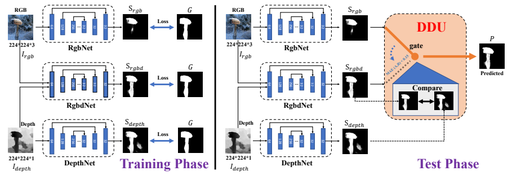
Figure 5 . Illustration of the proposed D 3Net. In the training stage (Left), the input RGB and depth images are processed with three parallel sub-networks, e.g., RgbNet, RgbdNet, and DepthNet. The three sub-networks are based on a same modified structure of Feature Pyramid Networks (FPN) (see § IV-A for details). We introduced these sub-networks to obtain three saliency maps ( i.e., Srgb, Srgbd, and Sdepth ) which considered both coarse and fine details of the input. In the test phase (Right), a novel depth depurator unit (DDU) ( § IV-B) is utilized for the first time in this work to explicitly discard ( i.e., Srgbd) or keep ( i.e., Srgbd) the saliency map introduced by the depth map. In the training/test phase, these components form a nested structure and are elaborately designed ( e.g., gate connection in DDU) to automatically learn the salient object from the RGB image and Depth image jointly.
Original paper · CC BY 4.0 · Deng-Ping Fan, Zheng Lin, Jia-Xing Zhao, Yun Liu, Zhao Zhang, Qibin Hou, Menglong Zhu, Ming-Ming Cheng · Rethinking RGB-D Salient Object Detection: Models, Data Sets, and Large-Scale Benchmarks · Original paper figure · Extracted the figure area from page 6 of the original PDF.Why RGB-D saliency needs a depth filter and a shared benchmark
Most RGB-D saliency models are tested on depth from Kinect, light field cameras or optical flow, which differ from the depth a smartphone camera produces. Depth helps identify salient objects, but a low-quality depth map often causes wrong detections, and most RGB-D models fuse depth with RGB without any step that drops a bad map.
Benchmarks are also thin: few datasets are used in each paper, which limits how far the results generalize. The F-measure is often reported without saying which statistic was taken or which threshold scheme was used, so scores from different papers cannot be compared fairly. The authors also argue that the three pixel-level metrics in common use, F-measure, MAE and the PR curve, give an incomplete picture of structure.
The study therefore asks two questions: whether a model can learn to discard a depth map when it is unhelpful, and how contemporary methods rank when they are all evaluated under one protocol.
The SIP dataset and how it was built
SIP contains 929 RGB-D images captured with a Huawei Mate 10, which records RGB and monochrome images and estimates the depth map on the device.
From 5,269 captured images, about 2,500 were first selected as containing one or more salient people. Six viewers drew bounding boxes around the most attention-grabbing person, a voting scheme kept the top 1,000 images, and five further annotators traced silhouettes inside those boxes before 929 images with high-quality ground truth remained.
Scenes contain up to five salient objects per image, and the counts are 591 images with one object, 159 with two and 179 with three or more. Normalized object size ranges from 0.48% to 66.85%, with an average of 20.43%. Compared with the earlier datasets, SIP and two small datasets show less center bias.
The three-stream feature learning module
Each of the three sub-networks, RgbNet, RgbdNet and DepthNet, has the same structure and receives a 224×224 input, differing only in its number of input channels. RgbNet takes the RGB image, DepthNet takes the depth map, and RgbdNet takes the four-channel combination of the two. Each sub-network produces a saliency map, Srgb, Srgbd or Sdepth, and the whole arrangement is shown in Figure 5.
The backbone is VGG-16, and a sixth layer with two 3×3 convolutions is added to capture deeper semantic information. The top-down path doubles the coarser feature map with nearest-neighbour upsampling, reduces the finer map with a 1×1 convolution, and merges the two by concatenation instead of the addition used in the original pyramid network.
The sub-networks are trained with a pixel-wise cross entropy loss, using the Adam optimizer with an initial learning rate of 1e-4, a batch size of 8 and 30 epochs on a GTX TITAN X. Training uses 1485 NJU2K image pairs and 700 NLPR image pairs, following the protocol of CPFP, and horizontal flipping is used for augmentation. The depth depurator unit is not used in training; it acts only at test time.
How the depth depurator unit picks an output
At test time the RGB and depth inputs are resized to the training size, and a comparison unit measures the distance between the depth-only map Sdepth and the RGB-D map Srgbd.
The authors reason that a high-quality depth map yields a depth-only prediction close to the RGB-D prediction, while a low-quality depth map pushes the two apart, so the gate falls back on the RGB stream. Because \(F_{cu}\) is a fixed switch rather than a learned weight, the authors leave an adaptive weighting for future work.
The threshold was tested over 0.01, 0.02, 0.05, 0.10, 0.15 and 0.20, and t = 0.15 gave the best result. Without post-processing such as CRF, the computation takes about 0.015 s for a 224×224 image on the authors' platform.
Benchmark results under one protocol
The benchmark covers 18 models, 10 traditional and 8 CNN-based, on seven datasets, which the authors count as about 97K images in total. The test sets of NJU2K and NLPR are used, together with the full STERE, DES, SSD, LFSD and SIP datasets. The metrics are S-measure, F-measure, E-measure and MAE, and the PR curve, each computed with the same procedure for all models.
Across six datasets the authors report an improvement of 1.0% to 5.8% over CPFP, and on SIP they report 1.4%.
Among the traditional models, SE, MDSF and DCMC rank highest overall. Among deep models, D3Net, CPFP and TANet rank highest overall. In the qualitative comparison, CPFP, TANet and PCF often keep a distinct background or lose fine detail when the depth map is damaged, which the authors attribute to missing cross-modality learning.
Ablation of the depth depurator unit
Table V reports S-measure for RgbNet, RgbdNet and DepthNet without the gate, and for D3Net with the gate, on SIP and six other datasets. RgbdNet beats RgbNet on SIP (0.862 against 0.831), STERE, DES, LFSD, SSD and NJU2K, but not on NLPR, where RgbNet reaches 0.911 against 0.910. DepthNet alone reaches 0.862 on SIP, the same as RgbdNet, yet only 0.713 on STERE.
Adding the gate gives slightly higher S-measure than RgbdNet on STERE, DES, NJU2K and NLPR. On SIP and LFSD the gate gives slightly lower scores than RgbdNet, and on SSD the two are equal. The authors explain the SSD result as the gate matching the single RGB-D stream, and they note that the gate gains are small on most datasets.
The lower and upper bounds select the worse or better of the RgbNet and RgbdNet predictions for each input, giving 0.822 and 0.872 on SIP, against 0.860 for D3Net. Averaged over the datasets, D3Net stays about 1.6% below the upper bound.
Background changing as an application
A user uploads a candidate image, the saliency map from the model isolates the salient person, and a book cover template supplies the layout. The authors describe this as a prototype, and the paper's own illustration of the workflow is the demo in Figure 11 rather than a measured evaluation. The model runs at 65fps on a single GPU, which the authors give as the speed for the saliency step.
Limitations
The SIP dataset has fewer images than most RGB salient object detection datasets, and the authors plan to add harder cases and more kinds of foreground people. The three sub-networks may increase memory use on light-weight devices, and the authors suggest MobileNet V2, dimension reduction or ESPNet V2 as alternatives. The gate does not reach the upper bound on the current training subset, so a better gate remains open.
The runtime comparison is not on one platform for every model, because some timings were borrowed from original papers or provided by the authors.
Paper info
- Authors
- Deng-Ping Fan, Zheng Lin, Jia-Xing Zhao, Yun Liu, Zhao Zhang, Qibin Hou, Menglong Zhu, Ming-Ming Cheng
- Venue
- arXiv · Preprint
- First published
- 2019-7-15
- Added
- 2026-11-6
- Updated
- 2020-7-11
- Version
- v2
- arXiv
- 1907.06781
- DOI
- 10.1109/tnnls.2020.2996406
- Category
- cs.CV
- Original paper terms
- CC BY 4.0
- What we show
- Paper info, commentary and permitted figures from the original paper
AI commentary is a separate explanation from the original paper and may contain errors. The original paper and figures follow each source's terms of use and any rights noted separately.
Abstract
The use of RGB-D information for salient object detection has been extensively explored in recent years. However, relatively few efforts have been put towards modeling salient object detection in real-world human activity scenes with RGBD. In this work, we fill the gap by making the following contributions to RGB-D salient object detection. (1) We carefully collect a new SIP (salient person) dataset, which consists of ~1K high-resolution images that cover diverse real-world scenes from various viewpoints, poses, occlusions, illuminations, and backgrounds. (2) We conduct a large-scale (and, so far, the most comprehensive) benchmark comparing contemporary methods, which has long been missing in the field and can serve as a baseline for future research. We systematically summarize 32 popular models and evaluate 18 parts of 32 models on seven datasets containing a total of about 97K images. (3) We propose a simple general architecture, called Deep Depth-Depurator Network (D3Net). It consists of a depth depurator unit (DDU) and a three-stream feature learning module (FLM), which performs low-quality depth map filtering and cross-modal feature learning respectively. These components form a nested structure and are elaborately designed to be learned jointly. D3Net exceeds the performance of any prior contenders across all five metrics under consideration, thus serving as a strong model to advance research in this field. We also demonstrate that D3Net can be used to efficiently extract salient object masks from real scenes, enabling effective background changing application with a speed of 65fps on a single GPU. All the saliency maps, our new SIP dataset, the D3Net model, and the evaluation tools are publicly available at https://github.com/DengPingFan/D3NetBenchmark.
Quote from the paper
Deng-Ping Fan, Zheng Lin, Jia-Xing Zhao, Yun Liu, Zhao Zhang, Qibin Hou, Menglong Zhu, Ming-Ming Cheng (2019). Rethinking RGB-D Salient Object Detection: Models, Data Sets, and Large-Scale Benchmarks. arXiv:1907.06781v2. https://doi.org/10.1109/tnnls.2020.2996406
BibTeX
@article{fan2019rethinking,
  title = {{Rethinking RGB-D Salient Object Detection: Models, Data Sets, and Large-Scale Benchmarks}},
  author = {Deng-Ping Fan and Zheng Lin and Jia-Xing Zhao and Yun Liu and Zhao Zhang and Qibin Hou and Menglong Zhu and Ming-Ming Cheng},
  year = {2019},
  eprint = {1907.06781},
  archivePrefix = {arXiv},
  doi = {10.1109/tnnls.2020.2996406},
  url = {https://arxiv.org/abs/1907.06781v2}
}