Paper commentary
On the Limits of Sufficient Explanations
Sufficient explanations can be impossible on graphs and strings because of co-bounds
- Problem Sufficient explanations have been widely used on graphs and strings, but no unified formal analysis said when they can exist. Earlier work mostly covered fixed-size feature spaces, where sufficient explainers always exist.
- Method The authors model an explainer with a select relation on the instance space. A sufficient explainer exists exactly when no co-bounds exist, meaning no instance can be selected from a differently labeled instance.
- Results Nine of ten datasets contain co-bounds, and ENZYMES would need an 82% accuracy loss to remove them. Full sufficiency is unattainable on most datasets tested.
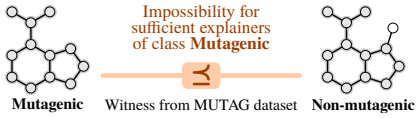
Figure 1 .A co-bound—a non-sufficiency witness—in the MUTAG dataset for subgraph-based explanations. The mutagenic molecule on the left is a subgraph of the non-mutagenic molecule on the right. Every subgraph of the mutagenic molecule also appears in the non-mutagenic molecule. Hence, a subgraph cannot explain the mutagenicity of this molecule sufficiently. 14% of all instances in MUTAG are co-bounds (see Table 1).
Original paper · CC BY 4.0 · Weinbauer, Klaus, Stadler, Peter F., Gärtner, Thomas, Malhotra, Sagar · On the Limits of Sufficient Explanations · Original paper figure · Extracted the figure area from page 2 of the original PDF.Why sufficiency is hard to pin down on structured data
Most formal analyses of sufficiency have focused on fixed-dimensional feature spaces, such as R^d and {0,1}^d, and on logical reasoning systems. On constant-size instance spaces, sufficient explainers always exist, because instances of fixed size are incomparable. Whole instances form an antichain under the selection order, so the whole instance can serve as a sufficient explanation.
Graphs and strings behave differently, because one instance can be a sub-instance of another. An explainer selects such sub-instances, such as subgraphs for graphs and substrings for strings.
The authors model the explainer with a select relation on the instance space, which covers graphs, strings, and vector spaces. A sufficient explainer exists if and only if there are no co-bounds.
The authors argue that low empirical sufficiency can reflect the task itself rather than the explainer. A single pair of a co-bound instance and a differently labeled super-instance rules out sufficient explainers for the task. Even the trivial explainer, which selects the whole instance, isn't sufficient for a task that admits co-bounds.
Earlier remedies target out-of-distribution perturbations, such as marginalizing over plausible replacements or training separate evaluation models. This obstruction is in-distribution and can be checked directly on a dataset.
Co-bounds as the obstruction to sufficient explainers
A sufficient explainer fails whenever one instance can be selected from a differently labelled instance. The authors call such an instance a co-bound: x is a co-bound when some x' has x ⪯ x' and f(x) ≠ f(x'). The definition uses only the classifier and the select relation, so the obstruction doesn't depend on any particular explainer. Because the co-bound is defined on the instance space, it can be checked directly on a dataset.
Connectedness of graphs illustrates the point in Figure 3. The trivial explainer returns a connected graph x1, but x1 is also a subgraph of a disconnected graph x2 with a different label. Any explanation of x1 then contradicts the label of x2, so no explainer can be sufficient for x1. Not even the instance itself is a sufficient explanation here.
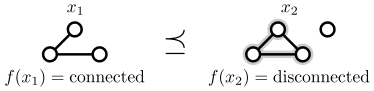
Figure 3 .Graphs are classified according to connectedness. A subgraph explanation for the connected instance x1 can never be sufficient because the instance x1 is also a subgraph of the disconnected instancex 2.
Original paper · CC BY 4.0The main result is that a sufficient explainer exists for a selection order exactly when there are no co-bounds, that is Z = ∅. Because the select relation and the classifier together determine co-bounds, the answer depends on both, not on the classifier alone. The select relation is assumed to be uniform across instances: a sub-instance selectable from one instance stays selectable from any instance that contains it.
Assumption 3.1 means that selection doesn't depend on the specific data instances.
Take K3 with label 1 and P3 with label 0. Under edge-induced subgraphs, P3 can be selected from K3, so P3 is a co-bound and no sufficient explainer exists. Under node-induced subgraphs, P3 isn't selectable from K3, and the trivial explainer becomes sufficient. The same logic applies to strings, where 'great' is a substring of 'not great' with the opposite sentiment.
When structure alone guarantees sufficiency
An antichain under the selection order is the simplest case where a sufficient explainer is guaranteed. In that case no instance can be selected from another, so the whole instance serves as a sufficient explanation. This holds for any classifier, because the argument uses only the structure of the instance space. Fixed-resolution images, propositional variables, and tabular data are modalities where instances are incomparable.
Darwiche and Hirth show a sufficient explainer for every propositional logic classifier, and this follows from the antichain argument. Their proof, however, relies on writing the classifier as minimal sufficient explanations, the prime implicants. Theorem 4.2 needs only the nature of the instance space, so it doesn't depend on the classifier or the task.
A size function assigns each sub-instance a number so that proper sub-instances are strictly smaller. Boolean variables, vertices for node-induced subgraphs, edges for edge-induced subgraphs, and string length are examples of size functions. In a constant-size instance space every instance has the same size n, so no instance is a proper part of another.
Corollary 4.3 therefore says that every constant-size instance space admits a sufficient explainer. The size function and the selection order must agree, so the size function can't be trivialized without trivializing the order. A second route is an unbounded selection order, where no selectable element is shared by two instances with different labels.
Under an unbounded selection order every explainer is sufficient, by Proposition 4.1.
When no sufficient explainer exists, the authors ask for a class-wise sufficient explainer for a single class. Such an explainer exists for class y when every other class is monotone, meaning its instance set is closed under the select relation. A clique K_n is non-monotone, while not having K_n as a subgraph is monotone, because removals never create a K_n.
Forbidden-substructure characterizations of graph classes give such monotone classes, and each forbidden substructure explains the complementary class. The authors show that a node-induced subgraph explainer always exists for every purely existentially quantified positive first-order formula on graphs.
What survives under probabilistic and deletion sufficiency
Probabilistic sufficiency replaces the exact requirement with a probability taken over a distribution µ on the instances. Dasgupta et al. (2022) define it for a local explanation, which is the explanation of one specific instance. The applicability set X_π collects every z with π ⪯ z, and the coverage c_e(x) is µ of X_e(x). The local sufficiency m_e(x) is the probability that a sample drawn from X_e(x) keeps the label f(x).
Theorem 4.4 bounds every explainer against the trivial explainer t(x) = x, for an instance with positive coverage c_t(x). The bound reads m_e(x) ≤ 1 − c_t(x)(1 − m_t(x)), so the ceiling depends only on the trivial explainer's quantities. High coverage by the trivial explainer, paired with low local sufficiency, pulls that ceiling down. The trivial explainer's coverage and local sufficiency come from the data, so the bound holds for the task rather than for any one explainer.
Deletion sufficiency checks only whether the prediction survives when parts of the instance are removed. It is weaker than sufficiency because it looks only at deletions from the original instance. Every sufficient explainer is deletion sufficient, and the trivial explainer always is, but the converse fails. For a monotone class, the condition holds at every instance of that class, so it tests nothing there.
In graph classification, a single node already qualifies as a deletion-sufficient explanation for acyclic or planar graphs.
Consistency asks that explanations for different classes stay distinct, which is weaker than sufficiency. In a sentiment task where every text has a comma and a period, an explainer can highlight the comma for positive text and the period for negative text. That explainer is consistent yet uninformative, since those characters carry no sentiment signal.
The trivial explainer is always consistent, so every selection order admits a consistent explainer.
How far real datasets are from sufficiency
The authors apply subgraph selection to molecular and protein graphs, and substring selection to sentences. A co-bound search tests every distinct pair of dataset instances for whether one can be selected from the other. From that relation it derives the transitive closure, and all three metrics come from it together with the labels. Table 1 lists the co-bound counts, runtimes and the three statistics for each of the ten datasets.
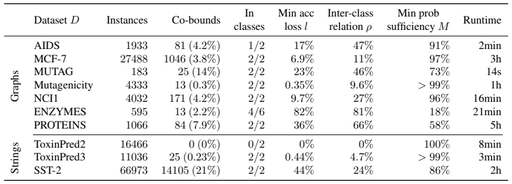
Table 1 .Existence of co-bounds in molecular, protein, and natural language classification datasets. A co-bound is a witness for an insufficiently explainable class. For graphs the select relation is subgraphs, and for strings it is substrings. The runtime is the wall-clock time of finding co-bounds on an Intel(R) i9-12900KF CPU (no parallelization). Graph datasets are used as provided by Morris et al. (2020). Isomorphic duplicates are reduced to one copy, or removed if they occur in more than one class. See Appendix E for co-bound examples.
Original paper · CC BY 4.0Nine of the ten datasets contain co-bounds, and seven of them have co-bounds in every class. ToxinPred2 is the only dataset without co-bounds, while AIDS and ENZYMES have them only for some classes. In SST-2, 21% of instances are co-bounds, partly because the data includes parse-tree phrases. For AIDS, 47% of relations join instances with different labels.
Repairing a dataset means relabeling whole connected components, so a few co-bounds can pull many instances in. ENZYMES has only 2.2% co-bounds, yet making it co-bound free needs an accuracy loss of 82%. MUTAG has 14% co-bounds but only a 23% accuracy loss, so the co-bound count alone doesn't decide the matter. Mutagenicity has a 9.6% inter-class relation ratio, yet it is nearly sufficiently explainable.
The minimum upper bound on local probabilistic sufficiency is 58% for PROTEINS and 73% for MUTAG. These numbers reflect the ground-truth labels and the select relation, not any particular model or explainer.
Where the limits of these results stop
The authors don't see the full domain, so they compute every statistic on a dataset D of instances they have access to. The co-bound search checks every distinct pair in D, and the metrics use the relation restricted to D. All three statistics take in instances, labels and the select relation, so they don't diagnose a particular model or explainer.
They capture intrinsic limits of the ground-truth labels and the select relation, not failures of a trained classifier.
The authors tested only subgraph and substring select relations, on chemical, biological and sentiment datasets. They didn't test other select relations, such as those over feature subsets, so these statistics say nothing about them. The limits they report are in-distribution, unlike the out-of-distribution problems that Fang et al. (2023) discuss.
In ENZYMES and AIDS, co-bounds appear only for some classes, so class-wise results can differ from dataset-wide ones. ENZYMES has 2.2% co-bounds, yet removing them requires an accuracy loss of 82%. MUTAG has a 14% co-bound ratio but only a 23% accuracy loss, so counts alone can't decide sufficiency. Mutagenicity has a 9.6% inter-class relation ratio and is nearly sufficiently explainable.
The 82% figure assumes coordinated relabeling of whole connected components, which the authors compute as the minimum loss.
The minimum probabilistic sufficiency values are upper bounds, so they set a ceiling rather than a measured score. The PROTEINS bound of 58% and the MUTAG bound of 73% come from instances with many relations to other instances.
Paper info
- Authors
- Weinbauer, Klaus, Stadler, Peter F., Gärtner, Thomas, Malhotra, Sagar
- Venue
- arXiv · Preprint
- First published
- 2026-11-13
- Added
- 2026-11-16
- Updated
- 2026-11-13
- Version
- v1
- arXiv
- 2611.18163
- Category
- cs.LG
- Original paper terms
- CC BY 4.0
- What we show
- Paper info, commentary and permitted figures from the original paper
AI commentary is a separate explanation from the original paper and may contain errors. The original paper and figures follow each source's terms of use and any rights noted separately.
Abstract
We formally characterize the conditions under which sufficient explanations exist for classifiers on structured data such as graphs and strings. We focus on post-hoc explainers that select parts of the input as sufficient explanations. An explanation is sufficient if the selected part alone ensures the predicted label. Sufficient explanations have been widely adopted across data modalities, including graphs, strings, and images. However, a unified formal analysis of sufficient explanations remains missing. We bridge this gap with four main contributions: (i) We define a general explanation formalism consisting of an instance space, a classifier, and a select relation. The select relation specifies which potential sub-instances or feature subsets can be selected as explanations from each instance; (ii) We show that the existence of sufficient explainers is fully characterized by the interplay between the classifier and the select relation; (iii) We extend this analysis to practically relevant variants of sufficiency, including probabilistic sufficiency and deletion sufficiency; (iv) Based on the formal analysis, we devise statistics that bound the maximum achievable sufficiency for a given task. We evaluate these statistics on language, protein, and molecular classification datasets and find that full sufficiency is unattainable on most of them. Since these bounds hold for every explainer, they provide a task-level reference against which any explainer's sufficiency can be judged in absolute terms.
Quote from the paper
Weinbauer, Klaus, Stadler, Peter F., Gärtner, Thomas, Malhotra, Sagar (2026). On the Limits of Sufficient Explanations. arXiv:2611.18163v1. https://arxiv.org/abs/2611.18163v1
BibTeX
@misc{klaus2026limits,
  title = {{On the Limits of Sufficient Explanations}},
  author = {Weinbauer, Klaus and Stadler, Peter F. and Gärtner, Thomas and Malhotra, Sagar},
  year = {2026},
  eprint = {2611.18163},
  archivePrefix = {arXiv},
  url = {https://arxiv.org/abs/2611.18163v1}
}