Paper commentary
A Large-Scale Dataset for Cross-Lingual Multi-Jurisdiction Patent Drafting from Patent Cooperation Treaty Applications
A PCT-linked dataset pairs Japanese and English patent claims across jurisdictions
- Problem Earlier claim-revision datasets stay inside a single patent office, so they cannot show how claims change when language and jurisdiction both change.
- Method QLoRA adapts a 4-bit Qwen3.6-27B with one shared adapter trained on claim sets linked through PCT patent families, rather than only prompting the model.
- Results QLoRA reached the highest BLEU on all four core tasks, 2.87 to 4.98 BLEU above the best non-adapted system.
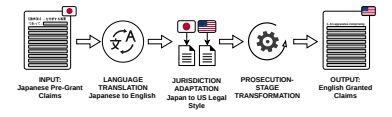
Figure 1 : Cross-lingual patent drafting and its instantiation in our dataset, illustrated by the ja_pre→en_granted direction. Each task instance links source and target claim sets within the same PCT- derived patent family.
Original paper · CC BY 4.0 · Le, Trung Phuong, Nonaka, Hirofumi, Marusaki, Koji, Sudoh, Katsuhito, Kawano, Seiya · A Large-Scale Dataset for Cross-Lingual Multi-Jurisdiction Patent Drafting from Patent Cooperation Treaty Applications · Original paper figure · Extracted the figure area from page 2 of the original PDF.Why claims change across borders
A PCT application can enter several national phases, and each patent office then examines it independently. Claims derived from the same international application can diverge in language, structure, scope, and number. Translation alone doesn't close that gap, because a target-jurisdiction claim may keep the same invention while adding office-specific drafting conventions and prosecution-stage amendments.
The desired output can therefore be a legally consequential transformation rather than a faithful translation of the source. The authors call this task cross-lingual patent drafting, which produces a plausible complete claim set for a chosen target language, jurisdiction, and prosecution stage.
Earlier claim-revision resources are useful, but each one stays inside a single office. ClaimBrush covers JPO pre-grant-to-granted rewriting, Patent-CR covers EPO claim revision, and PatentEdits covers USPTO edit prediction. Cross-lingual work, by contrast, mostly treats patent text as machine-translation data. Prior work therefore leaves open how to generate complete claim sets when language, jurisdiction, and stage all change at once.
This study targets that gap with a PCT-linked Japanese–English benchmark.
Linking PCT families into claim-set pairs
The authors link Japanese JPO records with English USPTO records through 884,179 PCT-derived patent families. Those families yield 4,067,168 directional claim-set instances across six released configurations, and four of them form the core benchmark. Each instance points from a source claim set to a target claim set inside the same family, so it marks a linkage rather than a unique invention.
Google Patents Public Data supplies the family_id field, which groups publications that share the same priority claims.
The stage of each document comes from its publication kind code, with A-type codes marking pre-grant publications and B-type codes marking grants. Same-stage tasks pair matching stages across the two offices, while cross-stage tasks pair a pre-grant source with the other office's granted claims. A cross-stage target is only one observed prosecution outcome, because a single source claim set can support several plausible drafts.
The authors split families 80/10/10, and every instance from one family stays in the same partition. That arrangement keeps within-family pairings from leaking content between training and evaluation. The chronological assignment shifts the instance-level proportions to roughly 72/10/18.
The two pre-grant transfer directions each hold about 1.26M examples. The two pre-grant-to-granted directions hold 817k and 637k examples, which supply the main supervision for cross-stage drafting. The two granted-to-granted directions are much smaller, so the authors treat them as supplementary tasks.
Many linked pairs are far from translations of each other. 56.0% of instances score below chrF 50 when compared with a machine-translated version of the source claims. 78.3% of instances differ from the source in claim count. The authors keep this divergence rather than filtering it out, because drafting has to model it.
What each system receives and what QLoRA learns
Each system receives only the source claim set, because the specification and prosecution history stay outside the input. Google Translate v3 serves as the commercial translation reference, called through the Cloud Translation API (Advanced). Qwen3.6-27B gets a task-specific drafting instruction in the zero-shot condition, and one manually selected demonstration in the few-shot condition.
The simple-MT ablation swaps that drafting instruction for a plain translation request, which isolates the effect of task framing. GPT-5.4 receives the same zero-shot instruction and the same demonstration through the API.
GPT-5.4 Draft-then-Translate drafts in the source language and then translates the result, on the cross-stage tasks. Translate-then-Draft reverses that order, translating the pre-grant claims first and then drafting in the target language.
The base model is Qwen3.6-27B, loaded in 4-bit NF4 with double quantization and bfloat16 computation. LoRA adapters with rank 16, scaling factor 32, and dropout 0.05 attach to the query, key, value, and output projections. Training runs for 12,000 steps, and the final 12,000-step adapter is frozen for evaluation.
Every system is scored on the same 1,000 instances from each core direction, 4,000 in total. SARI assumes monolingual editing, so each source claim set is first translated into the target language by Google Translate. For cross-stage tasks, |∆r| and |∆s| give the mean absolute claim-count difference from the reference and from the source.
Prompting and adaptation on overlap and claim counts
Prompting alone moves the scores very little on this benchmark. Changing only the requested target stage in the paired control shifts BLEU by 0.05 and chrF by 0.52 on en_pre→ja_granted, as Table 8a shows. The authors read this as evidence that prompting doesn't reliably induce the jurisdictional and stage changes the task needs.
It also leads SARI on three tasks, but trails GPT-5.4 zero-shot by only 0.11 on ja_pre→en_granted. The authors interpret this as supervised cross-jurisdictional examples carrying task-specific information that prompting doesn't draw out reliably.
On both cross-stage tasks, QLoRA lowers |∆r| relative to Qwen zero-shot. The value falls from 12.39 to 10.35 on ja_pre→en_granted and from 10.84 to 9.94 on en_pre→ja_granted. At the same time, its |∆s| rises toward the reference values of 16.42 and 17.51. Even the strongest cross-stage results leave mean claim-count gaps of 9.0 to 9.4 claims, so structural control still has room to improve.
GPT-5.4 Draft-then-Translate is the clear exception on BLEU. It improves BLEU by 4.92 points over GPT-5.4 zero-shot on en_pre→ja_granted. The authors suggest the gain reflects better wording rather than full structural change, though they didn't isolate that mechanism. On the supplementary ja_granted→en_granted task, every scored system gets higher BLEU and SARI but lower chrF than on ja_pre→en_pre.
The authors tie this shift to more stabilized granted-stage structure and the shorter length of granted claims.
Pilot preferences and evaluator agreement
Two evaluators judged 25 sampled en_pre→ja_granted cases, with each case compared across three system pairings. That setup yields 75 judgments, with system identities hidden, candidate order randomized, and ties permitted. The human evaluator has professional JPO expertise, so the pilot stays in the direction where that expertise applies.
Judges saw the English source and an auxiliary Japanese pre-grant claim set, but not the observed Japanese granted reference.
The human evaluator preferred QLoRA over simple-MT in 20 of 25 cases, or 80%. The LLM evaluator preferred QLoRA over simple-MT in 19 of 25 cases, or 76%. Against GPT-5.4 zero-shot, the human evaluator chose QLoRA in 19 cases, or 76%, while the LLM evaluator chose it in 13, or 52%. Both evaluators produced the same preference order, with QLoRA first, GPT-5.4 zero-shot second, and simple-MT last.
Human–LLM agreement over the three labels is 82.7%, with Cohen's κ of 0.68. Excluding tie-involving comparisons raises agreement to 88.4%, with κ of 0.77. Per comparison, agreement is 96% for QLoRA versus simple-MT, 64% for QLoRA versus GPT-5.4, and 88% for GPT-5.4 versus simple-MT. Most disagreement sits in the QLoRA versus GPT-5.4 comparison, where the LLM leaned toward GPT-5.4 or a tie.
The LLM verdicts stayed server-side until each human decision was committed, so neither evaluator saw the other's verdict.
The authors treat the LLM evaluator as a diagnostic, not a substitute for human evaluation. Ties were permitted only when there was no practically meaningful difference between candidates. The item-level judgments are provided in the released repository.
What the evidence leaves open
A source claim set alone can't explain why a granted target contains a given amendment. Assessing support for generated changes would need the specification and the prosecution records. Those records would show whether an added limitation like the anodic bonding in the JPO grant is technically supported.
Language and jurisdiction vary together in this data, so their separate effects can't be isolated. Other filing routes and patent offices remain untested, so the results may not transfer to them. The dataset covers only Japanese–English PCT-linked applications at the JPO and USPTO.
Expert human assessment is limited in scope, and the pilot covers 25 en_pre→ja_granted cases with one human evaluator. The chrF divergence probe relies on machine translation, so translation errors can lower its scores. That means part of the 56.0% figure may reflect translation error rather than content divergence.
Public patent documents may appear in model pretraining data, and family-disjoint splits don't rule that out. The direction-dependence of Draft-then-Translate stays open, because target language, jurisdiction, and prosecution history aren't separated.
Paper info
- Authors
- Le, Trung Phuong, Nonaka, Hirofumi, Marusaki, Koji, Sudoh, Katsuhito, Kawano, Seiya
- Venue
- arXiv · Preprint
- First published
- 2026-11-9
- Added
- 2026-11-10
- Updated
- 2026-11-9
- Version
- v1
- arXiv
- 2611.11891
- Category
- cs.CL · cs.AI
- Original paper terms
- CC BY 4.0
- What we show
- Paper info, commentary and permitted figures from the original paper
AI commentary is a separate explanation from the original paper and may contain errors. The original paper and figures follow each source's terms of use and any rights noted separately.
Abstract
Securing patent protection across countries requires drafting claims separately for each national patent office, in the relevant language and according to its legal and stylistic conventions. Patent claims can therefore differ across languages and jurisdictions because of translation, target-office drafting practices, and prosecution-stage changes. We formulate cross-lingual patent drafting as generating plausible candidate claim sets for a specified target language, jurisdiction, and prosecution stage from a source claim set in another language. The task models jurisdiction- and stage-specific transformations beyond content-preserving translation. We construct a large-scale Japanese-English dataset by linking Japan Patent Office (JPO) and United States Patent and Trademark Office (USPTO) records through 884,179 Patent Cooperation Treaty (PCT)-derived patent families. Across six released configurations, these families yield 4,067,168 directional claim-set instances; four core configurations form the main benchmark. Commercial machine translation and zero- and few-shot prompting capture part of the task, while supervised adaptation provides the strongest overall baseline, showing that task-specific patterns can be learned from linked cross-jurisdictional claim sets.
Figures from the paper
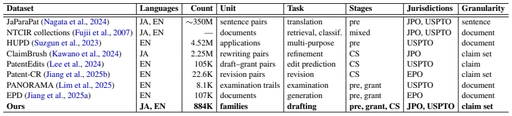
Table 1 : Comparison with existing patent datasets. Counts use each dataset’s native unit and are therefore not directly comparable across rows. For ours, 884,179 families yield 4,067,168 directional linked claim-set instances across six released configurations. Pre = pre-grant; grant = granted; CS = cross-stage (pre to grant); a claim set is all claims in one publication.Boldidentifies our dataset.
Original paper · CC BY 4.0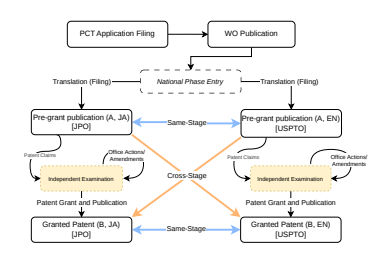
Figure 2 : Publication stages and task structure. Same- stage tasks link documents at matched stages across jurisdictions; cross-stage tasks link a pre-grant source to the other jurisdiction’s granted claims.
Original paper · CC BY 4.0
Table 3 : Extended statistics for the six released task directions. V ocabulary size uses MeCab (IPA dictionary) for Japanese and whitespace-after-punctuation splitting for English. Claims are means per claim set; Mean T/S is the mean per-instance target/source claim-count ratio. Character columns are median NFC-normalized Unicode code-point counts.
Original paper · CC BY 4.0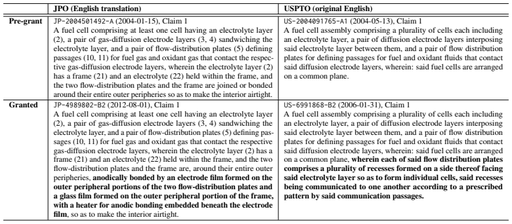
Table 4 : English-language claim comparison for one invention across jurisdictions and prosecution stages. The JPO claims are translated into English for presentation; the original Japanese appears in Appendix E. All four documents derive from PCT publication WO2001/095404 and were prosecuted independently at the JPO and USPTO. Bold text highlights limitations added during examination.
Original paper · CC BY 4.0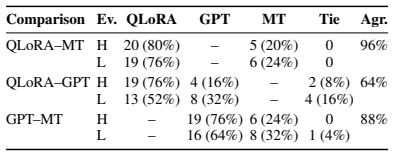
Table 6 : Blind pairwise preferences. H and L denote the human and LLM evaluators; GPT denotes GPT-5.4 zero-shot and MT denotes Qwen simple-MT. Percent- ages use the 25 cases in each comparison, and Agr. is per-comparison human–LLM agreement over the three labels (first candidate, second candidate, tie).
Original paper · CC BY 4.0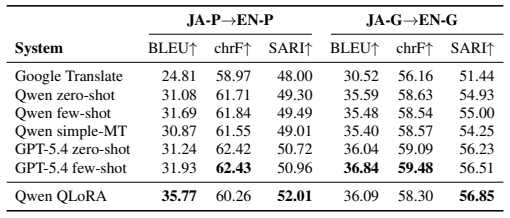
Table 7 : Supplementary comparison of Japanese-to-English pre-grant and granted-stage transfer. P and G denote pre-grant and granted stages; SARI scoring follows Section 5. Bold marks the best system within each task and metric.
Original paper · CC BY 4.0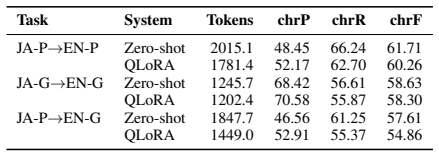
Table 8 : Additional diagnostics. Panel (a) changes only the requested target stage in a separately generated paired Qwen3.6-27B rerun on the same 1,000 en_pre→ja_granted examples; the cross-stage row is its internal paired baseline and is distinct from the main benchmark run. Panel (b) compares Qwen3.6-27B zero-shot and QLoRA on the English-target tasks; Tokens is mean generated length, and chrP/chrR are character n-gram precision and recall.
Original paper · CC BY 4.0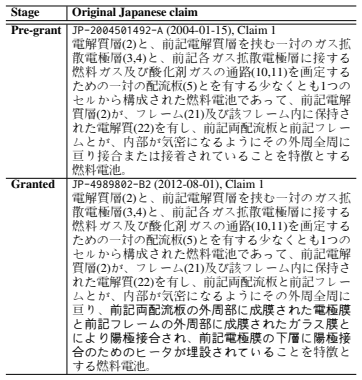
Table 9 : Original Japanese JPO claims for the transla- tions in Table 4; bold marks the limitation added in the granted claim.
Original paper · CC BY 4.0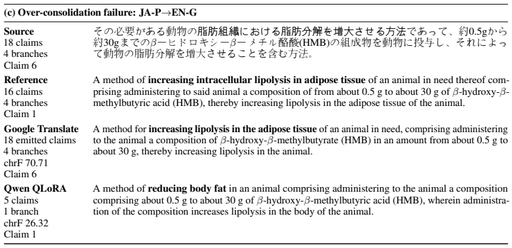
Table 10 : Qualitative comparison of Google Translate and QLoRA against the reference. Panel (a) shows reference- like consolidation; panel (b), source-supported narrowing by incorporating source Claim 2’s ranges into independent Claim 1; and panel (c), over-consolidation in which QLoRA reduces four method branches to one and omits the glycerol-export and comorbidity branches. Examples are illustrative, not assessments of legal validity; claim numbering differs because outputs are complete claim sets. P and G denote pre-grant and granted stages.
Original paper · CC BY 4.0Quote from the paper
Le, Trung Phuong, Nonaka, Hirofumi, Marusaki, Koji, Sudoh, Katsuhito, Kawano, Seiya (2026). A Large-Scale Dataset for Cross-Lingual Multi-Jurisdiction Patent Drafting from Patent Cooperation Treaty Applications. arXiv:2611.11891v1. https://arxiv.org/abs/2611.11891v1
BibTeX
@misc{phuong2026large,
  title = {{A Large-Scale Dataset for Cross-Lingual Multi-Jurisdiction Patent Drafting from Patent Cooperation Treaty Applications}},
  author = {Le, Trung Phuong and Nonaka, Hirofumi and Marusaki, Koji and Sudoh, Katsuhito and Kawano, Seiya},
  year = {2026},
  eprint = {2611.11891},
  archivePrefix = {arXiv},
  url = {https://arxiv.org/abs/2611.11891v1}
}