Paper commentary
Language Models Steer on Injected Uncertainty Tokens, but Fail to Self-Monitor In Situ
Language models fail to notice their own errors but readily recover from injected doubt
- Problem Agent scaffolds ask models to write a confidence number after each step, but nobody had checked whether that number drops at the model's own reasoning errors. Prior work tested repair only when the error location was given.
- Method The authors keep the model's steps, then overwrite the confidence tags at the error step with a fixed low value of 10%. A matched control sets both tags to 95%, so only the tag value changes.
- Results Verbalized confidence stays saturated at 95.1% to 99.9% even at the first error, with within-position AUROCs of 0.500 to 0.561. Injected low confidence raises correction by +3.7 to +22.5 points over the 95% control in all four models.
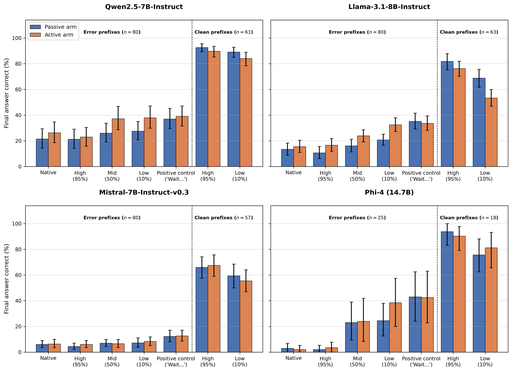
Figure 2 :Counterfactual Causal Steering Across Conditions and Arms for Four Models.Percentage of continuations achieving correct final answers after counterfactual tag injection at𝑘∗, with 95% cluster-robust confidence intervals across Qwen2.5-7B-Instruct, Llama-3.1-8B-Instruct, Mistral-7B-Instruct-v0.3, andPhi-4 (14.7B). Evaluated across 27,568 continuations on error and clean prefixes. Injecting Low (10%) confidence tags significantly increases correction rates over High (95%) certainty tags across all four models (𝑝≤0.0022in passive arms;𝑝≤0.0341in active arms).
Original paper · CC BY 4.0 · Daniel Theron · Language Models Steer on Injected Uncertainty Tokens, but Fail to Self-Monitor In Situ · Original paper figure · Converted the paper's own image file from its arXiv HTML version to PNG.Why self-reported confidence can't flag errors
Agent scaffolds increasingly ask a model to write a confidence number after every reasoning step. A controller then uses those numbers to decide whether to continue, backtrack or prune. That design only works if the number falls when the model is actually wrong. Zero-shot verbalized confidence is already known to be overconfident in aggregate.
Prior work showed that Tyen et al. models can repair an error when handed its exact step location. That work never separated this repair from whether the model notices its own error while writing.
The authors split the problem into two questions, and keeping them apart matters. The first question asks whether the confidence number drops at the first reasoning error. It also asks whether the number can separate valid steps from invalid ones. The second question asks whether the model can be steered by doubt once that doubt is in its context.
A failure to self-correct could come from either side, so the authors measure both.
The authors ran four open-weights models, Qwen2.5-7B-Instruct, Llama-3.1-8B-Instruct, Mistral-7B-Instruct-v0.3 and Phi-4, on math problems. On those failure points, they applied 27,568 counterfactual continuations. Monitoring results show near-chance within-position AUROCs between 0.500 and 0.561. Trajectory confidence stayed flatly saturated at 95.1% to 99.9% even at the first error.
Injecting a low-confidence tag at the error step still raised downstream correction in every model. The gain ranged from +3.7 to +22.5 points over a format-matched 95% certainty tag. Injected doubt on already-correct steps made models discard valid reasoning, cutting solve rates by up to 22.8 points. A controller that prunes on self-reported confidence therefore filters on a signal that barely moves at mistakes.
Injected doubt as the key idea
The key idea is to let the model write its steps, then replace its own confidence tags at the error step with a fixed low value of 10%. The matched comparison keeps the same wording but sets both tags to a fixed high value of 95%, so only the value of the tag changes. Both tags are set to the same value, so the model gets one unambiguous uncertainty signal rather than a mix of contradictory cues.
Injecting doubt is a way to ask whether the model can use uncertainty once it is in context, without relying on the model to produce that doubt itself.
This is a causal test of steering, not a test of self-monitoring. If the model recovers when doubt is injected but never produces doubt on its own, the bottleneck sits in monitoring rather than in repair. The authors frame one possible cause as autoregressive commitment, where the model keeps affirming a step it has already written. The same injection also tests the cost side, because doubt placed on correct steps can make the model discard valid reasoning.
Injected doubt therefore separates two questions that self-reported confidence alone cannot separate.
How the two phases run
Phase 1 samples 15,200 primary traces from four open-weights models on GSM8K and MATH-500 problems. Qwen and Llama each contribute 4,400 traces, while Mistral and Phi-4 contribute 3,200 each. Generation uses vLLM with nucleus sampling at temperature 0.7 and top-p 0.95, with eight samples per problem.
Format checks remove malformed traces, and an item counts as contested only when its solve rate sits between 15% and 85%. After filtering, 3,873 valid traces remain, and 2,017 of them are verified error traces.
Claude Opus 5.5 locates the first invalid step. The judge receives the problem, a gold reference derivation and the step blocks with every confidence tag stripped, so it can't see the model's self-ratings.
Phase 2 cuts each prefix right after the reasoning text of step k* and then appends one of five tag conditions. The conditions are Native, High (95%), Mid (50%), Low (10%) and a Positive Control that keeps the native tags and adds a rethink sentence. Each condition runs under a Passive arm and an Active arm, and the Active arm adds a rule to re-examine earlier steps when on-track confidence falls below 50%.
Clean prefixes at matched depths receive the same kinds of tags, which measures the collateral cost on valid reasoning.
In total the run produced 27,568 continuations. The contrasts come from GEE logistic models with an exchangeable working correlation, clustered by problem item.
Monitoring: confidence stays flat at errors
At the first error step, the verbalized confidence barely moves, so the number a controller would read gives no warning. Raw boundary drops are close to zero, ranging from -0.52 points for Qwen to +1.01 points for Llama. The authors read this as confidence that doesn't register the error at all.
A paired check compares each error transition with a clean transition at the same depth on the same item. The paired differences are +0.36 points for Qwen and +1.23 points for Llama, which the authors judge too small to support operational filtering. Qwen's clean traces drift upward at depth k*, which is why its raw and paired signs disagree.
Mistral and Phi-4 show paired differences of +0.45 and 0.00 points, with no significant shift.
Mistral shows them in 0.8% of its error traces, and Phi-4 in none of its 57. Chance is 0.5, so the signal barely separates valid steps from erroneous ones. A position-only baseline reaches 0.692 to 0.739, which is why the analysis controls for step depth. Local step confidence gives similar values of 0.536, 0.552, 0.522 and 0.500.
Phi-4 is the largest model tested at 14.7B, and it also shows chance-level within-position AUROC. Its perceptible confidence dips remain absent, so scale did not resolve the monitoring failure in these experiments. The pooled recovery slope over 117 dips is -0.071, with a 95% CI from -0.262 to 0.121. Because pre-dip confidence sits near 100%, recovery is mechanically capped near 1.0, so dips simply revert.
The authors find no evidence of an active confidence ratchet and read the dips as token noise that regresses to the mean.
Steering: injected doubt moves outcomes
The steering test asks whether a low-confidence tag injected at the error step lifts correction rates above a format-matched high-confidence tag. Each prefix was cut right after the reasoning text of step k*, and five tag conditions were appended under two prompt arms. Native continuations established baseline recovery of 21.4% for Qwen, 13.4% for Llama, 6.6% for Mistral, and 3.0% for Phi-4.
Under passive prompting, injecting a Low tag raised correction in every model, with the largest gain in Phi-4. The High tag shares the same syntax, so the authors read the gain as steering by uncertainty rather than generic token disruption. All four passive contrasts stay significant after Holm adjustment, with p at most 0.0044.
Under active instructions, the Low tag produced its largest gains in Qwen, Llama, and Phi-4. In Phi-4 the active Low tag moves the rate from 3.5% to 38.5%, a gain of 35.0 points over active High. Mistral's gain stayed smaller, at 9.4% under active Low tags against 6.9% under active High. Solve rates remain below 40% across models and conditions.
The Low tag carries no diagnosis of the error, yet it reaches the Positive Control rate within a few points in Qwen, Llama, and Phi-4.
The cost appears on clean prefixes, where injecting Low tags lowers retention. In Llama, retention is 76.2% under active High tags and 53.4% under active Low tags. The authors tie this to unnecessary reconsideration, since backtracking on clean prefixes reaches 91.7% in Llama under active Low tags. Llama's clean-prefix disruption shows that doubt can hurt sound reasoning as well as help broken reasoning.
The authors turn this trade-off into a break-even threshold, where Acc Low minus Acc High gives the error-side gain. Mistral needs 67.3% passive and 81.4% active, which makes it the most demanding case. Phi-4 needs 44.6% passive and 20.5% active. The Phi-4 active figure rests on a retention contrast that isn't statistically significant (p = 0.2946), so the authors present it as an upper bound.
Limitations of the monitoring and steering claims
The design leaves one causal question open, because no detached self-evaluation control was run. In that control, the model would judge its own derivation prefixes in a clean evaluation prompt, with prior confidence tags stripped. Such a pass would separate generative commitment bias from a general lack of evaluative ability, which this study can't do.
The authors left the three candidate causes unresolved, so the study can't say which one drives the monitoring failure.
The verbalization-format comparison is also incomplete, since token log-probabilities and predictive entropy were not benchmarked against the verbalized numbers. Those signals are available at zero extra inference cost, because the primary derivations ran through vLLM. Without that comparison, the study can't tell whether latent uncertainty detects errors that the verbalized numbers miss.
The error boundaries depend on an automated judge, which reached 85.0% exact step accuracy on ProcessBench. Sensitivity analysis across k* plus or minus 1 left the saturation pattern unchanged, so localization noise doesn't explain the absence of dips. The Phi-4 results rest on a small contested set of 25 items and 57 boundary-evaluable error traces.
Injection timing is bounded too, since tags were appended only at the boundary step k*. Future work would need to measure how steering degrades across delayed horizons at k* plus delta.
Paper info
- Authors
- Daniel Theron
- Venue
- arXiv · Preprint
- First published
- 2026-11-23
- Added
- 2026-11-28
- Updated
- 2026-11-23
- Version
- v1
- arXiv
- 2611.31228
- Category
- cs.AI
- Original paper terms
- CC BY 4.0
- What we show
- Paper info, commentary and permitted figures from the original paper
AI commentary is a separate explanation from the original paper and may contain errors. The original paper and figures follow each source's terms of use and any rights noted separately.
Abstract
Prompting language models to verbalize stepwise numerical confidence during generation is an increasingly popular approach for triggering backtracking and error correction in agentic reasoning. This strategy presupposes two capabilities: (1) in-situ monitoring fidelity (does confidence drop when an error occurs?) and (2) downstream steering control (does an uncertainty token causally steer the model to repair its error?). We evaluated four open-weights models (Qwen2.5-7B, Llama-3.1-8B, Mistral-7B, and Phi-4, 14.7B) across 15,200 math benchmark attempts, isolating 2,017 reasoning errors within each model's capability frontier. Applying 27,568 counterfactual continuations across these failure points, we demonstrate a consistent decoupling between monitoring and control. On monitoring, all four models fail to detect their own errors. Verbalized confidence does not distinguish mistake steps from sound reasoning, yielding near-chance within-position AUROCs between 0.500 and 0.561. Even at a model's first reasoning error, trajectory confidence remains saturated at 95.1% to 99.9%, with noticeable drops ($\ge 10$ points) appearing on fewer than 9% of errors in Llama and under 1.6% in the other three models. In contrast, models respond readily to external uncertainty: injecting a low-confidence tag (10%) at the error step significantly increases downstream correction across all models (+3.7 to +22.5 points over format-matched 95% certainty; all $p \le 0.0022$), reaching up to 38.5% under active rethinking instructions. However, injecting doubt onto already-correct steps causes models to discard valid reasoning, reducing solve rates by up to 22.8 points. Inference-time self-correction is thus bottlenecked by in-situ error detection rather than downstream repair capacity: models readily steer toward recovery when prompted with doubt, yet fail to self-monitor during generation.
Figures from the paper
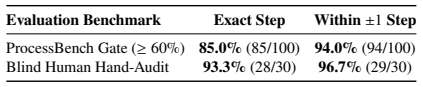
Table 1 :Process Judge Validation and Blind Hand-Audit. Accuracy on ProcessBench (𝑁=200 , 100 error items) and blind human audit on contested experimental traces (𝑁=30).
Original paper · CC BY 4.0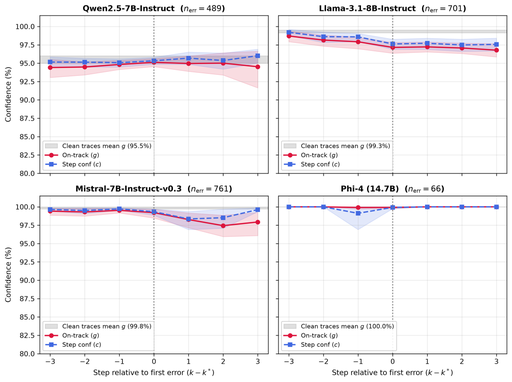
Figure 1 :Confidence Dynamics at the First Error Step (𝑘∗).Mean on-track confidence (𝑔𝑘, red circle) and step confidence (𝑐𝑘, blue square) centered at the earliest error step (𝑘−𝑘 ∗ =0 ) with 95% bootstrap confidence intervals across four models: Qwen2.5-7B-Instruct, Llama-3.1-8B-Instruct, Mistral-7B-Instruct-v0.3, and Phi-4 (14.7B). Sample sizes at relative steps𝑘−𝑘 ∗ <0 exclude step-1 errors (𝑘∗ =1 , leaving𝑛=429 Qwen, 551 Llama, 646 Mistral, and 57 Phi-4 at 𝑘−𝑘 ∗=−1). Trajectories remain flatly saturated at 95–100% across reasoning errors.
Original paper · CC BY 4.0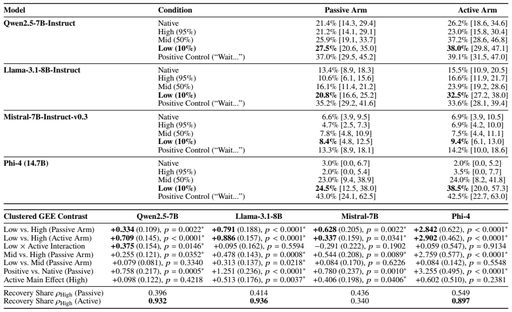
Table 3 :Counterfactual Correction Rates and Item-Clustered GEE Logistic Contrasts.Correction rates (%) across 27,568 continuations with 95% cluster-robust CIs. Contrasts reflect log-odds differences𝛽 (with item-clustered SE) from Generalized Estimating Equations (GEE) logistic models with exchangeable working correlation, clustering by problem item. The Recovery Share relative to Positive control,𝜌High=(Acc Low−AccHigh)/(AccPositive−AccHigh), is computed from unrounded continuation counts and measures the proportion of explicit rethink recovery achieved by the Low numeric tag relative to format-matched High certainty.
Original paper · CC BY 4.0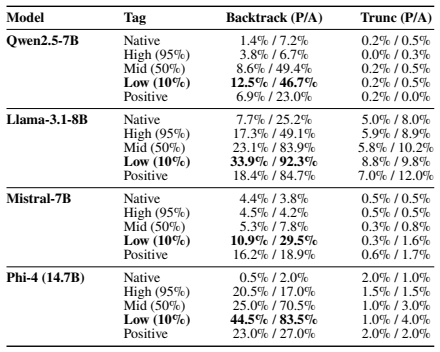
Table 4 :Downstream Behavior on Error Prefixes.Percent- age of continuations exhibiting backtracking and truncation under Passive (P) vs. Active (A) prompt arms across all four models.
Original paper · CC BY 4.0Quote from the paper
Daniel Theron (2026). Language Models Steer on Injected Uncertainty Tokens, but Fail to Self-Monitor In Situ. arXiv:2611.31228v1. https://arxiv.org/abs/2611.31228v1
BibTeX
@misc{theron2026language,
  title = {{Language Models Steer on Injected Uncertainty Tokens, but Fail to Self-Monitor In Situ}},
  author = {Daniel Theron},
  year = {2026},
  eprint = {2611.31228},
  archivePrefix = {arXiv},
  url = {https://arxiv.org/abs/2611.31228v1}
}