Paper commentary
YOLOP: You Only Look Once for Panoptic Driving Perception
- Problem Driving perception needs obstacle, drivable area and lane outputs at once, but onboard compute is limited, so running separate networks for each task costs time.
- Method Uses one shared encoder (CSP-Darknet with SPP and FPN) feeding an anchor-based detection head and two segmentation heads, trained with a weighted sum of losses.
- Results Reached 41 FPS on a single NVIDIA TITAN XP and 23 FPS on Jetson TX2, with a vehicle mAP50 of 76.5 and a drivable area mIoU of 91.5 on the BDD100K validation set.
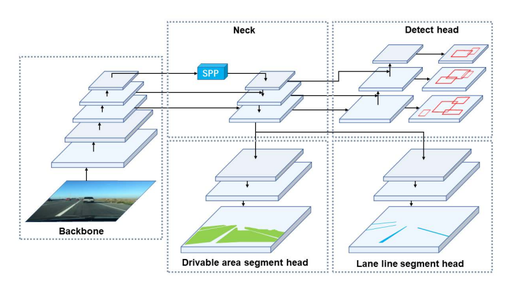
Figure 2 . The architecture of YOLOP. YOLOP shares one encoder and combines three decoders to solve different tasks. The encoder consists of a backbone and a neck.
Original paper · CC BY 4.0 · Dong Wu, Manwen Liao, Weitian Zhang, Xinggang Wang, Xiang Bai, Wenqing Cheng, Wenyu Liu · YOLOP: You Only Look Once for Panoptic Driving Perception · Original paper figure · Extracted the figure area from page 4 of the original PDF.Why one network for three perception tasks
A driving perception system has to return where obstacles are, whether the road ahead is drivable and where the lanes run, so the decision system can plan a route. The compute available on an ADAS-class platform is often small, which makes meeting both accuracy and latency requirements hard.
Running a separate model for each task adds latency on embedded hardware, even though the tasks are related: lanes bound the drivable area, and the drivable area surrounds traffic objects. A multi-task network can process the tasks together instead of one after another, and its tasks can share one feature extraction backbone.
One encoder feeding three decoders
The shared encoder is a CSP-Darknet backbone followed by a neck that combines Spatial Pyramid Pooling and a Feature Pyramid Network, so the features carry several scales and semantic levels. The three decoders read the same encoder output and contain no extra shared blocks between them, which keeps the design simple enough for end-to-end training.
The detection head fuses top-down FPN features with bottom-up PAN features and predicts on the fused multi-scale maps. Each grid cell is given three prior anchors with different aspect ratios, and the head predicts position offsets, height and width scaling, class probabilities and a confidence for each.
The drivable area head and the lane line head share one structure and both start from the bottom FPN layer, a feature map at one-eighth of the input width and height with 256 channels. Three upsampling steps restore the map to full size with two channels, giving a per-pixel probability for drivable area or lane line against background, and nearest interpolation replaces deconvolution to keep this cheap.
Joint loss and training schedule
The detection loss is \(L_{det}=\alpha_1 L_{class}+\alpha_2 L_{obj}+\alpha_3 L_{box}\), where \(L_{class}\) and \(L_{obj}\) are focal losses and \(L_{box}\) is \(L_{CIoU}\). The focal loss lowers the weight of well-classified examples so that training concentrates on hard ones, and \(L_{box}\) accounts for distance, overlap, scale and aspect ratio between the predicted and ground-truth boxes.
Both segmentation losses use cross entropy with logits, \(L_{da-seg}=L_{ce}\), and the lane line loss adds an IoU term, \(L_{ll-seg}=L_{ce}+L_{IoU}\), where \(L_{IoU}=1-\frac{TP}{TP+FP+FN}\). The IoU term is added for lane lines because the lane category is sparse and the IoU term suits that case.
The final loss is \(L_{all}=\gamma_1 L_{det}+\gamma_2 L_{da-seg}+\gamma_3 L_{ll-seg}\), with the weights tuned to balance the three parts. The network is trained with Adam, using an initial learning rate of 0.001, \(\beta_1=0.937\) and \(\beta_2=0.999\), with warm-up and cosine annealing for the learning rate and augmentation of hue, saturation, value, rotation, scaling, translation, shearing and flipping.
The default run is end to end, while the alternative trains the encoder and detect head first, then the two segmentation heads with the encoder and detect head frozen, and finally the whole network.
Data and evaluation setup
The BDD100K dataset provides a training set of 70K images, a validation set of 10K images and a test set of 20K images. Because the test labels are not public, all evaluation is run on the validation set.
Input images are resized from 1280×720×3 to 640×384×3 for all experiments, and the control experiments use the same settings and metrics. The reported speeds are 41 FPS on a single NVIDIA TITAN XP and 23 FPS on Jetson TX2.
The baselines are MultiNet, DLT-Net, Faster-RCNN, YOLOv5 and PSPNet, which the authors retrained on BDD100K for detection and drivable area segmentation, while lane detection is compared with ENet, SCNN and ENet-SAD.
Traffic object detection results
Only vehicles are compared, because MultiNet and DLT-Net detect vehicles only, and recall and mAP50 are the accuracy metrics. YOLOP reached a recall of 89.2 and an mAP50 of 76.5 at 41 fps, against 81.3 and 60.2 for MultiNet at 8.6 fps, 89.4 and 68.4 for DLT-Net at 9.3 fps, 81.2 and 64.9 for Faster R-CNN at 8.8 fps, and 86.8 and 77.2 for YOLOv5s at 82 fps.
YOLOP's mAP50 is higher than those of Faster R-CNN, MultiNet and DLT-Net, while its recall is slightly below DLT-Net's 89.4. The authors describe YOLOP's accuracy as comparable to YOLOv5s, which they say uses more tricks, and they note YOLOv5s is faster because it has no lane line and drivable area heads.
The authors attribute the more reasonable predictions to shared information across tasks, which lets YOLOP avoid labelling objects far from the road as vehicles and reduces false negatives.
Drivable area segmentation results
Both area/drivable and area/alternative are merged into one drivable class, so the model only separates drivable area from background, and mIoU is the metric. YOLOP reached an mIoU of 91.5 at 41 fps, against 71.6 for MultiNet at 8.6 fps, 71.3 for DLT-Net at 9.3 fps and 89.6 for PSPNet at 11.1 fps.
The margins over MultiNet, DLT-Net and PSPNet are 19.9, 20.2 and 1.9, and the text describes the inference speed as 4 to 5 times faster than these three.
The authors say YOLOP segments edge areas next to vehicles and lane lines better than PSPNet, which they attribute to the other two tasks supplying edge information. They also report that YOLOP makes fewer errors such as taking the opposite lane area for drivable area.
Lane detection results
BDD100K labels each lane with two lines, so the center line is computed from them, and training lines are drawn 8 pixels wide while test lines stay 2 pixels wide, following the protocol of ENet-SAD. Pixel accuracy and lane IoU are the metrics.
YOLOP reached 70.50 accuracy and 26.20 IoU at 41 fps, against 34.12 and 14.64 for ENet at 100 fps, 35.79 and 15.84 for SCNN at 19.8 fps, and 36.56 and 16.02 for ENet-SAD at 50.6 fps. The authors describe the gap in accuracy as dramatic, while ENet runs faster than YOLOP in the same table.
The authors say YOLOP's lane lines are more accurate and continuous than ENet-SAD's, and that YOLOP does not mark vehicle or drivable areas as lanes, which ENet-SAD does.
Joint versus step-by-step training
The ablation compares end-to-end training with several step-by-step schedules, written with E for encoder, D for detect head, S for the two segment heads and W for the whole network, so Algorithm 1 is ED-S-W. The authors conclude that the end-to-end run already performs well enough, so alternating optimization is not needed.
Schedules that train detection first perform slightly better than the others, which the authors explain by detection being harder to converge. A three-step schedule slightly outperforms the two-step one, and more alternating steps gave negligible gains.
Multi-task versus single-task training
The multi-task model is compared with three single-task models for detection, drivable area segmentation and lane line segmentation. The authors report that its performance is close to that of the single-task models, and that it saves a lot of time compared with running each task alone.
Grid-based versus region-based prediction
The region-based comparison model, R-CNNP, extends Faster R-CNN with two semantic segmentation heads, and both it and YOLOP are trained for detection with two segmentation tasks separately and then together.
The authors explain this by the detection head of YOLOP predicting globally over the whole feature map, as the segmentation heads do, while R-CNNP first selects region proposals and predicts on each one. R-CNNP is also far behind YOLOP in inference speed.
Limitations
The model handles only three tasks, and the authors name depth estimation as a task that could be added in future work.
All evaluation uses the BDD100K validation set, since the test labels are not public. Lane results depend on the center-line construction and the 8-pixel training and 2-pixel test line widths.
The step-by-step schedules were tested only in the variants listed in the ablation, and the authors did not find a need for alternating optimization. The region-based comparison model R-CNNP was built by the authors from Faster R-CNN, so it is not a published baseline.
Paper info
- Authors
- Dong Wu, Manwen Liao, Weitian Zhang, Xinggang Wang, Xiang Bai, Wenqing Cheng, Wenyu Liu
- Venue
- arXiv · Preprint
- First published
- 2021-8-25
- Added
- 2026-11-6
- Updated
- 2022-3-26
- Version
- v7
- arXiv
- 2108.11250
- DOI
- 10.1007/s11633-022-1339-y
- Category
- cs.CV
- Original paper terms
- CC BY 4.0
- What we show
- Paper info, commentary and permitted figures from the original paper
AI commentary is a separate explanation from the original paper and may contain errors. The original paper and figures follow each source's terms of use and any rights noted separately.
Abstract
A panoptic driving perception system is an essential part of autonomous driving. A high-precision and real-time perception system can assist the vehicle in making the reasonable decision while driving. We present a panoptic driving perception network (YOLOP) to perform traffic object detection, drivable area segmentation and lane detection simultaneously. It is composed of one encoder for feature extraction and three decoders to handle the specific tasks. Our model performs extremely well on the challenging BDD100K dataset, achieving state-of-the-art on all three tasks in terms of accuracy and speed. Besides, we verify the effectiveness of our multi-task learning model for joint training via ablative studies. To our best knowledge, this is the first work that can process these three visual perception tasks simultaneously in real-time on an embedded device Jetson TX2(23 FPS) and maintain excellent accuracy. To facilitate further research, the source codes and pre-trained models are released at https://github.com/hustvl/YOLOP.
Quote from the paper
Dong Wu, Manwen Liao, Weitian Zhang, Xinggang Wang, Xiang Bai, Wenqing Cheng, Wenyu Liu (2021). YOLOP: You Only Look Once for Panoptic Driving Perception. arXiv:2108.11250v7. https://doi.org/10.1007/s11633-022-1339-y
BibTeX
@article{wu2021yolop,
  title = {{YOLOP: You Only Look Once for Panoptic Driving Perception}},
  author = {Dong Wu and Manwen Liao and Weitian Zhang and Xinggang Wang and Xiang Bai and Wenqing Cheng and Wenyu Liu},
  year = {2021},
  eprint = {2108.11250},
  archivePrefix = {arXiv},
  doi = {10.1007/s11633-022-1339-y},
  url = {https://arxiv.org/abs/2108.11250v7}
}