Paper commentary
Which Successes Make Good References? Action-Sequence Alignment for Multi-Turn On-Policy Distillation
Action-sequence alignment picks better reference successes for multi-turn distillation
- Problem Conditioning the teacher on one successful run can mislead it, because different successes can reach incompatible interaction states.
- Method The authors match each failed rollout to the successful reference sharing the most ordered actions, using longest common subsequence (LCS) instead of a common prefix.
- Results LCS was the only tested selector to beat reference-free OPD on ALFWorld overall scores and all three airline metrics.
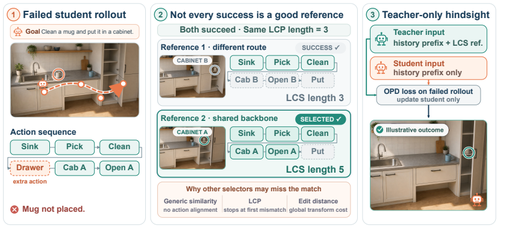
Figure 1 :LCS selects compatible references for failure-only OPD.Two same-task successes have the same LCP length (3), but LCS favors the reference with greater ordered action agreement (5 vs. 3). The reference conditions only the teacher; the student sees only its own history.
Original paper · CC BY 4.0 · Mufei Li, Nikki Lijing Kuang, Zhuoer Wang, Samson Koelle, Jie Yuan, Manqing Mao, Hong Wang, Yanjun Lin, James Feng, Daniel Edmiston, Pan Li, Wei Niu · Which Successes Make Good References? Action-Sequence Alignment for Multi-Turn On-Policy Distillation · Original paper figure · Extracted the figure area from page 2 of the original PDF.Why some successes mislead the teacher
Multi-turn tool-use agents make each decision depend on earlier actions, so one early slip can steer the rest of the run. Moving an object can likewise reshape the room layout that later steps see in embodied tasks. Reference-augmented OPD uses this hindsight: the teacher scores a student run while seeing a successful run from the same task instance.
The student never sees that successful run, and it needs no reference at inference.
A single task often has several successes, and they don't all help equally with a given failure. Different successes can follow different paths, so correcting a failure may require broader changes to the student's behavior. Recent work reports that conditioning on one successful trajectory can even degrade multi-turn distillation.
Figure 2 shows an ALFWorld case where the student tries to take N2 while it still holds N1. The N1/N2 reference keeps the student's choice of N2, while the N1/N3 reference takes N3 instead. A reference that preserves the student's valid choices helps the teacher isolate the error. A reference that follows a different path may risk disrupting behavior that was already correct.
The authors ground this choice in the observation that identical action prefixes certify identical state prefixes under deterministic transitions. Figure 1 shows the selection step, where the reference conditions only the teacher and the student sees only its own history. That motivates choosing among successes by their action-sequence alignment with the failed run, which the next section formalizes.
Reference choice as a transport problem
Each failed rollout needs one reference, and the authors prefer the reference that requires the least correction. Summing these pairwise correction costs over all failed rollouts gives an optimal transport problem, with failures as source mass and successes as candidate targets. The uniform empirical distribution over the N_x failed rollouts is written as a sum of unit point masses at each failed trajectory.
The directional cost is set to the negative compatibility score, so minimizing cost maximizes compatibility.
The free-target formulation optimizes the target marginal nu jointly with the transport plan. Because nu is free, reference usage adapts to pairwise compatibility without fixed selection frequencies. Since c equals negative s, the reference selector becomes an arg max over compatibility scores, so the problem reduces to independent nearest-reference assignment.
That reduction also motivates failure-only OPD, because the nearest-reference rule assigns references only to failed student rollouts. Student successes already achieve the task outcome, so extra teacher corrections could introduce unnecessary changes or disrupt valid behavior. The authors cite SRPO for finding that failure-only distillation keeps most of the benefit, while success-only distillation degrades performance and destabilizes training.
PTD-PO further reports that failure-only distillation outperforms distillation on all trajectories.
The OT formulation leaves open how to measure compatibility, and the authors answer with action sequences rather than observations. Observations are often long, free-form, and sensitive to formatting, so similar-looking observations can hide incompatible states.
Comparing actions and scoring them with LCS
The latent state path stays hidden under partial observability, so the authors need an observable stand-in for compatibility. Observations look like the natural choice, but they are long, free-form and sensitive to formatting. An API response can carry the same record with a different field order, so similar text can hide a real mismatch.
Thus, observation overlap becomes an unreliable proxy for state-path compatibility.
Under a shared start and deterministic transitions, identical action prefixes certify identical state prefixes. That argument naturally motivates longest common prefix (LCP) as a conservative test. LCP stops counting at the first unmatched action, even when that action is a harmless detour. Longest common subsequence (LCS) keeps counting ordered agreement after a mismatch, so two references tied on LCP can still separate.
For a failed trajectory and a reference, the LCS length is the largest m whose matched index pairs keep order and equal actions. The normalized score divides this length by a normalizer Z(T−, T+) that must be greater than zero. Setting Z to T− measures failed-trajectory coverage, while min{T−, T+} measures agreement against the shorter trajectory.
This score instantiates the pairwise compatibility function that the optimal-transport framework needs.
In the ALFWorld example of Fig. 2, the LCS-selected reference scores 0.636, while the alternative scores 0.545. Both references take N1 first, then differ on the second newspaper. The higher score keeps the failed rollout's valid choices, which matches the correction-cost view from the transport formulation. The example shows how the score ranks references, not a training result.
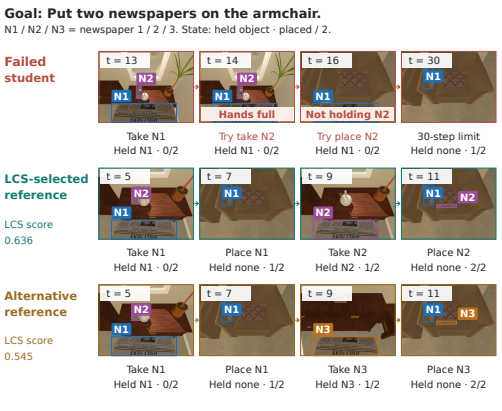
Figure 2 :Reference selection in an ALFWorld task.Both successful references place N1, then N2 or N3. LCS selects the one with greater ordered action agreement with the failed rollout. Only key turns are shown; LCS scores are computed over the full action sequences.
Original paper · CC BY 4.0What the two theorems claim
Theorem 3.1 says that every LCS-matched action pair is latent-state consistent under a few assumptions. It needs a shared initial state and the same deterministic dynamics, st+1 = F(st, at). It also needs recoverability: each unmatched action block reaches the same state whenever it is entered from the same state. The authors view this as a formal version of the idea that LCS keeps useful agreement after an early divergence that is redundant, ineffective, or later reversed.
State consistency alone doesn't show that the teacher gets better supervision, so the authors define a supervision gain for each candidate reference. The gain at turn t compares the teacher's log probability of a response with the reference against the same quantity without it, averaged over an ideal corrective target q* that doesn't depend on the reference.
A positive gain means the reference makes desirable responses more likely than reference-free supervision does.
Theorem 3.2 assumes the gain is at least g on the m LCS-matched turns and at least −b on the remaining turns, with g > 0 and b ≥ 0. Under these assumptions, the average gain over the failed trajectory's turns is bounded below by (g+b)m/T⁻ − b. The average gain is therefore strictly positive whenever mT⁻ > bg+b, which means m/T⁻ exceeds b/(g+b).
For fixed g and b, greater LCS coverage of the failed trajectory strengthens this lower bound. The g and b values are assumed in the theorem, and the paper doesn't measure them.
ALFWorld success rates
Two students, Qwen2.5-3B-Instruct and Qwen2.5-7B-Instruct, were trained with a GiGPO-trained Qwen2.5-7B-Instruct teacher. Each student was compared with zero-shot baselines, SFT, vanilla OPD and seven alternative reference selectors. Every student was scored on Valid Seen and Valid Unseen, with success broken down by task category and overall.
For Qwen2.5-3B-Instruct, vanilla OPD reaches 79.3 overall on Valid Seen and 78.4 on Valid Unseen. LCS raises these overall scores to 85.7 on Valid Seen and 85.8 on Valid Unseen. On the harder Valid Unseen split, the 3B student's overall gain is the one the authors highlight.
For Qwen2.5-7B-Instruct, LCS moves overall success on Valid Unseen from 83.6 to 94.0.
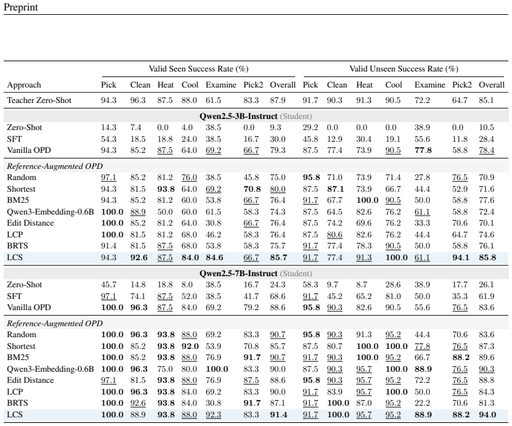
Table 1 :ALFWorld results.Success rates are reported by task category and overall on Valid Seen and Valid Unseen. The best and second-best results for each student are shown inboldand underlined , respectively. LCS is the only reference selector to improve both overall scores over vanilla OPD for both students.
Original paper · CC BY 4.0The aggregate scores put LCS above both Edit Distance and LCP for both students. The authors attribute this gap to LCS directly identifying the longest shared ordered action backbone, while tolerating unmatched actions that may be recoverable detours.
LCS on τ 3-bench airline and retail
The authors collect references and optimize only on the airline domain, using retail solely for out-of-domain evaluation. Each task is run four independent times at evaluation, and every τ 3-bench number averages three random seeds. Pass^1 measures the average single-trial success rate, while Pass^4 counts only tasks solved in all four trials.
BM25 is slightly higher on Pass^1 and Pass@4 for the 2B student, so LCS doesn't rank first on every metric there. For Qwen3.5-4B, LCS ranks first on all three airline metrics, while every non-LCS selector underperforms vanilla OPD.
The airline-trained checkpoints were applied directly to retail without further optimization. Table 2 reports that LCS improves vanilla OPD across all six metrics, covering airline and retail. The authors didn't test any target domain beyond retail, so the transfer result covers a single shift.
Why successes are left out of the update
Table 3 compares OPD on all rollouts with OPD on failed rollouts only. The authors run this check on the two smaller students, Qwen2.5-3B-Instruct on ALFWorld and Qwen3.5-2B on τ 3-bench. The larger-student results sit in Table 9 of the appendix, so the main table stays focused on the smaller models.

Table 3 : Correcting already successful rollouts consistently degrades LCS-based OPD performance, evaluated using Qwen2.5-3B-Instruct on ALFWorld and Qwen3.5-2B onτ 3-bench. Better results arebolded.
Original paper · CC BY 4.0For vanilla OPD, adding successes gives mixed results rather than a clear loss. On τ 3-bench retail, Pass^4 rises from 38.3 with successes to 44.2 without them.
LCS behaves differently, because including successes lowers its scores on the metrics we see here. On ALFWorld, LCS falls from 85.7 to 69.3 on Valid Seen and from 85.8 to 72.4 on Valid Unseen. On the airline domain, Pass^1 drops from 68.8 to 57.1 and Pass^4 drops from 41.7 to 21.7. On the retail domain, Pass^1 drops from 78.3 to 68.5 with successes included.
The authors read this pattern through a correction view of OPD. Reward-validated successes already reach acceptable behavior, so extra teacher supervision can add unnecessary or erroneous updates. Prior work points the same way, since SRPO finds failure-only distillation keeps most benefits while success-only distillation degrades performance.
Selector scores during training
The selector-score view checks whether the nearest-reference cost falls as OPD training proceeds on failed ALFWorld rollouts. The figure tracks these scores for the Qwen2.5-3B-Instruct student, with the failed rollouts forming the empirical source distribution. Rising LCS scores correspond to decreasing nearest-reference assignment costs, so the cost direction matches the method's goal.
Normalized LCS starts substantially higher than normalized LCP and stays above it throughout training. The early gap between LCS and LCP suggests that many failures keep considerable ordered action agreement after an early divergence.
LCS rises through training before settling into a noisy, non-saturated plateau. The authors read this as failed rollouts becoming increasingly compatible with their nearest successful references. Normalized edit distance improves only modestly, so 1 minus normalized edit distance gives a weaker trend than LCS. BRTS overlap saturates near one quickly, so it gives little room to separate rollouts over training.
The complementary view covers all student rollouts from the same ALFWorld OPD run, shown in Fig. 4 of the appendix. Selected-reference scores generally increase across criteria, which points to broad movement toward successful reference trajectories. LCS rises more strongly in this all-rollout view than in the failure-only view. Its batch-to-batch fluctuations are smaller than several alternatives, while the other criteria follow patterns consistent with Fig.
3.
Table 3 shows that the failure-only updates used with LCS are not an isolated choice. Its end-to-end results on ALFWorld and the airline domain support the same reference criterion the score dynamics track. Together with the Valid Unseen gains, the score trends indicate that LCS tracks compatibility as training proceeds.
Limitations and untested assumptions
The experiments cover only ALFWorld and the airline domain of τ 3-bench, with retail used for transfer only. Each benchmark pairs two student models with a single teacher model. According to the authors, the zero-shot success rate of Qwen3.5-4B, at 13.3%, may make reference-augmented distillation more sensitive to reference selection. They explain that poorly aligned references can mislead the teacher when the student's initial behavior is unreliable.
The theorems need a shared initial state, deterministic dynamics, and recoverable unmatched action blocks. For stochastic transitions, the paper offers only a weaker statement about distributions over state prefixes. Theorem 3.2 needs a positive supervision gain g over the LCS-matched turns, and the paper doesn't estimate the gain Δt on its training trajectories.
Selection can't change anything on tasks with a single success, and the paper doesn't isolate those tasks in its results. Failure-only training rests on the correction view, and Table 3 tests it only on Qwen2.5-3B-Instruct and Qwen3.5-2B.
The τ 3-bench task sets are small, so the authors average each τ 3-bench result over three random seeds. Reference pools come from four teacher rollouts per training task, so the paper doesn't test larger pools.
Paper info
- Authors
- Mufei Li, Nikki Lijing Kuang, Zhuoer Wang, Samson Koelle, Jie Yuan, Manqing Mao, Hong Wang, Yanjun Lin, James Feng, Daniel Edmiston, Pan Li, Wei Niu
- Venue
- arXiv · Preprint
- First published
- 2026-11-9
- Added
- 2026-11-11
- Updated
- 2026-11-9
- Version
- v1
- arXiv
- 2611.13135
- Category
- cs.LG · cs.AI · cs.CL
- Original paper terms
- CC BY 4.0
- What we show
- Paper info, commentary and permitted figures from the original paper
AI commentary is a separate explanation from the original paper and may contain errors. The original paper and figures follow each source's terms of use and any rights noted separately.
Abstract
On-policy distillation (OPD) reduces train-inference distribution mismatch by supervising a student on its own trajectories. For multi-turn tool-use agents, conditioning the teacher on a validated same-task successful trajectory as a reference can provide useful hindsight, but different successes may reach incompatible interaction states and offer misleading supervision. We cast successful-reference selection as a free-target optimal transport problem, which reduces to assigning each failed trajectory its most compatible successful reference. Because latent state paths are hidden, we use action-sequence alignment as an observable proxy for compatibility and instantiate it with longest common subsequence (LCS), which identifies a shared ordered backbone of actions while allowing recoverable detours. This perspective makes trajectory compatibility the central criterion for reference selection in multi-turn OPD. Experiments on ALFWorld and the airline domain of $τ^3$-bench show that LCS is the only evaluated reference selector to improve over reference-free OPD on both ALFWorld overall scores and all three airline metrics. Without further optimization, the airline-trained models also transfer to the retail domain, where LCS improves all three metrics.
Quote from the paper
Mufei Li, Nikki Lijing Kuang, Zhuoer Wang, Samson Koelle, Jie Yuan, Manqing Mao, Hong Wang, Yanjun Lin, James Feng, Daniel Edmiston, Pan Li, Wei Niu (2026). Which Successes Make Good References? Action-Sequence Alignment for Multi-Turn On-Policy Distillation. arXiv:2611.13135v1. https://arxiv.org/abs/2611.13135v1
BibTeX
@misc{li2026which,
  title = {{Which Successes Make Good References? Action-Sequence Alignment for Multi-Turn On-Policy Distillation}},
  author = {Mufei Li and Nikki Lijing Kuang and Zhuoer Wang and Samson Koelle and Jie Yuan and Manqing Mao and Hong Wang and Yanjun Lin and James Feng and Daniel Edmiston and Pan Li and Wei Niu},
  year = {2026},
  eprint = {2611.13135},
  archivePrefix = {arXiv},
  url = {https://arxiv.org/abs/2611.13135v1}
}