Paper commentary
OLMo: Accelerating the Science of Language Models
- Problem Most open model releases share weights and inference code but not the training data or pipeline, which makes it hard to study how training shapes a language model.
- Method Trains a decoder-only transformer with non-parametric layer norm, SwiGLU and RoPE on a 2T-token sample of Dolma, and releases the data, code, checkpoints and logs alongside the weights.
- Results Reached 69.3 average accuracy over eight core zero-shot tasks for OLMo-7B and 60.4 for OLMo-1B.
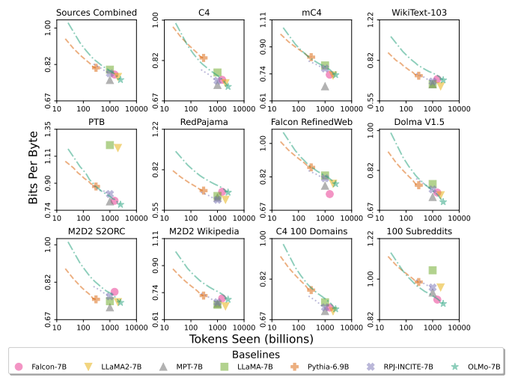
Figure 2 : Bits per byte on 11 evaluation data sources from Paloma and their combination (Magnusson et al., 2023), decontaminated from OLMo’s pretraining data. While models follow a general data scaling trend, sample efficiency is most favorable on in-distribution data. For example, OLMo-7B overtakes all other models on C4, perhaps from having 88.8% Common Crawl pretraining data.
Original paper · CC BY 4.0 · Extracted the figure area from page 8 of the original PDF.Why release the training data with the weights
Most earlier open releases shared model weights and inference code, while the data and the training and evaluation code stayed out of reach. OLMo was designed to close that gap by publishing the training data, the training and evaluation code, intermediate checkpoints and training logs together. The authors link this to questions they expect the release to help answer, such as how pretraining data relates to model capabilities and how hyperparameter and optimizer choices affect training.
The release covers a 1B and a 7B scale, and all of these models were trained on at least 2T tokens. Several hundred intermediate checkpoints are made available as revisions on HuggingFace. Code and weights are released under the Apache 2.0 License.
Architecture changes to the vanilla transformer
OLMo keeps a decoder-only transformer and changes several components that the authors chose for training stability and throughput. The changes follow recent models such as PaLM, the LLaMA family, OpenLM and Falcon, and Table 5 places the 7B architecture next to those models.
All bias terms are removed from the architecture, which the authors say improves training stability. The layer norm has no affine transform, so it has no adaptive gain or bias; the authors judged this the safest and fastest option against parametric layer norm and RMSNorm. The feed-forward block uses SwiGLU with a hidden size of approximately 8/3 d, rounded up to a multiple of 128, which gives 11,008 for the 7B model.
Because SwiGLU is gated, its input has twice that width, 2 × 11,008 = 22,016 for the 7B model. Absolute positional embeddings are replaced by rotary positional embeddings (RoPE).
The tokenizer modifies the BPE tokenizer of GPT-NeoX-20B and adds tokens for masking personally identifiable information, giving a vocabulary size of 50,280. The embedding matrix is enlarged to 50,304, a multiple of 128, to improve training throughput.
Optimizer, precision and batch layout
Table 1 lists the 1B and 7B settings: the 1B model has 16 layers and a peak learning rate of 4.0E-4 with 2000 warmup steps and weight tying, while the 7B model has 32 layers and a peak learning rate of 3.0E-4 with 5000 warmup steps and no weight tying. The learning rate warms up over 5000 steps, about 21B tokens, and then decays linearly to a tenth of the peak over the rest of training.
After warm-up, gradients are clipped so that the global L2 norm over all parameter gradients does not exceed 1.0.
Training uses FSDP, which shards the model weights and the optimizer state across GPUs. At the 7B scale each GPU processes a micro-batch of 4096 tokens. The global batch is approximately 4M tokens, made of 2048 instances of 2048 tokens each. Mixed precision keeps the softmax in full precision and runs other operations in bfloat16, while the sharded weights and optimizer state stay in full precision and gradients are reduced in full precision.
The training corpus is a 2T-token sample of Dolma; an EOS token is appended to each document, the stream is cut into 2048-token instances, and every run shuffles the instances in the same way. Some models were trained for a second epoch with a different shuffle; the authors expect the effect of repeating this small share of data to be negligible, citing prior work.
Dolma as the pretraining corpus
Dolma draws on sources that are common in large pretraining runs and are accessible to the public. It is built through language filtering, quality filtering, content filtering, deduplication, multi-source mixing and tokenization. Documents from each source are kept separate during curation and in the final release.
How checkpoints are scored
Evaluation runs at two stages: an online signal computed in the training loop every 1000 steps, and offline evaluation of checkpoints with Catwalk. Downstream tasks are scored zero-shot on eight core tasks, selected because each can be framed as text completion scoring.
Each candidate completion is ranked by likelihood and the prediction accuracy is reported.
Perplexity is measured on Paloma, which contains 585 domains drawn from 18 sources. Before the perplexity evaluation, pretraining documents containing paragraphs leaked from Paloma were removed, which the authors describe as decontamination. The aggregate covers 11 of the 18 sources, and results are reported as bits per byte so that models with different vocabularies can be compared.
Zero-shot results on the core tasks
OLMo-1B averages 60.4, above Pythia 1B at 54.5 and TinyLlama 1.1B at 59.4, while StableLM 1.6B averages 66.5 but is significantly larger and was trained on data the paper does not identify.
Accuracy generally rises as OLMo-7B sees more tokens, and all tasks except OBQA show an upward trend. The sharpest rise on many tasks occurs between the last two checkpoints, which the authors attribute to lowering the learning rate linearly to zero over the final 1000 training steps.
Bits per byte on Paloma sources
Across the combined 11 sources OLMo-7B has a competitive fit, and its intermediate checkpoints follow scaling trends similar to those of the other models. Checkpoints trained for fewer steps look steeper partly because of where they sit in the learning rate schedule. MPT-7B improves ahead of the other models in the combined plot; the authors connect this to its data mix, with 27% non-Common Crawl data against 18% for LLaMA, 12.2% for RedPajama and 11.2% for OLMo, and to its semantic deduplication on C4.
OLMo-7B overtakes all other models on C4, and the authors attribute this partly to the 88.8% Common Crawl share of its pretraining data. It is less sample efficient than the other models on WikiText-103, M2D2 S2ORC and M2D2 Wikipedia, which are further from scraped web text, and Falcon-7B fits Falcon RefinedWeb best.
Instruction tuning and preference training
OLMo-7B is instruction finetuned on the TÜLU data and training setup, then aligned with Direct Preference Optimization on distilled preference data. The instruction stage uses a learning rate of 2 × 10⁻⁶ for 3 epochs on the TÜLU V2 SFT mix, and the DPO stage uses a learning rate of 5 × 10⁻⁷ and beta 0.1 for 3 epochs on UltraFeedback pairs.
MMLU is scored 0-shot, with the score for the base model at 28.3, OLMo+SFT at 47.3 and OLMo+SFT+DPO at 46.2. AlpacaEval win rate against Davinci-003 rises from 57.0 after SFT to 69.3 after DPO, with GPT-4 as the judge.
The ToxiGen setup uses 500 hateful prompts per group, and TruthfulQA uses 818 questions with LLaMA 2-based judges. Table 8 gives the 0-shot MMLU score of OLMo+SFT+DPO as 46.1, while Table 4 gives 46.2 for the same setting; the paper does not reconcile the two values. TÜLU 2 reaches 50.4 on MMLU, and the authors suggest the remaining gap may reflect test set contamination in Llama 2 and a TÜLU mix designed for Llama models.
Pretraining emissions estimate
Power is measured on a single node every 25ms, averaged over the run, multiplied by the number of nodes and scaled by a power usage effectiveness of 1.1. The 7B models are estimated to have consumed 239 MWh of energy. The A100-40GB run was assigned a carbon intensity of 0.610 kg CO2 per kWh for Australia, while the LUMI run uses the official LUMI data, giving a total of 69.78 tCO2eq.
A hydroelectric carbon intensity of 0.024 from another source would imply 3.54 tCO2eq for the LUMI run. The authors call these figures lower bounds, since they leave out embodied emissions, lifetime use, rebound effects, water and mining, and development work such as debugging and hyperparameter tuning.
Auxiliary tasks and code-data results
On six auxiliary end-tasks, OLMo-7B averages 47.5, the highest value in Table 7 among the compared models. These tasks gave less stable trends than the core suite and limited signal during training, as Figure 4 illustrates, so the authors caution against relying on them heavily.
The authors note this may partly reflect contamination, since decontaminating code data is beyond the scope of the Paloma method, and that OLMo-7B's code was processed with exactly the same post-processing as the Dolma code subset.
Limitations
The pretraining data is limited to English, and the authors hope the open framework will support multilingual models later. The data likely contains toxic language, personal information and copyrighted text, and the authors say no current approach removes such content completely. Because of the page limit, training runs that diverged or failed to learn are not documented in detail.
The adapted models still show bias, toxicity and hallucination, and the TÜLU mix was designed for Llama models, so OLMo may need a different data mixture. Many downstream tasks do not reflect how people use language models as chatbots, and language model evaluations are described as very noisy, so comparisons should be read with caution. Whether the Paloma comparison holds for code sources is not established, because those sources cannot be decontaminated with the Paloma method.
Paper info
- Authors
- Dirk Groeneveld, Iz Beltagy, Pete Walsh, Akshita Bhagia, Rodney Kinney, Oyvind Tafjord, Ananya Harsh Jha, Hamish Ivison, Ian Magnusson, Yizhong Wang, Shane Arora, David Atkinson, Russell Authur, Khyathi Raghavi Chandu, Arman Cohan, Jennifer Dumas, Yanai Elazar, Yuling Gu, Jack Hessel, Tushar Khot, William Merrill, Jacob Morrison, Niklas Muennighoff, Aakanksha Naik, Crystal Nam, Matthew E. Peters, Valentina Pyatkin, Abhilasha Ravichander, Dustin Schwenk, Saurabh Shah, Will Smith, Emma Strubell, Nishant Subramani, Mitchell Wortsman, Pradeep Dasigi, Nathan Lambert, Kyle Richardson, Luke Zettlemoyer, Jesse Dodge, Kyle Lo, Luca Soldaini, Noah A. Smith, Hannaneh Hajishirzi
- Venue
- arXiv · Preprint
- First published
- 2024-2-1
- Added
- 2026-10-20
- Updated
- 2024-6-7
- Version
- v4
- arXiv
- 2402.00838
- Category
- cs.CL
- Original paper terms
- CC BY 4.0
- What we show
- Paper info, commentary and permitted figures from the original paper
AI commentary is a separate explanation from the original paper and may contain errors. The original paper and figures follow each source's terms of use and any rights noted separately.
Abstract
Language models (LMs) have become ubiquitous in both NLP research and in commercial product offerings. As their commercial importance has surged, the most powerful models have become closed off, gated behind proprietary interfaces, with important details of their training data, architectures, and development undisclosed. Given the importance of these details in scientifically studying these models, including their biases and potential risks, we believe it is essential for the research community to have access to powerful, truly open LMs. To this end, we have built OLMo, a competitive, truly Open Language Model, to enable the scientific study of language models. Unlike most prior efforts that have only released model weights and inference code, we release OLMo alongside open training data and training and evaluation code. We hope this release will empower the open research community and inspire a new wave of innovation.
Quote from the paper
Dirk Groeneveld, Iz Beltagy, Pete Walsh, Akshita Bhagia, Rodney Kinney, Oyvind Tafjord, Ananya Harsh Jha, Hamish Ivison, Ian Magnusson, Yizhong Wang, Shane Arora, David Atkinson, Russell Authur, Khyathi Raghavi Chandu, Arman Cohan, Jennifer Dumas, Yanai Elazar, Yuling Gu, Jack Hessel, Tushar Khot et al. (2024). OLMo: Accelerating the Science of Language Models. arXiv:2402.00838v4. https://arxiv.org/abs/2402.00838v4
BibTeX
@misc{groeneveld2024olmo,
  title = {{OLMo: Accelerating the Science of Language Models}},
  author = {Dirk Groeneveld and Iz Beltagy and Pete Walsh and Akshita Bhagia and Rodney Kinney and Oyvind Tafjord and Ananya Harsh Jha and Hamish Ivison and Ian Magnusson and Yizhong Wang and Shane Arora and David Atkinson and Russell Authur and Khyathi Raghavi Chandu and Arman Cohan and Jennifer Dumas and Yanai Elazar and Yuling Gu and Jack Hessel and Tushar Khot and William Merrill and Jacob Morrison and Niklas Muennighoff and Aakanksha Naik and Crystal Nam and Matthew E. Peters and Valentina Pyatkin and Abhilasha Ravichander and Dustin Schwenk and Saurabh Shah and Will Smith and Emma Strubell and Nishant Subramani and Mitchell Wortsman and Pradeep Dasigi and Nathan Lambert and Kyle Richardson and Luke Zettlemoyer and Jesse Dodge and Kyle Lo and Luca Soldaini and Noah A. Smith and Hannaneh Hajishirzi},
  year = {2024},
  eprint = {2402.00838},
  archivePrefix = {arXiv},
  url = {https://arxiv.org/abs/2402.00838v4}
}