Paper commentary
Swapping the Judge Changes the Ranking: A Preregistered Study of Cross-Provider Replication in LLM-Judged System Comparisons
Cross-provider judge replication often picks the wrong system ranking
- Problem Without human labels, teams check an LLM judge's comparison by repeating it with a judge from another provider. Nobody had tested whether that check matches what human voters prefer.
- Method The authors re-judge 4,000 human-voted Chatbot Arena battles with five judges from three providers, in both response orders. They then score each judge's verdicts and rankings against the human votes.
- Results Replicated conclusions from two low-cost judges reached 0.902 precision, against 0.804 for single judges. Rankings still varied widely by judge, with Kendall's tau from 0.167 to 0.889.
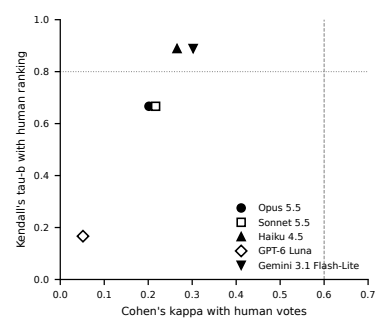
Figure 1 : Verdict agreement and rank correlation with the human reference. Markers identify individual judges; the reference lines show the preregistered H1 thresholds.
Original paper · CC BY 4.0 · Sangdo Han, Moonsoo Kim · Swapping the Judge Changes the Ranking: A Preregistered Study of Cross-Provider Replication in LLM-Judged System Comparisons · Original paper figure · Extracted the figure area from page 5 of the original PDF.Why a second judge is the usual check
Without human labels, an LLM judge is often the only tool for comparing two systems. A typical setup has the judge read one request and two responses, then aggregate its verdicts into a win rate or a ranking. When no human labels exist, the only check on that conclusion is another judge. That safeguard is only as good as the expectation behind it.
The check itself says nothing about whether either judge matches what people prefer.
A widely repeated observation gives the check some support. The authors preregistered this observation as hypothesis H1, which is a replication hypothesis. They add three further hypotheses: H2 on replication, H3 on sample requirements, and H4 on co-occurring disagreement. Each one checks a different part of the replication idea.
The study asks two practical questions about that check. First, when a judge from a different provider reproduces a single-judge conclusion, does it match the conclusion human votes would give? The registered design had six judges, and one was dropped after registration. The study re-judged 4,000 battles from a public Chatbot Arena release with five judge models from three providers.
Re-judging battles that already have human votes
The core design takes battles that already carry a human vote and has each judge re-judge them. Because the judge and human quantities come from the same items, the comparison doesn't depend on two different samples. The authors ask two questions: whether a conclusion from a second provider's judge matches the human conclusion, and how many verdicts a judge needs compared with human votes.
The source is arena-human-preference-140k, a public Chatbot Arena release pinned to a fixed revision that holds 135,634 battles. That filtering leaves 65,636 battles, and the authors don't filter by language.
The sample is split by pair into a development set of 1,000 battles for pipeline checks and a confirmation set of 4,000 battles for all reported results.
Each judge sees the same prompt, which shows the request and two responses without system names. Each judge must end with a final verdict line of A, B, or tie, after a brief justification. Each battle is judged twice with the response order swapped, and the two orders must pick the same system for a win to count. If the two orders select different systems or either is a tie, the resolved verdict becomes a tie.
Battles whose two orders agree on the same system or are both ties are called order-consistent.
Verdict and ranking agreement under H1
H1 asked whether judge rankings stay stable enough to match the human ranking, and it pairs low verdict agreement with high rank agreement. The median Cohen's κ over the five judges is 0.217, with a 95% bootstrap interval of 0.193 to 0.240. That median sits below the 0.6 threshold that H1 set for verdict agreement. The median Kendall's τb is 0.667, with an interval of 0.556 to 0.722.
That median falls below the 0.8 threshold, so H1 isn't supported.
Each judge's Bradley–Terry ranking of the nine systems is compared with the human ranking. The judges spread widely, with τb from 0.167 for GPT-6 Luna to 0.889 for Haiku 4.5 and Gemini 3.1 Flash-Lite. Across nine systems, the gap between 0.889 and 0.667 means four of the 36 system pairs are ordered differently from the human ranking. On English battles, τb runs from 0.111 to 0.944, which shows the same wide spread.
On non-English battles, τb runs from 0.167 to 0.889.
Verdict agreement is low for every judge, while rank correlation depends strongly on which judge is used. The authors say this means their preferences are closer to those of Arena voters, not that their verdicts are more correct.
The majority vote of the five judges reaches τ of 0.778, which doesn't beat the best single judges. That check doesn't show the disagreements are random, because with nine systems the ranking statistic alone can't separate systematic from random disagreement. The provider-level analysis in Section 4.6 is what can make that separation.
Does replication across providers help (H2)
Replication here means two economy judges from different providers must both return a significant direction in the same way. Replicated precision is the share of those shared conclusions that match the human direction. Coverage is the share of the 23 pairs in E that yield a conclusion, which is the cost side of the check. The economy set is Haiku, Luna and Flash-Lite, the three low-cost judges from different providers.
Averaged over the economy set, single-judge precision is 0.804 and replicated precision is 0.902. The difference of 0.098 has a 95% interval of 0.052 to 0.194 and a Holm-adjusted p of 0.002, so H2 is supported. The same difference on all 33 pairs with a nonzero human direction is 0.125, with an interval of 0.028 to 0.172. Table 2 breaks these numbers down by source.
Haiku and Flash-Lite each reach the human conclusion on 22 of 23 pairs. Their shared conclusions are right on the same 22 of 23 pairs, so replicating them adds nothing. Their one wrong conclusion is common to both judges, which replication can't catch. Requiring agreement with a second judge keeps seven of eight replicated conclusions right, but only eight of 23 comparisons get a conclusion.
Replication with Luna therefore drops coverage from 100% to 35% of comparisons.
Replication works here as a filter against one poorly aligned judge, not as a general gain in validity. A user can't tell from replication alone whether two judges agree because both are right or because they share a flaw. The verdict-level analogue from Arena Team (2026) found that unanimous agreement among twelve judges matched the human vote on only 60.6% of battles.
How many verdicts a judge needs (H3)
For each pair and source, the authors draw 1,000 resamples of 25, 50 or 100 battles with replacement and check how often the direction matches the full-data direction. H3 is assessed on the 23 pairs with a human gap of at least 0.1, using the median ratio of judge n* to human n*, which must be at most 2.
Human votes reach a stable direction on all 23 of these pairs, and the median ratio is 1 for four judges and infinite for Luna, so H3 holds for four of five judges. Table 3 shows the full distribution of n* by source.
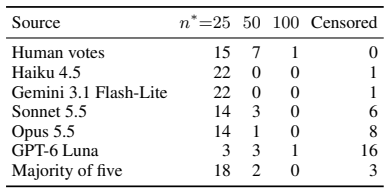
Table 3 : Number of system pairs (of the 23 with human gap gH ≥0.1 ) by the smallest sample size at which the source reproduces the human direction in at least 95% of resamples. Censored: not reached at any size tested.
Original paper · CC BY 4.0For these pairs the judge's win rate sits on the other side of 0.5 or too close to it, so the verdicts don't recover the human direction at the sizes tested. The authors connect this to Dorner et al. (2025), where judge bias, not judge noise, limits what extra judge labels can deliver.
Disagreements that move together (H4)
H4 asks whether the three economy judges, Haiku, Luna and Flash-Lite, err on the same battles more often than independence would predict. The rule is that D, defined as O minus E⊥, must be greater than zero.
On 2,351 such confirmation battles, all three judges disagree with the human vote on 15.8% of battles. Independent disagreements would predict 3.5%, so D comes to 0.122, with a 95% interval of 0.111 to 0.133. After Holm correction the p-value is 0.002, so H4 is supported as a statistical result.
Only one user's single vote serves as the reference, which narrows what the number can mean. If that user preferred the response most readers would rate worse, all three judges would disagree together without sharing any bias. The design can't separate that case from shared judge bias, because each battle has just one human vote. Two post hoc checks are consistent with a substantial share of voter noise in the disagreements.
The co-occurrence rate is also lower in pairs with larger human gaps, a pattern the authors also label post hoc. The authors therefore call the finding co-occurring disagreement with the human vote, not evidence of common judge error.
Which provider the judges favor
The provider-preference analysis asks whether each judge favors its own provider's systems over what human voters show. The nine selected systems come mostly from three providers, so dropping battles with a judge's own provider wasn't workable. Excluding those battles would remove 31 to 63% of the sample. Instead, the authors measured preference directly, as a prespecified secondary analysis.
Table 4 compares each judge's score with the human score for systems from each provider. Each cell uses only battles where exactly one of the two systems comes from that provider, with 870 to 2,163 battles per cell. Opus 5.5 scores its own Anthropic systems +0.173 above the other cells, with a 95% interval of 0.141 to 0.211. Sonnet 5.5 shows a similar lean toward Anthropic systems, at +0.129 with an interval of 0.098 to 0.163.
Gemini 3.1 Flash-Lite favors Google systems by +0.193, with an interval of 0.161 to 0.224.
Haiku 4.5 goes the other way, at -0.136 with an interval of -0.167 to -0.105. GPT-6 Luna doesn't show an own-provider preference, with -0.039 and an interval that includes zero. Luna instead scores Anthropic systems +0.245 above human voters. All judges rate Mistral and Alibaba systems lower than human voters do.
The authors read these preferences as systematic and judge-specific, since provider identity alone doesn't explain them. These numbers compare judges with Arena voters, so they don't say which side is right. They match recent reports of self- and family-preference, which the authors cite as Panickssery et al., 2024; Awuni et al., 2026; Arena Team, 2026.
What replication and sample size buy a judge chooser
Replication with a second provider worked mainly as a screen against one poorly aligned judge. Luna's replicated conclusions were right in seven of eight cases, but only eight of 23 comparisons got a conclusion at all. The authors therefore treat replication as a screen for an unreliable judge, not as a substitute for human validation.
Haiku and Flash-Lite reproduced the human direction with 25 verdicts on 22 of 23 pairs. Human votes needed 50 or more on eight pairs, so those judges' verdicts were less noisy than individual votes. Sonnet, Opus, and Luna didn't converge on 6, 8, and 16 pairs, which is 26%, 35%, and 70%. More verdicts from the same judge didn't resolve those pairs within the sizes tested.
Judge choice matters more than sample size, so a practitioner's first decision is which judge to use. Haiku 4.5 reaches κ 0.266 and Gemini 3.1 Flash-Lite reaches 0.302. Opus 5.5 reaches 0.202 and Sonnet 5.5 reaches 0.217 on the same measure. The larger Anthropic judges agreed less with human votes than the low-cost judges did. One reading is that larger models weight correctness over presentation, but the data don't test that reading.
A small human-labeled set could reveal which judge fits the task at hand. That reference rests on a single crowd vote per battle, which reflects voter preference rather than correctness.
Limitations of the cross-provider judge study
The study's own limits start with its judge set, which changed after the preregistration was frozen. The registered design had six judges, including an open-weight model from a fourth organization, and that judge was dropped for a logistical reason. Because of this, H1 is evaluated over five judges, while H2 and H4 rest on three economy judges.
The authors release the verdicts themselves, which is the practical fallback for anyone who wants to check the numbers.
The authors tested one prompt and one verdict-resolution rule. Treating order-inconsistent verdicts as ties is one of several reasonable choices, and they didn't test it. Reasoning settings weren't uniform across judges, because providers expose different controls. GPT-6 Luna ran with reasoning turned off, while Opus and Sonnet ran with low-effort reasoning.
Paper info
- Authors
- Sangdo Han, Moonsoo Kim
- Venue
- arXiv · Preprint
- First published
- 2026-11-3
- Added
- 2026-11-5
- Updated
- 2026-11-3
- Version
- v1
- arXiv
- 2611.04090
- Category
- cs.CL · cs.AI · cs.CY
- Original paper terms
- CC BY 4.0
- What we show
- Paper info, commentary and permitted figures from the original paper
AI commentary is a separate explanation from the original paper and may contain errors. The original paper and figures follow each source's terms of use and any rights noted separately.
Abstract
Practitioners who compare systems with an LLM judge and have no human labels often check a conclusion by repeating it with a judge from another provider. We test how far that check can be trusted. In a preregistered study (with a disclosed post-registration reduction of the judge set), five judge models from three providers re-judged 4,000 Chatbot Arena battles (nine systems, 33 system pairs) that carry human votes, each in both response orders. Agreement with the human vote was low at the verdict level (median Cohen's kappa = 0.22), and system rankings did not survive a change of judge: Kendall's tau with the human ranking ranged from 0.17 to 0.89 (median 0.67), so the preregistered hypothesis that rankings remain stable was not supported. Conclusions replicated by two low-cost judges from different providers matched the human conclusion more often than single-judge conclusions (+0.10 precision), but the gain came from filtering out one poorly aligned judge, and replication involving that judge left a conclusion for only 35% of comparisons. Judges that agreed with humans reached a stable conclusion with no more verdicts than human votes required; the others failed to converge on 26-70% of system pairs at the sample sizes tested (up to 100 verdicts per pair). Disagreements with the human vote co-occurred across judges far more often than independence predicts, although a single human vote per battle cannot separate shared judge bias from voter noise.
Quote from the paper
Sangdo Han, Moonsoo Kim (2026). Swapping the Judge Changes the Ranking: A Preregistered Study of Cross-Provider Replication in LLM-Judged System Comparisons. arXiv:2611.04090v1. https://arxiv.org/abs/2611.04090v1
BibTeX
@misc{han2026swapping,
  title = {{Swapping the Judge Changes the Ranking: A Preregistered Study of Cross-Provider Replication in LLM-Judged System Comparisons}},
  author = {Sangdo Han and Moonsoo Kim},
  year = {2026},
  eprint = {2611.04090},
  archivePrefix = {arXiv},
  url = {https://arxiv.org/abs/2611.04090v1}
}