Paper commentary
When Scores Conflict with Preferences: Pre-Alignment Diagnosis and Adaptive Correction of Constraint Drift in DPO
Conflict-aware DPO diagnoses and corrects constraint drift before training starts
- Problem Standard DPO treats pairs whose preferred answer scores worse on a pointwise criterion the same as other pairs. These conflict pairs raise constraint cost, so the policy drifts toward outputs that win comparisons but cost more.
- Method CoDPO sets conflict pair weights from a dataset diagnostic, then adds a margin shift.
- Results On four domains CoDPO reduces drift while largely preserving vanilla DPO's preference learning. Hard filtering keeps only 7% to 41% of the P(chosen) gain over the base model on HelpSteer2, GSM8K, ARC and Math-Calc.
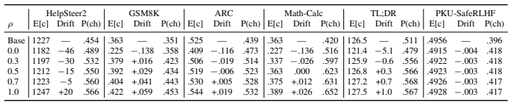
Table 2 : Drift curves across six domains. Each row corresponds to a different average conflict weight ρ; Base denotes the reference model before alignment. The constraint cost is response length (characters) on HelpSteer2 and TL;DR, binary incorrectness probability on GSM8K, ARC, and Math-Calc, and based on the safety score on PKU-SafeRLHF (Appendix A).
Original paper · CC BY 4.0 · Ping Liu, Yan Yan · When Scores Conflict with Preferences: Pre-Alignment Diagnosis and Adaptive Correction of Constraint Drift in DPO · Original paper figure · Extracted the figure area from page 9 of the original PDF.Why conflict pairs push a cost up under DPO
Plain DPO treats every preference pair the same, even when the preferred answer scores worse on a pointwise criterion. The paper calls such pairs conflict pairs, and it defines them by a score gap below zero. On GSM8K and ARC, the preferred answer is the incorrect one in 71% and 58% of pairs, respectively. Each conflict pair pushes the policy toward an output that wins the comparison but costs more on the criterion.
The authors call this degradation constraint drift, borrowing the idea of semantic drift from PSDPO.
Existing fixes leave the strength of the intervention to the practitioner. Per-pair weighting attenuates conflict pairs instead, but its strength is still chosen by hand. The paper's theory explains drift as a balance, not as a count of conflicts. Conflict pairs raise the expected constraint cost, while matching pairs repair it. Drift therefore depends on conflict-side pressure against matching-side repair, which is why conflict frequency alone isn't enough.
Theorem 1 gives the first-order mechanism behind this balance under gradient descent on the DPO loss. The conflict term has a positive pressure term kappa_0, and matching pairs contribute a repair term mu_0. Drift becomes positive when p_c times kappa_0 exceeds (1 minus p_c) times mu_0, for sufficiently small step size eta. The paper's reasoning is first-order, so it holds for small updates rather than the whole training run.
CoDPO builds one loss from two parts, with the weights fixed before training and the margin shift adjusted during training. The coarse level down-weights conflict pairs by severity, following PSDPO's asymmetric weighting. The fine level shifts each pair's DPO margin in proportion to its cost gap, so it can respond to residual drift.
Pressure against repair as a diagnostic before training
Each DPO step moves the constraint cost in two directions, so the net effect depends on how the two balance. Conflict pairs have a positive cost gap, and the conflict rate p_c is the fraction of pairs with a negative score gap. The scorer s is oriented so that larger values mean better satisfaction, and the cost c decreases in s. Theorem 1 gives a lower bound on the expected change in constraint risk after one gradient step with step size η.
The conflict-side term κ0 is positive, and the matching-side term µ0 repairs the cost. Drift appears when p_c κ0 exceeds (1−p_c) µ0, so the balance decides the sign of the change.
The ratio in this condition depends on quantities that change during training, so the authors evaluate it at initialization. At initialization π_θ equals π_ref, so the implicit margin is zero on every pair. The learning signal β(1−σ(βr̂_θ)) then takes the value β/2 on every pair, and it cancels exactly in the ratio. Under Assumption (vi), learning a conflict pair changes the expected cost about as much as learning a matching pair per unit cost gap.
With that assumption, the geometry term cancels approximately, and the ratio reduces to average cost differences.
The diagnostic ρ*eq equals (1−p_c)|Δc|match divided by p_c Δc_conf, which uses only the dataset's cost gaps. So ρ*eq depends on how large the cost differences are, not only on how often conflicts occur. A value at or above 1 marks the dataset as self-correcting, so no intervention is needed. A value below 1 calls for intervention.
The next step asks how much down-weighting conflict pairs is enough. CoDPO takes its estimate ρ*eq in place of ρ*, because ρ* depends on model gradients. Some drift can still remain, since ρ* shifts as training proceeds.
Down-weighting conflict pairs by severity
CoDPO keeps matching pairs at weight 1 and gives each conflict pair an exponential weight that falls as its score gap grows. The weight is exp(−(|Δs|/τ)^p) for conflict pairs, where τ sets the overall strength and p sets how sharply the weight drops. Setting p to 1 recovers the asymmetric exponential weighting of PSDPO, and the paper uses p = 8 in all experiments.
In PSDPO, τ is a hyperparameter, but CoDPO solves for τ so that the average conflict weight equals ρ∗eq clipped to the range 0 to 1. The average conflict weight rises strictly with τ, so bisection finds a unique τ whenever ρ∗eq lies strictly between 0 and 1. When ρ∗eq is at least 1, every weight stays at 1 and the run is plain DPO.
CoDPO cannot compute ρ∗ because it depends on model gradients, so it uses the closed-form estimate ρ∗eq instead. Some drift can still remain, since the estimate sits at the balance point rather than strictly below ρ∗, and the balance point moves during training.
Shifting the DPO margin during training
The fine level handles the drift that remains after the coarse weights, because the weights are calibrated when every margin is zero. As training proceeds, the learning signal differs from pair to pair, so the balance point moves while the weights stay fixed. CoDPO adds λ times the cost gap to each pair's margin, so a conflict pair is pushed less and a matching pair is pushed more.
Unlike the fixed margin offsets of ODPO, R-DPO and SafeDPO, this single scalar λ can be changed during training.
The shift needs no change to the DPO loss, because tilting the reference policy against high-cost outputs produces the same margin shift. The reference is tilted with exp(−λc(x, y)), and the normalizer Z(x) cancels in the pairwise margin. The tilt links the shift to Lagrangian constrained alignment, which raises λ while an estimated cost exceeds a threshold.
Setting the shift strength during training
The shift strength λ starts at α times λtilt, with α set to 0.1 in the main setup. The cap λtilt = max(0, 2E_D[Δc] / (β E_D[Δc²])) comes from the same first-order analysis as ρ*eq, for the unmodulated loss. The maximum with zero stops λ from turning negative, which would reverse the shift. When the average cost gap is at most zero, λtilt is zero and CoDPO reduces to vanilla DPO.
The training loop evaluates CbD on the training pairs every K = 500 steps. CbD weights the cost of each chosen and rejected response by a normalized policy probability qθ,i. Because CbD reuses responses already in the training data, it adds no generation cost. When CbD rises between two evaluations, λ goes up by αλtilt, but it never passes λtilt.
When CbD stays flat or falls, λ keeps its current value, since the current shift already suffices. This differs from Lagrangian methods, which raise λ when an estimated average cost exceeds a target.
The shift enters the combined loss as βλΔc, and each pair's fixed coarse weight wi multiplies its log-sigmoid term.
Drift curves and the diagnostic's intervention call
Drift grows with the average conflict weight ρ, which the authors vary over 0, 0.3, 0.5, 0.7 and 1. At ρ = 0, drift is negative because only matching pairs shape training. At ρ = 1, drift turns positive because conflict pairs keep their full weight. P(chosen) mostly rises with ρ, so removing conflicts also weakens preference learning. Hard filtering keeps only 7% to 41% of the P(chosen) gain over the base model on HelpSteer2, GSM8K, ARC and Math-Calc.
On TL;DR, hard filtering pushes P(chosen) below the base model. The diagnostic ρ∗eq is below 1 on all five conflict-dominated domains, matching the positive drift at ρ = 1. On PKU-SafeRLHF, the conflict rate is 2.5%, and ρ∗eq is 1.0, so the diagnostic predicts no intervention. The authors report that ρ∗eq lies within 0.05 to 0.30 of the zero crossing, and they attribute this gap to the first-order approximation behind Remark 1.
Table 3 reports +59 for vanilla DPO on HelpSteer2. Table 4 reports the same +59 for vanilla DPO on HelpSteer2.
Comparing CoDPO with constrained and multi-objective baselines
SafeDPO and PD-DPO enforce a constraint on the expected cost, so they pull drift well below the reference model. Their P(chosen) stays near or below the base model's .454 on HelpSteer2. C2-DPO constrains the update itself, so its drift stays near zero, at ≈0 on HelpSteer2 and Math-Calc. Its P(chosen) stays close to the base values, at .457 on HelpSteer2.
The configurations with higher P(chosen) have roughly 1.5 to 5 times CoDPO's drift. Among methods with drift comparable to or below CoDPO's, CoDPO has the highest P(chosen) in all four domains.
Relative to vanilla DPO, CoDPO reduces drift and raises P(chosen) in all four domains. For MODPO and Soups, the table reports the setting with the smallest absolute drift.
Generation quality and ablation checks
The JudgeLM-13B comparison on HelpSteer2 tests whether lower drift changes the generated answers. CoDPO wins 14.1% of comparisons against vanilla DPO. Against vanilla DPO, CoDPO loses 10.5% of comparisons and ties 75.5%. Against SafeDPO, PD-DPO and MODPO, CoDPO wins 52% to 86% of comparisons, in line with their lower P(chosen). Against C2-DPO and Rewarded Soups, most comparisons are ties, at 75% to 77%.
GPT-4o as a second judge prefers CoDPO over MODPO 44.9% to 3.9%.

Table 5 : LLM-as-judge evaluation (JudgeLM-13B) on HelpSteer2: CoDPO compared pairwise against each method.
Original paper · CC BY 4.0The ablation separates vanilla DPO, coarse weights alone, and full CoDPO across four conflict-dominated domains. Adding the margin shift lowers drift further in every case. The extra reduction from the margin shift is largest on GSM8K, at 17 percentage points. It is smallest on HelpSteer2, at 2 percentage points. On HelpSteer2, the coarse-only row gives +20, while the combined CoDPO row gives +18.7.
Across four base models on HelpSteer2, vanilla DPO drifts upward in every case. Table 8 sweeps the steepness parameter p on HelpSteer2. Drift reduction rises from 22% to 75% as p increases, while P(chosen) stays between .640 and .644.
Tracking ρ* during vanilla DPO training on HelpSteer2 checks the initialization approximation. At initialization, ρ*(0) is 0.710, which matches ρ*eq of 0.709. As σ rises to 0.946, ρ* moves to 0.603, a gap of 0.11.
What these results don't establish
The sharpness parameter p stays at 8 in every experiment, so these results don't show how sensitive CoDPO is to it. On HelpSteer2, the sweep shows drift reduction rising from 22% to 75% as p grows, while P(chosen) holds between .640 and .644. The authors didn't tune p per domain, and they note that a larger p lowers drift further. As p grows without bound, the modulation becomes a hard threshold on |∆s| that keeps mild conflicts, which differs from ρ → 0.
The diagnostic ρ∗eq rests on a first-order approximation, and it lies 0.05 to 0.30 from the zero crossing of drift. The authors attribute that gap to the approximation, so the zero crossing isn't exactly predicted by ρ∗eq. On HelpSteer2, the recomputed value ρ∗(0) of 0.710 matches ρ∗eq of 0.709 at initialization. Once σ reaches 0.946, the balance point moves to 0.603, a gap of 0.11.
The paper doesn't test whether the adaptive margin shift keeps pace with this moving balance point beyond these runs.
Drift is measured on the training pairs, so the paper doesn't report drift on held-out pairs. The main comparison uses Qwen2.5-7B-Instruct with LoRA and DPO at β=0.1. The additional base models and preference losses appear only on HelpSteer2 in Table 4. The PKU-SafeRLHF control appears only in the drift curves of Table 2. Generation quality rests on JudgeLM-13B, and GPT-4o serves only as a second judge.
They leave for future work the settings where the preference pairs are generated during training.
Paper info
- Authors
- Ping Liu, Yan Yan
- Venue
- arXiv · Preprint
- First published
- 2026-11-5
- Added
- 2026-11-6
- Updated
- 2026-11-5
- Version
- v1
- arXiv
- 2611.07375
- Category
- cs.LG
- Original paper terms
- CC BY 4.0
- What we show
- Paper info, commentary and permitted figures from the original paper
AI commentary is a separate explanation from the original paper and may contain errors. The original paper and figures follow each source's terms of use and any rights noted separately.
Abstract
Direct Preference Optimization (DPO) is increasingly used in settings where pairwise preferences coexist with pointwise criteria such as response length, answer correctness, or safety scores. When the two disagree, standard DPO treats pairs whose preferred output scores worse on the pointwise criterion (conflict pairs) in the same way as the remaining (matching) pairs. We characterize a systematic failure mode, constraint drift: for sufficiently small updates, conflict pairs tend to increase constraint cost while matching pairs tend to repair it, and the net change depends on their balance. This balance yields a closed-form pre-alignment diagnostic, $ρ^{*}_{\mathrm{eq}}$, computable from dataset statistics, that indicates whether a dataset is self-correcting or requires intervention. Building on this diagnostic, we propose Conflict-aware DPO (CoDPO), which down-weights conflict pairs with a strength set from $ρ^{*}_{\mathrm{eq}}$ rather than tuned, and adds an adaptive margin shift that addresses residual drift during training. Empirically, drift grows monotonically with conflict exposure on the conflict-dominated domains, and the intervention decision given by $ρ^{*}_{\mathrm{eq}}$ matches the observed drift on every domain, including one that it identifies as self-correcting. On all four domains of the main comparison, CoDPO reduces drift while largely preserving the preference learning of vanilla DPO. Compared with hard filtering and recent constrained and multi-objective baselines, CoDPO also achieves a more favorable drift-preference trade-off.
Quote from the paper
Ping Liu, Yan Yan (2026). When Scores Conflict with Preferences: Pre-Alignment Diagnosis and Adaptive Correction of Constraint Drift in DPO. arXiv:2611.07375v1. https://arxiv.org/abs/2611.07375v1
BibTeX
@misc{liu2026when,
  title = {{When Scores Conflict with Preferences: Pre-Alignment Diagnosis and Adaptive Correction of Constraint Drift in DPO}},
  author = {Ping Liu and Yan Yan},
  year = {2026},
  eprint = {2611.07375},
  archivePrefix = {arXiv},
  url = {https://arxiv.org/abs/2611.07375v1}
}