Paper commentary
Gumbel Substitution: Removing Sampler Drift from RL Without Trusting the Sampler
- Problem Samplers on an open network can differ from the trainer in hardware, precision and checkpoint, so training on their tokens adds a term that pushes the policy toward the sampler's distribution. Existing corrections need the sampler's reported probability.
- Method Admission gates on match rate and gap decide which rollouts enter the loss.
- Results In the lab, uncorrected training collapsed at steps 41 and 44 at learning rate 5e-6 on a 2B model under strong mismatch, while substitution stayed stable. In production, the 9B run reached a 0.979 match rate with 1.21% of trained tokens substituted.
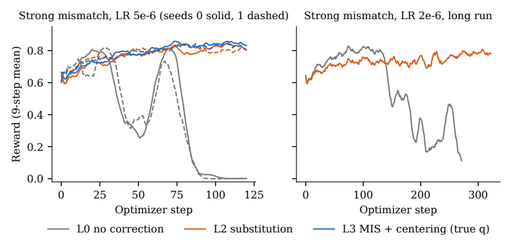
Figure 2 :Reward of the mini-trainings under strong mismatch (2B, gsm8k). Left: learning rate5× 10−6, two seeds; uncorrected training (L0) collapses at steps 41 and 44. Right: long run at2× 10−6; L0 collapses at step 184, substitution (L2) stays stable for 323 steps.
Original paper · CC BY 4.0 · Romain Fanucci, Malik El Hassani · Gumbel Substitution: Removing Sampler Drift from RL Without Trusting the Sampler · Original paper figure · Extracted the figure area from page 11 of the original PDF.Why sampler drift destabilizes RL
When samplers pick their own hardware, precision and checkpoint, the distribution they draw from is not the trainer's current policy. Accepting their tokens for training then adds a term that acts like supervised fine-tuning toward the sampler's distribution. The problem is concrete for the Reliquary subnet, where a coordinator pays independent operators per verified token and the trainer never inspects their models.
Several published corrections handle this mismatch by reweighting, masking or centering each token using the sampler's probability of that token. Those include truncated and masked importance sampling, IcePop, score centering, GSPO and CISPO. Left uncorrected, GRPO collapses on mixed-precision, mixed-accelerator samplers, and the authors observed the same instability in their own runs.
Replacing the target, not the context
The method keeps the sampler's tokens as the prefix and changes only the token that is scored. The coordinator fixes noise for each token position before sampling, so the sampler and the trainer can use the same noise. The sampler draws each token as the argmax of its logits plus that noise. The trainer then takes the argmax of its own logits plus the same noise at the same prefix, and that token becomes the target.
The loss averages the group-normalized advantage times the log-probability of the trainer's pick over the tokens of a step. The pick is computed without gradient, in the sampler's prefix, from the latest checkpoint's fp32 head. Where the pick equals the sampler's token, the update is the usual on-policy score. Where it differs, the trainer scores its own pick with the advantage earned by the sampler's trajectory.
How the shared noise is built
For each checkpoint the coordinator draws a 32-byte secret and publishes only its commitment. Lease nonces hash that secret with the environment, prompt and checkpoint, so two leases on the same environment, prompt and checkpoint share the same draw.
A splitmix64 mix of the position key and the token id gives a 53-bit uniform for each token. The Gumbel value is \(G_v = -\log(-\log U_v)\), computed in float32 with a non-fused logf so the bits match on A100, RTX 4090, H100 PCIe and CPU.
Two parties with the same noise can pick different tokens only if their two best scores lie within \(2\max_v|\ell_{pv}-\ell_{qv}|\) of each other. Position counting follows the model's token counts rather than sampler calls. An earlier per-slot counter broke after vLLM preemption reset it, and that misaligned the noise.
Match rate, admission and payment
The match rate is the fraction of stochastic positions, those with maximum probability below 0.99, where the trainer's pick equals the sampled token. It comes from the logits of the training forward pass, so it adds almost no cost. Because it checks the sampled tokens themselves, the match rate also verifies rollouts. Training rollouts carry no separate proof, unlike TOPLOC, which commits to activations.
Audits cover groups outside the learning zone, which are not trained and are checked against the latest checkpoint.
What the zero-drift argument covers and what it leaves out
If the noise at a position is independent of the prefix, Gumbel-max gives an exact sample from the trainer's policy given that prefix. For any coefficient independent of the noise given the prefix, the expectation of that coefficient times the gradient of the log-probability of the pick is \(c\sum_v p_v\nabla\log p_v = 0\).
The mean L1 gap between the two softmaxes is 0.0098 per position, so the deployed claim is approximate zero drift, with about 0.5% of probability mass moved.
The estimator is not an unbiased on-policy gradient. Prefixes and returns come from the sampler's distribution, and no importance correction is applied. At a disagreement position the advantage depends on both the pick and the continuation. The residual cross-credit bias is concentrated where the action value of the sampler's token and that of the pick differ, and it vanishes where they are equal.
The threat model trusts the trainer and the coordinator's secrets and trusts nothing the sampler reports. The guarantee assumes causal generation, so a sampler that chooses its prefix from the noise of later positions falls outside it. A sampler that withholds a group after seeing its draws can only forfeit its own pay for that group, and the bound does not cover that selection.
No coupling agrees more often than \(1-\mathrm{TV}(p,q)\). Gumbel sampling agrees at least \((1-\mathrm{TV})/(1+\mathrm{TV})\) of the time, so the disagreement rate is bounded as \[\mathrm{TV}(p,q)\le\Pr[v^*\ne y]\le\frac{2\,\mathrm{TV}(p,q)}{1+\mathrm{TV}(p,q)}.\]
Gumbel-max against inverse-CDF sampling
Under Gumbel-max a token's disagreement rate depends only on its own probability. Across 881 tokens, none deviated from the rate predicted by that probability by more than four standard deviations.
Honest samplers on five card types agree with the trainer to within 0.0006 in match rate. W4A16 and NVFP4 samplers fall to 0.854 to 0.856, below the 0.90 admission floor. Per-rollout AUC for detecting fp8 weights under Gumbel is 0.98 to 0.997, while an fp8 KV cache is not separable from honest rollouts at AUC 0.55.
Lag, gradient direction and the cross-credit test
The Gumbel replay of the same rollouts falls from 0.987 to 0.949, and the rewritten share rises from 5.5% to 17.9%. Lag rotates the gradient away from the true-q correction. The cosine with the true-q gradient for the substitution loss is 0.938 at lag 0 and 0.792 at lag 8, while the uncorrected cosine falls to 0.606 at lag 8.
The cross-credit test measures the absolute value difference between the action values of the sampler's token and the pick. At disagreement positions the mean is 0.096, with 95% CI 0.089 to 0.103, against 0.103, with CI 0.096 to 0.111, at entropy-matched controls. The authors conclude that disagreements are not concentrated on decision points, though this test covers math only.
Mini-trainings under strong mismatch
The mini-trainings use a 2B model on gsm8k with Gumbel noise and 120 steps unless stated. Strong mismatch calibrates weight noise to a 0.90 match rate and adds lag 4, and the real fp8 arm uses vLLM fp8 with lag 4. At learning rate 5e-6, uncorrected training collapsed at steps 41 and 44 in the two seeds, while substitution and MIS with score centering were stable.
In the long run at learning rate 2e-6, uncorrected training collapsed at step 184, while substitution stayed stable for 323 steps.
At learning rate 2e-6 under strong mismatch, the uncorrected run has the best reward over the last 20 steps, 0.791, against 0.734 for substitution and 0.740 for MIS with score centering. The authors note that its entropy falls to 0.221. Under real fp8 on a short horizon, substitution scores 0.765 against 0.816 for the uncorrected run, a cost of about 0.05 reward.
The production run on a permissionless network
The run covered steps 1 to 158 of the 9B model Teutonic-I after supervised fine-tuning, from October 22 to November 2, 2026, and mixed seven environments. It totals 15.75B trained tokens from 161 sampler accounts with at least one trained group, with up to 73 active at once over steps 1 to 131. The match rate over stochastic positions was 0.979, and substitution covered 1.21% of all trained tokens.
Entropy declined from 0.70 to between 0.54 and 0.57 in the later phases, and the authors report no collapse.
Substitution rose from 0.62% in steps 1 to 20 to between 1.0% and 1.7% in later phases, which the authors name as the only indicator that degrades clearly. The match rate eased from 0.9900 in steps 1 to 20 to 0.9698 in steps 81 to 100, mostly on agentic tasks and instruction following.
Per-sampler math match rates form clusters near the lab values for each precision, including about 0.993 for fp32 heads and about 0.986 for bf16 heads.
Held-out benchmark results after RL
On SWE-bench Verified, pass@1 rose from 17.3 after SFT to 43.6 after RL, with 95% intervals of 13.9 to 20.7 and 39.2 to 48.0. Pass@1 on TMax rose from 28.4 to 74.8 and on LiveCodeBench from 40.7 to 62.0. On AIME 2025 the value moved from 73.3 to 91.2, and on AIME 2026 from 74.2 to 89.6. RL improved every benchmark, from +3.3 points on GPQA Diamond to +46.4 on TMax.
The intervals are disjoint for SWE-bench Verified, TMax and LiveCodeBench, while they overlap on AIME, IFBench, MMLU-Pro and GPQA Diamond.
The held-out TMax and SWE-bench Verified sets come from the same task families as training, so their gains partly measure learning of those families. The sets farthest from training, GPQA Diamond and MMLU-Pro, moved least. Checkpoint curves recorded during the run use an earlier protocol and are not comparable with the final table. Under that protocol pass@4 on TMax rose from 36.5 to 80.5 between checkpoints 0 and 85.
Where substitution sits among related methods
Most mismatch corrections weight the sampler's own tokens, while substitution changes the scored token. Decoupled PPO and M2PO can use a recomputed old policy but still need the sampler's probabilities. Token-DiFR checks sampled tokens against a seed-synchronized reference for auditability, and the authors reuse that seed to build the training target.
Gumbel-based counterfactual methods such as drafter-invariant speculative decoding regenerate continuations or evaluate counterfactual rewards, while substitution uses neither a regenerated continuation nor sampler probabilities.
Limitations
The gradient is biased: states and returns come from the sampler's distribution, and cross-credit bias remains at disagreement positions. The branching test covers math only.
Paper info
- Authors
- Romain Fanucci, Malik El Hassani
- Venue
- arXiv · Preprint
- First published
- 2026-11-20
- Added
- 2026-11-23
- Updated
- 2026-11-20
- Version
- v1
- arXiv
- 2611.27375
- Category
- cs.LG
- Original paper terms
- CC BY 4.0
- What we show
- Paper info, commentary and permitted figures from the original paper
AI commentary is a separate explanation from the original paper and may contain errors. The original paper and figures follow each source's terms of use and any rights noted separately.
Abstract
When RL rollouts come from untrusted samplers on arbitrary hardware, precision and checkpoint lag, the sampling distribution $q$ differs from the trainer's policy $p$, and training on the sampler's tokens adds a drift term equal to supervised fine-tuning toward $q$. Published corrections (TIS, MIS, IcePop, score centering, GSPO, CISPO) all need $q(y)$, which a permissionless sampler reports and can misreport. We introduce Gumbel substitution. The coordinator fixes public Gumbel noise for every token position, bit-identical across GPUs, and the sampler draws $y=\arg\max(\ell^q+G)$. The trainer recomputes $v^*=\arg\max(\ell^p+G)$, the token its own policy would have drawn with the same noise, and scores $v^*$ in the sampler's context. For a sampler that follows the protocol, $v^*$ is an exact sample from $p$ given the prefix, so the drift vanishes in expectation for any $q$, without sampler-reported probabilities. We measure the residual left by the deployed heads, bound the one added by admission gates, and state what an adaptive sampler can still do. The same comparison gives a per-token match rate that admits and pays samplers. In the lab, on a 9B model with the same head on both sides, the expected drift of uncorrected training is at least 170 to 4,800 times that of substitution. On a 2B model under strong mismatch, uncorrected training collapses while substitution stays stable, comparable to MIS with score centering given the true $q$. On a permissionless network, a 9B model was trained for 158 optimizer steps on 15.75B tokens from heterogeneous samplers, with no skipped step and 1.21% of tokens substituted; it improved on all eight held-out benchmarks.
Quote from the paper
Romain Fanucci, Malik El Hassani (2026). Gumbel Substitution: Removing Sampler Drift from RL Without Trusting the Sampler. arXiv:2611.27375v1. https://arxiv.org/abs/2611.27375v1
BibTeX
@misc{fanucci2026gumbel,
  title = {{Gumbel Substitution: Removing Sampler Drift from RL Without Trusting the Sampler}},
  author = {Romain Fanucci and Malik El Hassani},
  year = {2026},
  eprint = {2611.27375},
  archivePrefix = {arXiv},
  url = {https://arxiv.org/abs/2611.27375v1}
}