Paper commentary
Looped Models are Fast Multi-Token Predictors
Floodgates lets looped language models draft several tokens at once
- Problem Looped drafters for speculative decoding propose only one token per loop, or accept well only when the model runs many loops. That caps how many drafted tokens the target accepts.
- Method Floodgates appends a block of mask tokens and trains low-rank adapters so one shallow loop drafts them all in parallel, instead of a separate cache per depth.
- Results Floodgates reached 5.04× on GSM8K for Ouro 1.4B, compared to 2.77× for LoopSpec.
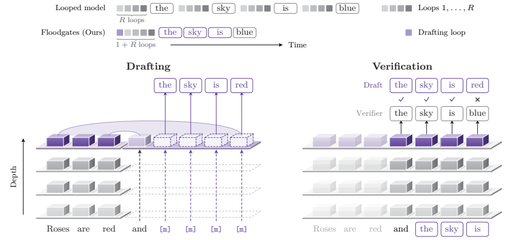
Figure 2 Floodgates drafts a block of tokens with a single loop and verifies it in one decoding step.(Left) A single loop reads the deep prefix cache (purple) computed during the previous verification and drafts several tokens (lilac) in parallel from mask tokens. (Right) The full model verifies the drafts in one decoding step, accepts them up to the first mismatch, and produces the prefix cache for the next draft. (Top) This allows the shallow drafter to leverage full-depth computation for fast speculative decoding.
Original paper · CC BY 4.0 · Ayhan Suleymanzade, Sean McLeish, Sehoon Kim, Jinwoo Kim, Antoine Bosselut · Looped Models are Fast Multi-Token Predictors · Original paper figure · Extracted the figure area from page 2 of the original PDF.Why speculative decoding stalls on looped models
Each new token has to wait for every earlier token, so generation runs as one serial chain. Speculative decoding breaks that chain by letting a cheap drafter propose several tokens that the target model checks in one pass. Under greedy decoding, the drafts are kept up to the first position where they differ from the target's argmax.
That partial view limits how many of its drafts the target accepts.
Looped models avoid this limit because every loop runs the same block, so a shallow loop can still draw on all of the parameters. Existing looped drafters, however, either propose a single token per loop or accept well only when the model runs many loops. They also depend on pipelining, which requires a separate prefix cache for every loop depth that is batched together.
Drafting a block of tokens in one loop
The key idea is that one shallow loop can draft a block of future tokens while reading the deep prefix cache that verification has already computed. The authors expect this to work because all-depth training already pushes shallow states toward information about later tokens.
After the current token \(x_t\), the method appends \(k\) mask tokens, each a copy of a learnable vector \(m\), which gives \(k+1\) slots. The output head \(g\) then reads each slot to give the draft distribution \(q_j = g(\hat z_{t+j})\). Figure 2 shows this loop drafting from mask tokens and the full model verifying the draft in one step.
Training the drafter without touching the verifier
Only the adapters and the mask vector are trained, using a weighted cross-entropy over the next \(k\) tokens. The weights decay as \(e^{-(j-1)/4}\) so that earlier draft positions count more, since a later draft is accepted only if the earlier ones are. The training sequences come from the target model itself, because verification checks drafts against that model's own predictions.
The adapters are active only at the mask slots, so the base weights and the output head stay frozen. Because the verifier's parameters never change, the decoding output stays identical to that of the target model.
Elastic refinement and budgeted verification
On deep models one loop is cheap, so extra passes of the pretrained loop can refine the draft over a window of positions. Each pass updates all \(W\) draft tokens together, so \(E\) passes cost about \(E/W\) effective loops per position. These passes use no adapters, so they need no extra training. The authors set \(E = 0\) for the 4-loop Ouro models and \(E = 24\) for the 32-loop models in the main tables.
At larger batches verification becomes compute-bound, so the method verifies only the most promising drafts. Each slot's acceptance estimate is the product of the drafter's probabilities over the slots before it. A per-step budget \(M^\star\) is then chosen to maximize expected accepted tokens divided by the profiled verification time \(T(M)\).
Speed at batch size one against prior lossless methods
On the Thinking variants under greedy decoding, Floodgates reached 3.7 to 3.9× on the reasoning tasks, compared to 2.7 to 3.1× for LoopSpec. Under sampling, Floodgates is fastest in 16 of the 24 settings of Table 1, so the sampled picture is less uniform than the greedy one.
Why a shallow loop drafts well
On Ouro 1.4B, a single loop of Floodgates runs 25% of a decoding step's layers and reached 5.48× on GSM8K with 7.6 tokens per step. A separate 4-layer drafter reached 3.70× on GSM8K, and the 5-layer DFlash block reached 4.32× with 278M trained parameters.
The authors attribute the gap to the looped block using all of its parameters and attending to the deep prefix cache.
Elastic drafting across verifier depths
Recurrent Llama 3.2 ran at 4 to 64 loops with one drafter trained at 32 loops. Single-pass drafting was fastest up to 16 loops, while at 32 and 64 loops the speedup peaked at 16 to 24 elastic passes. At every depth and budget up to 24, Floodgates stayed ahead of DAS-Wave.
The authors attribute the large early margin to starting the elastic passes from a trained multi-token draft.
Across 4 to 64 loops, Floodgates was fastest at every depth on both models. From 4 to 16 loops Floodgates gave 3.4 to 4.4× on Recurrent Llama 3.2 and 2.7 to 4.1× on Huginn 3.5B.
Limits of the evidence
Under sampling, LoopSpec is faster than Floodgates on Recurrent TinyLlama and on four Recurrent Llama 3.2 tasks. Sampling also lowers the number of accepted tokens for every block drafter.
The elastic budget is chosen per model on 100 held-out problems, so a different budget would be needed for a model outside the study. The depth sweep covers GSM8K only, and the serving sweep covers Ouro 1.4B, Ouro 2.6B and Recurrent Llama 3.2 on GSM8K, plus Ouro 1.4B Thinking on MATH-500.
Paper info
- Authors
- Ayhan Suleymanzade, Sean McLeish, Sehoon Kim, Jinwoo Kim, Antoine Bosselut
- Venue
- arXiv · Preprint
- First published
- 2026-11-25
- Added
- 2026-11-26
- Updated
- 2026-11-25
- Version
- v1
- arXiv
- 2611.33896
- Category
- cs.LG · cs.CL
- Original paper terms
- CC BY 4.0
- What we show
- Paper info, commentary and permitted figures from the original paper
AI commentary is a separate explanation from the original paper and may contain errors. The original paper and figures follow each source's terms of use and any rights noted separately.
Abstract
Looped language models can adapt computation for predicting a token without a proportional rescaling in unique model parameters by adjusting the number of loops. This property has been used for self-speculative decoding, taking shallow loops as fast drafters and deep loops as verifiers, which is effective since drafting still uses full parameters. In this paper, we show that shallow loops can be also predictive of several future tokens and leverage this to drastically accelerate the inference of looped language models. To that end, we present Floodgates, a simple self-speculative decoding method that appends a block of mask tokens as a suffix and learns via low-rank adaptation to draft these tokens in parallel. Across seven models, five benchmarks, a range of batch sizes, and both greedy and sampled decoding, Floodgates is the fastest lossless decoding method in most cases, attaining up to 7.5x acceleration. Through analysis, we show that this speedup is enabled by all-depth training of looped models, with the shallow drafter's ability to leverage full-depth computation by conditioning on deep prefix cache evaluated during verification.
Quote from the paper
Ayhan Suleymanzade, Sean McLeish, Sehoon Kim, Jinwoo Kim, Antoine Bosselut (2026). Looped Models are Fast Multi-Token Predictors. arXiv:2611.33896v1. https://arxiv.org/abs/2611.33896v1
BibTeX
@misc{suleymanzade2026looped,
  title = {{Looped Models are Fast Multi-Token Predictors}},
  author = {Ayhan Suleymanzade and Sean McLeish and Sehoon Kim and Jinwoo Kim and Antoine Bosselut},
  year = {2026},
  eprint = {2611.33896},
  archivePrefix = {arXiv},
  url = {https://arxiv.org/abs/2611.33896v1}
}