Paper commentary
The Optimal Rate Constant of Heavy-Ball Momentum on Smooth Strongly Convex Functions
Optimally tuned heavy-ball momentum is asymptotically four times faster than gradient descent
- Problem Heavy-ball momentum accelerates gradient descent on quadratics, but no fixed tuning accelerates it on smooth strongly convex functions. The best achievable rate constant on this class was unknown.
- Method The authors pin the rate constant from both sides. A spiral construction on a non-quadratic function gives the lower bound, and an explicit tuning with a Lyapunov function gives the matching upper bound.
- Results The authors prove the rate constant c(κ) tends to 8 in every dimension two or more. That makes optimally tuned heavy-ball asymptotically four times faster than gradient descent, whose constant tends to 2.
Where heavy-ball stops accelerating
Heavy-ball's advantage over gradient descent starts on quadratics, where Polyak's choice of step and momentum reaches the accelerated rate. Polyak's tuning fails to converge on some functions once κ reaches 9 + 4√5. Goujaud et al. showed that no tuning accelerates in dimension two or more. Their counterexamples are cycles, found numerically and then constructed in closed form.
So every choice of (γ, β) either fails to converge on some function or converges no faster than 1 − O(1/κ), already on quadratics.
The open question is the constant c(κ) in the best worst-case rate 1 − c(κ)/κ. Gradient descent gives c(κ) ≥ 2κ/(κ+1), so the constant is at least about 2. Non-acceleration says only that c(κ) is bounded, and the paper asks how large it is. Goujaud's thesis records the proved bounds 2 ≤ c ≤ 100/3 asymptotically, and computes numerical optima at κ = 20, 100 and 1000.
Concurrently with this work, Liu et al. proved a one-dimensional lower bound that implies c ≤ 24. The exact limit of the constant was therefore the open target.
The paper determines this limit: in every dimension d ≥ 2 it proves c(κ) → 8. The lower bound holds for every tuning, so no tuning can beat 1 − 8/κ on this class. If a tuning is faster than 1 − 8/κ on quadratics, a function of two variables makes heavy-ball follow a decaying spiral around the minimizer. The matching upper bound comes from an explicit tuning with momentum 1 − β ≈ 4/√κ and step size γ ≈ 32/(L√κ).
Together the two bounds give 8 − 64/√κ ≤ c(κ) ≤ 8, so optimally tuned heavy-ball is asymptotically four times faster than gradient descent.
A spiral that quadratics can't produce
The key idea is to force heavy-ball onto a spiral that contracts at the rate 1 − 8/κ, on a function that is not quadratic. Along such a spiral, the gradient is the iterate scaled and rotated by a fixed nonzero angle, which no quadratic can produce along the whole spiral. A quadratic would need a symmetric Hessian to map the iterate to the gradient, and a pure rotation is not symmetric.
So the rotation has to come from curvature that varies across the function, which is where the convex non-quadratic function enters.
A convex function that is not quadratic can supply some of that rotation, but only a limited amount. The interpolation conditions allow a rotation of size |b| up to 2m tan(θ/2), where m is a quantity tied to the curvature a. Balancing the rotation against the curvature gives the condition c(2w − 1) ≥ 8w² for a free parameter w. Some w satisfies this exactly when c ≥ 8, so the exchange is cheapest at half the largest curvature L, which is where the constant 8 comes from.
At c = 8 the best spiral has curvature 1/2, the middle of the range of curvatures. Such a spiral turns by about 2√X per step, and a tuning that beats 1 − 8/κ on quadratics lies beyond the edge c = 8.
The proof then finds a window of values of (h, u) around u = 2X on which the polynomial Φ is positive. Inside that window a root of unity exists, so a decaying spiral at rate 1 − 8/κ exists for every such tuning. Figure 1 shows such a spiral at κ = 100 for the tuning γL = 2.5 and β = 0.736. Its iterates turn by 2π/7 per step and contract by r = 0.92, while on quadratics the rate is at best 0.858.
How the lower bound is proved
The first step is a fact about quadratics: a tuning that beats 1 − 8/κ on them must satisfy a set of constraints. In the coordinates X = 1 − β/r and h = γL, with η = 1 − r, these constraints read η < X and 8X < h < (2 − η)(2 − X). The edge h = 8X matters most, because it says the effective step must exceed 8. Lemma 1 comes from the Schur–Cohn criterion applied to the two characteristic roots, one at curvature q and one at curvature 1.
Next the proof places heavy-ball on a planar spiral x_t = z^t with z = r e^{iθ} and θ = 2π/K. Those gradients interpolate the data only if certain pairwise inequalities hold, and these reduce to m ≥ 0 together with the non-negativity of a polynomial Φ. The proof checks that every finite subset of the data is interpolable, so the argument needs an infinite version of the interpolation conditions.
A compactness argument (Lemma 3) then passes from finitely many interpolation conditions to a single function of the class, so the data are interpolable by one function.
Φ is concave in both h and u, so it is enough to check its four corners on the window of admissible values. The corner values are positive, which the authors verify with symbolic identities and exact Sturm counts. Lemma 5 then supplies the root of unity: for every X in (0, 2/5] some integer K ≥ 4 puts u_K = 2sin²(π/K) inside that window.
With Φ positive at that u_K, the spiral at rate r is realised by a function of the class, so no smaller rate ρ is achievable. Extending the planar function by (μ/2)‖·‖² in the other coordinates gives the same bound in every dimension d ≥ 2.
The explicit tuning and its Lyapunov certificate
The upper bound uses one explicit tuning, written with s = κ^(−1/2): C = 8 − 64s, r = 1 − Cs², β = r(r − 4s), and γ = Cs(4 + Cs)L, for κ ≥ 400. Its momentum agrees with Polyak's to first order, while its step is about √κ/8 times smaller. On quadratics this tuning gives rate r, because the roots in the flattest direction are r and β/r.
The proof does not follow a spiral, and it uses a Lyapunov function that is a small perturbation of the mechanical energy of the heavy ball. The function combines the potential, a kinetic term, a cross term between velocity and gradient, and a small multiple of the squared gradient. Two interpolation inequalities are added, one between consecutive iterates and one between the iterate and the minimizer, with multipliers r² and 1 − r².
These are the only multipliers that cancel the function values, and with them the Lyapunov function satisfies V_{t+1} ≤ r² V_t.
What remains is a quadratic form in the iterates and gradients that must be positive semidefinite. The quadratic (μ/2)‖x‖² reaches rate r, so the form must vanish along that direction, which fixes three of the six entries. The authors found the other three numerically, rounded them, and then proved positivity for all κ ≥ 400 by exact root counting.
The constant M in the bound is given in the proof, and it is below 78 at κ = 400.
Positivity is checked through principal minors of U^T F3 U and of G, which are rational functions of s. Sturm counts show that their numerators have no root in (0, 1/20]. The minors are positive on that interval, so Sylvester's criterion gives positive definiteness. The identity (16), the null vector and the root r are checked symbolically or by exact root counting.
The certificate holds from κ ≈ 357.2901 on, and the authors state κ ≥ 400 for simplicity. Below that range the same tuning still converges through the Pasechniuk-Vilensky region, but this certificate doesn't cover it. Together the two bounds give 8 − 64/√κ ≤ c_d(κ) ≤ 8 for d ≥ 2 and κ ≥ 400, so c_d(κ) tends to 8. Gradient descent's constant 2κ/(κ+1) tends to 2 on the same scale, which is why heavy-ball is asymptotically about four times faster.
What the computer checks establish
Parts of both proofs were checked by computer, and none of those checks uses floating-point arithmetic. Symbolic checks expand the difference between two polynomials or rational functions and test that it is zero. Sturm checks count the real roots of a univariate polynomial on a closed interval and evaluate its sign at one point. Interval checks use outward-rounded interval arithmetic instead of floating point.
Table 1 lists every such step with its exact parameter range, its method and its script.
The Lemma 1 check is symbolic, covering all parameters, and it verifies the two Schur–Cohn identities. The Lemma 4 check verifies the corner identities and the coefficient of u squared symbolically, over all parameters. Its sign checks on the univariate polynomials use Sturm counts on y in [0, 7/11] and an interval check on 76 boxes. For Proposition 1, the identity and null vector are checked symbolically for all s, while the six leading minors are checked by Sturm counts on (0, 1/20].
The heaviest check is the positivity of the Lyapunov minors, which involve polynomials of degree up to 34. The positivity of the quadratic form in the Lyapunov certificate is verified by exact root counting for all κ ≥ 400. Lemma 5 is proved by hand with exact rational constants, and an independent interval check covers inequality (13) on 4000 pieces.
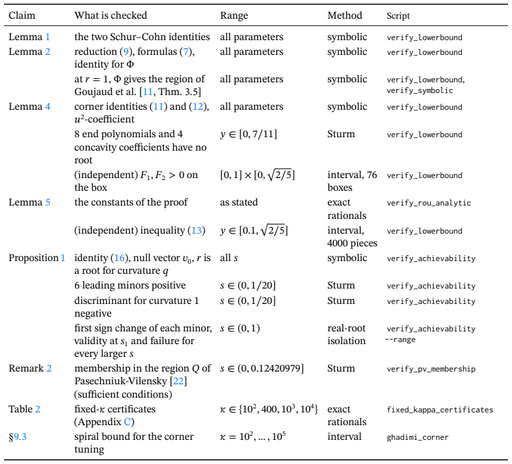
Table1 :Computer-assistedsteps.“Range”istheexactparameterrangeonwhichthecheckholds.The scriptsareincode/.
Original paper · CC BY 4.0Because the proofs are not formalized in a proof assistant, the trust base includes the polynomial routines of SymPy and mpmath.iv. The lower bound does not need interval arithmetic, and its two main lemmas are checked a second time by an independent route.
Fixed-κ certificates and numerical brackets
At finite κ, the paper asks how close exact and numerical constants come to the limit of 8. For κ = 10², 400, 10³ and 10⁴, the authors searched numerically for the fastest tuning in the Pasechniuk-Vilensky region Q. They rounded each tuning to a rational one whose rate r is a root of the polynomial for curvature q. They solved a small semidefinite program for the free entries of P, rounded them, and verified the certificate exactly.
These certificates prove c(κ) ≥ 5.032, 6.173, 6.734 and 7.548 at these values of κ, in every dimension. Each of these constants exceeds 8 − 64/√κ at the same κ, so the tuning of Theorem B is not optimal at finite κ.
The authors also computed two further quantities in floating point, and they are not certified. On the side of functions, each tuning took the larger of ρQ and the rate of the slowest decaying spiral. The spirals are either root-of-unity spirals as in Lemma 2, or general log-spirals with any θ.
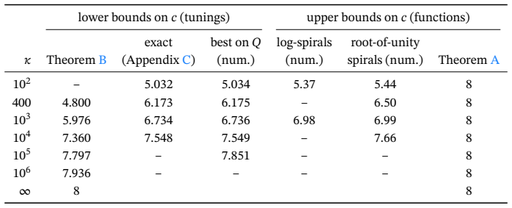
Table 2 :Bounds on𝑐(𝜅) =𝜅(1−𝜌 ⋆(𝜅)) for𝑑≥2 . Lower bounds on𝑐 come from tunings, and upper boundsfromfunctionsthatsloweverytuningdown.Lowerboundsareroundeddownandupperbounds up.Thecolumnsmarked“num.”arefloatingpoint.
Original paper · CC BY 4.0 · Marcos Hernanz · The Optimal Rate Constant of Heavy-Ball Momentum on Smooth Strongly Convex Functions · Original paper figure · Extracted the figure area from page 24 of the original PDF.Polyak's tuning has 1 − β = 4s/(1+s)², so its momentum agrees with the tuning of Theorem B to first order. At κ = 10⁴ the tuning has γL = 0.2998 and β = 0.9586, with rate 1 − 7.36/κ. The certified tunings of Table 4 have the same shape, with β ≈ r(r − σs).
Open problems and limits
The paper proves the leading constant 8 but leaves the second-order coefficient open, since it only places c₂ in the interval from 0 to 64. That suggestion stays unproved, and the authors don't claim it as a result. Lag-one certificates of this form seem unable to push the upper end below 48, so the authors suggest longer memory may be needed.
Theorem B is optimal only as κ grows, because the authors have no closed form for the better tunings that exist at fixed κ.
In one dimension, the paper gives 8 − 64/√κ ≤ c₁(κ) ≤ 50/3 + o(1), and it leaves open whether c₁ tends to 8. The lower-bound functions are not twice differentiable at the minimizer, while the one-dimensional bound of Liu et al. holds for C∞ functions. If the function were twice differentiable at the minimizer, the iterates would converge at a rate of at most ρ_Q, below 1 − 8/κ.
Whether 1 − 8/κ persists on smoother subclasses of the function class is also open.
The results concern constant parameters and exact gradients on smooth strongly convex functions. Variable parameters and restarts are not covered, and neither are Nesterov's method or the triple momentum method, which accelerate. The constant 8 is related to the constant of the Ghadimi et al. region, but the authors know of no deeper connection between them.
Paper info
- Authors
- Marcos Hernanz
- Venue
- arXiv · Preprint
- First published
- 2026-11-9
- Added
- 2026-11-10
- Updated
- 2026-11-9
- Version
- v1
- arXiv
- 2611.12310
- Category
- cs.LG · math.OC
- Original paper terms
- CC BY 4.0
- What we show
- Paper info, commentary and permitted figures from the original paper
AI commentary is a separate explanation from the original paper and may contain errors. The original paper and figures follow each source's terms of use and any rights noted separately.
Abstract
The heavy-ball method with a constant step size and a constant momentum parameter accelerates gradient descent on quadratics, but no choice of the two parameters does so on the class of smooth strongly convex functions. We determine how much faster than gradient descent it can be made on this class. Writing the best worst-case rate over all tunings as $1-c(κ)/κ$, where $κ$ is the condition number, we prove that $c(κ)$ tends to $8$ in every dimension of two or more. The lower bound on the rate holds for every tuning, because a tuning that is faster than $1-8/κ$ on quadratics follows a slowly decaying spiral on some function of two variables. The matching upper bound comes from an explicit tuning, with nearly the momentum of Polyak's tuning and a step size about $\sqrtκ/8$ times smaller, and from a Lyapunov function whose positivity is verified in exact arithmetic. Optimally tuned heavy-ball is therefore asymptotically four times faster than gradient descent on this class.
Quote from the paper
Marcos Hernanz (2026). The Optimal Rate Constant of Heavy-Ball Momentum on Smooth Strongly Convex Functions. arXiv:2611.12310v1. https://arxiv.org/abs/2611.12310v1
BibTeX
@misc{hernanz2026optimal,
  title = {{The Optimal Rate Constant of Heavy-Ball Momentum on Smooth Strongly Convex Functions}},
  author = {Marcos Hernanz},
  year = {2026},
  eprint = {2611.12310},
  archivePrefix = {arXiv},
  url = {https://arxiv.org/abs/2611.12310v1}
}