Paper commentary
V3D: Video Diffusion Models are Effective 3D Generators
Video diffusion models can be fine-tuned into effective 3D generators
- Problem Image-based multi-view models produce fewer than 6 views, too few for reconstruction. Dense consistency across views needs memory-heavy cross-attention or an intermediate 3D structure.
- Method V3D fine-tunes a pre-trained video diffusion model to output 360° orbit frames of an object from one image. It then reconstructs meshes or 3D Gaussians from those frames.
- Results On Google Scanned Objects, V3D scored PSNR 22.08, compared to 21.45 for MVDiffusion++.
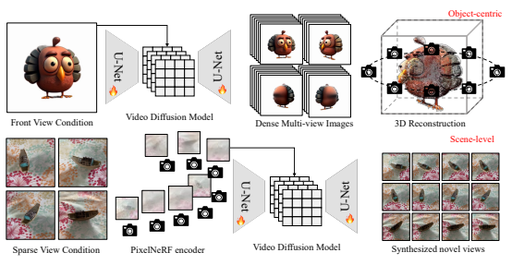
Fig. 2 : Overview of the proposed V3D.
Original paper · CC BY 4.0 · Zilong Chen, Yikai Wang, Feng Wang, Zhengyi Wang, Huaping Liu · V3D: Video Diffusion Models are Effective 3D Generators · Original paper figure · Extracted the figure area from page 5 of the original PDF.Why multi-view generation stalls
Optimization methods built on Score Distillation Sampling are slow, and they can suffer from mode collapse and the Janus problem. Feed-forward alternatives either map images directly into 3D representations or first generate multi-view images and reconstruct from them. The multi-view route runs into a practical limit: image diffusion models can only generate a few views, fewer than 6.
Dense consistency across those views usually requires memory-consuming cross-attention or an intermediate 3D structure.
Video diffusion models take a different position: they can generate hundreds of frames with strong spatio-temporal consistency. The open question is whether that consistency is strict enough for reconstruction, and the authors say current video diffusion models find this difficult. The authors aim to unleash the perception of the 3D world in video diffusion models and inject a geometrical consistency prior.
Their fix is to fine-tune on 3D datasets and use perceptual loss instead of pixel-wise loss for reconstruction.
Treating an orbit as a video
V3D treats the views of an object turning on a circle as the frames of a video. The authors argue that videos with changing perspectives show objects from many angles, so the model can learn a sense of the physical 3D world. Image-based multi-view generators produce fewer than 6 views, while a video model can output hundreds of frames. Multi-view models that rely on cross-attention scale quadratically, which limits how many views they can use.
Stable Video Diffusion serves as the starting point, so the front view becomes the condition and the orbit frames become the output.
The front view enters the U-Net through two separate paths. Its CLIP embedding is injected via cross-attention, which carries high-level semantic information. Its latent is concatenated along the channel dimension, which gives the model low-level information. The authors remove the motion bucket ID and FPS ID as irrelevant for image-to-3D.
Elevation isn't conditioned at all, and the object is randomly rotated in elevation during training. The authors' experiments showed that generated views can't be constrained to a specified elevation angle. A mismatch between the video camera poses and the reconstruction poses could significantly damage the final outcome.
For object-centric training, the team fine-tunes on Objaverse, using a filtered subset of about 290k synthetic triangle meshes. Each mesh is normalized to unit length, with the camera distance fixed at 2 and the elevation set to 0. The camera moves around the object at N = 18 azimuths from 0 to 2π, producing orbit videos at 512 resolution.
Fine-tuning on orbit videos
Objaverse contains many low-quality objects, so V3D starts from a hand-curated subset of higher quality. For each object, the mesh is normalized to unit length and the camera distance is fixed to 2. The elevation is set to 0, and the camera moves uniformly over the azimuth N times, from 0 to 2π, to make a smooth orbit video at 512 resolution.
Training follows SVD in using the EDM framework with the simplified diffusion loss. The authors use a noise distribution larger than the one in SVD, with P_mean = 1.5 and P_std = 2.0. They ablate this choice: a smaller schedule with P_mean = 0.7 and P_std = 1.6 yields unreasonable or degenerated geometry, such as the pistol and the cartoon-style astronaut.
The authors link this failure to the strong image signal and the simple nature of the synthetic Objaverse data, so the noise should shift towards stronger noise.
To enable classifier-free guidance, the latent and the CLIP embedding of the front view are each set to zero independently with a probability of 20%. This precomputation speeds up training and saves GPU VRAM. The base diffusion model was fine-tuned for 22.5k steps, which took about one day. Further training settings are given in the supplemental material, which the paper does not reproduce here.
From generated views to Gaussians and meshes
Generated views are high resolution but not pixel-aligned, so a pixel-wise loss leaves floaters and blurry textures. V3D instead uses an image-level perceptual loss to resolve inconsistencies among the multiple input images. The authors choose 3D Gaussian Splatting because it trains fast and renders a full image with minimal cost, which makes image-level loss affordable.
The objective adds LPIPS to the usual 3DGS terms, as L_recon(I, I_gt) = MSE(I, I_gt) + λs D-SSIM(I, I_gt) + λl LPIPS(I, I_gt). Here I is the rendered image, I_gt is the ground truth generated view, and λs and λl are the loss weights.
Initialization matters because the original 3DGS starts from Gaussian blobs and needs many iterations to remove floaters. V3D instead applies space carving: an off-the-shelf background removal model segments the foreground of each generated frame into an object mask. Marching cubes then extracts a surface from this grid, and Ninit points are sampled on it as the starting positions of the Gaussians.
The authors designed this to skip optimization on empty space and to speed up reconstruction.
For meshes, V3D adopts NeuS with a multi-resolution hash grid for fast surface reconstruction. Image-level loss is too costly to render through NeuS, so the extracted mesh textures come out blurry. The texture is then refined with LPIPS loss on the generated multi-views while the geometry stays unchanged. This refinement takes about 15 seconds, owing to differentiable mesh rendering.
Object-centric comparisons
Figure 3 sets V3D against LGM and TriplaneGaussian, two 3DGS methods, and against Magic123 and ImageDream, two optimization methods. The 3DGS baselines look blurry, and the authors link this to the small number of Gaussians they can produce. Magic123 produces inaccurate geometry and a blurry backface, while ImageDream over-saturates its textures.
V3D runs in about 3 minutes, compared to more than 30 minutes for the optimization-based methods.
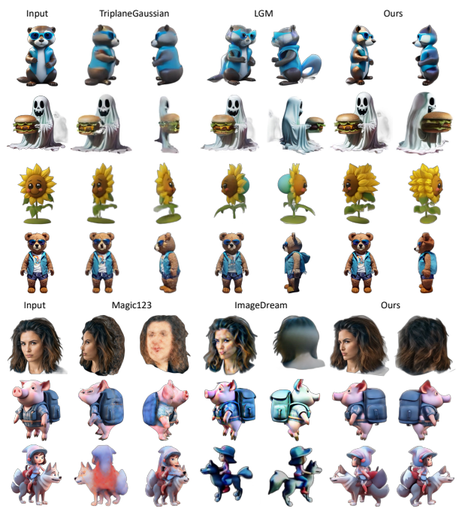
Fig. 3 : Qualitative comparison between the proposed V3D and state-of-the-art 3DGS- based image-to-3D methods (LGM [85] and TriplaneGaussian [117]) and optimization- based methods (Magic123 [69] and ImageDream [95]). The corresponding360° videos are demonstrated in the supplemental video.
Original paper · CC BY 4.0A user study with 58 volunteers rated objects from V3D and other methods under 30 condition images. The raters watched rendered 360° spiral videos and picked the best method for alignment and for fidelity. V3D's win rate is 51.72 for alignment and 55.17 for fidelity. The strongest baselines are Wonder3D at 17.24 on alignment and LGM at 24.14 on fidelity.
A win rate is the share of preference votes each method received, so it reflects rater choice rather than a geometric error measure.
Against SyncDreamer and Wonder3D, the authors compare generated multi-view images at a resolution of 512. SyncDreamer produces views that are simple in geometry and over-saturated in texture. The authors attribute this to SyncDreamer's structure differing from the original Stable Diffusion, so it doesn't fully use image pre-training. V3D generates triple the multi-views of Wonder3D at double the resolution.
The authors credit this setup for better texture quality and multi-view consistency.
Dense view synthesis on Google Scanned Objects
On Google Scanned Objects, the authors compare dense multi-view synthesis against four baselines: RealFusion, Zero-1-to-3, SyncDreamer and MVDiffusion++. RealFusion has the lowest PSNR and SSIM in the table, at 15.26 and 0.722, and the highest LPIPS, at 0.283. Zero-1-to-3 scores PSNR 18.93, SSIM 0.779 and LPIPS 0.166. SyncDreamer scores PSNR 20.05, SSIM 0.798 and LPIPS 0.146.
MVDiffusion++ is the strongest baseline in each column, at PSNR 21.45, SSIM 0.844 and LPIPS 0.129. V3D reaches PSNR 22.08, SSIM 0.882 and LPIPS 0.102 on the same benchmark. Its PSNR and SSIM are higher, and its LPIPS is lower, than every listed baseline.
The model behind these numbers is fine-tuned on orbit videos rendered from Objaverse objects at 512 resolution. The table reports image metrics only, so it measures the rendered views rather than the reconstructed 3D asset. A separate user study asked 58 volunteers to judge objects generated under 30 condition images. In that study, V3D won with 51.72 for alignment and 55.17 for fidelity.
The paper reports this dense-view comparison on one dataset only. The image metrics and the user study point the same way for object-centric output. They didn't test dense views on other object datasets in this table.
Camera control for scene-level views
Camera embeddings in image diffusion models like Zero-1-to-3 don't use 3D information, which makes precise pose control hard. V3D instead integrates a PixelNeRF feature encoder into the video diffusion model, drawing on GeNVS and ReconFusion. Given posed input images, PixelNeRF renders a feature map for the target camera poses. That feature map is concatenated to the U-Net input, so the model encodes relative camera pose explicitly.
The formula is f = PixelNeRF({π} | π_cond, I_cond), where {π} holds the poses of the frames to generate. This design accepts an arbitrary number of input images, and the CLIP image embeddings grow from one to multiple.
For scene-level fine-tuning, the authors use MVImgNet, which provides 219k posed real-world video clips. The PixelNeRF encoder gets an extra down-sampled photometric loss, following ReconFusion, where f_RGB predicts a downsampled image. Training randomly selects 1 to 4 input images and zeroes the conditions with a probability of 20%. The new PixelNeRF input channels start at zero, which keeps the pre-trained priors at the start of training.
Scene-level results on CO3D
The authors test V3D on the 10-category subset of CO3D, following the benchmark setup that SparseFusion uses. They fine-tune V3D on the videos of each category for one epoch, and they label this model as fine-tuned. Scores are reported at 2, 3 and 6 input views, with PSNR, SSIM and LPIPS for each setting.
The fine-tuned V3D reaches PSNR 22.19 at 2 views, against 21.34 for SparseFusion. At 3 views it scores 23.31 versus 22.35, and at 6 views it scores 24.70 versus 23.74. Its LPIPS is also lower at every view count, at 0.093, 0.082 and 0.074 against SparseFusion's 0.225, 0.216 and 0.200. The authors say this margin over previous novel view synthesizers shows the value of pre-trained video diffusion models.
The zero-shot model is trained only on MVImgNet, so it never trains on CO3D. It scores 20.64 at 2 views, below SparseFusion's 21.34. At 3 views it reaches 22.04, still below 22.35, but at 6 views it reaches 23.94, above 23.74. So the zero-shot model lags at sparse input but beats SparseFusion once six views are given. The authors add that the zero-shot version beats most of the competitors.
The camera-conditioning variants reach PSNR 18.27 with a learnable camera embedding and 20.11 with a Plücker embedding at 2 views. For a qualitative check, the authors run COLMAP on generated views from the hydrant subset of CO3D. Point clouds from V3D images contain more points and sit closer to those from real images, which the authors read as better multi-view consistency.
Which design choices matter
The from-scratch variant is the first ablation, and it differs from the full model only in its U-Net initialization. So the video pre-training carries most of the weight, and the orbit data alone doesn't get the model to a usable multi-view generator.
Fine-tuning length matters in both directions, as the authors tested it on the Objaverse data. Excessive fine-tuning steps give overly simplistic textures, because Objaverse renders are considerably less complex than real images. An inadequate number of steps leads to strange and inaccurate geometries. The noise schedule ablation uses P_mean = 0.7 and P_std = 1.6, the setting from Stable Video Diffusion's image-to-video pre-training, instead of the full model's larger noise.
With this smaller noise, the model generated unreasonable geometry for the pistol and degenerated geometry for the cartoon-style astronaut. The authors attribute this to the strong image signal and the simple nature of the synthetic Objaverse data, so they argue for shifting the noise towards stronger noise.
The camera conditioning ablation replaces the PixelNeRF conditioning with two alternatives, a learnable camera embedding or a Plücker ray embedding. Both variants concatenate the condition images into the U-Net input, with added channels set to zero, so the comparison stays fair. At 2 input views, the camera embedding variant reaches PSNR 18.27 and the Plücker variant reaches 20.11.
The authors read this as evidence that the PixelNeRF conditioning gives accurate 3D information, while both embeddings degrade performance significantly.
Limitations
The authors state that V3D struggles on some complex objects and scenes, with inconsistent views or unreasonable geometry. Failure cases are discussed only in the supplemental material, not in the main text.
Scene-level results cover only the 10-category CO3D subset, with per-category fine-tuning for one epoch. The object-centric ranking rests on one user study with 58 volunteers and 30 condition images.
Paper info
- Authors
- Zilong Chen, Yikai Wang, Feng Wang, Zhengyi Wang, Huaping Liu
- Venue
- arXiv · Preprint
- First published
- 2024-3-11
- Added
- 2026-11-6
- Updated
- 2024-3-11
- Version
- v1
- arXiv
- 2403.06738
- Category
- cs.CV
- Original paper terms
- CC BY 4.0
- What we show
- Paper info, commentary and permitted figures from the original paper
AI commentary is a separate explanation from the original paper and may contain errors. The original paper and figures follow each source's terms of use and any rights noted separately.
Abstract
Automatic 3D generation has recently attracted widespread attention. Recent methods have greatly accelerated the generation speed, but usually produce less-detailed objects due to limited model capacity or 3D data. Motivated by recent advancements in video diffusion models, we introduce V3D, which leverages the world simulation capacity of pre-trained video diffusion models to facilitate 3D generation. To fully unleash the potential of video diffusion to perceive the 3D world, we further introduce geometrical consistency prior and extend the video diffusion model to a multi-view consistent 3D generator. Benefiting from this, the state-of-the-art video diffusion model could be fine-tuned to generate 360degree orbit frames surrounding an object given a single image. With our tailored reconstruction pipelines, we can generate high-quality meshes or 3D Gaussians within 3 minutes. Furthermore, our method can be extended to scene-level novel view synthesis, achieving precise control over the camera path with sparse input views. Extensive experiments demonstrate the superior performance of the proposed approach, especially in terms of generation quality and multi-view consistency. Our code is available at https://github.com/heheyas/V3D
Quote from the paper
Zilong Chen, Yikai Wang, Feng Wang, Zhengyi Wang, Huaping Liu (2024). V3D: Video Diffusion Models are Effective 3D Generators. arXiv:2403.06738v1. https://arxiv.org/abs/2403.06738v1
BibTeX
@misc{chen2024video,
  title = {{V3D: Video Diffusion Models are Effective 3D Generators}},
  author = {Zilong Chen and Yikai Wang and Feng Wang and Zhengyi Wang and Huaping Liu},
  year = {2024},
  eprint = {2403.06738},
  archivePrefix = {arXiv},
  url = {https://arxiv.org/abs/2403.06738v1}
}