Paper commentary
What Do Multilingual Self-Supervised Speech Encoders Know About Sentence Meaning?
Linear probes reveal uneven sentence meaning in multilingual speech encoders
- Problem Speech encoders now cover thousands of languages, but almost no work has checked whether they hold sentence meaning beyond a few languages. Earlier probing studies used small language sets and mostly monolingual models.
- Method The authors train a linear map from frozen speech features into SONAR's sentence embedding space. Shared probes learn from many languages at once, and leave-one-out tests check transfer to unseen languages.
- Results The multilingual w2v-BERT-2.0 probe scores 47% top-1 on FLEURS, against 36% for its monolingual probes.
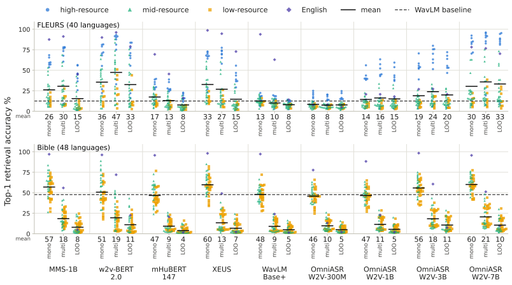
Figure 2 : Monolingual, multilingual, and leave-one-language-out (LOO) top-1 accuracy of mean-pooled probes of self-supervised models on FLEURS (top) and Bible (bottom). English is excluded from mean calculations.
Original paper · CC BY 4.0 · Kevin Krahn, Eric Fosler-Lussier · What Do Multilingual Self-Supervised Speech Encoders Know About Sentence Meaning? · Original paper figure · Extracted the figure area from page 5 of the original PDF.Why multilingual semantics is hard to see
Self-supervised speech models have grown from a handful of languages to thousands of languages, trained on over a million hours of audio. Our understanding of what these models encode hasn't kept pace with that growth in language coverage. Earlier probing work found that S3M representations are dominated by acoustic and phonetic structure.
Those same studies also found some word and sentence meaning, so semantics is present but was never the main finding. That evidence rests on a small number of languages and usually on monolingual models, so it says little about many languages at once.
Pasad et al. (2021) found that the middle, most contextualized layers of wav2vec 2.0 best encode word meaning. Multilingual analyses such as ML-SUPERB evaluate many languages, but they target downstream tasks like ASR and language identification. They don't explore cross-lingual semantic structure.
Multilingual probing so far has focused on acoustic and phonetic unit discovery, and on ASR and language identification. Whether semantic content reaches beyond high-resource languages, and how it is shared among them, therefore stayed open. The authors ask what these encoders know about sentence meaning when many languages are examined together.
A linear probe into a frozen sentence space
The core constraint is that the map from speech to text stays linear, so retrieval success reflects content already in the frozen encoder. Keeping the map linear means the probe adds no nonlinear capacity that could build meaning on its own. The target is the SONAR embedding of the English transcript, so the input and target share no acoustic, speaker, or lexical overlap.
SONAR is chosen because it maps semantically similar sentences in different languages to nearby vectors, which mitigates English bias compared to a monolingual text encoder.
Each utterance yields frame-level hidden states at a chosen layer, and the probe first pools them into one vector. Mean pooling is the default, with each frame weighted by 1/T. Attention pooling instead uses a single learnable query vector to score frames, and it starts from exact mean pooling because the query is initialized to zero. A LayerNorm and a linear layer then map the pooled vector into the SONAR space, with e=1024 and roughly 1.05M trainable parameters, most of them in W.
The low-rank variant factors W as AB, which limits how much the map can memorize acoustic-to-word associations.
Training uses a contrastive loss that scores each speech embedding against all training transcript embeddings, with cosine similarity scaled by s=20. Parallel utterances in other languages share one target, so a single shared probe can learn across languages. The authors use AdamW with a learning rate of 3 × 10⁻³, dropping to 1 × 10⁻³ for attention pooling.
Three probe regimes differ only in which languages supply training data: monolingual, multilingual, and leave-one-out (LOO). The LOO regime trains on all languages except the target, so it tests for language-agnostic structure because the probe has never seen that language. Each model's layer is chosen by sweeping all layers with mean-pooled monolingual probes, so each model is compared at its best depth.
Mean centering subtracts each language's mean speech embedding, which shows whether performance depends on language- and speaker-specific directions.
Two corpora with different speakers
FLEURS provides multi-speaker read speech of FLORES sentences drawn from Wikipedia, and the sentences are dense in named entities. The FLEURS study uses 40 languages, with 1509, 150 and 350 sentences in the train, validation and test splits. Each sentence has about 2.3 recordings from different speakers, so a speaker can't repeat across splits.
Sentences and speakers are disjoint across splits, which means FLEURS scores measure cross-speaker generalization.
The Bible corpus combines verse-segmented New Testament recordings from OpenBibleTTS, Snow Mountain and the English WEB version. It covers 48 languages with a single speaker per language, and 12 of those languages are shared with the FLEURS subset. The corpus uses 4,000, 1,000 and 1,400 verses for training, validation and testing. Missing or near-silent verses are replaced with other verses, which affects 3.4% of the total.
Scripture and religious recordings are among the only speech data for many low-resource languages, so Bible data is more in-domain for them. MMS extends to 1,300 languages and XEUS to 4,000+ languages in pretraining, and scripture forms a substantial share of that data. Because each Bible language has one speaker, probes can latch onto speaker and channel cues that FLEURS does not expose as easily.
FLEURS lacks speaker IDs, so the paper can't separate speaker effects within that corpus.
English is the exception, because an English probe can map words directly, so the authors treat it as an upper-bound reference.
Where decodability is high and where transfer holds
Retrieval stays hard for self-supervised encoders, even the strongest ones, on FLEURS. The strongest models, w2v-BERT-2.0 and OmniASR-W2V-7B, reach more than 75% monolingual accuracy on several high-resource languages. Accuracy drops steeply on the mid- and low-resource tiers, so the signal is uneven across languages. WavLM Base+ still reaches 13% on non-English languages, even though it was pretrained only on English.
The authors read this as a linear map that can exploit acoustic-lexical patterns, not as semantic understanding.
A single shared probe often matches or beats the per-language probes. The multilingual w2v-BERT-2.0 probe scores 47% top-1 on FLEURS, against 36% for its monolingual probes. The OmniASR-W2V-7B LOO probe reaches 33%, against 30% for its monolingual probes. That LOO probe wins on 24 of 39 languages, which the authors describe as broad gains rather than gains on a few languages.
LOO probes train on far more data than monolingual probes, so the authors read this as other languages compensating for scarce target-language data.
Most models drop sharply in the LOO regime, and the OmniASR models are the exception. Monolingual strength does not predict transfer, because XEUS scores 33% monolingual but only 15% LOO on FLEURS. XEUS sits on par with MMS-1B and OmniASR-W2V-3B in monolingual decodability, yet it transfers poorly. The authors link this gap to prior work showing that contrastive objectives give better cross-lingual ASR features than masked prediction.
MMS-1B reaches 30% multilingual top-1 against 24% for OmniASR-3B, winning on 29 of 39 non-English languages.
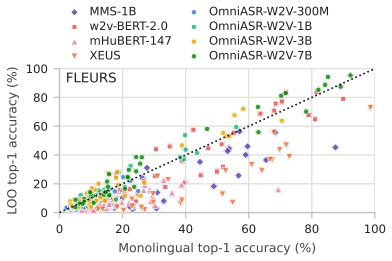
Figure 3 : Monolingual against leave-one-out (LOO) retrieval accuracy for 40 FLEURS languages, showing the relationship between monolingual scores and cross- lingual transfer. OmniASR models show high transfer with many languages above the diagonal.
Original paper · CC BY 4.0Scale, pooling and ASR tuning
Scaling the OmniASR-W2V family from 300M to 7B helps high-resource languages far more than low-resource ones. Monolingual probes rise from 14% to 68% for the high-resource tier. The mid tier moves from 7% to 22%, and the low tier moves from 6% to 12%. The paper reads this as the low end staying relatively flat while the gap between tiers widens.
Depth grows from 24 to 128 layers, but the semantic peak only shifts from layer 14 to layer 28. Most of the extra depth sits after the peak, where it isn't relevant for this task. MMS-1B beats OmniASR-3B on FLEURS, with 30% against 24% in the multilingual regime, despite OmniASR-3B being three times larger. MMS-1B wins on 29 of 39 non-English languages, and the authors speculate that OmniASR spreads its training mix across the long tail.
Scale alone doesn't explain the results: w2v-BERT-2.0 at 580M parameters reaches 47% multilingual accuracy, above OmniASR-W2V-7B.
Pooling choice changes the picture for self-supervised encoders, since attention pooling beats mean pooling for every one of them. ASR-tuned models change little, sometimes negatively, which suggests ASR tuning makes meaning recoverable without pooling tricks. The authors read this as semantic content sitting unevenly across frames, so mean pooling dilutes it.
They didn't run every probe regime with attention pooling, because that sweep was computationally prohibitive.
ASR tuning gives the largest jump in monolingual FLEURS retrieval. OmniASR-7B rises from 30% in its W2V form to 76% with CTC and 82% with the LLM decoder. The mono-to-LOO gap also widens for ASR-tuned models, with OmniASR-7B LLM at 82% monolingual against 57% LOO. Removing the per-language mean recovers most of that held-out transfer, so the ASR gain sits largely in language-specific directions.
The OmniASR W2V counterparts are nearly centering invariant, which contrasts with the ASR-tuned models. Figure 7 shows that centering closes the LOO gap for w2v-BERT-2.0 and MMS-1B on FLEURS.
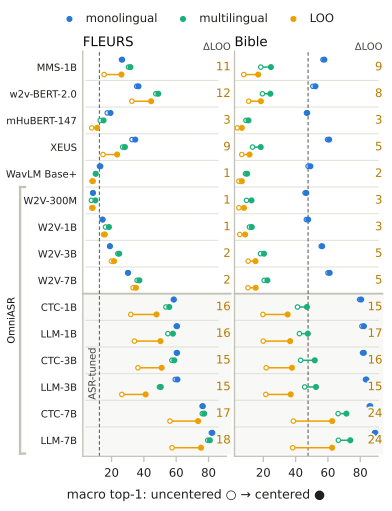
Figure 7 : Mean (non-English) top-1 scores before and after mean centering. Dashed line marks the WavLM Base+ baseline. On FLEURS, centering closes the LOO vs. mono gap for w2v-BERT-2.0 and MMS-1B, and partially for ASR-tuned models, but has little effect on other models. On Bible, mean centering can partially close the gap but LOO still lags far behind mono results.
Original paper · CC BY 4.0Acoustic cues and entity shortcuts in the retrieval scores
The high Bible scores could come from speaker cues rather than meaning, and the paper tests that possibility directly. XEUS reaches 60% monolingual accuracy on Bible, compared to 33% on FLEURS. Even the monolingual WavLM Base+ baseline averages 48% on Bible, which the authors attribute to single-speaker recordings letting probes exploit speaker and channel cues.
Several monolingual Bible probes beat that WavLM baseline, but no self-supervised model beats it under the multilingual or LOO regimes. The authors read this pattern as monolingual Bible probes benefiting from speaker and channel regularities that don't transfer across languages.
Per-language centering subtracts each language's training-set mean speech embedding, so it removes language- and speaker-specific offsets. Centering closes the LOO to monolingual gap on FLEURS for w2v-BERT-2.0 and MMS-1B, but it barely changes Bible's gap. Mean centering yields small improvements for LOO probes, yet it isn't nearly enough to close the monolingual to LOO gap on Bible.
So Bible's monolingual advantage can't be a simple speaker or language offset, and acoustic and semantic information aren't cleanly separated. The rank test restricts the projection, and rank 64 keeps most mean-pooled performance, staying well above full-rank WavLM on FLEURS. Below rank 64, retrieval weakens substantially, and Bible probes gain more from higher ranks, which the authors link to speaker-specific directions in single-speaker training data.
Gemma-4-31b-it produced a masked variant, where each entity becomes a generic placeholder, and a names-only variant, where only entities remain. Masking tests whether entities are necessary, and names-only tests whether they are sufficient for retrieval. After masking, w2v-BERT-2.0 and OmniASR-W2V-7B keep 33% and 31% masked LOO accuracy, against a masked WavLM baseline of 6%.
For weaker encoders, masked LOO accuracy falls to 7 to 14%, close to that masked WavLM baseline. Names-only scores stay below gold scores, so entities alone don't explain the strongest encoders, though they do add information.
The authors conclude that entities contribute information, but entity matching alone doesn't explain the gap between the strongest and weakest encoders. Named-entity shortcuts and acoustic cues therefore limit how far single-speaker scores can be read as meaning.
Limitations of linear, frozen, and narrow probing
The probes are linear, so the scores measure what a linear map can read from frozen features, not what a nonlinear system could extract. That limit cuts both ways: the authors say results could understate the semantic content actually present. Acoustic associations, however, could push the scores up and overstate the semantic content. The low-rank and named-entity controls suggest the effect doesn't need a full-capacity projection or entity-only matching.
Other lexical cues may still contribute, and the paper doesn't isolate them.
Retrieval runs against one frozen text encoder, SONAR, so the results depend on its capabilities and biases. A different text encoder could rank the same speech representations differently, and the paper doesn't test that.
The two corpora are narrow: FLEURS covers Wikipedia-style news and geography, and the Bible corpus covers New Testament text. FLEURS has no speaker IDs, so speaker confounds can't be cleanly separated within that corpus. Language coverage is still a small share of the languages these massively multilingual models were trained on.
Settling that question would need nonlinear probes, which this study doesn't run.
Paper info
- Authors
- Kevin Krahn, Eric Fosler-Lussier
- Venue
- arXiv · Preprint
- First published
- 2026-11-13
- Added
- 2026-11-16
- Updated
- 2026-11-13
- Version
- v1
- arXiv
- 2611.17686
- Category
- cs.CL
- Original paper terms
- CC BY 4.0
- What we show
- Paper info, commentary and permitted figures from the original paper
AI commentary is a separate explanation from the original paper and may contain errors. The original paper and figures follow each source's terms of use and any rights noted separately.
Abstract
Self-supervised speech models (S3Ms) have been scaled up to thousands of languages and millions of hours of audio, yet little is known about how these models structure semantic knowledge across languages. In this work, we probe sentence-level semantics in massively multilingual S3Ms across 76 languages, using linear maps from frozen speech representations into a frozen text embedding space, evaluated by cross-modal retrieval. Sentence meaning is linearly accessible but highly uneven across languages and resource tiers. Cross-lingual probes can match language-specific probes on languages never seen in probe training, but per-model monolingual decodability does not predict transfer. Within the OmniASR wav2vec family, scaling from 300M--7B disproportionately benefits high-resource languages, and ASR tuning sharply improves semantic decodability while making representations more language-specific. However, semantic content is entangled with acoustics, inflating apparent performance on single-speaker corpora.
Quote from the paper
Kevin Krahn, Eric Fosler-Lussier (2026). What Do Multilingual Self-Supervised Speech Encoders Know About Sentence Meaning?. arXiv:2611.17686v1. https://arxiv.org/abs/2611.17686v1
BibTeX
@misc{krahn2026what,
  title = {{What Do Multilingual Self-Supervised Speech Encoders Know About Sentence Meaning?}},
  author = {Kevin Krahn and Eric Fosler-Lussier},
  year = {2026},
  eprint = {2611.17686},
  archivePrefix = {arXiv},
  url = {https://arxiv.org/abs/2611.17686v1}
}