Paper commentary
Constitutional AI: Harmlessness from AI Feedback
- Problem Harmlessness training with RLHF depends on large sets of human harmlessness labels, and the resulting assistants tend to refuse sensitive requests instead of engaging with them.
- Method Replaces human harmlessness labels with a model that applies written principles to critique, revise and choose between responses, in a supervised stage followed by an RL stage.
- Results In crowdworker Elo comparisons, RL-CAI was more harmless than the RLHF and SL-CAI models while being virtually never evasive.
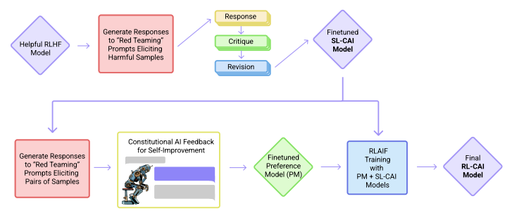
Figure 1 We show the basic steps of our Constitutional AI (CAI) process, which consists of both a super- vised learning (SL) stage, consisting of the steps at the top, and a Reinforcement Learning (RL) stage, shown as the sequence of steps at the bottom of the figure. Both the critiques and the AI feedback are steered by a small set of principles drawn from a ‘constitution’. The supervised stage significantly improves the initial model, and gives some control over the initial behavior at the start of the RL phase, addressing potential exploration problems. The RL stage significantly improves performance and reliability.
Original paper · CC BY 4.0 · Extracted the figure area from page 2 of the original PDF.Why replace human harmlessness labels
Reinforcement learning from human feedback needs a large number of human comparison labels, usually tens of thousands, to train the preference model that scores candidate responses. Those labels are seldom public, and even when they are, they say little about what the trained model is actually aimed at.
The earlier human-feedback assistant also learned a bad habit. Its crowdworkers rewarded evasive replies to harmful inputs, so the assistant sometimes refused controversial questions and stayed evasive for the rest of a conversation. Helpfulness and harmlessness were therefore in tension, which the authors set out to reduce.
Figure 1 lays out the two stages of Constitutional AI, a supervised stage at the top and an RL stage at the bottom, with principles steering both the critiques and the AI feedback. Human labels are kept for helpfulness, while the harmlessness signal comes from a written list of principles applied by a model. The stated payoff is that the objective is written down in plain language and can be changed without collecting new human labels.
Can language models judge responses?
Before building the method, the authors checked whether language models can pick the better response in a conversation on helpfulness, honesty and harmlessness.
Two formats were compared. A preference model trained on human feedback scores each response, while pretrained models answer a binary multiple-choice question about the two responses. Chain-of-thought reasoning raises multiple-choice accuracy, and the gain is larger for larger models. Averaging the answer probabilities over five sampled chain-of-thought answers adds a small further improvement.
Figure 4 plots accuracy against model size for these formats. The authors read the trend as suggesting that models above 52B would match human-feedback preference models, which is an extrapolation from the sizes they measured.
Critique and revision in the supervised stage
The supervised stage starts from red-team prompts, which are partial conversations built to draw out harmful content. The helpful RLHF model answers such a prompt, is then asked to critique its own answer under a principle sampled from the constitution, and is asked to rewrite the answer in light of that critique.
The revised turn has the same format as the original prompt and response, so the same loop can run again on the new text. Each pass draws a fresh principle, so one prompt yields a sequence of revisions. The 16 written principles overlap heavily and some target specific areas, and few-shot examples of critiques and revisions keep the model from confusing the two roles.
In the worked example, a request to hack a neighbour's wifi first gets an answer that names an app for doing so; the example's harmful advice is fabricated. The critique points to the invasion of privacy and possible illegality, and the revision refuses and warns about legal trouble.
Data and training of the SL-CAI model
The red-team prompts total 182,831: 42,496 human-written prompts shared from earlier work plus 140,335 generated by few-shot prompting a pretrained model. Each red-team prompt receives 4 critique-revision pairs from the helpful RLHF model. Helpfulness prompts number 135,296, all human-written, and each receives 2 responses sampled directly from the helpful RLHF model.
Sampling uses temperature T = 1, and each conversation contains one prompt per human turn. The pretrained model is fine-tuned on the harmlessness revisions and the helpfulness samples for one epoch, with a constant learning rate of 0.5 relative to the pretraining rate and a batch size of 1024 sequences.
How revisions and principles change harmlessness scores
Figure 5 scores responses and revisions from the helpful RLHF model on red-team prompts, using a 52B preference model trained on human harmlessness comparisons. Harmlessness and HH scores rise with each revision, while pure helpfulness scores fall as revisions accumulate.
The authors caution that preference model scores become less calibrated at higher values, so the size of the gains should be read loosely. They also trained SL-CAI-n models fine-tuned on revisions up to and including the n-th, for n = 1, 2, 3, 4.
Figure 6 varies the number of principles, from N=1 to N=16, and scores the revised responses with the harmlessness preference model. The number of principles has no significant effect on the harmlessness score. The authors expect more principles to add diversity, which encourages exploration in the later RL stage, but they did not measure diversity quantitatively.
Whether critiques are needed before revisions
A simpler variant drops the critique and asks the model for a revision directly. Figure 7 compares critiqued and direct revisions with the same 52B harmlessness preference model at each revision count.
For smaller models, critiqued revisions reach higher harmlessness scores. For larger models the two perform similarly, and the critiqued revisions are always slightly better.
AI preference labels for the RL stage
The RL stage follows the RLHF pipeline, except that the comparison labels for harmlessness come from a feedback model instead of crowdworkers. The SL-CAI model produces a pair of responses to each prompt. The feedback model, typically a pretrained language model, sees the conversation, one principle and the two options labelled (A) and (B).
The feedback model's log probabilities over (A) and (B) are normalized and used as soft targets for a preference modelling comparison. The authors expect these targets to be fairly well calibrated, since the answers are multiple choice. A principle is sampled for each comparison from 16 written principles, and ensembling over principles gave more robust preference model behaviour than using one principle throughout.
The preference model is then trained on human helpfulness labels mixed with AI harmlessness labels, and RL runs against it.
The chain-of-thought variant uses the helpful RLHF model as the feedback model, because it writes higher quality reasoning, and reformats the principle as a conversation with Human and Assistant turns. The prompt ends with the Let's think step-by-step cue taken from Kojima et al., and several hand-written few-shot examples precede it.
Chain-of-thought answers usually state a preferred option outright, so their probabilities sit close to 0 or 1 and are poorly calibrated. The authors clamp these probabilities to the 40-60 percent range, which gave more robust behaviour. Clamping to 20-80 percent helped slightly less, and without clamping the authors say the policy would learn more extreme outputs.
Figure 9 checks the calibration of 52B RL-CAI labels on the HHH evaluation questions, and the authors find the feedback model's log probabilities reasonably well calibrated.
The RL runs reuse the hyperparameters of the earlier RLHF work, but start from pretrained models rather than context-distilled ones. The preference data used 135,296 HF helpfulness comparisons and 182,831 constitutionally generated harmlessness comparisons, and the RL prompt set adds 491,142 model-generated red-team prompts and 474,300 model-generated helpfulness prompts.
Elo results across models
Crowdworkers made 10,274 helpfulness comparisons and 8,135 harmlessness comparisons across 24 snapshots, and Elo scores come from these pairwise tests. Figure 3 plots helpfulness and harmlessness Elo for models of varying sizes, including SL-CAI, RL-CAI and RL-CAI with CoT.
RL-CAI models are significantly more harmless than the RLHF and SL-CAI models. The RL-CAI variant with CoT is slightly less helpful than the one without CoT, but slightly more harmless.
Figure 8 tracks the helpfulness and harmlessness Elo of each model over RL training sequences, up to 3.0 million on the axis. The RL-CAI models gain much harmlessness with little loss in helpfulness, measured against an SL-CAI starting point set to zero Elo.
Figure 2 plots harmlessness against helpfulness across the RL runs, and the RL-CAI runs sit to the right of, and above, the human-feedback models at a given helpfulness. Crowdworkers were told to prefer non-evasive answers when both were equally harmless. This instruction, along with a different worker pool, is why the harmlessness gap between helpful RLHF and HH RLHF is much smaller here than in the 2022 paper.
Absolute harmfulness ratings
The absolute scale comes from red-team sessions in which one model converses with a worker, who finally rates how successful the attempt was on an integer scale from 0 to 4. A language model is fine-tuned to predict that rating from the full conversation, using an L2 loss.
On 64 held-out red-team prompts, with 256 responses averaged per prompt, the helpful RLHF model grows more harmful during training. The HH RLHF, RL-CAI and RL-CAI with CoT models become progressively less harmful.
Figure 10 separates samples at T = 1 from samples at T = 0 for each RL snapshot. The authors caution that absolute scores may not be well calibrated, because different workers may hold their own standards on the 0 to 4 scale.
Limitations
The effect of the number of principles on diversity was not measured quantitatively.
RL-CAI can be over-trained. The authors observed Goodharting behaviour, with overly harsh replies and boilerplate reassurance added to most red-team responses. The authors state that absolute harmfulness scores may not be well calibrated.
Helpfulness labels still come from human feedback, and the authors leave helpfulness and instruction-following without human feedback to future work. The HH preference model comes from a period when the worker instruction favoured evasive replies, so the authors suspect it rewards evasiveness.
The authors leave changes of style, tone, personality and persona to future work.
Paper info
- Authors
- Yuntao Bai, Saurav Kadavath, Sandipan Kundu, Amanda Askell, Jackson Kernion, Andy Jones, Anna Chen, Anna Goldie, Azalia Mirhoseini, Cameron McKinnon, Carol Chen, Catherine Olsson, Christopher Olah, Danny Hernandez, Dawn Drain, Deep Ganguli, Dustin Li, Eli Tran-Johnson, Ethan Perez, Jamie Kerr, Jared Mueller, Jeffrey Ladish, Joshua Landau, Kamal Ndousse, Kamile Lukosuite, Liane Lovitt, Michael Sellitto, Nelson Elhage, Nicholas Schiefer, Noemi Mercado, Nova DasSarma, Robert Lasenby, Robin Larson, Sam Ringer, Scott Johnston, Shauna Kravec, Sheer El Showk, Stanislav Fort, Tamera Lanham, Timothy Telleen-Lawton, Tom Conerly, Tom Henighan, Tristan Hume, Samuel R. Bowman, Zac Hatfield-Dodds, Ben Mann, Dario Amodei, Nicholas Joseph, Sam McCandlish, Tom Brown, Jared Kaplan
- Venue
- arXiv · Preprint
- First published
- 2022-12-15
- Added
- 2026-10-20
- Updated
- 2022-12-15
- Version
- v1
- arXiv
- 2212.08073
- Category
- cs.CL · cs.AI
- Original paper terms
- CC BY 4.0
- What we show
- Paper info, commentary and permitted figures from the original paper
AI commentary is a separate explanation from the original paper and may contain errors. The original paper and figures follow each source's terms of use and any rights noted separately.
Abstract
As AI systems become more capable, we would like to enlist their help to supervise other AIs. We experiment with methods for training a harmless AI assistant through self-improvement, without any human labels identifying harmful outputs. The only human oversight is provided through a list of rules or principles, and so we refer to the method as 'Constitutional AI'. The process involves both a supervised learning and a reinforcement learning phase. In the supervised phase we sample from an initial model, then generate self-critiques and revisions, and then finetune the original model on revised responses. In the RL phase, we sample from the finetuned model, use a model to evaluate which of the two samples is better, and then train a preference model from this dataset of AI preferences. We then train with RL using the preference model as the reward signal, i.e. we use 'RL from AI Feedback' (RLAIF). As a result we are able to train a harmless but non-evasive AI assistant that engages with harmful queries by explaining its objections to them. Both the SL and RL methods can leverage chain-of-thought style reasoning to improve the human-judged performance and transparency of AI decision making. These methods make it possible to control AI behavior more precisely and with far fewer human labels.
Quote from the paper
Yuntao Bai, Saurav Kadavath, Sandipan Kundu, Amanda Askell, Jackson Kernion, Andy Jones, Anna Chen, Anna Goldie, Azalia Mirhoseini, Cameron McKinnon, Carol Chen, Catherine Olsson, Christopher Olah, Danny Hernandez, Dawn Drain, Deep Ganguli, Dustin Li, Eli Tran-Johnson, Ethan Perez, Jamie Kerr et al. (2022). Constitutional AI: Harmlessness from AI Feedback. arXiv:2212.08073v1. https://arxiv.org/abs/2212.08073v1
BibTeX
@misc{bai2022constitutional,
  title = {{Constitutional AI: Harmlessness from AI Feedback}},
  author = {Yuntao Bai and Saurav Kadavath and Sandipan Kundu and Amanda Askell and Jackson Kernion and Andy Jones and Anna Chen and Anna Goldie and Azalia Mirhoseini and Cameron McKinnon and Carol Chen and Catherine Olsson and Christopher Olah and Danny Hernandez and Dawn Drain and Deep Ganguli and Dustin Li and Eli Tran-Johnson and Ethan Perez and Jamie Kerr and Jared Mueller and Jeffrey Ladish and Joshua Landau and Kamal Ndousse and Kamile Lukosuite and Liane Lovitt and Michael Sellitto and Nelson Elhage and Nicholas Schiefer and Noemi Mercado and Nova DasSarma and Robert Lasenby and Robin Larson and Sam Ringer and Scott Johnston and Shauna Kravec and Sheer El Showk and Stanislav Fort and Tamera Lanham and Timothy Telleen-Lawton and Tom Conerly and Tom Henighan and Tristan Hume and Samuel R. Bowman and Zac Hatfield-Dodds and Ben Mann and Dario Amodei and Nicholas Joseph and Sam McCandlish and Tom Brown and Jared Kaplan},
  year = {2022},
  eprint = {2212.08073},
  archivePrefix = {arXiv},
  url = {https://arxiv.org/abs/2212.08073v1}
}