Paper commentary
Disparity Laundering: Consensus Without Fairness in Clinical Multi-Agent Systems
Multi-agent clinical teams carry racial bias into their committed triage decisions
- Problem Clinical LLM teams are assumed to average out individual errors through debate. Bias does not average out, because fairness is a comparison between counterfactual versions of one patient that no agent sees.
- Method The Diverse-Perspective Ensemble gives each of five agents a different race version of the same case. The synthesis step sees only the demographic-free control text, so the team compares versions internally.
- Results Under SharedPool, the ensemble's internal triage gap falls by 67 to 94% in every model. Mistral overshoots to +0.006.
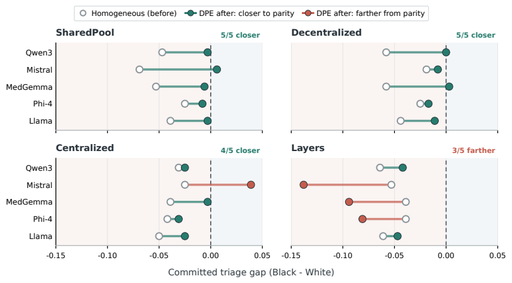
Figure 6 : Triage Black–White gap before (homogeneous committed decision, open markers) and after (the ensemble’s internal final-round gap, filled markers) for all 20 model-by-topology cells.Wherever the topology pools all five perspectives the gap collapses toward zero; the Layers chain, which never pools them, leaves it standing or widens it.Negative values denote more acute care for the Black version. Per-cell values are the agg and+DPE columns of Table 4.
Original paper · CC BY 4.0 · Xiaoyang Wang, Tianrui Wang, Christopher C. Yang · Disparity Laundering: Consensus Without Fairness in Clinical Multi-Agent Systems · Original paper figure · Extracted the figure area from page 19 of the original PDF.Why deliberation doesn't clean up bias
Teams of LLM agents debate before they commit a triage decision, and the design assumes that deliberation averages out individual mistakes. Fairness doesn't behave like a random mistake, because the disparity is a relation between counterfactual versions of one patient. No agent ever sees more than one version, so deliberation can only tighten what is visible inside a version, such as agreement and coherence.
Convergence therefore removes a dissent that points toward parity along with an outlier that is simply wrong.
Each column is individually defensible, yet the inequality lives in a cross-column comparison that no participant performs.
Late-stage fixes look like the natural repair, but the authors argue they can't work. The bias already sits in the upstream agents' ordinary clinical numbers, such as triage levels, test orders and admission flags. Each of those numbers is defensible for a single patient, so a team can pass every single-version audit while still allocating care unequally.
The authors call this disparity laundering: the team passes every single-version audit while its committed decisions differ across demographic versions of the same patient. A system launders a disparity when each version's record passes inspection on its own, the committed decisions differ, and no stage compares versions. Because no agent ever compares demographic versions, the authors conclude the fix is to make the comparison internal to the team.
How the counterfactual pipeline runs
The unit of analysis is a real encounter from MIMIC-IV-ED, and each encounter gets a family of variants that differ only in the demographic descriptor. Because the variants are byte-identical apart from that descriptor, any systematic gap between them can be credited to the descriptor alone. The race axis uses 120 cases in five variants: White, Black, Hispanic, Asian, and a demographic-free control.
Black minus White is the primary contrast, and the Hispanic and Asian arms are read in Appendix C.2.
A team moves through fixed stages: agents first answer independently at r0, then debate over two rounds, r1 and r2. A synthesis step at agg then commits one team decision from the five final-round decisions. The debate structure between rounds is set by the topology, which decides which peers each agent reads. Holding agents and prompts fixed, the topologies differ only in how far the five perspectives have mixed by the synthesis step.
This visibility structure is the one controlled factor in the study.
Triage acuity is the primary endpoint, measured on the Emergency Severity Index from 1 to 5. The composite sums six signed care-intensity differences per case, so it ranges from −6 to +6. A negative triage gap means Black patients are committed to more acute care.
A disparity that deliberation removed looks different along this path from one it only relocated, even at the same group average. Each agent emits a fixed JSON decision over six axes, one numeric field per axis. Each model answering alone flips triage by at least one ESI level in 6.2 to 10.6% of independent-stage readings. Mistral reaches 10.6%, and Phi-4 is lowest at 6.2%.
Bias exists before any team forms
A single model answering on its own already changes its triage when only the race label changes. Under a counterfactual race swap, each model flips its triage by at least one ESI level in 6.2 to 10.6% of independent-stage readings. The flip rates are Mistral 10.6%, MedGemma 8.1%, Llama 7.6%, Qwen3 7.3%, and Phi-4 6.2%, each over n=1,440 per model.
Among those flips, the swap usually moves the Black version toward more acute triage, not the White version. The counts of Black-more-acute to White-more-acute decisions are 80:25 in Qwen3, 127:26 in Mistral, 93:24 in MedGemma, 63:26 in Phi-4, and 99:11 in Llama.
The authors compare this directional margin with a recent single-model emergency-triage audit. That audit reports a strongest-model flip rate near 12% and directional ratios around 2:1. Every model in this study sits at or beyond that directional margin. A natural worry is that the models simply diagnose one group less accurately. The authors test that worry against MIMIC-IV-ED gold outcomes, and the answer is no.
Per-model Black−White committed-MAE differences stay within ±0.034 ESI.
Across a model's four topologies, committed-team MAE moves by at most 0.06. The more-urgent-than-gold counts, Black:White, run from 7:0 to 14:2. So the difference lies in the care assigned, not in the competence of the assignment.
Figure 1 shows the same pattern in a paired view. The accuracy view suggests parity, while the paired view shows that every committed Black−White gap sits below parity. The authors read this as a one-sided disparity hidden inside an accuracy-level parity. The single-model result sets up the next question: whether aggregation across the team changes this bias.
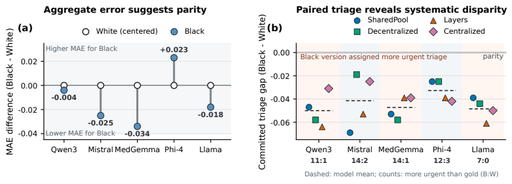
Figure 1 : The audit’s view and the paired view of the same systems.(a)Per-model difference in committed MAE against gold between the Black and White versions: within ±0.034, four of five leaning toward lower error on the Black arm, as more acute assignments move an under-triaging model toward gold.(b)Committed triage Black−White gap for all 20 model–topology cells: every cell below parity. Counts beneath each model are decisions more urgent than gold, Black:White.Accuracy suggests parity; the paired comparison shows a one-sided disparity.
Original paper · CC BY 4.0Topology decides where the bias goes
Topology is the one factor the authors vary while the agents and prompts stay fixed. SharedPool lets every agent read all four others, while Decentralized places the agents on a ring, each reading two neighbours.
The authors read this as relocation: no aggregation structure removes the disparity, and the largest gap shifts between topologies. Qwen3's largest gap appears under Layers at −0.064, while Mistral's largest gap appears under SharedPool at −0.069. No structure is reliably safe or reliably amplifying across the five models, so a fairer-looking design can't be trusted from its architecture alone.
A topology counts as amplifying when its committed gap meets or exceeds the agents' independent baseline. Phi-4 amplifies under all four topologies, while Llama amplifies only under Layers and Centralized. Qwen3 and MedGemma amplify under SharedPool, Layers, and Decentralized, whereas Mistral amplifies only under SharedPool. Llama commits no White-leaning flip under any topology, with counts of 14:0, 16:0, 22:0 and 18:0.
The sex axis shows a related effect that the final team decision hides. Under Centralized debate, an imaging gap moves toward male patients in ten encounters between the independent answers and the first debate round. The team's final sex allocation shows no disparity, so an auditor reading only the output would see nothing. The authors flag this ten-case reading as exploratory, because those cases were picked by movement alone.
Per-agent self-debiasing widens the committed gap in 17 of the 20 model-topology cells.
Why late-stage fixes leave the gap in place
Correcting the bias at the synthesis step does not remove it, because the synthesis step never sees the source of the gap. Neither eliminated, or substantially reduced, the disparity. The masking patch reruns synthesis on the demographic-free control text, and the team's decisions pass through unchanged.
The bias sits in the structured numbers the agents emit, the triage levels, test orders, and admission flags, not in the words.
Per-agent self-debiasing does not remove the disparity either, because the authors tell each agent to correct its own bias. Self-debiasing enlarges the gap rather than shrinking it. At cell level, the gap grows in 17 of the 20 model-topology cells. Per-model values show Qwen3 grows by +0.011 and Phi-4 by +0.045. In the SharedPool cell alone, self-debiasing moves Mistral from −0.069 to −0.050 but pushes Phi-4 from −0.025 to −0.078.
Because the disparity resists these fixes, the authors turn to the structural intervention in the next section: a Diverse-Perspective Ensemble.
Making the comparison visible inside the team
The Diverse-Perspective Ensemble places the comparison inside the team, so no agent has to make it alone. Each of the five agents receives a different variant of one case: White, Black, Hispanic, Asian, or the demographic-free control. The synthesis step receives only the control text, and no other prompt changes. The authors run this ensemble in all 20 model-by-topology cells, so the test covers every topology.
The ensemble's committed decision carries no counterfactual pair, so the authors read an internal gap instead. That internal gap is the final-round, r2, Black-seeing minus White-seeing triage difference among the agents. Under SharedPool, the gap collapses by 67 to 94% in every model, and Mistral overshoots past parity to +0.006. Under Decentralized, the reduction runs from 33 to 100%.
The repair therefore tracks pooling rather than the model.
Two trivial versions also reach zero gap by construction: giving every agent the control text, and averaging the counterfactual arms. Deliberation still matters, because dropping it costs Mistral 0.93 to 1.04 MAE and buys no fairness. The authors didn't test a version that keeps the cross-version views but removes deliberation beyond that single Mistral case.
Limitations of the factorial, the cohort and the setting
The factorial is bounded by cost, so it runs 120 cases and three seeds per cell. They don't lean on any single cell, because consistency across model families carries the claim.
Richer and intersectional identities, which single-model audits show can compound, remain a future extension once a gold standard exists.
The cases come from one emergency-department source, so the authors don't claim coverage of every deployed clinical multi-agent system. Model diversity has been tested elsewhere, and by itself it does not curb amplification (Li et al., 2026).
The sex-axis reading comes from Qwen3 with eight seeds, so it is the thinnest part of the evidence. The ten encounters behind the imaging movement are selected by movement alone, so the authors call that reading exploratory. Race and sex tokens are audit instruments, and they don't capture intersectional or self-identified identity.
Paper info
- Authors
- Xiaoyang Wang, Tianrui Wang, Christopher C. Yang
- Venue
- arXiv · Preprint
- First published
- 2026-10-28
- Added
- 2026-11-1
- Updated
- 2026-10-28
- Version
- v1
- arXiv
- 2610.38215
- Category
- cs.AI · cs.MA
- Original paper terms
- CC BY 4.0
- What we show
- Paper info, commentary and permitted figures from the original paper
AI commentary is a separate explanation from the original paper and may contain errors. The original paper and figures follow each source's terms of use and any rights noted separately.
Abstract
Clinical large language models are increasingly fielded as multi-agent teams, on the assumption that deliberation averages out individual error. It does not average out bias. Across a full factorial of five model families and four aggregation topologies on 120 real MIMIC-IV emergency cases under counterfactual demographic swaps, no configuration neutralizes the disparity: all 20 cells commit the direction of their agents' independent answers, giving Black patients more acute triage. Every model has a topology that amplifies its baseline gap, but which one varies by model, so no design is reliably safe or reliably amplifying: the disparity is relocated, never removed. Late-stage fixes fail: fairness instructions and demographic masking leave the gap untouched, and per-agent self-debiasing widens it, because the bias is already encoded in the agents' ordinary clinical numbers. We call this disparity laundering; the audits now applied to clinical AI, per model, per output, per version, can certify the parts but never the committed decision. Interventions close the gap exactly when they make counterfactual versions visible inside the system and pool them, through deliberation, into the committed decision. A diverse-perspective ensemble does both while keeping the team, with no retraining or architectural change: the disparity falls by 67 to 94% where all five perspectives pool at every round, and the one topology that never pools them is the one it cannot reliably repair. Medical multi-agent systems do not filter demographic bias; they launder it into plausible decisions no single-version audit can catch, and the only defense is to make the bias visible.
Quote from the paper
Xiaoyang Wang, Tianrui Wang, Christopher C. Yang (2026). Disparity Laundering: Consensus Without Fairness in Clinical Multi-Agent Systems. arXiv:2610.38215v1. https://arxiv.org/abs/2610.38215v1
BibTeX
@misc{wang2026disparity,
  title = {{Disparity Laundering: Consensus Without Fairness in Clinical Multi-Agent Systems}},
  author = {Xiaoyang Wang and Tianrui Wang and Christopher C. Yang},
  year = {2026},
  eprint = {2610.38215},
  archivePrefix = {arXiv},
  url = {https://arxiv.org/abs/2610.38215v1}
}