Paper commentary
Are Scaling Laws of Universal MLIPs Universal?
Data sampling choice changes how universal MLIPs scale with training size
- Problem Adding more training structures is assumed to help MLIPs predictably, but equal-sized datasets can hold very different information. Earlier scaling studies varied only the number of structures, not the sampling policy or the test set.
- Method The authors fit power-law scaling curves for M3GNet, MACE and PET trained on subsets drawn by ten sampling policies. Policies include random sampling, stratified sampling, iDIRECT and furthest-point sampling, and each is tested on two test sets.
- Results No tested policy consistently beat random sampling in distribution, but stratified chemical sampling improved the shifted MP-r2SCAN test for PET. Relative loss tracked the size-adjusted test-to-train chemical divergence.
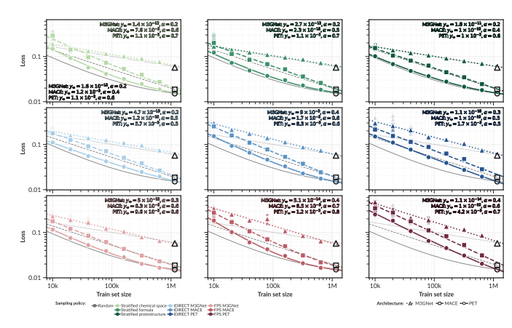
Figure 1 : MPES-ALOE test set loss scaling laws of M3GNet, MACE and PET trained on data selected with 10 sampling policies. The loss function is defined in Eq. 1 and parameters are of a simple power law with asymptotic limit (see Eq. 2). A lower loss is better. The random policy is shown as thin gray lines in each panel, and the parameters are given in the upper left panel.
Original paper · CC BY 4.0 · Theo Keane, Anthony Onwuli, Richard Tomsett, Robert M. Forrest, Jonathan J. Bean · Are Scaling Laws of Universal MLIPs Universal? · Original paper figure · Extracted the figure area from page 6 of the original PDF.Why structure count misleads
MLIPs learn from DFT energies, forces and stresses, because running DFT at the length and time scales of interest is too expensive. Universal MLIPs push this further by training on large DFT databases that span broad regions of chemical and structural space. Since DFT labels are costly, the practical question is how to spend a finite budget of calculations for the largest gain.
Broad materials datasets are uneven across chemical systems, structural motifs, coordination environments and positions on the PES. Two training subsets with the same number of structures can therefore hold very different amounts of information for a task. That is why the authors ask whether diversity-seeking sampling reduces the data needed for a given accuracy.
They also ask whether those conclusions survive a shift between the training and test distributions.
Sampling policies aim to use a finite labeling budget more effectively, for example through active learning or furthest-point sampling in a descriptor space. Earlier scaling studies of MLIPs vary the number of structures but don't assess the sampling policy or the test set.
The training pool, policies and models
The design holds each model's architecture and trainer fixed, so only the structures entering the training set change. The pool combines MatPES-R2SCAN-2025.1 with MP-ALOE, both computed with r2SCAN and identical DFT settings. Structures with any atom above 20 eVÅ−1 in force, or with pressure outside (−50,100)GPa, were removed. After filtering, the combined MPES-ALOE dataset contains 1,287,808 structures.
A 90:5:5 random split gives 64,391 structures each for validation and test, and the rest form the training partition.
Random sampling serves as the baseline, drawing structures uniformly without replacement. The three stratified policies draw in round-robin passes over chemical space, formula or protostructure labels. Each pass takes one unselected structure from every active label, so label-balanced subsets form at small sizes. iDIRECT returns exactly the requested number N of structures, refining target distance quantiles within BIRCH clusters.
FPS greedily selects structures maximally separated from those already chosen in embedding space. Because iDIRECT and FPS rely on embeddings, each pretrained M3GNet, MACE and PET model yields its own variant of each.
A second test set, MP-r2SCAN, uses r2SCAN with different calculation settings and keeps 183,648 structures. Structures whose differences prevent a meaningful comparison are removed from MP-r2SCAN before evaluation. M3GNet serves as the invariant architecture, MACE as the equivariant one and PET as the unconstrained one. The M3GNet parameters resemble MatterSim-5M, the MACE parameters match a single-headed MACE-MH-1, and PET matches PET-OMAT-M.
The loss and the power-law fit
Each trained model is scored with one scalar, the evaluation loss, which adds three normalized residual terms. The loss is L_eval = L_E + L_F + L_S, so energy, force and stress receive equal weight. Cohesive energy, force and stress are each measured first as mean absolute error before they enter the loss. The residuals are normalized with dataset-level scale factors, and the Huber loss uses δ = 1.
It uses a single-regime power law with an asymptotic error floor, y(N) = y∞ + (N/N0)^(−α). The fits use nonlinear least squares in log-performance space, run independently for each sampling policy.
The fit only shows how performance changes with size, so a second quantity links the curve to data composition. The authors compare the chemical-space distribution of each sampled training set with the test set using a test-to-train Kullback–Leibler divergence. This direction penalizes chemical spaces that appear in the test set but are absent or rare in the training sample.
Divergence falls as sample size grows, even under uniform random sampling, so the authors subtract that baseline. The size-adjusted divergence subtracts the expected value for a random subset R_n of the same size. A negative value means the sampled set sits closer to the test distribution than a random sample of that size. Matching sampling-policy, training-size and repeat indices lets the authors relate this divergence to model performance.
These two pieces feed the section's main comparison, which asks whether any policy beats random selection. The authors found that no tested policy consistently beat the random baseline. The scaling exponent α varies by 1.6 to 2× between policies within each architecture.
Which sampling policies beat random sampling in-distribution
No tested sampling policy consistently beats random sampling on the in-distribution MPES-ALOE test set. The fitted exponent alpha varies by 1.6 to 2 times between policies within each model architecture. For PET on cohesive-energy MAE, the exponent is 0.85 under random sampling and 0.706 under iDIRECT PET. A smaller exponent means the error falls more slowly as the training set grows.
The asymptotic limit y_inf can become negligible when a policy performs poorly at small dataset sizes.
The fits use the power law with an asymptotic floor, so the exponent and floor are read together. Figure 1 shows these in-distribution scaling curves for all ten sampling policies and three architectures. The authors expected the embedding-based policies to carry richer information than the chemical labels. The authors suggest the tested policies may not use the embedding information effectively.
Small training sets are the exception, because the effect of training-set size differs across policies and architectures. With 10k structures, the Stratified chemical space and Stratified formula policies give MACE higher losses than M3GNet. This reverses the usual order, where MACE normally outperforms M3GNet. The authors tie this to the sampling policy, so comparing architectures needs care when the policy changes.
They warn that the asymptotic limit in this regime can falsely collapse to near-zero. The authors didn't test whether a different embedding model would change the embedding-based ranking.
Whether the ranking survives a shifted test
The authors compare PET scaling on the in-distribution MPES-ALOE test with the distribution-shifted MP-r2SCAN test. Fig. 2 places the two test sets side by side for PET, so the same architecture is judged on two different distributions. On MP-r2SCAN, the PET Huber-loss exponent is 0.805 under random sampling and 0.97 under Stratified chemical space.
A larger exponent means the loss falls faster as data grows. Here the stratified policy gains slope on the shifted test, while random sampling keeps a smaller exponent.
Stratified formula with PET reaches an exponent of 1.11 on MP-r2SCAN, which is the steepest PET value in this table. The fitted asymptotic error y∞ and the characteristic scale N0 are reported alongside each exponent in the same table. Chemical and structural stratification could improve the shifted test, even though it slightly degrades the parent-distribution test.
The conclusions say that random sampling was difficult to outperform on the held-out test from the same parent distribution. iDIRECT and FPS, by contrast, reduced sample efficiency in these experiments. So the ranking of policies depends on which test set is used for evaluation. The authors tie this reversal to the size-adjusted test-to-train chemical-space divergence.
They didn't test a single ranking that holds across both test sets.
Divergence and the energy-force gap
Chemical divergence is the paper's main explanation for why relative loss moves across sampling policies. The authors report that relative loss is strongly associated with the size-adjusted test-to-train chemical-space divergence. They describe this association in words only, so no correlation coefficient is given. The divergence is size-adjusted, so the baseline expected from uniform random sampling at the same size is subtracted first.
Negative values mean a policy's training set sits closer to the target than a random sample of that size. Training subsets aligned with the test chemistry can therefore give more useful information at the same size.
Cohesive-energy error falls with training-set size faster than force or stress error does. The authors state this energy-force gap across architectures and sampling policies, not only for one model. For PET under random sampling, the fitted exponent is 0.85 for cohesive energy. The same PET fit gives exponents of 0.45 for force and 0.55 for stress.
These exponents describe PET alone, so they show the gap for one architecture and one policy. Because the energy curve steepens faster, a energy-only scaling analysis can overstate performance for force- and stress-dependent uses.
Limits of the scaling fits
The fits stop being reliable below roughly 100k structures, where the sampling policy changes the result the most. For example, MACE with 10k structures under the 'Stratified chemical space' and 'Stratified formula' policies has higher losses than M3GNet. That reversal suggests the small-data advantage usually attributed to equivariant models may depend on the sampling policy.
The authors therefore ask readers to compare scaling laws across architectures and policies with caution.
The fitted y∞ values in the appendix are reported with confidence intervals, and some of them are very wide. The power-law form in Eq. 2 is a single-regime model, and the authors treat it as one regime only. Related work on optical properties reports broken scaling regimes, so one power law may miss the full data range. Only three architectures are compared, and the MACE model is a single-headed variant.
They didn't test a multi-headed MACE, so their architecture comparison doesn't cover that setting.
The divergence analysis uses chemical space as its only categorical label. The size-adjusted divergence removes the baseline that a uniform random sample of the same size would give. The paper treats data scaling as a count of unique training structures, not as a count of atoms. Other studies that count atoms would give different scaling exponents, so the results aren't directly comparable with them.
Paper info
- Authors
- Theo Keane, Anthony Onwuli, Richard Tomsett, Robert M. Forrest, Jonathan J. Bean
- Venue
- arXiv · Preprint
- First published
- 2026-11-11
- Added
- 2026-11-13
- Updated
- 2026-11-11
- Version
- v1
- arXiv
- 2611.15603
- Category
- cs.LG · cond-mat.mtrl-sci · cs.AI · physics.chem-ph
- Original paper terms
- CC BY 4.0
- What we show
- Paper info, commentary and permitted figures from the original paper
AI commentary is a separate explanation from the original paper and may contain errors. The original paper and figures follow each source's terms of use and any rights noted separately.
Abstract
Neural scaling laws enable the prediction of returns from larger training datasets, but machine-learned interatomic potential (MLIP) datasets are heterogeneous and expensive to generate, and equal numbers of structures need not contain equal amounts of useful information. We study data scaling under fixed model configurations for M3GNet, MACE, and PET trained on subsets of a combined MatPES-MP-ALOE training pool. Across training structure subsets from 10,000 to 640,000, together with the full 1.16-million-structure training set, we compare uniform random sampling, three chemistry- and structure-informed stratification policies, iterative DIRECT, and furthest-point sampling using embeddings from three pretrained MLIPs. Models are evaluated using cohesive-energy, force, stress, and aggregate losses on both a held-out test set from the parent distribution and the distribution shifted MP-r$^2$SCAN test set. We observe power-law scaling improvements with increasing data, but the fitted scaling exponent, apparent error floor, and relative sample efficiency depend on the model architecture, target quantity, data sampling policy, and test set distribution. Sampling-policy rankings can reverse across test distributions: chemical stratification can improve cross-dataset performance while degrading in-distribution performance, whereas the embedding-space diversity policies frequently under-perform random sampling. Relative loss is strongly associated with test-to-train chemical-space divergence. These results show that structure count is a necessary but insufficient scaling variable for MLIPs. For training MLIPs, the return on additional first-principles calculations depends not only on how many additional structures are included, but also on how their chemical and configurational content aligns with the model's intended use.
Figures from the paper
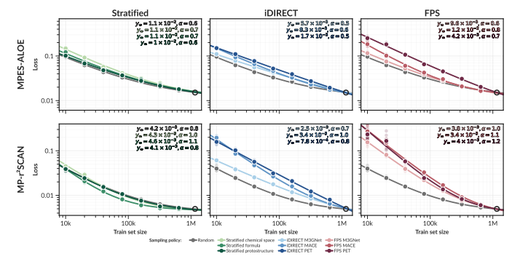
Figure 2 : Scaling laws of PET trained on data selected with 10 sampling policies on the MPES-ALOE and MP-r2SCAN evaluation tasks. The loss function is defined in Eq. 1 and parameters are of a simple power law with asymptotic limit (see Eq. 2). A lower loss is better.
Original paper · CC BY 4.0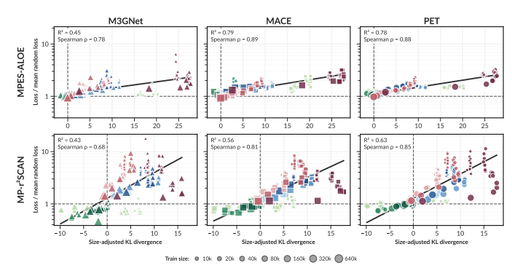
Figure 3 : Relative model performance correlates with distributional similarity of the test and training sets across model architectures and evaluation tasks. Each point corresponds to a specific training set. The size-adjusted KL divergence is defined in Eq. 3.
Original paper · CC BY 4.0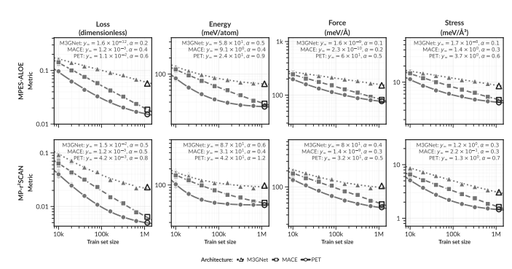
Figure 4 : Scaling laws for the three model architectures M3GNet, MACE and PET using the random data selection strategy on the two evaluation tasks MPES-ALOE and MP-r2SCAN. The loss is defined in Eq. 1, and mean absolute errors are reported for the other metrics (see Section 3.3). The parameters are of a simple power law with asymptotic limit (see Eq. 2). Comprehensive comparisons of all strategies are provided in the Appendix (Fig. A8 & Fig. A9).
Original paper · CC BY 4.0Quote from the paper
Theo Keane, Anthony Onwuli, Richard Tomsett, Robert M. Forrest, Jonathan J. Bean (2026). Are Scaling Laws of Universal MLIPs Universal?. arXiv:2611.15603v1. https://arxiv.org/abs/2611.15603v1
BibTeX
@misc{keane2026scaling,
  title = {{Are Scaling Laws of Universal MLIPs Universal?}},
  author = {Theo Keane and Anthony Onwuli and Richard Tomsett and Robert M. Forrest and Jonathan J. Bean},
  year = {2026},
  eprint = {2611.15603},
  archivePrefix = {arXiv},
  url = {https://arxiv.org/abs/2611.15603v1}
}