Paper commentary
Do Orthogonality Constraints Help Language-Model Training Beyond Sphere Optimization?
Orthogonality constraints fail to beat sphere optimization in language-model pre-training
- Problem Orthogonality constraints helped fine-tuning, but it was unclear whether they help LLM pre-training. Strict row orthonormality also removes about half of a square matrix's free parameters, which may hurt.
- Method The authors constrain only blocks of d rows, so d = 1 reduces to a per-row sphere constraint. They test fourteen variants across models from 360M to 3.1B parameters, trained on nearly 200B tokens.
- Results At d = 1, the sphere constraint reached 2.462 final C4 loss at 360M, compared to 2.475 for Muon. No block size above 1 reliably beat d = 1 across the network.
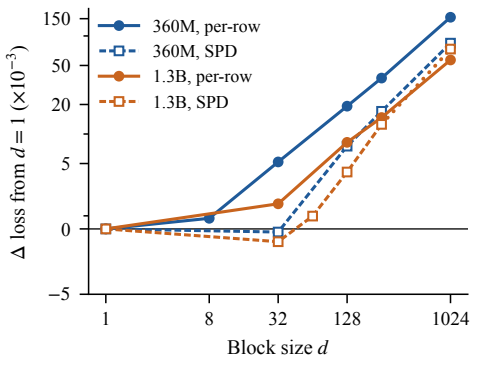
Figure 1 : The C4 loss penalty grows with block size under per-row and SPD gains (2 ×;
Original paper · CC BY 4.0 · Kai Hu, Li Zhang, Weichen Yu, Matt Fredrikson, Haoqi Hu · Do Orthogonality Constraints Help Language-Model Training Beyond Sphere Optimization? · Original paper figure · Extracted the figure area from page 8 of the original PDF.Why full orthogonality is costly
Strict row orthonormality requires W W⊤ = Im for a weight matrix W in R^(m×n) with m ≤ n. The effective number of parameters is therefore roughly halved, which is a very strong regularization.
In LLM pre-training, orthogonality has mostly shaped the training dynamics, because Muon orthogonalizes the update to each weight matrix. Yoshihara evaluated weights on the Stiefel manifold in GPT-2 models with up to 124M parameters, leaving the question open at scale. Whether keeping the weights themselves orthogonal helps pre-training at scale therefore stayed open, and the authors set out to test it with models from 360M to 3.1B parameters.
The authors recover the lost freedom by two routes, and the first keeps the constraint while adding magnitudes. That route learns a row-orthonormal factor Q and a positive diagonal factor D, with the effective weight W = DQ. Even with these per-row magnitudes, full-matrix orthogonality substantially worsens validation loss, whether enforced by the projected update or by manifold Muon.
The second route relaxes the constraint itself, so only each block of d rows must have orthonormal rows.
Block size as the single knob
Block size d sets how many rows must be mutually orthonormal, and it moves the constraint from sphere optimization toward full Stiefel blocks. An m-row matrix then has m(d − 1)/2 constrained row pairs, which is the fraction (d − 1)/(m − 1) of all pairs. The row norms and how they are optimized stay the same, so increasing d changes only the orthogonality between rows.
The paper reparameterizes each block with per-row magnitudes, Wk = DkQk, so every row keeps its own learned norm. To let rows mix, the authors replace Dk with an SPD factor Sk = LkLk⊤, so the effective rows are no longer orthogonal. Because Sk is generally dense, this form can represent any full-row-rank block through the polar decomposition.
Our main comparison keeps per-row magnitudes at every block size, so that d is the only thing that changes.
Across the 360M, 1.3B, and 3.1B pretraining runs, the authors use d = 1 as the control that every block size is measured against.
How OrthMuon takes a step
OrthMuon splits the work between two parts: Muon picks the update direction, and the constraint set keeps the parameter feasible. The constraint set is the row-Stiefel manifold, which is the orthogonal group when m equals n. Each step starts from the Euclidean gradient G, which Nesterov momentum and Newton–Schulz orthogonalization turn into Muon's direction Z.
The projection is written as Z minus sym(ZQ transposed) times Q, where sym takes the symmetric part of a matrix. The tangent step A equals Q minus eta times s times this projected direction, and s is Muon's shape-dependent scale.
OrthMuon returns to the manifold with a polynomial rather than a matrix factorization. The nearest point on the manifold is the polar factor of A, and the paper replaces its inverse square root with a fourth-order Taylor polynomial p(E). The retraction uses only matrix products, the same primitive that Newton–Schulz already relies on. The inner loop therefore needs no QR, SVD, or eigendecomposition.
Proposition 1 bounds the retraction error by c_r times the norm of Delta to the power 2r+2, and the order r equals 4 gives c_4 equal to 63/128. Going from order two to order four adds only two m-by-m products, which they judge a small cost. At 1.3B on GB300 GPUs, d equal to 1 trains at 98% of Muon's throughput.
Each block Q_k on the Stiefel manifold St(d, n) is then projected and retracted independently. Setting d equal to m makes this procedure constrain the whole matrix.
Does block orthogonality beat sphere optimization in the matched ladder
The matched ladder changes only the block size d, while every row keeps its own learned gain. At 360M and the 2× budget, d = 1 reached 2.462 final C4 loss, compared to 2.475 for Muon. Block size 8 reached 2.463 and block size 32 reached 2.467 on the same budget.
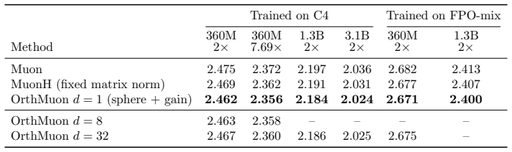
Table 1 : Final C4 validation loss (lower is better): the d = 1 control beats Muon and
Original paper · CC BY 4.0Against the d = 1 reference, d = 8 moves mean loss by only 0.8 to 1.1 milli-loss. Block size 32 raises it by 3.7 to 5.2 milli-loss across the budgets.
Matrix-valued gains restore that expressivity, and at d = 32 SPD differs from d = 1 by −0.2 milli-loss at 360M and −1.0 at 1.3B. SPD's gap to d = 1 is −0.3 at 3.1B, so these matrix-valued gains show no consistent advantage over d = 1. Per-row gains at d = 32 raise loss by 5.2 milli-loss at 360M, 1.9 at 1.3B and 0.8 at 3.1B. The penalty for d = 32 is largest at 360M and shrinks at larger scales.
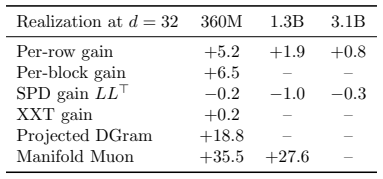
Table 2 : Change in final C4 loss from d = 1 at d = 32, 2 × (×10−3; negative is better;
Original paper · CC BY 4.0Sphere optimization against tuned Muon
Sphere optimization, the d = 1 control, beats tuned Muon by a wide margin in the 360M and 1.3B runs. At 360M, the d = 1 control lowers validation loss relative to tuned Muon by 13.1 to 17.7 milli-loss across the budgets tested. At 1.3B and 2×, the gain over Muon is 12.81 milli-loss, with a 95% half-width of 1.50. The authors split this gain into two parts: the unit-row constraint and the learned row gains.
Removing the learned row gain leaves the unit-row constraint alone, and that variant reaches 7.2 milli-loss at 2×. So the unit-row constraint supplies about half of the d = 1 gain, and learned row magnitudes supply the rest. MuonH, which fixes the Frobenius norm of each matrix, recovers 6.7 milli-loss at 2× and 10.8 at 4×. The authors also test a forward-normalized Muon that keeps the same function class.
Forward-normalized Muon recovers only 5.5 of the 13.1 milli-loss improvement over Muon. It also stays 7.6 milli-loss behind explicit sphere-coordinate optimization.
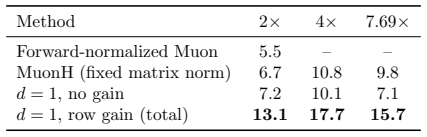
Table 4 : Improvement over tuned Muon at 360M ( ×10−3; higher is better). A unit-row
Original paper · CC BY 4.0The authors conclude that the coordinate system and update dynamics matter alongside the norm and scale.
Where SPD factors help on queries and keys
SPD factors on the query and key projections, with block size 64, are the one placement that improves on d = 1. That reference improves on the default by 0.6 to 1.8 milli-loss at 360M, 1.5 at 1.3B, and 0.3 at 3.1B. Queries and keys contribute about equally, because the query-only and key-only variants give smaller gains that sum to a similar effect.
SPD factors on value, output, or MLP projections don't help, as Table 3 shows. Table 3 shows that the value-only, output-only and MLP variants all have positive changes at 360M and 2×. The gain also shrinks with model size, to 1.1 milli-loss at 1.3B and 0.7 at 3.1B.
Larger blocks reverse the effect, so the placement doesn't hold up at scale. A per-row gain keeps those logits at most 222 for d = 1.
Re-examining the POET, Pion and StelLA gains
The POET and Pion results compare orthogonal methods against an AdamW baseline stored in bfloat16. Both released implementations keep the AdamW parameters and optimizer moments in bfloat16, so the baseline is weaker than it could be. Switching that baseline to fp32 storage makes AdamW far stronger, as Table 6 shows. POET's advantage at 130M and 0.2B tokens shrinks from 31.2 to 8.7 milli-loss under fp32 storage.
POET leads tuned AdamW by 370 and 61 milli-loss at 0.59B and 2B tokens in a separate 130M implementation.
At context length 4096, Pion trails the bfloat16 AdamW baseline by 15.0 milli-loss. Against fp32 AdamW, the same Pion run trails by 95.4 milli-loss.
The StelLA comparison uses Llama-3-8B commonsense adaptation and keeps the rest of the recipe fixed. Sphere improves over Euclidean factors by 2.12 accuracy points, with the paired interval at 1.732 to 2.500. Adding Stiefel constraints on top changes Sphere accuracy by −0.09 points, so row orthogonality adds nothing measurable.
The authors read these three cases as attributing the reported gains to precision, training horizon, optimizer realization, or norm control. Their conclusion is that the Sphere constraint, not the orthogonality between rows, carries the StelLA gain.
Image generation and fine-tuning: does the pretraining result carry over?
The authors test whether the pre-training findings hold for a diffusion transformer and for fine-tuned language models. The image model is SiT-B/2, a 130M-parameter diffusion transformer trained on ImageNet at 256 × 256 with query–key normalization. With an Adam inner optimizer, d = 1 lowers FID-50K from 25.50 to 24.60. With Muon, d = 1 lowers FID-50K from 21.55 to 20.81, and it lowers validation loss in both optimizer families.
Without query–key normalization, AdamW and d = 1 occasionally diverge late in training. The authors attribute the stability benefit of d > 1 to logit control rather than to orthogonality between rows.
That gap sits well within the variation between fine-tuning runs, so downstream accuracy doesn't separate the parameterizations. Muon and MuonH trail d = 1 by 0.7 and 1.1 points.
The fine-tuning study sits beside the earlier re-examinations, which test whether the reported gains of POET, Pion and StelLA hold up. POET and Pion don't constrain the rows of the effective weight, so the authors treat them as audits of orthogonality-based methods. Table 5 summarizes the four studies.
Limitations and scope of the experiments
The pre-training study uses fixed contiguous row blocks and reports validation loss, so it doesn't measure downstream accuracy. Comparisons within the ladder are matched, but the absolute gaps to Muon and MuonH depend on this shared setting.
Three seeds bound the parameterization effects to a few points in that setting. Queries and keys are also evaluated at 3.1B. Learned groupings define complementary interventions, which the authors note in citing Yoshihara (2026).
The adaptation studies cover 8B-class Llama models on commonsense reasoning. The image-generation study covers one 130M diffusion transformer on ImageNet.
Paper info
- Authors
- Kai Hu, Li Zhang, Weichen Yu, Matt Fredrikson, Haoqi Hu
- Venue
- arXiv · Preprint
- First published
- 2026-10-31
- Added
- 2026-11-7
- Updated
- 2026-10-31
- Version
- v1
- arXiv
- 2611.00593
- Category
- cs.LG
- Original paper terms
- CC BY 4.0
- What we show
- Paper info, commentary and permitted figures from the original paper
AI commentary is a separate explanation from the original paper and may contain errors. The original paper and figures follow each source's terms of use and any rights noted separately.
Abstract
A growing body of work reports benefits from orthogonality constraints in fine-tuning large language models (LLMs). These results raise an open question: do orthogonality constraints also help LLM pre-training? We conduct a systematic empirical study of decoder-only LLM pre-training with models ranging from 360M to 3.1B parameters, trained on nearly 200B tokens. We examine fourteen variants of orthogonality training: some constrain the weight matrix itself, while others use orthogonal factors to reparameterize it. Because a strictly orthogonal square matrix loses half of its degrees of freedom, we also study block-wise orthogonality, where every $d$ rows form a row-orthonormal (Stiefel) matrix and the block size $d$ is a hyperparameter. Among block sizes ranging from 1 to the shorter side of the matrix, no $d>1$ used throughout the network reliably outperforms $d=1$, and large blocks are clearly worse; the one placement that helps, symmetric positive-definite factors on the query and key projections, loses its small gain as models grow. At $d=1$, the constraint reduces to sphere optimization, with each row direction on its own unit sphere, which by itself already improves on tuned Muon. The same two findings hold for a diffusion transformer trained on ImageNet, and after fine-tuning, downstream accuracy does not separate the parameterizations. Our conclusion is that, across the realizations we tried, orthogonality between rows does not help language-model pre-training beyond sphere optimization. Since this appears to conflict with several prior results, we re-examine five prior methods in pre-training and fine-tuning that report orthogonality improvements. In each case the reported gain is attributable to numerical precision, training horizon, optimizer realization, or per-row norm control rather than to the orthogonality the methods impose.
Quote from the paper
Kai Hu, Li Zhang, Weichen Yu, Matt Fredrikson, Haoqi Hu (2026). Do Orthogonality Constraints Help Language-Model Training Beyond Sphere Optimization?. arXiv:2611.00593v1. https://arxiv.org/abs/2611.00593v1
BibTeX
@misc{hu2026orthogonality,
  title = {{Do Orthogonality Constraints Help Language-Model Training Beyond Sphere Optimization?}},
  author = {Kai Hu and Li Zhang and Weichen Yu and Matt Fredrikson and Haoqi Hu},
  year = {2026},
  eprint = {2611.00593},
  archivePrefix = {arXiv},
  url = {https://arxiv.org/abs/2611.00593v1}
}