Paper commentary
Technical Report MEG2text: Beyond Alignment in Non-Invasive Brain-to-Text
Learned readout improves non-invasive brain-to-text decoding
- Problem Ranking words by similarity to aligned embeddings can leave a word's informative scores below competing words. Those words never reach the top ten, even when their events are separable.
- Method MEG2text keeps the aligned MEG features frozen and fits a class-balanced linear readout. The readout learns how candidate words compete, instead of ranking them by cosine similarity.
- Results MEG2text reaches 64.12% mean Top-10 balanced accuracy across four corpora. That is 16.92 points above published MEG-XL.
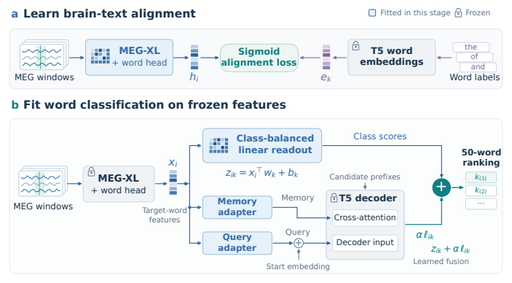
Figure 1 : MEG2text: from brain–text alignment to word prediction.(a)The encoder and word head learn alignment against fixed T5 embeddings using the corrected training and evaluation pipeline. (b)A class-balanced linear readout learns to rank candidate words from the frozen features. Two adapters map the target event to the memory and start-query inputs of a frozen T5 decoder, whose word scores are fused with the readout scores. Shaded blue modules are trained in the indicated stage; locks identify frozen modules. Signal traces are schematic.
Original paper · CC BY 4.0 · Yiqian Yang, Yiqun Duan · Technical Report MEG2text: Beyond Alignment in Non-Invasive Brain-to-Text · Original paper figure · Extracted the figure area from page 2 of the original PDF.Where similarity ranking gets stuck
MEG-XL aligns MEG features with frozen T5 word embeddings and ranks the fifty candidate words by similarity to those embeddings. On LibriBrain100, each event has to place its correct word among those fifty candidates, so this similarity is the whole decision rule. The rule is convenient, but a score can separate a word's own events from other events and still sit below competing words' scores.
The authors saw this failure in a retrained MEG-XL model, where some words had informative scores yet never reached the top ten. A word can therefore be separable from other events and still lose every comparison to a competitor. The open question is how to turn the information left after alignment into more accurate word predictions.
Repairs, readout and T5 fusion
The core idea is to keep the aligned MEG representation as it is and change only the rule that compares candidate words. MEG2text runs in stages that the authors summarize in Figure 1. In the first stage, the encoder and word head, initialized from MEG-XL V2 pretrained weights, learn alignment against frozen T5 word embeddings.
Before that training, two defects in the released code were repaired: evaluation left dropout on, and optimization and checkpoint saving skipped the loss temperature and bias. The fitted readouts then use the epoch-2 checkpoint, selected on validation data. Each event is scored against each candidate with a linear rule, \(z_{ik}=x_i^\top w_k+b_k\), where \(x_i\) is the normalized frozen representation.
Similarity scoring is the special case in which the weights are the normalized T5 embeddings and the biases are zero.
The ridge penalty applies to the weights only, so the bias stays unpenalized. A second readout uses squared loss on one-hot labels, with the same features, class weights and unpenalized bias, to test the choice of objective.
The T5 branch uses a frozen T5-large decoder, fed by two trained adapters that produce the cross-attention memory and the start query. The full system ranks each word by \(z_{ik}+\alpha\,\ell_{ik}\), with \(\alpha\ge 0\) fitted on training data. The complete system uses target-only memory, which holds only the target event's contextualized feature.
How far the full system sits above published MEG-XL
The comparison uses the official Subject 0 test partitions and fifty candidates for every event.
A matched control isolates the repairs, using the unmodified official code as the starting point. Repairing the code moves similarity scoring from 53.04% to 60.21%, a 7.17-point gain under the same initialization and two-epoch budget. Measured increments explain 11.08 points of the total, and the other 5.84 points reflect the difference between the published and control configurations.
On top of the repaired backbone features, the learned readout adds 3.77 points. Target-word T5 fusion adds a further 0.14 points, so most of the measured gain comes before the decoder branch.
Does a better readout help on identical features?
To isolate the readout, the authors hold checkpoint A's frozen features fixed and compare similarity scoring with the cross-entropy readout. Similarity scoring reaches 60.21% four-corpus test mean, and the cross-entropy readout reaches 63.98%.
Because the encoder outputs don't change, the authors attribute the gain to learning the word-classification rule rather than to new features. This shows that the representation holds information that cosine ranking doesn't use.
Against archived checkpoint-B similarity scores, the readout improves the four-corpus mean by 4.00 points, with a 95% interval of [+1.02,+5.72]. So the readout mainly moves the true word into the leading candidates.
Why the training objective matters
The paired interval for that gap is [+0.83,+4.43].
The authors read this as evidence that an objective comparing candidate scores directly gives the more consistent gain. On identical features, the cross-entropy readout correctly ranks 167 events that squared loss misses, and the reverse happens for 84 events. So recovering missed words isn't enough alone, because the readout also has to keep correct rankings elsewhere.
Words that similarity scoring never retrieves
Similarity scoring misses six words so consistently that they account for 943 of the 3,172 test events. Five of them, the, of, we, for and she, never enter the top ten, and i enters three times but never correctly. At the other extreme, were is nominated on 43.38% of all events.
The words we and she reach AUROCs of 0.75 and 0.72 despite never entering the top ten, so their scores carry class information that competing words outrank. A zero hit rate can therefore hide two problems: weak separation, and a ranking rule that doesn't turn separation into retrieval.
They account for 734 of the 837 newly correct events. The six recovered classes add +8.57 points to the four-corpus mean, while the remaining 44 classes contribute -4.57 points.
Alternatives and the T5 branch
None reaches a higher test mean than the linear cross-entropy readout. Within these designs, adding readout capacity doesn't give a consistent improvement.
Changing the input features of the squared-loss readout helps less than changing the objective.
Target-only memory is much stronger than group memory when each branch predicts words alone, but after fusion the two are close. So the standalone advantage shrinks to a small gain beyond the existing classifier.
Limitations
The study used one training seed, and the full system was chosen by test mean among 20 variants.
Subject 0 contributes about 96% of training events. Generalization to unseen participants and open-vocabulary decoding need separate evaluation.
Paper info
- Authors
- Yiqian Yang, Yiqun Duan
- Venue
- arXiv · Preprint
- First published
- 2026-11-25
- Added
- 2026-11-27
- Updated
- 2026-11-25
- Version
- v1
- arXiv
- 2611.34686
- Category
- cs.CL
- Original paper terms
- CC BY 4.0
- What we show
- Paper info, commentary and permitted figures from the original paper
AI commentary is a separate explanation from the original paper and may contain errors. The original paper and figures follow each source's terms of use and any rights noted separately.
Abstract
Non-invasive brain-to-text seeks to recover language from brain activity without surgery. A central challenge is turning learned brain-language representations into accurate word predictions. We present MEG2text, a decoding system that combines corrected training and evaluation, brain-text alignment, a class-balanced word readout, and target-word language-model fusion. On LibriBrain100's word-ranking task, MEG2text reaches 64.12% mean Top-10 balanced accuracy, improving on published MEG-XL by 16.92 percentage points across four corpora, with gains on each corpus. Controlled comparisons show that both implementation corrections and a learned readout contribute to this improvement. Candidate-level analysis reveals that some words receive informative scores yet consistently lose to competing candidates, while an identical-feature comparison shows that learning the classification rule improves decoding without changing the representation. These findings identify the decoding rule as a consequential part of non-invasive brain-to-text and show how system improvements can make better use of aligned neural features.
Quote from the paper
Yiqian Yang, Yiqun Duan (2026). Technical Report MEG2text: Beyond Alignment in Non-Invasive Brain-to-Text. arXiv:2611.34686v1. https://arxiv.org/abs/2611.34686v1
BibTeX
@misc{yang2026technical,
  title = {{Technical Report MEG2text: Beyond Alignment in Non-Invasive Brain-to-Text}},
  author = {Yiqian Yang and Yiqun Duan},
  year = {2026},
  eprint = {2611.34686},
  archivePrefix = {arXiv},
  url = {https://arxiv.org/abs/2611.34686v1}
}