Paper commentary
Measuring Robustness and Efficiency in a Connectome-Constrained Fly Visual System Model: Linking an Adversarial and a Perceptual Illusion
Connectome-constrained fly model shows how illusions and adversarial textures share one failure mechanism
- Problem Brain-like networks have not been compared with gradient-attackable networks on robustness and cost. Biological circuits fail under illusions, but no illusion had been tied to an adversarial stimulus within one system.
- Method FlyNet is a fly visual model wired by its real synaptic connectome. The authors optimize 3D object textures until FlyNet misclassifies looming objects, then test whether reverse-phi illusions disrupt the same motion code.
- Results FlyNet uses up to five orders of magnitude fewer FLOPs than RAFT and is more robust to common video corruptions than RAFT, though the CTRNNs are more robust than FlyNet across almost all perturbations.
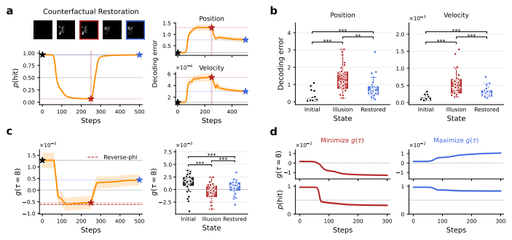
Figure 3 :A static adversarial texture and a dynamic illusion exploit the same low-level motion computation. (a) p(hit) and position and velocity decoding errors across adversarial optimization and counterfactual restoration (30 trajectories). Stars mark initial (black), illusion (red), and restored (blue) textures; texture evolution is shown above.(b)Position and velocity decoding errors at the three counterfactual restoration checkpoints.(c)HR correlator g(τ= 8) (Eq. 4) across counterfactual restoration steps (left), and at the three checkpoints (right).(d)Minimization (left) and maximization (right) of g(τ= 8) (top) and corresponding p(hit) (bottom) across optimization steps. Shaded area represents SEM; asterisks indicate significance from pairedt-test ( **:p <0.01, ***:p <0.001).
Original paper · CC BY 4.0 · Alexandre Garcia-Duran, Alejandro Rodriguez-Garcia, Manuel Molano-Mazón, Alexandre Hyafil, Srikanth Ramaswamy, Janne K. Lappalainen · Measuring Robustness and Efficiency in a Connectome-Constrained Fly Visual System Model: Linking an Adversarial and a Perceptual Illusion · Original paper figure · Extracted the figure area from page 7 of the original PDF.Why robustness and efficiency are hard to test together
Brain circuits keep computing reliably even though they operate under tight metabolic and wiring limits. Artificial networks, in contrast, consume far more energy and can fail under many kinds of perturbation. Biological circuits still aren't immune to perturbation, and classical visual illusions expose their limits. Comparing the two directly is hard, because the networks researchers can attack with gradients aren't wired like biological circuits.
FlyNet, a fly visual model constrained by real synaptic wiring, makes that comparison possible. The authors trained FlyNet on motion detection with the Sintel optical flow dataset, and it reproduces single-neuron responses across three decades of experiments. FlyNet lacks most of the features linked to robustness in artificial networks, since it has sparse recurrence and mostly local connectivity.
Its continuous-time dynamics are the one such feature it does share. Any robustness FlyNet shows might therefore come from sources other than recurrence or global integration.
The authors ask whether biological wiring adds robustness, efficiency, or both, and this split frames the whole study. To test this, they built a looming collision-detection task that scores both connectome-constrained and conventional optic-flow models. Rather than perturbing pixels, they optimize textures in 3D scene space, so the textures stay consistent as objects scale during looming.
Each robustness measurement is paired with computational cost in FLOPs per inference, so efficiency enters the comparison directly. No perceptual illusion had yet been tied to an adversarial stimulus within one system, so the authors ask whether both share a mechanism. They frame connectome-constrained models as a way to surface testable hypotheses about biological perceptual vulnerabilities.
FlyNet and the networks it is compared with
FlyNet models the early fly motion circuit, excluding LPLC2 and giant fiber neurons, with 45,669 neurons and 1.51M anatomically constrained edges. Each neuron is modeled as a passive-point unit that follows a leaky dynamics equation driven by synaptic input and a resting term. The synaptic weights are fixed by connectomic measurements, so the connectome sets the wiring of the model.
Only the neuronal and synaptic parameters are fitted, using an optic flow dataset for motion detection. The whole model keeps just 734 free parameters, and the authors trained it on Sintel optical flow. Two pretrained instances were edited into a hybrid model that shows accurate direction selectivity for all T4 and T5 subtypes.
CTRNN has 11,593 free parameters, and the authors trained it under the same Sintel protocol. sCTRNN starts from the trained CTRNN, unties the shared filter weights and prunes edges by the mean absolute injected current. It is pruned down to FlyNet's 1.51M connections and then fine-tuned on Sintel. sCTRNN reaches an EPE 2% below FlyNet's on held-out Sintel samples, so it serves as an edge-count-matched control that separates edge count from specific wiring.
The CNN baselines follow a FlowNet-inspired design of about 414k parameters and use the same hexagonal sampling as FlyNet. vCNN processes two consecutive frames with local receptive fields, while gCNN adds channel-wise global pooling to the second hidden layer. Two more vCNN variants, with 5 and 10 input frames, test the effect of temporal context.
RAFT has about 5.3M parameters and is run with 1, 6 or 12 recurrent iterations to probe recurrence. RAFT-small, with about 1M parameters, serves as a lower-parameter baseline, and hexRAFT is trained on Sintel with the hexagonal input that FlyNet uses.
Every network feeds a task-specific decoder, and the decoders are trained on frozen network representations. The hit/miss classifier has 512 hidden units with tanh, and the position/velocity regressor uses ReLU units. The decoder is spatial-only and nonlinear, because the authors modeled the LPLC2 computation that integrates spatial patterns.
All models use instantaneous T4/T5 responses, 5,768 units, as decoder input, so the readout is matched across the backbones.
A 3D looming task where textures are the object of attack
The stimulus is a binary task in which an object either hits the fly-observer or misses it. The authors implement the task in a fully differentiable 3D rendering pipeline built on pytorch3d. Rendering in 3D scene space keeps the perturbation consistent across frames as the object scales during looming. Optimizing in pixel space would lose effectiveness under geometric transformations, which is why the authors avoid it.
The pipeline renders grayscale sequences at 416×416 pixels and 100 Hz.
This polar sampling gives isotropic coverage of trajectories across the visual field. A trajectory is a linear translation over duration Ttraj, aimed at the origin for a hit or at a nearby offset endpoint for a miss. The miss endpoint keeps motion statistics comparable to hits, so the two classes differ mainly in collision. Each stimulus is defined by (R, θ, z0, Ttraj) and its appearance parameters.
Shapes are Sphere or Cube, and textures X come from Black, White, Checkerboard, Wavy or Random. Each texture is a 128×128 array, so the optimized object appearance is a compact tensor. That offset keeps the local mean different from the background. The trajectories span angular sizes from about 5 to 110 degrees, with peak expansion speeds up to 1,420 degrees per second.
Some networks take the rendered frames directly, while others take them through a hexagonal sampler. FlyNet receives the luminance of the stimulus on a regular hexagonal lattice of 721 columns.
Optimizing textures to fool the decoder, then restoring them
The adversarial stage works on hit trials and pushes the decoder's predicted probability of a collision down. Each texture X is optimized on hit trajectories, so the decoder's output p(hit) is the quantity being suppressed. Written out, the loss is L(X) = L_CE(X, y_target = 0) + λ_init ||X − X_init||_2, with the target label set to 0 (miss).
The L2 term keeps the texture close to its starting appearance, so the optimized pattern stays a small change from the baseline. The texture that minimizes this loss is the illusion texture, X_illusion.
The counterfactual stage starts from X_illusion and looks for the nearest texture that restores a correct hit classification. It minimizes L(X) = L_CE(X, y_target = 1) + λ_init ||X − X_illusion||_2, so the target label flips to 1 (hit). The L2 penalty now measures distance from X_illusion, which keeps the restored texture close to the adversarial one.
The authors describe this search as akin to optimization-based counterfactual explanations.
CW minimizes a distance plus misclassification objective, and NES estimates gradients from Gaussian perturbations, so it needs no gradient access. Robustness R is the area under the accuracy curve as the perturbation magnitude is swept.
Adversarial failure is not caused by unfamiliar textures
FlyNet keeps its hit/miss accuracy under flicker, but optimized L2-PGD adversarial textures pull its accuracy down. The open question is whether these attacks break the motion representations FlyNet was trained to compute, or only push the texture outside the training distribution. Reverse-phi offers a way to test the first option, because it disrupts motion without any change in the texture distribution.
The authors built reverse-phi looming stimuli from familiar textures by inverting the object's contrast every T seconds. Decoding errors for position and velocity spike at each inversion, as shown in Figure 2d, and they depend on T. Short periods leave the network too little time to recover, while long periods bring both p(hit) and the decoding errors back toward baseline.
Counterfactual restoration tests novelty directly, by finding the nearest texture to the illusion that recovers correct classification. If unfamiliar textures caused the failure, restored textures should still disrupt accuracy, but they don't. Position and velocity readouts recover together with p(hit), which ties the failure to the motion code that reverse-phi disrupts.
Activity induced by the adversarial illusion sits closest to reverse-phi's across all 5,768 T4/T5 neurons, compared with the original and restored conditions. The authors read this as adversarial textures and reverse-phi exploiting similar computational vulnerabilities.
A second-order motion statistic that is enough to fail the model
The authors ask whether the Hassenstein–Reichardt correlation is the lever behind both failures, rather than a texture that is simply unfamiliar. A positive g(τ) indicates looming, a negative value indicates contraction, and zero marks static or non-directional input. Because the computation depends only on the input, the correlator is agnostic to the model.
The authors first checked whether the correlator tracks the motion decoding errors across counterfactual restoration steps. It closely tracks those errors, so the statistic moves with the failure during restoration. The authors then minimized and maximized g(τ=8) directly, without access to the network. The delay of τ=8 corresponds to 8 frames, which is 80 ms.
Under minimization p(hit) dropped to ∼0.3, whereas under maximization it stayed above 0.8.
When the network is maximally fooled, the HR correlator reaches values close to those from reverse-phi. This points to a common vulnerability in FlyNet's motion representations, not to an unfamiliar texture statistic.
Which architectural features buy robustness
FlyNet is mostly local and feedforward, unlike the recurrent and globally integrating networks that robustness is usually linked to. The authors asked whether those ingredients are needed for robustness in general, and which one best explains FlyNet's profile.
Global pooling helps only when the pooled signal carries information that the perturbation needs. It fell behind vCNN under fog, low-photon shot noise and adversarial textures, where the pooled scene average can swamp weak local signals.
Recurrence helps against white-box attacks: accuracy under PGD rose substantially from RAFT-6 to RAFT-12. Robustness stayed unchanged under black-box NES and transfer attacks, and it dropped under motion jitter and fog. FlyNet is recurrent too, but it updates once per frame, so the RAFT result doesn't carry over directly.
Temporal context helps a feedforward network: vCNN with 5 or 10 frames beat the 2-frame version under most perturbation types. The continuous-time models low-pass filter frame-to-frame changes, which fits their high robustness to jitter, flicker and frame noise.
FlyNet's influence-weighted mean distance is about 1.5 hexagonal columns, compared to 2.2 for sCTRNN and 2.8 for CTRNN. sCTRNN raises robustness under PGD L2 and fog above both other models, but falls below CTRNN under L∞ transfer attacks. Neither edge count nor locality explains the ordering consistently, and under every adversarial attack FlyNet is the least robust of the three.
Robustness per order of magnitude of compute
The authors ask how much robustness each architecture buys per unit of compute, and they answer with a single score. That score is LERS, defined as robustness R minus log10 of FLOPs per inference, so it reads as robustness per order of magnitude of compute. The logarithm is conservative, because it penalizes compute less than a linear normalization would.
Any trade-off advantage seen for low-compute architectures would therefore only grow under a stricter normalization.
FlyNet versus CTRNN is the one within-group comparison where LERS departs from robustness. On common video corruptions, all three continuous-time models have R of at least 0.87. CTRNN's roughly 4 times higher compute raises its log10 E by about 7.5%, which outweighs its robustness lead over FlyNet. So FlyNet has higher LERS than CTRNN on common corruptions, even though CTRNN is more robust.
FlyNet and sCTRNN have nearly identical compute, so they are ordered by R alone and reach comparable LERS.
This holds despite CTRNN's higher raw robustness. The authors conclude that the efficiency advantage comes from sparsity, since sCTRNN reaches a comparable LERS without FlyNet's synapse-level wiring. The connectome seems to contribute efficiency through sparsity, not robustness.
Limitations of the connectome-constrained robustness claims
The authors list limits that bound how far their robustness and efficiency claims reach. Biological circuits also work under neuromodulation, synaptic plasticity, synaptic stochasticity and spiking, and FlyNet models none of these.
Decoder input dimensionality differs across architectures, so a higher-dimensional readout could add to measured robustness rather than the backbone alone.
The robustness and efficiency results hold only for the binary looming task. Generalization to object tracking, navigation and more naturalistic scenes remains untested and is left as future work. Compute is measured in FLOPs, which allows consistent cross-architecture comparison but doesn't capture the metabolic cost of biological computation.
Paper info
- Authors
- Alexandre Garcia-Duran, Alejandro Rodriguez-Garcia, Manuel Molano-Mazón, Alexandre Hyafil, Srikanth Ramaswamy, Janne K. Lappalainen
- Venue
- arXiv · Preprint
- First published
- 2026-11-10
- Added
- 2026-11-12
- Updated
- 2026-11-10
- Version
- v1
- arXiv
- 2611.14498
- Category
- cs.CV · q-bio.NC
- Original paper terms
- CC BY 4.0
- What we show
- Paper info, commentary and permitted figures from the original paper
AI commentary is a separate explanation from the original paper and may contain errors. The original paper and figures follow each source's terms of use and any rights noted separately.
Abstract
Biological visual systems compute reliably under tight metabolic and wiring constraints, whereas artificial vision systems consume far more energy and can be sensitive to adversarial perturbations. Whether networks with brain-like wiring are more robust at lower computational cost is unclear. We address this by benchmarking a task-optimized, continuous-time recurrent neural network of the fly visual system constrained by its synaptic connectome (FlyNet) against artificial neural networks. We compare it against CNNs, RAFT, and continuous-time recurrent neural networks without detailed connectome constraints (sCTRNN, CTRNN) on a collision-detection task within a differentiable 3D rendering pipeline. FlyNet is adversarially vulnerable but, relative to its compute, more robust to common video corruptions than RAFT, while using up to five orders of magnitude fewer FLOPs. The CTRNNs remain more robust than FlyNet across almost all tested perturbations, suggesting that connectome constraints benefit efficiency, through their low edge count, over robustness. Recurrence improves robustness to white-box attacks in RAFT and temporal context improves robustness to common corruptions. FlyNet's position and velocity representations degrade under adversarial textures but recover under counterfactual textures that restore correct classification while staying equally far from training, ruling out unfamiliar textures as the cause of failure. The reverse-phi illusion similarly disrupts these representations and inverts the same low-level motion statistic as the adversarial textures. Optimizing this input statistic alone, without access to the network, suffices to induce classification failure, attributing both perturbations to the same circuit vulnerability. Connectome-constrained models can thus surface adversarial failure mechanisms as testable hypotheses about biological perceptual vulnerabilities.
Figures from the paper
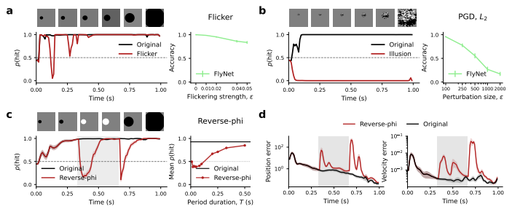
Figure 2 :FlyNet is robust to flicker but sensitive to adversarial and reverse-phi attacks. (a) p(hit) under flicker ( ε= 0.05 ) and accuracy vs. flicker strength (10 trajectories × 10 noise samples). (b) p(hit) under an L2-PGD adversarial texture (ε= 2000 ) and accuracy vs. perturbation size (15 trajectories × 2 restarts).(c) p(hit) under reverse-phi (T= 0.330s ) and average p(hit) vs. contrast- inversion period (50 trajectories).(d)Position and velocity decoding errors under reverse-phi vs. original texture (T= 0.330s ; 50 trajectories). Gray regions indicate contrast-inversion windows; error bars and shaded curves denote standard error of the mean (SEM).
Original paper · CC BY 4.0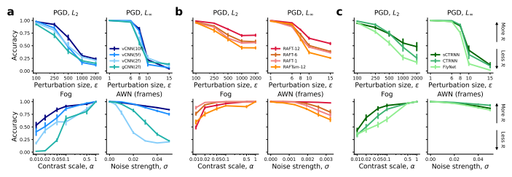
Figure 4 :Global integration, recurrence, temporal context, and connectivity shape robustness under adversarial and common video perturbations. (a)Effect of global signal integration (vCNN vs. gCNN) and temporal context (vCNN(2 frames) vs. vCNN(5 frames) vs. vCNN(10 frames)). (b)Effect of recurrence depth (RAFT family).(c)Effect of connectivity (FlyNet vs. sCTRNN vs. CTRNN). Top row: accuracy under PGD attacks ( L2 and L∞). Bottom row: two representative common video perturbations (AWN on frames and fog). Error bars represent SEM.
Original paper · CC BY 4.0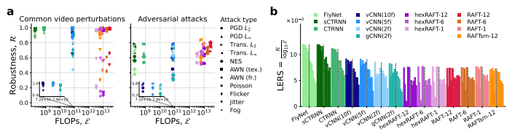
Figure 5 :Robustness-efficiency frontier across perturbation regimes. (a)Robustness R vs. computational cost E, measured in FLOPs, for each network and perturbation type. Left: common video perturbations, including texture noise, frame noise, Poisson noise, flicker, jitter and fog. Right: adversarial attacks, including PGD, transfer and NES attacks. Inset: zoom for the CNN family.(b) LERS computed for all networks and perturbation types. Common video perturbations (left group): AWN texture, motion jitter, shot noise, AWN frames, flicker, fog. Adversarial attacks (right group): transferL ∞, transferL 2, PGDL ∞, NES, PGDL 2.
Original paper · CC BY 4.0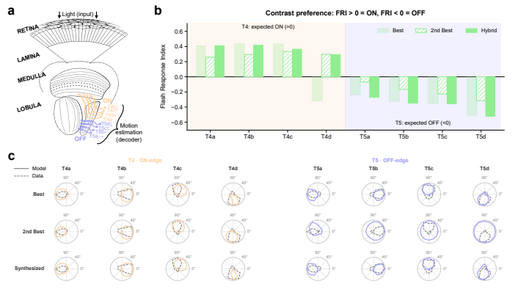
Figure 1 :FlyNet visual circuit. (a)Schematic of the fly optic lobe [ 64], from retina to lobula, highlighting ON and OFF motion-selective T4/T5 pathways used for motion estimation by the decoder.(b)Contrast preference of the T4 and T5 subtypes, measured by the flash response index (FRI; ON >0 , OFF <0 ), for the best-loss model, the second-best model (T4d donor), and the hybrid model. The parameter substitution reverses T4d from OFF to the expected ON preference and preserves the contrast preference of all other subtypes.(c)Directional tuning of T4 (ON-edge) and T5 (OFF-edge) neurons across the three models (solid lines), compared with experimental data (dashed lines).
Original paper · CC BY 4.0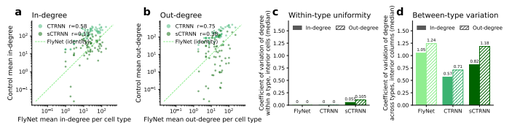
Figure 2 :Comparison of in-degree and out-degree statistics between FlyNet, CTRNN, and sCTRNN. (a)Mean in-degree per cell type in CTRNN and sCTRNN against FlyNet (each point one of 65 cell types; dashed line: identity). r: Pearson correlation with FlyNet’s per-type mean degree.(b)Same for out-degree.(c)Coefficient of variation of degree within a cell type’s interior cells (interior meaning 10 of 15 columns across to remove boundary effects), median across types: FlyNet, CTRNN, and sCTRNN share one filter support by construction. sCTRNN’s differs by a few edges, because of the remainder from pruning the isotropic convolutional filter support from 7.51M to 1.51M edges.(d)Coefficient of variation of degree across cell types within each interior column, median across columns. CTRNN’s dense filters flatten degree differences between types.
Original paper · CC BY 4.0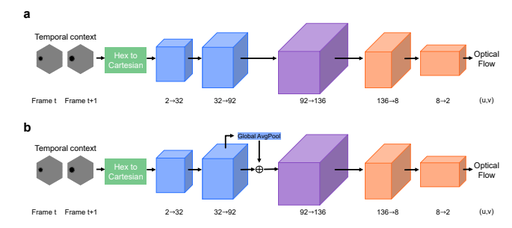
Figure 3 : vCNN(a)and gCNN(b)architectures.
Original paper · CC BY 4.0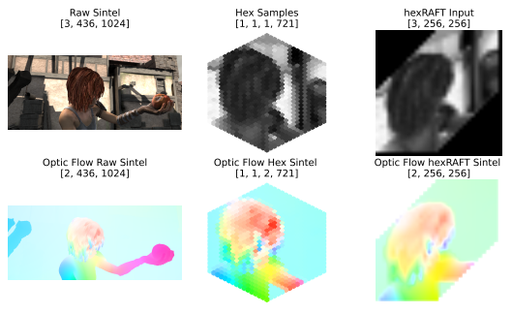
Figure 4 :Hexagonal sampling pipeline for hexRAFT Sintel.Sintel RGB frames (top) and ground- truth optical flow (bottom) are shown in their original resolution (left), after hexagonal sampling with 721 receptors (middle), and after conversion to the 256×256 Cartesian representation used by RAFT (right). This matches the hexagonal sampling geometry of FlyNet, as do the other CTRNN and CNN benchmark families.
Original paper · CC BY 4.0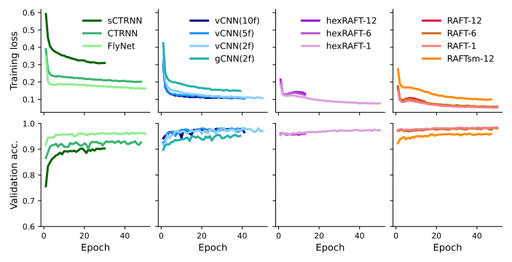
Figure 5 :Training dynamics of the hit/miss decoder across model architectures.Training loss (top) and validation accuracy (bottom) as a function of training epoch for FlyNet, CTRNN, sCTRNN, CNN-based models, and Cartesian and hexagonally sampled RAFT variants. Models are grouped by architecture across columns, with each curve representing a different model configuration.
Original paper · CC BY 4.0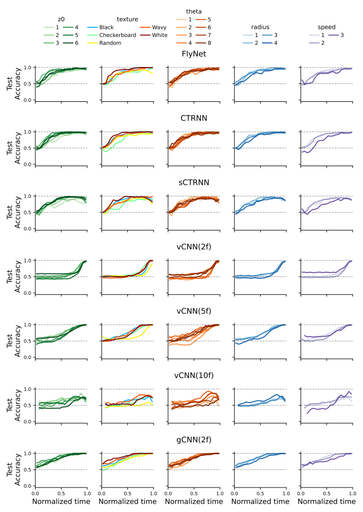
Figure 6 : Decoder test accuracy over time for all CTRNN and CNN networks, with normalized time (dividing by its total duration), conditioning on parameters of the simulation. Numbers in the legend correspond to ascending bins of the uniformly sampled parameters.
Original paper · CC BY 4.0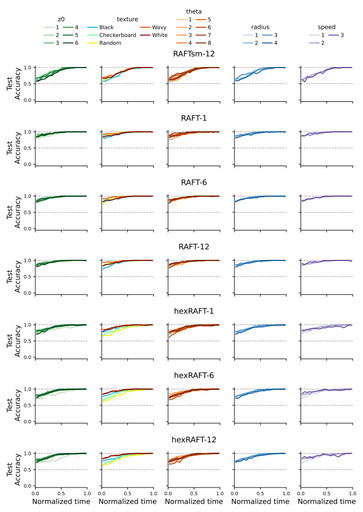
Figure 7 : Decoder test accuracy over time for all RAFT networks, with normalized time (dividing by its total duration), conditioning on parameters of the simulation. Numbers in the legend correspond to ascending bins of the uniformly sampled parameters.
Original paper · CC BY 4.0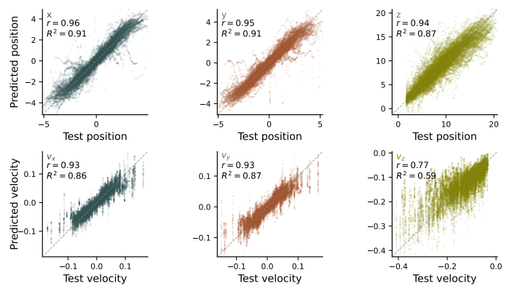
Figure 8 : FlyNet decoder predictions versus ground truth for position (top) and velocity (bottom) on the test set. Columns correspond to the (x), (y), and (z) components. Pearson’s (r) and (R2) are reported.
Original paper · CC BY 4.0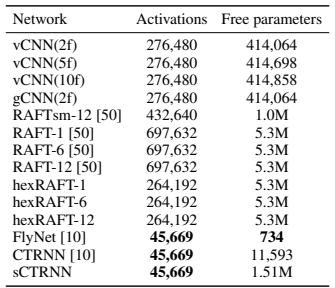
Table 1 : Parameter comparison across networks. In the case of sCTRNN, parameters comprise 1,513,231 per-edge weights, 65 resting potentials, and 65 time constants, yielding 1,513,361 free parameters.
Original paper · CC BY 4.0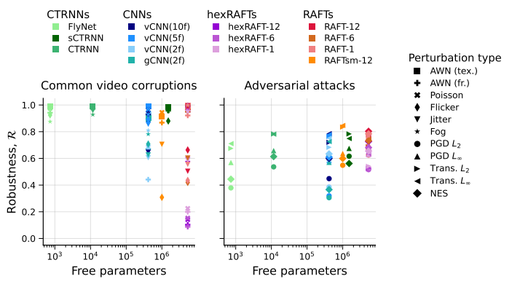
Figure 10 : Robustness versus free parameters across models under common video corruptions (left) and adversarial attacks (right).
Original paper · CC BY 4.0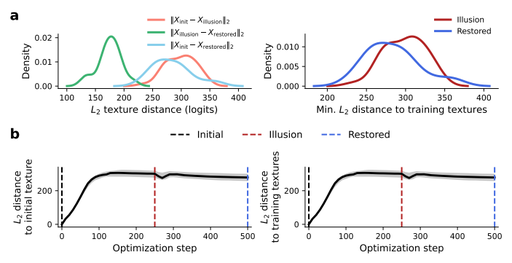
Figure 11 : L2 distances of the textures during counterfactual restoration. (a) L2 distance distributions between the Initial, Illusion, and Restored textures (left), and the minimum distance between such textures and the training set textures (right). The base texture is sampled from the training set, so the distance is 0.(b)Same asabut median evolution over steps, with shaded IQR.
Original paper · CC BY 4.0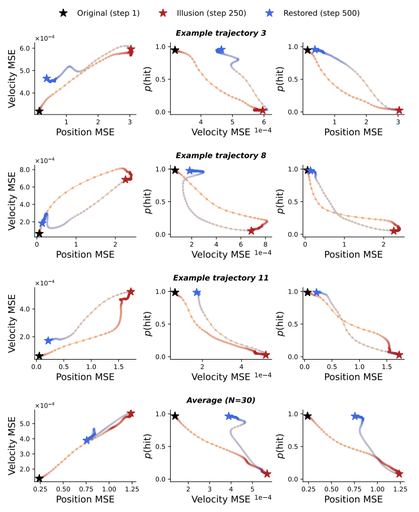
Figure 12 : p(hit), position and velocity decoding errors over steps during counterfactual restoration. Top 3: Example trajectories. Bottom: Average across 30 trajectories.
Original paper · CC BY 4.0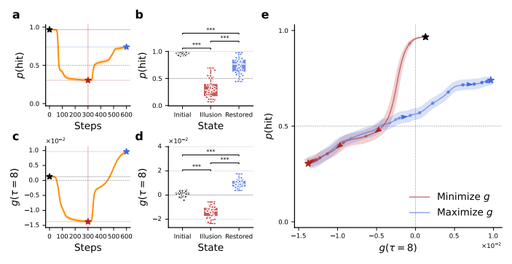
Figure 13 :Optimizing the input HR correlation alone produces the illusion and restores the hit response.Textures were optimized to minimize g(τ= 8) (Eq. 4) for 300 steps and then to maximize it for 300 steps, with a single Adam optimizer and an anchor penalty ( λ= 0.1 ; 30 trajectories).(a) p(hit) across optimization steps. Stars mark initial (black), illusion (red), and restored (blue) textures.(b) p(hit) at the three checkpoints.(c) g(τ= 8) across optimization steps. (d) g(τ= 8) at the three checkpoints.(e) p(hit) against g(τ= 8) along the optimization, during minimization (red) and maximization (blue); dot opacity and arrowheads indicate optimization steps. Lines show the mean; shaded area represents SEM; asterisks indicate significance from paired t-test (***:p <0.001).
Original paper · CC BY 4.0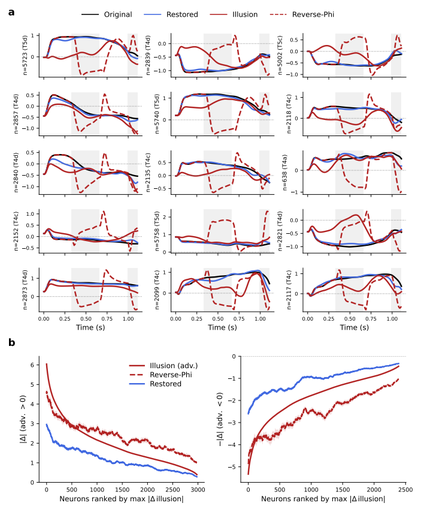
Figure 14 :(a)Single neuron activity (each panel is a neuron) over time, for a trajectory, under all conditions: original texture, reverse-phi, illusion texture and restored texture (from counterfactual restoration).(b)Maximum single-neuron activity perturbation, defined as ∆ =Act. condition− Act. original. Taken across trajectories, computed in the window of contrast change for reverse-phi —for reverse-phi, illusion and restored textures (from counterfactual restoration)—. Neurons sorted according to the maximum perturbation given by illusory texture. Left: predicted positive by the illusory texture. Right: predicted negative by the illusory texture. Mean rolling window of 200 neurons for smoothing.
Original paper · CC BY 4.0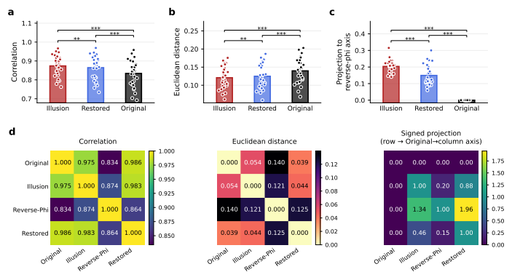
Figure 15 :Representational similarity to reverse-phi. (a–c)Closeness of each condition’s T4/T5 population response to reverse-phi, under three metrics: Pearson correlation across units(a), Eu- clidean distance(b), and the signed projection onto the original →reverse-phi axis(c), on which the original sits at 0 and reverse-phi at 1. Bars are means over the 30 trajectories, error bars s.e.m., dots individual trajectories; brackets give paired t-tests (**p <0.01, ***p <0.001). The adversarial texture is closer to reverse-phi than the restored one on every metric.(d)The full condition-by- condition matrix for each metric; panelsa–care its reverse-phi column. Each matrix is computed within a trajectory and averaged over the 30 trajectories. Insigned projectionentry (i, j)gives how far condition i lies along the original→j axis, so the original row and column are 0 by construction; reverse-phi overshoots the adversarial texture along the original→adversarial axis (1.34), placing the adversarial response between the original and reverse-phi rather than beyond it.
Original paper · CC BY 4.0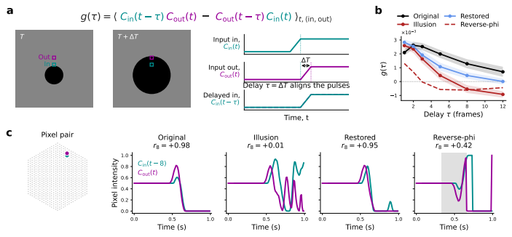
Figure 16 :The Hassenstein–Reichardt looming correlation. (a)Cartoon, two consecutive frames of a looming object (black ball) approaching the camera. Two neighboring pixels (in, out)are highlighted, with the activity of the highlighted neighboring pixels, and a delayed example.(b) Dependence of g(τ) on τ for FlyNet, for the 4 conditions (all averaged at the same window as reverse-phi). Average across 30 trajectories, shade indicates standard error of the mean.(c)Real example, pixel pair highlighted. Traces of the pixels ( in delayed) for the 4 conditions: Original, Adversarial illusion, Restored, Reverse-phi. Pearson correlation of the traces is reported on top.
Original paper · CC BY 4.0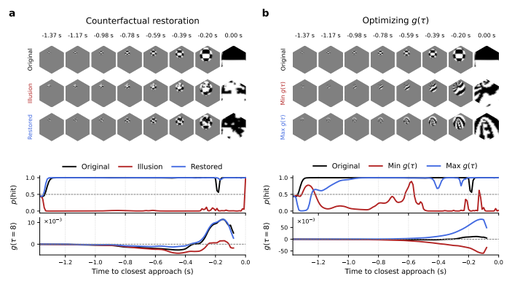
Figure 17 :Comparison between counterfactual restoration and g(τ) optimization on FlyNet. Top hex-panels: evolution over time of the input for the 3 conditions. Middle panel: p(hit) over time. Bottom panel: g(τ) over time.(a)Counterfactual restoration: original (black), adversarial illusion (red) and restored (blue).(b)Optimizing g(τ) : original (black), minimizing (red) and maximizing (blue)g(τ).
Original paper · CC BY 4.0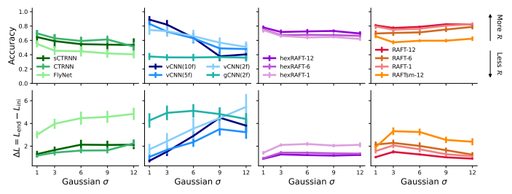
Figure 19 :Robustness of models under natural evolution strategies (NES) attacks.Classification accuracy and change in loss (L=L end −L ini) are shown as functions of the Gaussian perturbation standard deviationσacross model architectures. Error bars indicate variability across samples.
Original paper · CC BY 4.0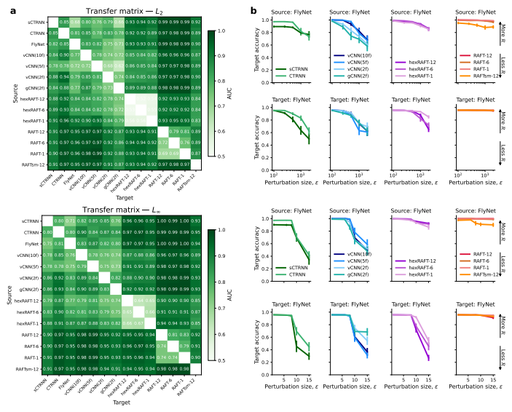
Figure 20 :(a)Transfer attack AUC matrices for PGD illusions. Rows: Source of illusion. Columns: Target of the illusion. Top: L2 norm. Bottom: L∞ norm.(b)Transfer attack curves for flynet as source (left) and target (right). Top:L 2 norm. Bottom:L ∞ norm.
Original paper · CC BY 4.0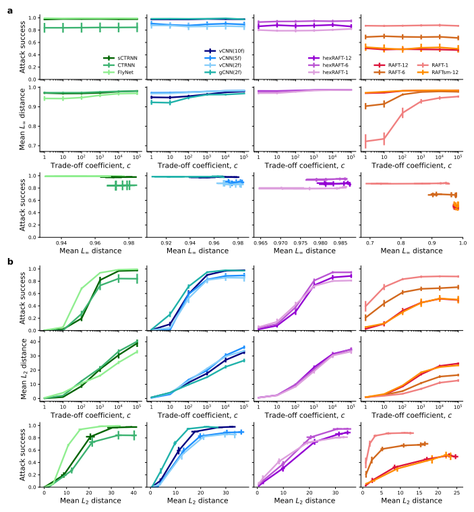
Figure 21 :Robustness of models under Carlini–Wagner (CW) attacks.(a) CW- L∞ and (b) CW-L2 attacks across model architectures. Attack success rates and mean perturbation distances are shown as functions of the attack parameter (c), together with attack success as a function of perturbation distance. Error bars indicate variability across samples.
Original paper · CC BY 4.0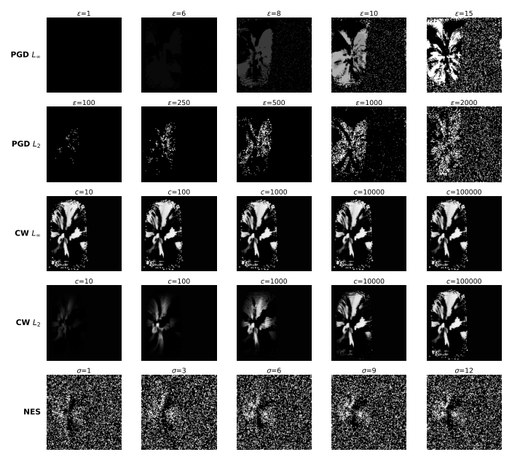
Figure 22 :Examples of adversarial textures found for FlyNet.Adversarial textures optimized for the synthesized FlyNet model under PGD, CW, and NES attacks. Columns show increasing perturbation strength, either ε for PGD, c for CW, or σ for NES, illustrating the distinct texture structures induced by each attack objective and constraint.
Original paper · CC BY 4.0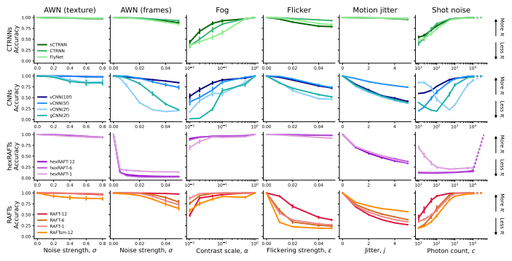
Figure 23 :Accuracy of networks under common video perturbations, for each network family. Order (columns): Additive White Noise (AWN) on the texture, AWN on the frames, Fog/Reduced contrast, Flicker, Motion Jitter and Shot (Poisson) noise. The first five consist on the average across 10 trajectories and 10 noise samples for each trajectory. The last consists on the average across 20 trajectories. Each row corresponds to a network family.
Original paper · CC BY 4.0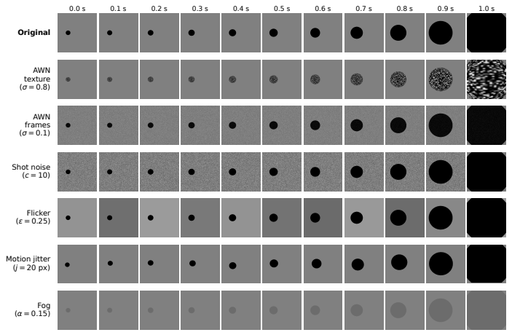
Figure 24 : Examples of frames over time of each different video corruption.
Original paper · CC BY 4.0Quote from the paper
Alexandre Garcia-Duran, Alejandro Rodriguez-Garcia, Manuel Molano-Mazón, Alexandre Hyafil, Srikanth Ramaswamy, Janne K. Lappalainen (2026). Measuring Robustness and Efficiency in a Connectome-Constrained Fly Visual System Model: Linking an Adversarial and a Perceptual Illusion. arXiv:2611.14498v1. https://arxiv.org/abs/2611.14498v1
BibTeX
@misc{garciaduran2026measuring,
  title = {{Measuring Robustness and Efficiency in a Connectome-Constrained Fly Visual System Model: Linking an Adversarial and a Perceptual Illusion}},
  author = {Alexandre Garcia-Duran and Alejandro Rodriguez-Garcia and Manuel Molano-Mazón and Alexandre Hyafil and Srikanth Ramaswamy and Janne K. Lappalainen},
  year = {2026},
  eprint = {2611.14498},
  archivePrefix = {arXiv},
  url = {https://arxiv.org/abs/2611.14498v1}
}