Paper commentary
Deep Reinforcement Learning framework for Autonomous Driving
- Problem Supervised learning struggles to cover the interactions a driving car meets, and the usual split into isolated subproblems may not combine into driving.
- Method Chains sensor fusion, a CNN with attention, LSTM-based temporal aggregation and a DQN or DDAC planning network into one end-to-end pipeline from raw sensor inputs to driving actions.
- Results Lane keeping in TORCS was reported successful with both discretized DQN actions and continuous DDAC actions, and with apprenticeship learning where 50% of actions come from the model at epsilon 0.5.
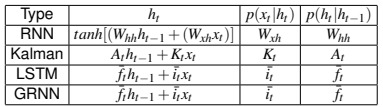
Table 1 : Comparison of state functions for temporal filters
Original paper · CC BY 4.0 · Ahmad El Sallab, Mohammed Abdou, Etienne Perot, Senthil Yogamani · Deep Reinforcement Learning framework for Autonomous Driving · Original paper figure · Extracted the figure area from page 5 of the original PDF.Why supervised pipelines fall short for driving
Driving is hard to pose as supervised learning because the car keeps interacting with other vehicles, pedestrians and roadworks. A labelled dataset would have to cover every mix of vehicle count, road layout and other drivers' behaviour, which is difficult to achieve.
The standard approach splits driving into isolated subproblems, such as object detection and visual odometry, and then merges their outputs in a post-processing layer. The authors see two problems with this split: a subproblem can be harder than driving itself, and the isolated outputs may not combine into coherent driving.
The paper frames driving as three categories, recognition, prediction and planning, and focuses on planning, which the authors treat as the hardest of the three. RL fits planning because its reward signal ties driving actions to the goal of driving well, and training such a system on a real car is risky, so most RL work uses simulators such as TORCS or Unity.
From MDPs and Q-learning to DQN and DDAC
The problem is cast as a Markov Decision Process with states S, actions A, transition probabilities, a discount factor γ and a reward R. The goal is a policy whose expected accumulated reward is maximal, and Q-learning estimates an action-value function Q over state-action pairs by recursive temporal-difference updates. The update is written in the paper as \\( Q_{t+1}(s,a) \\leftarrow Q_t(s,a) + \\alpha[r + \\gamma \\arg\\max_{a'} Q_t(s',a') - Q_t(s,a)] \\), and the symbols are kept as printed.
A table cannot hold Q values once states are continuous, so the Q-function is approximated by a deep network Q(s,a,w) with parameters w. Training minimizes the mean squared error of the Q values, \\( l(w)=\\mathbb{E}[(r+\\gamma \\arg\\max_{a'} Q_t(s',a',w)-Q_t(s,a,w))^2] \\), by gradient-based methods such as SGD, and the resulting method is called DQN.
DQN still needs discrete action values, so DDAC handles continuous actions with two networks, an actor π(s,u) that maps states to actions and a critic Q(s,a,w) that scores the chosen action. The critic is trained as in DQN, while the actor is updated through the chain rule, \\( \\frac{\\partial J}{\\partial u} = \\frac{\\partial Q}{\\partial a}\\big|_{a=\\pi(s,u)} \\frac{\\partial \\pi(s,u)}{\\partial u} \\), so the whole objective stays differentiable with respect to the network weights.
Partial observability and attention in deep RL
The Markov assumption breaks when the environment is only partly observed, as happens with occlusion during tracking, mapping and localization, so the state must be inferred from observations over several time steps. Recurrent networks suit this setting, and DRQN adds an LSTM to DQN, which the paper tests on a flickering variant of Pong where recurrence helps.
Attention targets the observation that DQN's CNN features do not contribute equally to the final objective, so only part of the extracted features should drive the decision. In the glimpse network, a convolution kernel is placed at selected image parts, and its motion is learned with the REINFORCE algorithm. DARQN places an attention filter after the CNN feature extractor inside DRQN, and the cited work reports that it highlights important regions of Atari games.
The authors argue that an attention filter applied over all the data does not reduce computation, whereas glimpse and action networks deploy the kernel only to selected parts and so cut computation at inference time.
Pipeline from sensors to driving actions
The framework is a pipeline trained end to end: its inputs are the environment states and their aggregation over time, and its output is the set of driving actions. The first stage, spatial aggregation, has two parts, sensor fusion and spatial feature extraction.
Sensor fusion groups all sensor information into one raw input vector, and the network learns how to weight each sensor's features through SGD during training, so no fusion rule is hand-written. The paper contrasts this with traditional driving algorithms, which deduce the surrounding objects from sensor readings before planning a path.
The environment state can only be inferred from sensor clues, so the pipeline integrates information over time, following the Bayes filter view that uses a motion model and a sensor model. Bayes filters are derived under the MDP assumption, Kalman filters add linear state equations and Gaussian assumptions, and RNNs and LSTMs are presented as learned versions of the same filter structure, with LSTM gates controlling what to keep, forget and add.
Table 1 places the state functions of RNN, Kalman, LSTM and GRNN side by side, which is the comparison the paragraph relies on.
The planning stage is a Q-network trained with the DQN objective when actions are discrete, and the DDAC network when actions are continuous, with the same error back propagated through the layers.
Lane keeping results in TORCS
The sample task is lane keeping in TORCS, accessed through the Simulated Car Racing add-on, which provides car controls and car states. The network input is the track border position sensor together with the car speed, and the outputs are steering, gear, acceleration and brake values.
For the discrete setup, the actions are tiled and discretized to form a classification problem, and the network is trained end to end with the DQN objective. In the continuous setup, the actions are real values learned with the DDAC policy gradient, and the authors report successful lane keeping in both cases.
The authors report that removing the replay memory in the DQN setup gave faster convergence and better performance. Tile coding of actions made the DQN steering more abrupt, whereas the continuous DDAC policy produced smoother actions and better performance.
In the apprenticeship setup, a proportional controller that keeps the lane while limiting speed supplies the demonstrations, and a regression neural network is fitted to reproduce that controller. The epsilon factor reduces supervision gradually, so at epsilon 0.5 the actions are 50% from the model and 50% from the controller, and at epsilon 0 the model is fully in control.
The reported result is successful lane keeping with a speed limit.
Videos of DQN training, DDAC training and the regression-network driving demo are linked in the appendix.
Limits of the evidence
Experiments cover only lane keeping in TORCS, and the text gives no numeric lane-keeping score for any setup, only that the lane keeping succeeded. The abstract describes simple interaction with other vehicles, but the tested task is lane keeping with track position input, so multi-vehicle interaction is not tested.
No experiment was run on a real car, which the paper's own discussion of training risk makes expected. The authors list deploying the framework in a simulated environment with artificially controlled sensors and actuators as future work, before any extension to real driving.
Paper info
- Authors
- Ahmad El Sallab, Mohammed Abdou, Etienne Perot, Senthil Yogamani
- Venue
- arXiv · Preprint
- First published
- 2017-4-8
- Added
- 2026-11-6
- Updated
- 2017-4-8
- Version
- v1
- arXiv
- 1704.02532
- DOI
- 10.2352/issn.2470-1173.2017.19.avm-023
- Category
- stat.ML · cs.LG · cs.RO
- Original paper terms
- CC BY 4.0
- What we show
- Paper info, commentary and permitted figures from the original paper
AI commentary is a separate explanation from the original paper and may contain errors. The original paper and figures follow each source's terms of use and any rights noted separately.
Abstract
Reinforcement learning is considered to be a strong AI paradigm which can be used to teach machines through interaction with the environment and learning from their mistakes. Despite its perceived utility, it has not yet been successfully applied in automotive applications. Motivated by the successful demonstrations of learning of Atari games and Go by Google DeepMind, we propose a framework for autonomous driving using deep reinforcement learning. This is of particular relevance as it is difficult to pose autonomous driving as a supervised learning problem due to strong interactions with the environment including other vehicles, pedestrians and roadworks. As it is a relatively new area of research for autonomous driving, we provide a short overview of deep reinforcement learning and then describe our proposed framework. It incorporates Recurrent Neural Networks for information integration, enabling the car to handle partially observable scenarios. It also integrates the recent work on attention models to focus on relevant information, thereby reducing the computational complexity for deployment on embedded hardware. The framework was tested in an open source 3D car racing simulator called TORCS. Our simulation results demonstrate learning of autonomous maneuvering in a scenario of complex road curvatures and simple interaction of other vehicles.
Quote from the paper
Ahmad El Sallab, Mohammed Abdou, Etienne Perot, Senthil Yogamani (2017). Deep Reinforcement Learning framework for Autonomous Driving. arXiv:1704.02532v1. https://doi.org/10.2352/issn.2470-1173.2017.19.avm-023
BibTeX
@article{sallab2017deep,
  title = {{Deep Reinforcement Learning framework for Autonomous Driving}},
  author = {Ahmad El Sallab and Mohammed Abdou and Etienne Perot and Senthil Yogamani},
  year = {2017},
  eprint = {1704.02532},
  archivePrefix = {arXiv},
  doi = {10.2352/issn.2470-1173.2017.19.avm-023},
  url = {https://arxiv.org/abs/1704.02532v1}
}