Paper commentary
CHANNELS4WORLD: An Environment-Scale Dataset for Wireless Foundation Models
CHANNELS4WORLD releases a scene-centered dataset for training wireless foundation models
- Problem Wireless datasets often sample few sites densely, so models see little environmental variety. Extra base-station and user positions add observations without adding new environments.
- Method CHANNELS4WORLD generates 100,000 procedural outdoor scenes and binds each scene's geometry, placements and channel records together. Environment count and observation density can therefore be varied independently.
- Results Under matched training exposure, the 90K-scene model reaches held-out Path GMM NLL 7.180, versus 8.039 for the 1K-scene model.
Why environment breadth needs its own scale
A large channel dataset can still cover very few environments, because base-station and user positions multiply observations inside one site. Varying these positions produces many distinct channel observations without adding any new environment. So a large aggregate link count doesn't by itself mean broad environmental coverage.
The paper argues this split matters most for wireless foundation models, which aim to learn representations that transfer across tasks and deployment settings. The diversity of the pretraining data matters, not just its volume. The same breadth-density distinction applies to other data-driven methods that must transfer across deployment environments.
Configurable channel models support controlled experiments, but they don't tie the channels to a specific geometry. Site-specific ray tracing gives dense channels tied to explicit geometry, yet it covers only the sites it models. Measurement campaigns capture hardware effects and interference, but they need substantial equipment, calibration, site access and post-processing.
It also needs a consistent representation that keeps the physical environment, transceiver deployment and channel records aligned. CHANNELS4WORLD meets this need with a scene-centered design, in which each scene binds one environment, one placement set and the resulting channel records. Environment count and within-environment observation density can therefore be controlled independently.
One scene binds geometry, placements and channels
The scene is the unit of data in CHANNELS4WORLD: one environment, one placement set, and every channel record attached to that scene. Geometry, placements, channels and interactions stay aligned across frequencies, so environment count and observation density can be changed independently. The environment is a three-dimensional geometry with material assignments, and the placement set holds BS and UE coordinates in one shared metric frame.
Each scene is evaluated at 3.5 and 7 GHz with the same environment and placements, which isolates frequency effects from changes to the site. Each scene contains 524,288 BS–UE pairs, so each scene yields twice as many evaluations before retention is applied. The two evaluations of one physical pair share placements, but their retained paths don't need to match one-to-one across frequencies.
Each retained path keeps a complex coefficient, an absolute delay, departure and arrival zenith-azimuth angles, an interaction count and summary flags. Paths are stored in descending power order, so the kth entry is the kth strongest retained path. The interaction records give the mechanism and scene-frame position of each bounce, ordered from BS to UE.
A scalar channel impulse response and frequency response can be rebuilt from the coefficients and delays, but the angles don't enter that scalar form.
Building the scenes and trimming the paths
Scene generation starts from a centered 500 × 500 m domain that gets carved into blocks by road corridors. Major road corridors first divide the land into primary blocks, and smaller corridors then subdivide them recursively. Roads are negative space in the ground plane rather than raised meshes, and the remaining polygons become source lots.
Fig. 1 shows example environments from the three profiles, with buildings colored by their assigned RF material class.
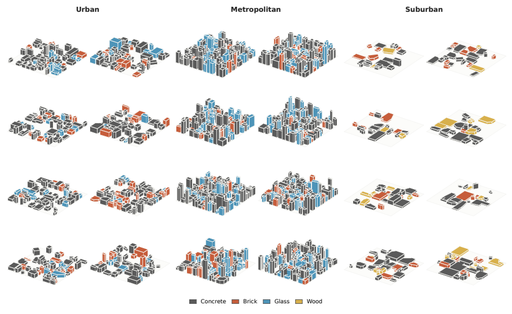
Fig. 1 . ExampleCHANNELS4WORLDenvironments across the Urban, Metropolitan, and Suburban generation profiles. Building colors denote assigned RF material classes.
Original paper · CC BY 4.0 · Joonkyu Jang, Hyung-Joo Moon, Kwang Soon Kim, Seong-Lyun Kim, Jakob Hoydis, Robert W. Heath,, Chan-Byoung Chae · CHANNELS4WORLD: An Environment-Scale Dataset for Wireless Foundation Models · Original paper figure · Extracted the figure area from page 2 of the original PDF.Each source lot works as an envelope, so building shape doesn't simply copy the road subdivision. The generator draws a smaller footprint with randomized size and orientation, then may add diagonal cuts or rectangular notches. Some candidate lots stay unbuilt on purpose, which creates open space. Accepted footprints must be valid, hole-free, large enough, and not overly elongated before they become buildings.
A footprint-dependent cap stops excessively tall, narrow structures.
After simulation, the retention rule decides which candidate paths get stored for each evaluation. Each retained-path sequence is ordered by descending power, and the ordering uses the squared magnitude of each coefficient. The corpus policy keeps at most 16 paths per link and applies a strict power threshold of −150 dB. Because the ceiling truncates the list, a link at 16 paths may still contain weaker candidate paths.
Corpus counts, integrity and the public split
The release holds 100,000 scenes, split 50,000 Urban, 25,000 Metropolitan and 25,000 Suburban. The same placement set is evaluated at 3.5 and 7 GHz, which yields 52.43 billion physical BS–UE pairs. Those pairs produce 104.86 billion frequency-specific evaluations, packaged in a 29.14-TB payload. The profile names are configured generation settings, so they don't stand for classes of real cities.
Because the scene is the release unit, geometry, placements, channels and interactions stay aligned across both frequencies.
Retention counts the share of frequency-specific evaluations that keep at least one retained path. Overall retention falls from 85.40% at 3.5 GHz to 77.33% at 7 GHz. Paths per retained link drop from 10.39 at 3.5 GHz to 8.28 at 7 GHz, and the same frequency trend shows in every profile. Suburban has the highest retention at both carriers, while Metropolitan has the lowest.
The authors argue that these profile gaps don't simply follow from different link-distance distributions.
The canonical public split assigns 90,000 scenes to training and 10,000 scenes to test. The 50:25:25 Urban, Metropolitan and Suburban mix is kept exactly in both parts. Split membership follows scene identity, so a scene's records at both frequencies stay on one side. Replay regenerated the geometry and placements of six sampled scenes and matched their stored artifact hashes.
That replay checks asset regeneration, not channel and interaction regeneration, and it doesn't establish real-world propagation accuracy.
The release design stores geometry and placements apart from the frequency-specific channel and interaction records. Users can fetch only the components they need instead of the full packaged corpus. Deterministic nested subsets contain 200, 1,000, 10,000, 50,000 and 100,000 scenes. Nesting lets an experiment grow from a small subset without replacing scenes it already uses.
Every subset keeps scene identity, inherits the canonical train–test assignments, and keeps the profile composition.
How 7 GHz retains fewer and weaker paths
The authors compare 3.5 and 7 GHz on the same physical environments and placements, using a 3,000-scene morphology-stratified sample. Because the sample was drawn with unequal selection rates across morphology strata, the statistics are reweighted with inverse-selection design weights.
The 7 GHz records are sparser than their 3.5 GHz counterparts. The top-16 path ceiling is reached by 41.3% of retained links at 3.5 GHz but by 24.5% at 7 GHz. The authors treat this ceiling as truncation by the corpus retention policy, not as a physical upper bound on multipath richness. So evaluations at Kq = 16 may still hold additional weaker candidate paths that were cut off.
Across aligned pairs, 77.4% are retained at both carriers, 8.04% only at 3.5 GHz, and fewer than 0.01% only at 7 GHz. A further 14.5% of pairs are retained at neither carrier. Among pairs retained at both carriers, the 7 GHz records hold 2.97 fewer paths per link. Their retained coefficient-power sum is 7.54 dB lower on average, so the power loss is larger than the path-count loss suggests.
Delay structure also differs between the two carriers. RMS delay spread is 14.1 ns lower at 7 GHz, and the earliest retained path arrives 14.3 ns later. The authors attribute these differences to frequency-dependent propagation and the shared retention policy.
What diffraction and path retention change in the stored channels
The authors fix 48 scenes, including their environments and BS/UE placements, and rerun propagation with and without diffraction. The direct effect is defined as the no-diffraction result minus the baseline. Diffraction changes which links survive retention. It also reshapes the multipath structure of the links that remain.
Panel (a) reports the retained-link effect in percentage points. Panel (b) reports the path and delay effects. Panels (a) and (b) use the corpus setting of K=16 with a strict greater-than -150 dB policy. Their pooled effects come with scene-stratified 95% bootstrap intervals. Panels (c) and (d) vary the path-count limit from 1 to 64 and the threshold from -130 to -170 dB, plus an off setting.
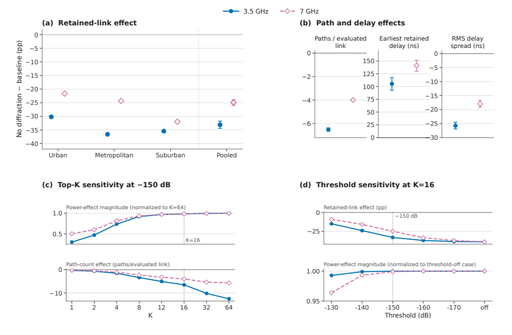
Fig. 5 . Controlled sensitivity of the retained channel records to diffraction and path-retention settings across 48 scenes. Direct effects are no diffraction minus baseline. Panels (a)–(b) use the corpus K= 16, strict >−150 -dB policy and show scene-stratified 95% bootstrap intervals for pooled effects; panels (c)–(d) vary the path-count limit and power threshold.
Original paper · CC BY 4.0The corpus retention policy substantially reduces storage. That reduction comes with little loss in represented aggregate power. The K=16 ceiling reflects truncation by the retention policy, not a physical limit on multipath richness. Evaluations at K=16 can still hide weaker candidate paths. This sensitivity study covers only these 48 scenes.
Does training on more environments help held-out prediction?
The learning study uses the stored 7 GHz records and drops diffraction-flagged paths to match the Channel2World scope. Each episode is one scene and one BS, with 32 query links that have a retained LoS path. The 192 context links are drawn from the remaining nonempty links, so query and context never overlap. The model has 83,501,266 trainable parameters and predicts path and channel positions with Gaussian mixtures.
Each position head uses 8 spherical Gaussian components, and its scale is floored at a value that corresponds to 0.5 m.
The training scenes come from one common SHA-256 order, and the tiers hold its first 100, 1,000, 10,000 and 90,000 scenes. Narrower tiers revisit the same environments more often, because scenes are sampled with replacement under a fixed exposure budget. Validation uses 5,000 fixed held-out scenes with one episode each, and the metric averages equally over scenes.
With correctly aligned embeddings, Path GMM NLL was 8.039 for E1K, compared to 7.199 for E10K and 7.180 for E90K. The authors read the broader tiers as reaching lower NLL under the tested protocol, though the gap depends on the training horizon. Under the tested training budget, models trained on 10,000 or 90,000 scenes beat the model trained on 1,000 scenes on held-out data.
The equal-episode control fixes 32,000 available episodes and compares two ways of spending them. E1K uses 32 episodes from each of 1,000 scenes, while E32K-BS1 uses one episode from each of 32,000 scenes. Both conditions match episode count and aggregate exposure but spread it differently across environments and BS locations. At the tested horizon the difference is small, so scene count alone doesn't explain the larger gaps in the main ladder.
The switched-embedding test replaces each correctly aligned environment embedding with one from a different same-profile validation scene. For E1K, Path GMM NLL rises from 8.039 to 26.882 after the swap. For E10K and E90K, NLL rises from 7.199 to 20.737 and from 7.180 to 20.301. The context test keeps the correct environment and re-encodes 32, 64, or 128 of the 192 links.
For E10K, NLL falls from 9.027 to 7.199 as the matched context grows from 32 to 192 links. The model was trained with 192 links, so this measures inference-time sensitivity rather than training at other context sizes.
Limitations of the learning study and the dataset scope
The learning study rests on a single training seed, one Channel2World-based architecture and objective, and a fixed 7 GHz learning view. The comparisons don't quantify variability across independent training runs. They also don't establish architecture-independent scaling laws or convergence behavior. The main training ladder raises the number of BS-centered episodes as environmental breadth grows.
The equal-episode control changes how a fixed episode count is spread across environments and BS locations, so scene count can't be isolated as a single causal variable.
The stored environments are procedural, so they aren't reconstructions of any deployed site. Held-out scenes test generalization across procedural realizations, not across real cities. Each scene is limited to a 500×500 m domain, and the scenes omit terrain, vegetation, facade apertures, weather, traffic and moving blockers.
Each retained link stores at most 16 strongest candidate paths that pass the strict power threshold. Applications built on these records can still choose waveform, interference, noise and hardware assumptions for each task.
Paper info
- Authors
- Joonkyu Jang, Hyung-Joo Moon, Kwang Soon Kim, Seong-Lyun Kim, Jakob Hoydis, Robert W. Heath,, Chan-Byoung Chae
- Venue
- arXiv · Preprint
- First published
- 2026-11-8
- Added
- 2026-11-10
- Updated
- 2026-11-8
- Version
- v1
- arXiv
- 2611.11428
- Category
- cs.LG · cs.IT · eess.SP
- Original paper terms
- CC BY 4.0
- What we show
- Paper info, commentary and permitted figures from the original paper
AI commentary is a separate explanation from the original paper and may contain errors. The original paper and figures follow each source's terms of use and any rights noted separately.
Abstract
Wireless foundation models learn reusable representations across tasks, configurations, and deployment environments. Their pretraining requires environmental breadth, yet wireless datasets often sample few sites densely. We introduce Channels4World, a scene-centered dataset of 100,000 distinct outdoor RF scenes and a procedural method for generating them. Each scene links a generated environment and RF material assignments to 32 base-station (BS) positions, 16,384 UE positions, and aligned variable-length multipath and ordered interaction records at 3.5 and 7~GHz. The corpus comprises 52.43 billion physical BS-UE pairs, 104.86 billion frequency-specific evaluations, and a 29.14-TB packaged payload. Scene identity aligns geometry, placements, channels, and interactions across frequencies, allowing environmental breadth and within-scene observation density to vary independently. The public release offers predefined subsets at multiple scales and separate access to corpus components. A deterministic 90K/10K scene-level train-test split keeps both frequencies and all scene components together. We characterize morphology, RF materials, and transceiver placement across three generation profiles. Controlled propagation and path-retention analyses show that diffraction materially affects retained-link availability and multipath structure, while the retention policy reduces storage substantially with little loss in represented aggregate power. Under matched training exposure, models trained on broader scene collections perform better on held-out scenes, although an equal-episode control shows that scene count alone cannot explain the gain. By making environmental breadth explicit and controllable, Channels4World supports the development and evaluation of wireless foundation models for generalization across deployment environments.
Quote from the paper
Joonkyu Jang, Hyung-Joo Moon, Kwang Soon Kim, Seong-Lyun Kim, Jakob Hoydis, Robert W. Heath,, Chan-Byoung Chae (2026). CHANNELS4WORLD: An Environment-Scale Dataset for Wireless Foundation Models. arXiv:2611.11428v1. https://arxiv.org/abs/2611.11428v1
BibTeX
@misc{jang2026channels4world,
  title = {{CHANNELS4WORLD: An Environment-Scale Dataset for Wireless Foundation Models}},
  author = {Joonkyu Jang and Hyung-Joo Moon and Kwang Soon Kim and Seong-Lyun Kim and Jakob Hoydis and Robert W. Heath, and Chan-Byoung Chae},
  year = {2026},
  eprint = {2611.11428},
  archivePrefix = {arXiv},
  url = {https://arxiv.org/abs/2611.11428v1}
}