Paper commentary
Harder Than the Task: From Technical to Organizational Difficulty in AI Benchmarking
Benchmarks should test the organizational difficulty of work, not only technical difficulty
- Problem Most AI benchmarks treat a task as a self-contained prompt with the objective, information and authority already settled. Real work happens inside organizations, where dependencies, conflicting interests and changing conditions add difficulty that these benchmarks leave out.
- Method The authors build a taxonomy of organizational structure drawn from organization theory. They then code 522 prominent benchmarks against its six dimensions, using evidence levels of mention, claim or measure.
- Results Only 23 percent of 522 prominent benchmarks claim any organizational dimension.
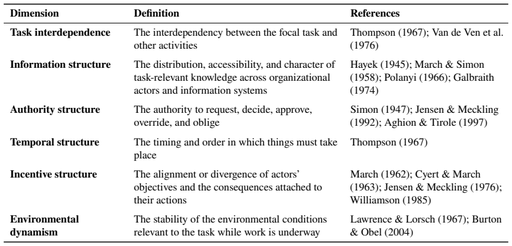
Table 2 .The Taxonomy Dimensions of the Structure of Work
Original paper · CC BY 4.0 · Victor Barres, Aden Barton, Nicolai J. Foss, Henrik M. Nielsen · Harder Than the Task: From Technical to Organizational Difficulty in AI Benchmarking · Original paper figure · Extracted the figure area from page 12 of the original PDF.Why benchmark scores miss organizational work
Benchmarks score models on atomic tasks, yet most economically valuable work happens inside organizations. A benchmark hands the model a prompt in which the objective, the relevant information and the authority to act are already settled. Whatever the prompt leaves out gets treated as either retrievable or irrelevant, so the environment changes mostly through the agent's own actions.
These assumptions stay hidden because the format builds them in instead of stating them. Benchmarks with other actors often still don't create real dependence, and simulating those actors with LLMs raises validity questions. This design measures technical difficulty well, but it quietly holds the organizational setting at a fixed null value.
Take an HR employee who must set a service date after a merger. The calculation is simple, yet the right date may hinge on several sources, from a handbook to former employees. Some sources may conflict. So the hard part lies in the surrounding structure rather than in the calculation.
The authors call this extra difficulty organizational task difficulty, set apart from technical task difficulty. Technical difficulty comes from the focal transformation once the objective, inputs and authority are given. The two vary independently, so a technically hard task can be organizationally simple, and the reverse holds too.
Two sources of difficulty
The core idea is that difficulty comes from two places: the focal transformation itself, and the relationships linking it to other actors and activities. Most existing AI benchmarks focus on this kind of difficulty, such as problems in coding, math, or reasoning.
It also arises when actors have different objectives, which makes this source relational rather than a property of the focal transformation. A production engineer who needs design data, finance approvals, and a manager's decision illustrates how the surrounding structure adds difficulty.
Counting actors doesn't capture this source, because many actors whose activities are independent add little coordination. What matters is the structure of dependencies among actors, activities, information, and decision rights. Simplifying the technical side doesn't simplify the organizational setting, and the reverse also holds. A technically demanding task can be organizationally simple when the actor holds the information, has authority, and needs no one else.
A technically simple task can be organizationally difficult when information is spread across actors or approvals are required.
Both sources are often present for the same task, yet they vary independently. The two can vary independently, so the paper treats organizational task difficulty as a distinct dimension of AI capability. The economics of technological change focuses on tasks but doesn't separate their technical and organizational difficulty. The task-based framework treats jobs as bundles of tasks, so it doesn't capture the organizational content of those tasks.
The six dimensions of the structure of work
The paper stacks the organizational embedding of work into four layers that build on one another. The structure of work comes first, describing the conditions an actor faces before any governance mechanism comes into play. Coordination requirements come second, because the structure of work generates them. Governance mechanisms come third, and performance outcomes fourth, where the authors judge how well those requirements are met.
The taxonomy concentrates on the first layer, and the other three stay looser.
Task interdependence follows Thompson's three forms: pooled, sequential and reciprocal. The forms are cumulative, so the authors code a task by the most demanding form it shows. Each form implies a different coordination need, so the classification keeps that distinction. Information structure asks where the needed knowledge sits, whether it is concentrated or distributed across people, units and systems.
Conflicting and tacit knowledge add further difficulty, since the actor must resolve contradictions or infer know-how from practice. Organizational information dependence arises when obtaining or validating knowledge hinges on other actors or on systems the organization governs, rather than on simple retrieval.
Authority structure separates formal authority, the right to decide, from real authority, the effective control that rests partly on knowledge. Temporal structure asks whether success depends on when other activities occur, not only on how long the task takes. Incentive structure covers how far actors' objectives align and which rewards, penalties and measures shape their behavior.
Environmental dynamism covers how stable the conditions are while the task runs, and a task can become more demanding when those conditions suddenly change.
The dimensions describe distinct features rather than points on one scale, so the number of actors doesn't set difficulty. The configuration of dependencies, not their sheer number, shapes organizational difficulty. Coordination requirements then translate these features into what the actors must do, which the next layer records.
How the 522 benchmarks were sampled and coded
The authors sampled benchmarks from three groups that reflect what the field pays attention to. The industry group took every benchmark listed in the Artificial Analysis Intelligence Index and Epoch AI's Benchmarking Hub as of October 8, 2026, which gave 106 benchmarks. The top-conference group took benchmark papers from six venues between 2023 and 2026 that were oral, spotlight or award papers, giving 321.
Because one benchmark can fall into several groups, the authors counted each benchmark once, so 593 memberships became 522 distinct benchmarks.
Each of the six structure-of-work dimensions received one of three evidence levels: mention, claim or measure. A mention can appear anywhere in the paper, including its motivation, related work or limitations. A claim means the benchmark builds the dimension into its tasks, environment or grader. A measure means the reported results test the dimension separately, through a dedicated metric, an ablation or a failure analysis.
Every positive tag needed a verbatim quote from the paper, and the subsequent layers were tagged as a more exploratory step.
The τ2-bench paper has a simulated user in its environment, so the authors coded it as measuring task interdependence. Its results show a large drop in success when the agent must guide the user instead of acting alone. TheAgentCompany was coded as claiming incentive structure, since its agent negotiates with a simulated colleague, and it also measures information structure.
Vending-Bench 2 was coded as claiming environmental dynamism, yet it has no colleagues, managers or approvals.
The authors also tagged 523 conference benchmark papers classified as organizational or game-based, as a supplementary comparison. Table 3 lists the highest level each of the three example benchmarks reached on each dimension. The codes describe what each paper states, so they don't judge the quality of the benchmark.
How often benchmarks claim organizational conditions
Only 118 of the 522 prominent benchmarks claim any of the six structure-of-work dimensions, which is 23 percent. About half of those 118 benchmarks, or 60, claim only one dimension. Mention is far more common than claim, and claim is more common than separate measurement. Among the prominent benchmarks, 312 mention at least one dimension, which is 60 percent.
Only 81 benchmarks, or 16 percent, measure at least one dimension separately.
Coverage is uneven, and information structure is far more represented than task interdependence. The field keeps organizational conditions in view, but it tends to build only some of them into tasks.
By contrast, 42 of the 129 benchmarks published in 2026 do, which is 33 percent. The indices' recent versions emphasize agentic benchmarks, so the trend partly reflects the sample itself.
Where the subsequent layers stop
Among the 235 dimension claims in prominent benchmarks, 130, or 55%, state a coordination requirement. Only 84, or 36%, describe an environment mechanism, and 88, or 37%, have a grader that checks the outcome. These three shares sit on the same base of claims, so they aren't successive filters.
The split varies a lot by dimension, which is where the coordination picture gets sharper. Task interdependence claims reach 11 coordination statements out of 19, or 58%, and 17 environment mechanisms, or 89%. Information structure claims state a coordination requirement in 52 of 66, or 79%, but only 23, or 35%, describe a mechanism. Environmental dynamism claims state a coordination requirement in 29 of 45, or 64%.
Incentive structure is the least developed layer, with 7 of 44 claims, 16 percent, stating a coordination requirement. Only 3 of those 44 incentive claims, or 7%, describe an environment mechanism, and 4, or 9%, have a grader that checks the outcome. So incentives look like the least developed part of current benchmarks, even when a benchmark does claim them.
A missing tag doesn't show absence, because a paper may contain a layer without describing it. So a low share tells us what the paper states, not whether the benchmark has the mechanism.
Organizational and game-based benchmarks as a contrast
The authors ran a supplementary check with the most generous selection rule they could find. They classified benchmark papers as organizational or game-based from the title and abstract, and tagged 523 of them at the six conferences. Only papers with full text available made the cut, and 48 of these also appear in the prominent sample. Because the two samples overlap, the authors counted the 48 shared benchmarks in both columns of their comparison.
These benchmarks carry far more organizational content than the prominent ones, on every dimension and at every level. Of the 523, 402 claim at least one dimension, which is 77%, against 118 of 522 prominent benchmarks at 23%. Benchmarks that mention at least one dimension rise from 312 to 486, and those that measure one rise from 81 to 300.
The richest benchmarks are those classified as both organizational and game-based, which the authors describe as games set inside an organizational frame.
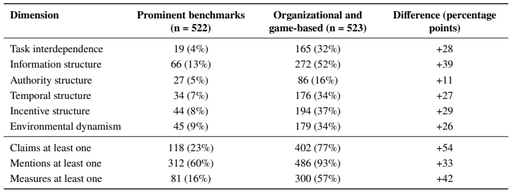
Table 5 .Benchmarks claiming each dimension: organizational and game-based benchmarks compared with prominent benchmarks
Original paper · CC BY 4.0Authority structure is the clearest case of a gap that stays open even in this selection. All 86 benchmarks that claim authority structure represent formal authority, and only 4 represent real authority. Games often lack the firm-like hierarchy, decision rights and obligations that real authority needs, so the authors rarely see those conditions here.
Colleagues or other members of an organization hold the knowledge the agent needs in only 19 of the 272 benchmarks with information structure.
What an aggregate score can't show
A single benchmark score can absorb organizational conditions without showing them. Organizational conditions may sit inside a benchmark and feed its aggregate score. The score can't say whether a failure came from the technical task or from the organizational setting around it. Fewer than one fifth of prominent benchmarks separately measure an organizational dimension.
Representing a condition in a benchmark and measuring an agent's ability to navigate it are different properties.
The authors place tasks on two axes, technical and organizational difficulty, to show where benchmarks sit. GDPval and the Remote Labor Index land in the technically difficult quadrant. Neither claims any of the six organizational dimensions, because the agent works alone with materials supplied up front. They don't look unrealistic, since they are built around real professional work.
The work they draw on simply isn't organizationally difficult.
Much organizational work is messier, and the paper gives a nurse as an example.
Organizational conditions can be built into benchmarks, and the authors don't treat them as impossible to include. The taxonomy gives benchmark builders a conceptual architecture for adding these conditions more systematically.
Capability versus conduct
The agent must both recognize that embeddedness and adapt its actions in line with that understanding. The authors place this capability with the agent, but they say the environment and agent are linked. Because the structure of work conditions this capability, it varies across contexts and periods rather than being a fixed trait. The paper treats it as relational and dynamic, so the organizational dimensions give the axes along which agents can fail and also the axes they can adapt to.
Organizational conduct is a separate matter, and the paper distinguishes it from navigation capability. An agent can acquire information, coordinate activities, and identify dependencies, yet still violate decision rights or confidentiality requirements. Navigation capability asks whether the agent recognizes and responds to organizational conditions, while conduct asks whether its actions follow the organization's rules and norms.
Capability and conduct both matter, and an agent can be capable without being reliable in how it uses that capability.
For evaluation, this split means a benchmark score can hide whether a failure came from the technical task or from the organizational setting. Fewer than one fifth of the prominent benchmarks measure an organizational dimension separately. Representing a condition in a benchmark and measuring an agent's ability to navigate it are different properties.
Limitations of the coverage numbers
The tags record what each paper says, so they can't serve as a verdict on benchmark quality. Every positive tag needed a verbatim quote from the paper, yet the coding still rests on how each paper words its benchmark.
A missing tag can mean the benchmark lacks the layer, or that the paper leaves it undescribed. The coverage figures therefore count papers, and they say little about the agents' measured performance. The 23 percent figure comes from 118 of 522 prominent benchmarks, so it reflects what the papers claim. The supplementary set of 523 benchmarks was chosen for looking organizational or game-based, so its higher rates partly follow from that choice.
The taxonomy takes the division and allocation of work as given, so it doesn't examine how actors are recruited into tasks. Resources and tools count as part of the technical environment, so the taxonomy leaves them out of the organizational dimensions. Whether LLM-simulated humans can stand in for real ones remains an open question for the benchmarks that use them.
The rise in organizational content over time partly follows what the indices choose to track. Only 1 of 49 benchmarks published before 2023 claims a dimension, while 42 of 129 published in 2026 do. Those counts can't separate a real shift in publishing from a shift in the indices' selection.
Paper info
- Authors
- Victor Barres, Aden Barton, Nicolai J. Foss, Henrik M. Nielsen
- Venue
- arXiv · Preprint
- First published
- 2026-11-2
- Added
- 2026-11-4
- Updated
- 2026-11-2
- Version
- v1
- arXiv
- 2611.03494
- Category
- cs.CY · cs.AI
- Original paper terms
- CC BY 4.0
- What we show
- Paper info, commentary and permitted figures from the original paper
AI commentary is a separate explanation from the original paper and may contain errors. The original paper and figures follow each source's terms of use and any rights noted separately.
Abstract
AI benchmarks have made remarkable progress in measuring the ability of AI systems to perform increasingly demanding cognitive and technical tasks. Yet, many of these benchmarks treat technical tasks as the unit of analysis, while much economically valuable work takes place within organizations, where tasks are embedded in a system of relations. Within organizations, successful task performance depends not only on solving the technical demands of the task but also on navigating the interdependence of activities, distributed knowledge, differentiated authority, temporal constraints, conflicting interests, and changing environmental conditions while the task is underway. Accordingly, we argue that organizational task difficulty constitutes a distinct and insufficiently recognized dimension of AI capability, and that existing approaches to benchmarking provide an incomplete basis for assessing how effectively AI agents can perform real-world organizational work. By drawing on organization theory, we develop a taxonomy of the structure of work that characterizes the conditions that agents face in organizational work. Applying this taxonomy to analyze existing benchmarks, we find limited and uneven coverage of organizational dimensions, with fewer than one quarter of prominent benchmarks claiming any of them. We therefore argue that AI benchmarks should increasingly move beyond the evaluation of technically difficult tasks toward the systematic assessment of agents' ability to navigate the organizational conditions under which economically valuable work takes place.
Quote from the paper
Victor Barres, Aden Barton, Nicolai J. Foss, Henrik M. Nielsen (2026). Harder Than the Task: From Technical to Organizational Difficulty in AI Benchmarking. arXiv:2611.03494v1. https://arxiv.org/abs/2611.03494v1
BibTeX
@misc{barres2026harder,
  title = {{Harder Than the Task: From Technical to Organizational Difficulty in AI Benchmarking}},
  author = {Victor Barres and Aden Barton and Nicolai J. Foss and Henrik M. Nielsen},
  year = {2026},
  eprint = {2611.03494},
  archivePrefix = {arXiv},
  url = {https://arxiv.org/abs/2611.03494v1}
}