Paper commentary
Autonomous Mobile Robots on a Computing Field
CABOT lets robots compute by storing states in the floor itself
- Problem Simple robots with no memory, lights or signals cannot coordinate on an inert floor. Adding capability to every robot costs hardware per robot, so the swarm gets expensive as it grows.
- Method CABOT makes the floor an active computing medium instead of strengthening the robots. Each grid cell holds one of a few states that a single local rule updates synchronously, and robots read those states during Look.
- Results Four field states suffice to form a line from connected configurations, and three states gather robots from arbitrary starts. The authors prove that neither gathering nor line formation can be solved field-silently with any number of states.
Why simple robots stall
Swarms of mobile robots are usually analysed in the Look-Compute-Move model, where each robot takes a snapshot, computes a destination and moves there. Those robots carry no identifiers, keep no memory across cycles and have no explicit means of communication. A robot that can't keep a history can't finish some tasks, and a robot that sees only a short range can't see the global shape a formation needs.
The standard fix gives each robot a light, a memory or a wider view. Each extra capability is added per robot, so a swarm of n robots needs n copies of the additional hardware.
With one field state, an inert floor, no algorithm solves Line Formation from connected configurations. The same inert floor rules out Gathering and Line Formation from arbitrary configurations, and Exploration of a torus or a bounded grid.
Connected starts are less hard, since a field-free rule gathers connected configurations of at most 11 robots. That rule gathered all 185,416 connected configurations of up to 11 robots, each within 2(n−1) rounds. It also gathered every random connected configuration of up to 800 robots that the authors tried. The study therefore focuses on arbitrary starts, where the field is indispensable.
Putting the memory in the floor
The rule takes a cell's own state, the states of its four neighbors, and whether a robot stands on the cell itself. The field update uses the old states and the new occupancy, so every cell applies the transition function at the same time. A robot's Look returns the states of the cells in its range as well as the positions of nearby robots.
So a robot can read what earlier robots left behind on the floor.
Information also spreads on its own, one cell per round, so a robot with visibility 1 can act on events it can't see. The robots stay as weak as before: oblivious, silent, lightless, myopic, and unable to write to the field. Robots have no write operation, so every change in the field comes from the rule, which only observes occupancy. The number of field states |Q| is the single resource the paper measures, since robot capability stays fixed.
The field is anonymous and uniform, with cells seeing only their four neighbors and no identifiers or coordinates. Because it is this weak, the field counts as minimal infrastructure rather than a powerful oracle. On a bounded grid, a missing neighbor reads as quiescent and unoccupied, and a robot moving into it stays in place.
Placing all computing capability in a finite-state field under the robots keeps the robots at their weakest setting. The paper then uses the number of field states as the measure of resources needed for each problem.
One round of the coupled system
Each round of CABOT has four phases: Look, Compute, Move and Update. In Look, every robot on a cell c obtains its view V(c) of the field and the occupied cells around it. In Compute, the robot evaluates its algorithm φ on that view and picks a direction or stays. In Move, each robot with a direction moves to the neighboring cell, rigidly and by at most one cell.
In Update, every cell applies δ to its old state, its neighbors' old states and its new occupancy. The two layers touch only at Look and Update, because robots read the field and the field reads robot positions.
The robots never write to the field, so every change in the field comes from δ, which only observes occupancy. A robot's view therefore carries the cell states of its neighborhood, but the robot cannot alter them. The field update is synchronous in the cellular automaton sense, so every cell reads old states and writes new ones. The scheduler is FSYNC, so every robot acts in every round, and the robots agree on the four directions.
The execution is fixed by φ, δ and the initial configuration, because both functions are deterministic.
Four states: a trace makes a line
The floor is the row of the lowest start cell, and robots fall onto it and slide east until they join into one row. A cell holding a robot is q3, and the cells beside a robot carry a trace that decays from q2 to q1 and then to q0. The field rule F1 marks occupied cells q3, and F2 refreshes a cell in q0 or q1 to q2 when a q3 lies horizontally next to it.
Otherwise F3 applies the decay map, so the trace fades by one step per round. Lemma 1 confirms that q3 marks occupancy exactly, so the robots can read occupancy from the field alone.
A robot slides east under rule R1 when a robot sits below it, the cell east of it is empty and shows q2, and the cell above shows q0. A robot falls south under rule R2 when the cell below it shows q1. Both moves read the same target cell in different states, so two robots can't enter one cell together. Lemma 2 shows that the trace beside a stationary robot alternates between q2 and q1, and the robots use this alternation as their timing signal.
The paper treats this mutual exclusion as the reason the same idea works in all its multiplicity-free algorithms.
The authors give a proof sketch of termination: once the floor freezes and the line is complete, no robot moves again. Lemma 6 pins the west end, so no robot ever enters column x_L and the bottom-most robot of that column only falls. The final cells are the n cells starting at column x_L on the floor row. Corollary 1 bounds the run at O(n²) rounds.
Those two cells alternate between q2 and q1 with period 2, while every other cell stays fixed. The obstruction is structural: a robot above the floor waits for the decay to q1, but F2 keeps pushing the trace back up to q2. Five states remove this oscillation by separating the persistent landing predicate from the transient timing signal.
Five states reach a fixed point
The four-state trace does two jobs at once: it marks a legal landing site and it supplies the timing that keeps robots from colliding. A persistent site can't decay while a robot waits beside it, so those two jobs clash. The authors split the jobs: a landing predicate ℓ2 stays on unconditionally, and the robots' own cells carry the marks m− or m+ that provide the timing.
That unconditional rule alone removes the oscillation that the four-state algorithm showed in Proposition 2.
A site that a robot has just left fades in later rounds, through G4 and then G5 and G6. Without a landing site below, S1 gives the robot no support to slide on. Lemma 8 shows that a landing predicate stays at ℓ2 once a neighbor of an unoccupied cell is occupied for all those rounds. Lemma 9 shows that no two robots enter the same cell, because the model's one-round delay would otherwise let both robots move.
Theorem 2 says the five-state rules form the line from connected configurations, ending at the same set of cells in O(n²) rounds. Theorem 2's proof sketch reuses the argument of Theorem 1 with Lemmas 8 and 9 in place of Lemmas 2 and 4. Three rounds after the robots reach P∞, the field is constant: m+ on the n cells of the line, ℓ2 on the two cells beside its ends, and q0 elsewhere.
The two end cells that alternated under four states now rest at ℓ2, so the field reaches a fixed point. The authors don't claim five states are necessary, and whether a four-state field can be field-silent is open.
Gathering from scattered starts with three states
Robots now start on any distinct cells with no connectivity, so a robot may never see another unless the rules bring them together. Each robot paints an axis upward, and a cell with an axis or a west cell to its east becomes w, so w floods the region west of the easternmost robots. The three states are blank q0, w for west, and a for axis, and the rules are applied in the first clause that fits.
Robots walk east through painted cells, and a robot that arrives below the lowest robot of the easternmost column climbs until it can enter.
A robot in the easternmost column descends its axis onto the lowest robot there, so all robots meet on that cell g. The authors give a proof sketch that every robot finally stands on g, the lowest robot of the easternmost column. In the proof sketch, the robots stop by a bookkeeping argument: each robot makes finitely many moves, and a climb ends in row y*.
Machine checks back this up on 4,445 small placements, covering up to three robots in a 5×5 box and four robots in a 4×4 box.
The impossibility argument runs one robot's execution from the origin and then starts a second copy far away. Because the field is uniform and the two copies stay more than the influence radius apart, neither run learns of the other. So no algorithm, with any number of states, gathers from arbitrary starts field-silently. The same argument holds for Line Formation from arbitrary configurations, so the three-state rules trade silence for termination.
Line formation from arbitrary starts with six states
Six field states let robots that cannot see each other still form a line, and the rules borrow the region painting of the gathering algorithm. The landing zone is a cell that sees a robot directly above it, so a converging robot can land there without colliding with one it can't see. Because the robots can't see each other, the landing zone is what keeps the approach collision-free.
The field stabilizes in each bounded region to a pattern of w, a, e and l marks, and no rule can fire once it does. A cell of the last two kinds becomes l instead when a robot stands directly above it.
The proof is only a sketch, and it relies on the stable pattern to rule out a robot left above the floor. Suppose a robot stays above row ymin; the easternmost robot of its highest row then forces the cell below it to be w. That makes the cells east of it a or w, which enables U2, a contradiction, so all robots end in row ymin. Occupied cells in the floor row end up consecutive, because a gap would let the western robot see w to its east and enable U2.
They also checked random configurations of up to 30 robots.
The landing zone is essential: without it, the same rules collide in about 30% of random executions. The landing zone is therefore the part of the design that prevents collisions, not an optional refinement. Because the regions keep spreading, this algorithm isn't field-silent, and Proposition 4 forces that outcome.
Exploration with a rotor-router floor
On an inert floor, a single robot repeats the same move forever, so it can't explore the arena. A move into a missing border cell leaves the robot in place, so no separate border rule is needed. The rule for each cell is simple: a cell with a robot advances its pointer through the cyclic shift N to E to S to W.
Lemma 17 shows that in consecutive visits to a cell v, the robot attempts consecutive directions N, E, S, W. A blocked move keeps the robot on v for one more round, and in every other case the cell is updated exactly once between two visits. Since the arena is finite, some cell v is visited infinitely often, so every neighbor of v is entered infinitely often.
On a torus Tw,h with w and h at least 2, the cover time is wh+h−1 rounds from any start cell. The robot sweeps the rows in the order 1, 0, h−1, h−2 and so on to 2, each sweep taking w rounds. On a bounded grid the cover time is O(wh(w+h)), and the walk settles into a period of 4wh rounds, which the authors observed in simulation for all sizes they tried.
Two states suffice on a torus, and a single state does not, so two is optimal. With two states, a cell flips its state each time a robot stands on it, and the robot moves north on q0 and east on q1. Since no move is ever blocked on a torus, the same cover count of wh+h−1 applies, with rows swept in the order 1, 2 and so on to 0. Whether two or three states suffice on bounded grids is open, and four states do by Theorem 5.
On Z2 neither rotor field explores, because the robot marches east forever, and whether a finite-state field can cover Z2 is open.
Where the results stand
Table 1 lists each problem with its initial configuration, arena, state count and guarantee. The state counts are four for terminating Line Formation, five for field-silent Line Formation, three for Gathering, six for Line Formation from arbitrary starts and two for torus Exploration. Only the two-state torus count is shown optimal, so the others may not be the smallest possible.
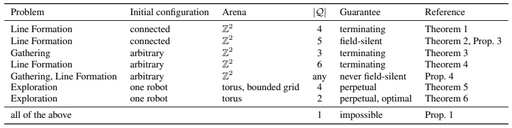
Table 1 : Summary of results. All robots are oblivious, silent, lightless and myopic with visibility range1, and operate underFSYNC.
Original paper · CC0 1.0 · Yonghwan Kim, Gil-Tak Kong, Un-Sook Choi · Autonomous Mobile Robots on a Computing Field · Original paper figure · Extracted the figure area from page 3 of the original PDF.The paper proves the inert-floor claim: with one state, no algorithm solves Line Formation from connected configurations. The same inert-floor result covers Gathering, Line Formation from arbitrary configurations and Exploration of a torus or bounded grid. The Gathering case from connected configurations is left out of that result, since an inert floor appears to suffice there.
Its evidence is an exhaustive check of 185,416 connected configurations of at most 11 robots, not a proof.
Most claims rest on proofs, and the proof sketches are short, with routine bookkeeping left out. Machine verification supports the Gathering result: the algorithm gathers from all 4,445 small placements and from random configurations of up to 100 robots. Some checks are exhaustive small-case enumerations, and the examples in Section 9 are checked by simulation only.
The ruler example reached exact spacing in all 1,200 random rows with k from 2 to 5 and up to 12 robots.
Ruler and painted-floor examples
The equal-spacing rule uses k+2 states, so a robot's cell is r and the cells east of it count their distance to that robot. In simulation, all 1,200 random rows with k from 2 to 5 and up to 12 robots ended exactly k apart.
The painted-floor example uses eight states, so the floor starts with targets rather than blank cells. The target states T and D mark empty and occupied targets, an inert state marks walls, and five states form the excitable medium. Each empty target emits waves of period four, and a target stops emitting once a robot stands on it. The authors didn't prove these rules and checked them only by simulation.
Limits and open questions
Several results in the paper stop short of a complete answer, and the authors name the gaps themselves. Whether Gathering from arbitrary configurations is possible with two states is an open question. Whether Line Formation from connected configurations is possible with three states, or field-silently with four, is also open. The five-state field-silent solution isn't claimed to be minimal, so whether some four-state field is field-silent remains unknown.
The authors note that only the two-state torus exploration bound is known to be optimal.
On tori, two states suffice for exploration, but the two-state field doesn't explore bounded grids. Whether two or three states suffice on bounded grids is left open, while four states do by Theorem 5. The number of states a bounded grid needs for Exploration is likewise an open question.
The further rule sets of Section 9 are validated by simulation only, so they aren't proved correct. The equal-spacing ruler was checked on 1,200 random rows with k from 2 to 5 and up to 12 robots.
The algorithms run under FSYNC, and the authors don't prove any result for weaker schedulers. In simulation, the arbitrary-start rules and the pattern-filling rules still succeed when a random subset of robots is activated each round. Under an asynchronous scheduler, where robots act on outdated snapshots, collisions occurred in simulation.
Paper info
- Authors
- Yonghwan Kim, Gil-Tak Kong, Un-Sook Choi
- Venue
- arXiv · Preprint
- First published
- 2026-11-12
- Added
- 2026-11-13
- Updated
- 2026-11-12
- Version
- v1
- arXiv
- 2611.16652
- Category
- cs.DC · cs.RO
- Original paper terms
- CC0 1.0
- What we show
- Paper info, commentary and permitted figures from the original paper
AI commentary is a separate explanation from the original paper and may contain errors. The original paper and figures follow each source's terms of use and any rights noted separately.
Abstract
We introduce CABOT, a computational model for autonomous mobile robots in which the discrete plane the robots operate on is not a passive stage but an active computing medium. In the classical Look-Compute-Move (LCM) model every increase in computational capability is obtained by strengthening the robots themselves, with lights, memory or wider visibility, at a cost paid once per robot. CABOT strengthens the environment instead: each cell of the grid holds a state from a finite set Q, the states evolve synchronously under a uniform local rule that also senses whether a robot stands on the cell, that is, the floor is a cellular automaton, and the Look operation returns the states of the visible cells in addition to the positions of the visible robots. The robots are as weak as we can make them: oblivious, silent, lightless, myopic with visibility range 1, without multiplicity detection and unable to write to the floor. The number of field states |Q|, rather than any robot capability, becomes the measure of the resources required. On an inert floor (|Q| = 1) such robots can neither form a line, nor gather from scattered positions, nor explore a grid. We show that a handful of states changes this. Line Formation from connected configurations is solvable with four states, and field-silently, so that the floor also reaches a fixed point, with five. Gathering from arbitrary, possibly disconnected, configurations is solvable with three states and Line Formation from arbitrary configurations with six; we prove that neither can be solved field-silently with any number of states. A single robot explores every finite grid forever with four states and every torus with two, which is optimal. Further rule sets, validated by simulation only, equalize the spacing of robots on a row, fill a pattern painted on the floor and guide robots through a maze, and indicate the range of the model.
Quote from the paper
Yonghwan Kim, Gil-Tak Kong, Un-Sook Choi (2026). Autonomous Mobile Robots on a Computing Field. arXiv:2611.16652v1. https://arxiv.org/abs/2611.16652v1
BibTeX
@misc{kim2026autonomous,
  title = {{Autonomous Mobile Robots on a Computing Field}},
  author = {Yonghwan Kim and Gil-Tak Kong and Un-Sook Choi},
  year = {2026},
  eprint = {2611.16652},
  archivePrefix = {arXiv},
  url = {https://arxiv.org/abs/2611.16652v1}
}