Paper commentary
Masked Autoencoders Are Scalable Vision Learners
Masked autoencoders learn scalable vision representations by filling in hidden image patches
- Problem Masked prediction has progressed slowly in vision, even though it succeeded in language. Images are spatially redundant, so a missing patch can be filled in from its neighbors.
- Method MAE hides most random image patches, encodes only the visible ones, and uses a light decoder to reconstruct the hidden pixels.
- Results MAE with ViT-Huge reaches 87.8% ImageNet-1K accuracy at 448 input, the best among methods using only IN1K data.
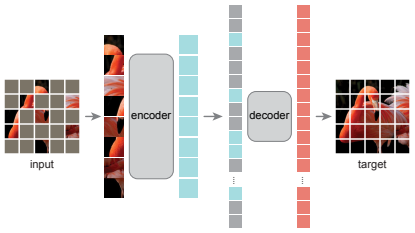
Figure 1 . Our MAE architecture . During pre-training, a large random subset of image patches ( e.g., 75%) is masked out. The encoder is applied to the small subset of visible patches. Mask tokens are introduced after the encoder, and the full set of en- coded patches and mask tokens is processed by a small decoder that reconstructs the original image in pixels. After pre-training, the decoder is discarded and the encoder is applied to uncorrupted images (full sets of patches) for recognition tasks.
Original paper · CC BY 4.0 · Kaiming He, Xinlei Chen, Saining Xie, Yanghao Li, Piotr Dollár, Ross Girshick · Masked Autoencoders Are Scalable Vision Learners · Original paper figure · Extracted the figure area from page 1 of the original PDF.Why masked autoencoding lags in vision
In NLP, masked prediction such as BERT hides part of the input and trains the model to predict the removed content. In vision, the same idea has progressed more slowly, even though it has been popular since the success of BERT. The authors ask what makes masked autoencoding different between the two fields and answer from three angles.
The first difference is architecture: convolutional networks dominated vision, and mask tokens and positional embeddings are awkward to add to convolutions. Vision Transformers remove that obstacle, so the authors treat architecture as no longer the blocker. The second difference is information density: a missing image patch can usually be recovered from its neighbors with little high-level understanding.
So a task that hides only a few units is too easy for images, and the authors hide a very high portion of random patches instead. The third difference is the decoder, which in vision outputs pixels, a lower semantic level than the words BERT's decoder predicts. Although BERT's decoder can be a trivial MLP, the authors found that the decoder design strongly shapes the semantic level of the learned representation for images.
Masking and the asymmetric encoder-decoder
The key idea is to hide most patches, encode only what remains, and ask a light decoder to fill in the pixels of the hidden patches. The image is split into regular non-overlapping patches, as in ViT, and MAE keeps a random subset while removing the rest. Patches are sampled uniformly without replacement, which avoids a bias toward the image center.
A high masking ratio removes much of the redundancy, so a hidden patch can't be solved by extrapolating from its visible neighbors.
The encoder is a ViT applied only to the visible patches, with no mask tokens in its input. Each visible patch gets a linear projection and a positional embedding, and the resulting set passes through Transformer blocks. Because the encoder handles about 25% of patches at a 75% masking ratio, it can be large while staying cheap to run.
After encoding, a shared learned mask token is appended for each hidden patch, and positional embeddings are added to every token. The decoder runs Transformer blocks over this full set, and it is narrower and shallower than the encoder. Its default uses under 10% of the encoder's computation per token, so the full set costs little. The decoder is discarded after pre-training, and the encoder alone is applied to uncorrupted images.
Reconstruction loss and the implementation
The loss is the mean squared error between reconstructed and original pixels, computed only on the masked patches. Computing the loss on all pixels, as traditional denoising autoencoders do, lowered accuracy by about 0.5%.
The normalized variant computes the mean and standard deviation of all pixels in each patch and uses them to normalize that patch. The authors found that normalized targets improved representation quality, so this variant is their main setting for the final models.
Every input patch becomes a token, and the tokens are randomly shuffled. The list is then cut by the masking ratio, which leaves the small set the encoder sees, equivalent to sampling without replacement. After encoding, mask tokens are appended and the full list is unshuffled so each token lines up with its target. Shuffling and unshuffling are fast, so the implementation adds negligible overhead and needs no sparse operations.
Ablations on masking ratio, sampling and decoder
On ViT-L/16 with ImageNet-1K, a 75% masking ratio works well for both fine-tuning and linear probing. Linear probing is far more sensitive: it falls to 54.6% at one extreme and reaches 73.5% at the best ratio, while fine-tuning stays good across 40–80%. Even at 85% and 95% masking, a model pre-trained at 75% produces plausible reconstructions.
Block-wise masking at 75% scored 82.8 fine-tuning and 63.9 linear probing, compared to 84.9 and 73.5 for random sampling. The authors attribute the drop to a harder task with higher training loss and blurrier reconstructions. Grid-wise sampling gives sharper reconstructions, but its linear probing of 66.0 is lower than random sampling's 73.5.
The authors attribute this to the last decoder layers specializing in pixel reconstruction, which deep decoders absorb so the encoder keeps more abstract features.
Keeping mask tokens in the encoder drops fine-tuning to 84.2 from 84.9 and linear probing to 59.6 from 73.5. The authors attribute this to a train-test gap, because uncorrupted images at deployment contain no mask tokens. Without any augmentation, linear probing falls to 65.7 from 73.5, while cropping alone keeps the results strong.
Training cost without mask tokens
Dropping mask tokens from the encoder cuts the training FLOPs by 3.3× in the ViT-L ablation. In wall-clock terms, ViT-L with mask tokens takes 42.4 hours and without them takes 15.4 hours, a 2.8× speedup. The speedup rises to 4.1× with ViT-H and a one-block decoder, and the ViT-H entry with mask tokens is estimated from ten epochs.
The timings use 800-epoch training on 128 TPU-v3 cores with TensorFlow at a 75% mask ratio. Against BEiT, the authors report MAE as about 3.5× faster per epoch, which they link to the same mask-token choice.
ImageNet-1K results and scaling
With normalized pixel targets and 1600 epochs of pre-training, MAE scored 83.6, 85.9 and 86.9 fine-tuning for ViT-B, ViT-L and ViT-H at 224 input. Fine-tuning ViT-H at 448 input lifts MAE to 87.8%, using only IN1K data.
Under end-to-end fine-tuning, ViT-L with MoCo v3 scored 84.1 and with BEiT 85.2, compared to 85.9 for MAE. The authors also report 31 hours for MAE over 1600 epochs and 36 hours for MoCo v3 over 300 epochs, both on 128 TPU-v3 cores.
The gain over scratch training grows with model capacity, which the authors say follows a trend similar to JFT-300M supervised pre-training.
Transfer to COCO and ADE20K
For COCO, the authors fine-tune Mask R-CNN end-to-end with a ViT backbone adapted to FPN. With ViT-L, MAE scores 53.3 box AP, compared to 49.3 for supervised pre-training. With ViT-B, the gap is smaller: 50.3 against 47.9 box AP.
On ADE20K with UperNet, MAE ViT-L scores 53.6 mIoU, compared to 49.9 for supervised pre-training. BEiT with ViT-L scores 53.3 on the same benchmark, so MAE is slightly ahead there too. The BEiT numbers come from the official code, while the other entries come from the authors' implementation.
Linear probing and partial fine-tuning
MAE with ViT-L reaches 75.8% linear probing accuracy, below the 77.6% of MoCo v3 for ViT-L. Fine-tuning only the last Transformer block raises MAE from 73.5% to 81.0%.
The authors argue that linear separability is not the sole measure of representation quality, because linear probing correlates poorly with transfer.
Limitations
MAE reconstructs pixels, which are not semantic entities, so the objective doesn't target a semantic breakdown of images directly. The authors present the semantic richness of the hidden representation as a hypothesis. MAE predicts content from the statistics of its training data, so it can reflect data biases and generate content that doesn't exist.
Linear probing for ViT-L still trails contrastive MoCo v3, and linear probing had not saturated at 1600 epochs.
Paper info
- Authors
- Kaiming He, Xinlei Chen, Saining Xie, Yanghao Li, Piotr Dollár, Ross Girshick
- Venue
- arXiv · Preprint
- First published
- 2021-11-11
- Added
- 2026-10-20
- Updated
- 2021-12-19
- Version
- v3
- arXiv
- 2111.06377
- Category
- cs.CV
- Original paper terms
- CC BY 4.0
- What we show
- Paper info, commentary and permitted figures from the original paper
AI commentary is a separate explanation from the original paper and may contain errors. The original paper and figures follow each source's terms of use and any rights noted separately.
Abstract
This paper shows that masked autoencoders (MAE) are scalable self-supervised learners for computer vision. Our MAE approach is simple: we mask random patches of the input image and reconstruct the missing pixels. It is based on two core designs. First, we develop an asymmetric encoder-decoder architecture, with an encoder that operates only on the visible subset of patches (without mask tokens), along with a lightweight decoder that reconstructs the original image from the latent representation and mask tokens. Second, we find that masking a high proportion of the input image, e.g., 75%, yields a nontrivial and meaningful self-supervisory task. Coupling these two designs enables us to train large models efficiently and effectively: we accelerate training (by 3x or more) and improve accuracy. Our scalable approach allows for learning high-capacity models that generalize well: e.g., a vanilla ViT-Huge model achieves the best accuracy (87.8%) among methods that use only ImageNet-1K data. Transfer performance in downstream tasks outperforms supervised pre-training and shows promising scaling behavior.
Quote from the paper
Kaiming He, Xinlei Chen, Saining Xie, Yanghao Li, Piotr Dollár, Ross Girshick (2021). Masked Autoencoders Are Scalable Vision Learners. arXiv:2111.06377v3. https://arxiv.org/abs/2111.06377v3
BibTeX
@misc{he2021masked,
  title = {{Masked Autoencoders Are Scalable Vision Learners}},
  author = {Kaiming He and Xinlei Chen and Saining Xie and Yanghao Li and Piotr Dollár and Ross Girshick},
  year = {2021},
  eprint = {2111.06377},
  archivePrefix = {arXiv},
  url = {https://arxiv.org/abs/2111.06377v3}
}