Paper commentary
What Makes World Action Models Generalize? An Empirical Study of Test-Time Future Modeling
Latent world action models lose generalization that future prediction provides
- Problem Latent WAMs skip future video generation at inference to save time, but they match explicit WAMs only in distribution. Their generalization to perturbed environments, scarce data and new tasks degrades.
- Method Simple-WAM keeps future video tokens as pure noise and runs the video expert once per chunk, instead of denoising them. Training samples that noise setting more often.
- Results On LIBERO-Plus, Simple-WAM scores 79.5 against 67.7 for the explicit paradigm, with efficiency close to latent WAMs.
Where latent WAMs get stuck
World action models (WAMs) predict future frames alongside actions, and that prediction is widely accepted as useful during training. Explicit WAMs go further, denoising the future into clean frames with every action chunk and conditioning the action on those frames. The video branch runs over far more tokens than the action branch, so denoising dominates the per-chunk cost.
That cost also hinders high-frequency closed-loop control.
Latent WAMs take the opposite bet: they keep video supervision during training but skip the heavy video generation at inference. Their success rates sit close to the explicit paradigm at a fraction of the latency. Those comparisons were made in distribution, so they don't show whether the latent approach generalizes. Motivated by this gap, the study asks directly whether inference-time video generation is necessary after all.
The authors frame the question as one about generalization, which the explicit and latent paradigms have not been compared on under a matched setting. Zhao et al. (2026) in Faster-WAM already highlight inference-time future conditioning for robustness under environmental perturbations. This study instead builds a broader framework spanning environmental perturbation, data efficiency, and task generalization.
What the two paradigms change at inference
The paper writes both paradigms as one action update, so the difference between them becomes a difference in a single feature. At each step k the action latent moves by a velocity term that reads the future conditioning feature c_{t,k}, which is the only place the paradigms can differ. Everything that distinguishes the two paradigms therefore sits in how c_{t,k} = Φθ(Y^{τk}_t) is formed.
Two quantities decide this: whether future video tokens are present in the video sequence, and which flow-time schedule those positions follow.
The explicit paradigm keeps the future video tokens and drives their flow time from τ1 = 1 down to τK+1 = 0. The action expert therefore reads a progressively sharper future at each step, instead of one fully denoised future. The latent paradigm drops the future video tokens, so its feature is computed from the current-frame latent alone.
No flow time is defined for that feature, and it stays the same across all K steps.
Inference cost follows from this split: the explicit paradigm costs K·C_vid + K·C_act, while the latent paradigm costs C_cur + K·C_act. The video term dominates because the future video tokens form a much longer sequence than the action tokens. Cost depends on how far τk is driven toward 0, not on how many times the action expert reads the future.
A schedule held near τ = 1 needs no denoising at all.
Earlier comparisons changed both factors at once, so the authors could not separate their effects. The authors held every other component of Eq. (3) fixed and varied token presence and schedule separately. In the matched setting, the two paradigms differ only in a structured attention mask. That mask decides whether the action tokens may attend to the future video tokens.
Three axes where the paradigms split
The authors split generalization into three axes, and each one tests a different kind of change after training. Environmental perturbation keeps the task fixed, and the authors test the in-distribution checkpoint without retraining under seven LIBERO-Plus factors. Data efficiency retrains each configuration from the same initialization with the per-task demonstration count cut to 10.
Task generalization runs two settings: without video, where no held-out task data exists, and with video, where action-free video of those tasks exists. Both paradigms use the Fast-WAM architecture with a pretrained Wan2.2-5B video DiT, so they differ only in a structured attention mask.
In distribution, the explicit paradigm scores 97.75 on LIBERO, while the latent paradigm scores 96.85. With 10-shot data, the explicit paradigm reaches 96.95 compared to 88.50, an 8.45-point difference.
Without held-out task data, both paradigms stay near the floor, at 6.25 for explicit and 2.10 for latent. The authors conclude that matching in distribution isn't enough to compare the two paradigms, since the latent one loses generalization at inference.
Finding 1 shows that the paradigms diverge, but it doesn't yet say how much of the future the action expert needs. The next experiment varies how many of the K denoising steps the video expert runs before the action expert reads the future.
How much of the future is needed
Finding 1 leaves open how much of the future must be modeled, so the authors ask whether a more clearly denoised future gives a better policy. They test this without retraining by running one explicit model's video expert for only the first t_denoise of the K steps. The action expert gets the feature from that last video pass held fixed for the rest of the chunk.
Only t_denoise changes, so setting it to K recovers the explicit paradigm itself. The sweep runs on LIBERO-Spatial across four settings, and the authors read almost all of the gain from the first pass.
At t_denoise = 1, the video expert runs once at τ1 = 1, where the future video tokens are pure Gaussian noise. Even so, this single pass beats the latent paradigm by 26.44, 8.2, 13.4 and 89.8 points across the four settings. The nine later passes, which carry the full cost of denoising the video, reach at best −1.62, +1.8, +0.8 and +0.8 against the latent paradigm.
So the extra denoising steps add little once the first pass has run.
Under that reading, a fully noised future is already enough for the action expert. This finding sets up Simple-WAM, which keeps the future video tokens and the single forward pass but drops the denoising steps.
Simple-WAM at inference
Simple-WAM keeps the future video tokens in the sequence but leaves them at pure Gaussian noise. Simple-WAM runs the video expert once, so the future stays in the policy's context at the cost of a single pass. The method doesn't add a module or a loss term, and it changes only the inference-time handling of the video expert. Simple-WAM takes its design from the two findings, since the authors keep the part of the video expert that they call for.
At inference, the video expert makes one forward pass over the sequence with its future video tokens left at noise. The feature from that pass, written c_{t,k} = Φθ(Y^{τ=1}_t), conditions all K action steps. The action denoising of Eq. (3) stays unchanged, so the action expert updates its latent exactly as in the explicit paradigm. Against the explicit paradigm, which pays K C_vid + K C_act, Simple-WAM pays C_vid + K C_act.
Against the latent paradigm, which pays C_cur + K C_act, Simple-WAM keeps the future video tokens that the explicit paradigm reads.
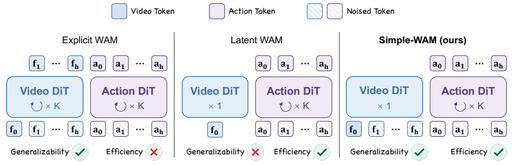
Figure 3 :The three conditioning schemes.The explicit paradigm denoises the future video tokens across the schedule; the latent paradigm drops them and keeps only the single forward pass. We propose Simple-WAM, which keeps both the future video tokens and the single forward pass: future video tokens are input as pure Gaussian noise atτ= 1and are never denoised.
Original paper · CC BY 4.0 · Renping Zhou, Zanlin Ni, Zihao Fan, Guohao Fu, Zeyu Liu, Hao Shi, Jie Zhang, Chi Bene Chen, Yang Yue, Xueyang Fu, Gao Huang · What Makes World Action Models Generalize? An Empirical Study of Test-Time Future Modeling · Original paper figure · Extracted the figure area from page 7 of the original PDF.Figure 3 marks the future tokens as pure Gaussian noise at τ = 1, and they are never denoised. The pass costs little because the video expert runs once, which keeps the per-chunk latency close to the latent paradigm.
Training with a mixed flow-time schedule
Simple-WAM reads the video expert only at τ=1 during inference, yet the explicit training schedule spends little of its budget there. Because the action expert depends on that single flow time, the training shifts the share spent at τ=1 upward. The goal is for the action expert to learn a useful feature from pure noise rather than from a partly denoised future.
Each training step draws the flow time of the future video tokens from a two-branch rule controlled by one scalar p. With probability p, the future video tokens receive τ=1, and otherwise τ=S(u) with u drawn from U[0,1]. Here S is the flow-time schedule of the explicit paradigm, so the remaining branch keeps the original sampling. The two experts still train jointly, the action expert still reads the tokens through Φθ, and the video loss applies at the sampled τ.
The mixture sharpens the feature at the one flow time inference reads, while the 1−p branch keeps the video expert under the flow-time sampling it was trained with.
The authors set p to 0.5 and ablate it later in Sec. 6.4. Training uses a video loss weight λ=3.0, and inference uses K=10 denoising steps. The classifier-free guidance scale is 1.0 at inference time, and the remaining settings follow Fast-WAM. The action chunk has H=32, with 9 video frames per chunk, using pretrained Wan2.2-5B as the video backbone.
Sec. A.1 lists the further hyperparameters, and the experiments run on LIBERO, RoboTwin 2.0 and LIBERO-Plus.
Simulation and speed results for Simple-WAM
Simple-WAM keeps most of the generalization gain of the explicit paradigm while staying close to the latent paradigm's cost. The authors tie the smallest margins to the camera factors, where a visual shift corrupts the future that the explicit paradigm generates. Across the eight measurements of Tab. 2, Simple-WAM leads the explicit paradigm on seven and the latent one on all eight.
On RoboTwin with video, the explicit paradigm is slightly higher, 47.3 compared to 44.5.
Latency is the other half of the claim, and Simple-WAM runs at 74.7 ms per action chunk. The latency figures come from a single RTX 5090 GPU, each under its own denoising settings. The authors conclude that the additional computation does not yield a consistent improvement.
Real-world tests and ablations
On a physical AgileX Aloha dual-arm platform, the authors ran four tasks with 200 demonstrations per task. Each task was scored over 30 trials on grasping, placement, and, for two tasks, whether the order was followed. In distribution the three models stay within 2.3 points of each other, so the simulation parity carries over to the real arm.
The held-out task Store in Order is the hardest test of task generalization in the real-world study. Action-free video of the task raises Simple-WAM from 2.2 to 87.8. That result compares against 68.9 for the explicit paradigm and 10.0 for the latent one. The per-task numbers and their standard deviations are reported in Tab. A3.
The ablations run on LIBERO-Spatial and use task generalization with video as the reference axis. The mixture probability p was swept over its whole range from 0 to 1. At p=0 training reverts to the explicit paradigm and keeps the train-test mismatch.
The second ablation asks whether pure Gaussian noise is a good input for the action expert. Replacing them with zeros drops the three axes by 22.2, 8.2 and 87.4 points. The authors attribute this to how far the substitution moves from pretraining, since the backbone saw neither queries nor zeros. Noised video tokens are what the backbone already denoises, so the noise input keeps the pretraining alignment.
Where the findings stop
The mixture probability and future-token ablations run only on LIBERO-Spatial, so their effect on the other suites is untested. On LIBERO, data efficiency runs use 10 and 5 demonstrations per task, while the RoboTwin runs use 10. Task generalization on RoboTwin withholds 10 randomly selected tasks, and LIBERO holds out one suite per fold.
The real-world study covers four tasks on one AgileX Aloha dual-arm platform, with 200 demonstrations per task. Each task is scored over 30 trials on grasping, placement, and order following where the task specifies one. Store in Order is the only held-out task, so the real-world task-generalization numbers rest on a single task. They didn't test a second held-out task, so the real-world transfer result can't be read as a general pattern.
Latency is measured on one NVIDIA GeForce RTX 5090 GPU, under each configuration's own denoising settings. The 3.8× speed-up over the explicit paradigm, from 286.9 ms to 74.7 ms per chunk, therefore depends on those settings. The explanation of the gap as a mismatch between visual fidelity and the feature the action expert needs is the authors' interpretation.
All models use Wan2.2-5B as the video backbone with K set to 10 steps and a CFG scale of 1.0. Whether the same conclusions hold at larger scale, or with embodied pretraining, remains open.
Paper info
- Authors
- Renping Zhou, Zanlin Ni, Zihao Fan, Guohao Fu, Zeyu Liu, Hao Shi, Jie Zhang, Chi Bene Chen, Yang Yue, Xueyang Fu, Gao Huang
- Venue
- arXiv · Preprint
- First published
- 2026-9-28
- Added
- 2026-10-20
- Updated
- 2026-9-29
- Version
- v2
- arXiv
- 2609.34981
- Category
- cs.CV · cs.RO
- Original paper terms
- CC BY 4.0
- What we show
- Paper info, commentary and permitted figures from the original paper
AI commentary is a separate explanation from the original paper and may contain errors. The original paper and figures follow each source's terms of use and any rights noted separately.
Abstract
World action models (WAMs) predict the future alongside actions during training. Due to the heavy computation cost of video denoising, whether the future must still be generated during inference is disputed: Explicit WAMs denoise it into clean frames along with every action chunk, whereas Latent WAMs discard it entirely for acceleration. We find that latent WAMs, despite matching explicit ones on in-distribution tasks, fail to retain the generalization benefits that originally motivated WAMs. To demonstrate this, we evaluate generalization along three axes: environmental perturbation, data efficiency, and task generalization. Controlled comparisons with a matched backbone, training data, and budget reveal consistent degradation across all three axes when the action expert no longer conditions on future representations. Further analysis shows that the gap arises almost entirely from the first denoising step: the benefit comes from preparing the future, not generating it. We therefore propose Simple-WAM, which simplifies future modeling into a single forward pass of fully noised video tokens and adapts the training-time noise schedule to this inference behavior. Across simulation and real-world tasks, Simple-WAM achieves the best of both worlds, leading explicit WAMs in generalization performance with efficiency comparable to Latent WAMs. Project Page: https://zrporz.github.io/Simple-WAM-Web/
Quote from the paper
Renping Zhou, Zanlin Ni, Zihao Fan, Guohao Fu, Zeyu Liu, Hao Shi, Jie Zhang, Chi Bene Chen, Yang Yue, Xueyang Fu, Gao Huang (2026). What Makes World Action Models Generalize? An Empirical Study of Test-Time Future Modeling. arXiv:2609.34981v2. https://arxiv.org/abs/2609.34981v2
BibTeX
@misc{zhou2026what,
  title = {{What Makes World Action Models Generalize? An Empirical Study of Test-Time Future Modeling}},
  author = {Renping Zhou and Zanlin Ni and Zihao Fan and Guohao Fu and Zeyu Liu and Hao Shi and Jie Zhang and Chi Bene Chen and Yang Yue and Xueyang Fu and Gao Huang},
  year = {2026},
  eprint = {2609.34981},
  archivePrefix = {arXiv},
  url = {https://arxiv.org/abs/2609.34981v2}
}