Paper commentary
Robust Dynamic Radiance Fields
- Problem Dynamic view synthesis methods need accurate camera poses, usually from SfM, and those poses fail on dynamic, low-light or blurred casual videos.
- Method Jointly optimizes per-frame camera poses, one shared focal length, a static voxel radiance field and a dynamic voxel radiance field, with flow, depth and scene-flow losses and motion masking.
- Results Reaches an ATE of 0.089 m on MPI Sintel, against 0.129 m for ParticleSfM.
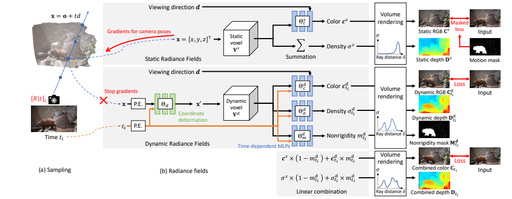
Figure 2 . Overall framework. We model the dynamic scene with static and dynamic radiance fields. The static radiance fields take both the sampled coordinates (x, y, z) and the viewing direction d as input and predict the density σs and color cs. Note that the density of the static part is invariant to time and viewing direction, therefore, we use summation of the queried features as the density (instead of using an MLP). We only compute the losses over the static regions. The computed gradients backpropagate not only to the static voxel field and MLPs but also to the camera parameters. The dynamic radiance fields take the sampled coordinates and the time t to obtain the deformed coordinates (x′, y′, z′) in the canonical space. Then we query the features using these deformed coordinates from the dynamic voxel fields and pass the features along with the time index to a time-dependent shallow MLPs to get the color cd, density σd, and nonrigidity md of the dynamic part. Finally, after the volume rendering, we can obtain the RGB images C{s,d} and the depth maps D{s,d} from the static and dynamic parts along with a nonrigidity mask Md. Finally, we calculate the per-frame reconstruction loss. Note that here we only include per-frame losses.
Original paper · CC BY 4.0 · Yu-Lun Liu, Chen Gao, Andreas Meuleman, Hung-Yu Tseng, Ayush Saraf, Changil Kim, Yung-Yu Chuang, Johannes Kopf, Jia-Bin Huang · Robust Dynamic Radiance Fields · Original paper figure · Extracted the figure area from page 3 of the original PDF.Why pose estimation limits dynamic view synthesis
Dynamic view synthesis asks for renderings of a changing scene from camera positions that were never recorded. Many dynamic methods built on NeRF assume the camera poses are already known, and they usually obtain them from a structure-from-motion pipeline such as COLMAP. Those pipelines are fragile on casual footage: low light, motion blur and moving people, cars or animals degrade the poses, so the dynamic model built on top of them fails as well.
Static NeRF variants can refine poses jointly with the scene, but they are limited to static sequences. Table 1 sorts methods by whether the scene is static and whether the camera poses are known, and RoDynRF is the entry for a dynamic scene with unknown poses.
RoDynRF drops the known-pose requirement and works from a casually captured video without accurate poses as input. It also takes no camera intrinsics as input, and it is framed as a space-time synthesis algorithm for dynamic monocular video.
Two radiance fields and one set of poses
The input is a monocular video of N frames, and the method optimizes camera poses, a focal length, a static radiance field and a dynamic radiance field together. Both fields are stored as explicit neural voxels, Vs for the static part and Vd for the dynamic part, so their features are read from voxel grids and the MLPs play a smaller role.
Three inputs are computed beforehand: optical flow from RAFT, monocular depth from MiDaSv2.1, and instance masks from Mask R-CNN.
The static branch models the background and estimates the poses and the focal length, while the dynamic branch models moving objects. A nonrigidity mask md blends the dynamic and static contributions in the rendering, and it is supervised toward the motion mask.
Keeping dynamic pixels out of pose estimation
Masking common moving objects with Mask R-CNN misses things that are hard to segment, such as drifting water or swaying trees. The method therefore also estimates a fundamental matrix from optical flow between consecutive frames, computes the Sampson distance of each pixel to its epipolar line, and thresholds it. The final motion mask combines the Mask R-CNN masks with this epipolar threshold.
The static branch optimizes a 6D camera pose for each frame together with one focal length shared by all frames, alongside the static voxel field. It starts with a small static voxel resolution and raises it during training, which the authors argue makes the energy surface smoother and lowers the chance of stopping at a poor pose solution.
Because the photometric loss is the main signal, the network could fit colors from the viewing direction alone and skip the voxel geometry and the poses. The viewing direction is therefore fed only into the last layer of the color MLP. Without this choice, the optimization can lower the photometric loss by changing the MLP, which leads to wrong poses and geometry.
The static photometric term compares rendered and captured colors and multiplies the error by \(1 - M(r)\), so only static pixels contribute. Three auxiliary losses regularize the static part for fast or purely rotating camera motion: reprojection against RAFT flow, a disparity term in inverse depth, and a monocular depth term. The monocular depth term is scale- and shift-invariant because MiDaS depth is known only up to scale and shift, and the authors add it because the other two cannot handle pure rotation.
All these losses are restricted to static regions, and their weights are annealed during training.
Modelling motion in a canonical space
The sampled coordinates and the time index first pass through a coordinate deformation MLP, which predicts offsets in x, y and z. Adding the offsets gives coordinates in a canonical voxel space, so points observed at different times are mapped to the same voxel location.
One canonical voxel grid cannot easily hold a whole sequence, so time-dependent MLPs take the queried voxel features together with the time index and predict time-varying color and density. These MLPs have only two to three layers, which is much shallower than the dynamic branches of other methods, because most of the motion is carried by the deformation MLP.
The photometric loss for the dynamic part compares the rendered dynamic color with the captured pixel.
A scene flow MLP takes a 3D point and a time and outputs forward and backward scene flow, so the three kinds of loss used in the static part can be applied to the dynamic part. The dynamic reprojection and disparity losses add the scene flow to the induced flow and to the 3D correspondence, and the dynamic monocular depth loss uses MiDaSv2.1.
A smoothness and small-magnitude penalty on the scene flow, written with L1 norms, keeps the predicted motion modest. Gradients from the dynamic field are detached from the camera poses, and the nonrigidity mask is pulled toward the motion mask with an L1 term.
The rendered color mixes the dynamic and static terms for each sample, weighted by md and by 1 minus md. The total training loss adds the rendering reconstruction term to the static and dynamic loss terms. Forward-facing scenes use normalized device coordinates and unbounded scenes use the contraction parameterization, and a distortion loss discourages floaters.
The finest voxel resolutions are 262,144,000 for normalized device coordinates and 27,000,000 for contraction, the voxel grid is decomposed with the VM-decomposition from TensoRF, and training takes around 28 hours on one NVIDIA V100 GPU.
Pose accuracy on MPI Sintel
On MPI Sintel the comparison uses ATE in meters, RPE trans in meters and RPE rot in degrees, and COLMAP is excluded because it fails on 5 of the 14 sequences. RoDynRF reaches an ATE of 0.089 m, against 0.129 m for ParticleSfM, 0.175 m for DROID-SLAM and 0.447 m for BARF. The NeRF-- entry at 0.433 m and R-CVD at 0.360 m are also higher than RoDynRF.
Its RPE trans is 0.073 m and its RPE rot is 1.313 degrees, while ParticleSfM scores 0.031 m and 0.535 degrees on the same two metrics. The authors attribute the gap to global optimization over the whole sequence, which differs from the local registration used by SLAM-style methods. On the same two metrics RoDynRF is still below DROID-SLAM, at 0.084 m and 1.912 degrees, and below R-CVD, at 3.443 degrees for rotation.
The sorted error plots over the 14 sequences show how the error of each method spreads, which the authors use to read accuracy and completeness or robustness together.
For the static comparison on DAVIS, the NeRF-based methods use the ground truth motion masks to exclude dynamic regions from their losses. The authors report that RoDynRF keeps detailed content and consistent geometry in these static reconstructions, while the other methods often do not.
Novel view synthesis across three datasets
On the Dynamic Scene dataset the evaluation follows DynamicNeRF: new views are rendered from the first camera while time changes, and PSNR and LPIPS are reported. Average PSNR is 25.89 with COLMAP poses and 25.38 without them, against 26.10 for DynamicNeRF, whose numbers are adopted from its paper. Average LPIPS is 0.065 with COLMAP poses, against 0.082 for DynamicNeRF, where lower is better.
The authors describe the results without COLMAP poses as comparable to those with COLMAP poses.
The iPhone evaluation follows DyCheck with masked PSNR and SSIM, reported as mPSNR and mSSIM. RoDynRF averages 17.09 mPSNR and 0.534 mSSIM, against 16.96 and 0.577 for T-NeRF, which has the highest mSSIM among the listed methods. The mPSNR is the highest of the five listed averages, while the mSSIM is the lowest, and the authors describe the iPhone results as on par with existing methods.
COLMAP fails to estimate poses for 44 of the 50 DAVIS sequences. The authors therefore run RoDynRF first and give its poses to NSFF, DynamicNeRF, HyperNeRF and TiNeuVox as inputs. They report that these methods build consistent static scenes with the estimated poses but still produce artifacts in dynamic parts, while RoDynRF produces fewer visual artifacts.
What each component contributes on Playground
Each ablation row removes one pose-estimation choice from the full model and keeps the rest, all measured on the Playground sequence. The authors call the coarse-to-fine voxel upsampling the most critical component for pose estimation.
The authors state that both the deformation MLP and the time-dependent MLPs improve the final rendering quality. Each of these gaps comes from a single sequence, so their size reflects Playground alone.
Failure modes and open constraints
Fast camera motion makes the optical flow estimate fail, which in turn gives wrong poses and geometry. The method assumes one focal length shared by all frames, so a changing focal length is not handled well.
Training takes around 28 hours on one NVIDIA V100 GPU. On the Dynamic Scene dataset the average PSNR with COLMAP poses is 25.89, below the 26.10 of DynamicNeRF. The iPhone mSSIM of 0.534 is below the averages of all four listed baselines.
The MPI Sintel pose comparison has no COLMAP baseline, because COLMAP fails on 5 of the 14 sequences. The ablation covers only the Playground sequence. The evaluation uses MPI Sintel, the Dynamic View Synthesis dataset, the iPhone dataset and DAVIS, and no other scenes are tested.
Paper info
- Authors
- Yu-Lun Liu, Chen Gao, Andreas Meuleman, Hung-Yu Tseng, Ayush Saraf, Changil Kim, Yung-Yu Chuang, Johannes Kopf, Jia-Bin Huang
- Venue
- arXiv · Preprint
- First published
- 2023-1-5
- Added
- 2026-11-5
- Updated
- 2023-3-21
- Version
- v2
- arXiv
- 2301.02239
- Category
- cs.CV
- Original paper terms
- CC BY 4.0
- What we show
- Paper info, commentary and permitted figures from the original paper
AI commentary is a separate explanation from the original paper and may contain errors. The original paper and figures follow each source's terms of use and any rights noted separately.
Abstract
Dynamic radiance field reconstruction methods aim to model the time-varying structure and appearance of a dynamic scene. Existing methods, however, assume that accurate camera poses can be reliably estimated by Structure from Motion (SfM) algorithms. These methods, thus, are unreliable as SfM algorithms often fail or produce erroneous poses on challenging videos with highly dynamic objects, poorly textured surfaces, and rotating camera motion. We address this robustness issue by jointly estimating the static and dynamic radiance fields along with the camera parameters (poses and focal length). We demonstrate the robustness of our approach via extensive quantitative and qualitative experiments. Our results show favorable performance over the state-of-the-art dynamic view synthesis methods.
Quote from the paper
Yu-Lun Liu, Chen Gao, Andreas Meuleman, Hung-Yu Tseng, Ayush Saraf, Changil Kim, Yung-Yu Chuang, Johannes Kopf, Jia-Bin Huang (2023). Robust Dynamic Radiance Fields. arXiv:2301.02239v2. https://arxiv.org/abs/2301.02239v2
BibTeX
@misc{liu2023robust,
  title = {{Robust Dynamic Radiance Fields}},
  author = {Yu-Lun Liu and Chen Gao and Andreas Meuleman and Hung-Yu Tseng and Ayush Saraf and Changil Kim and Yung-Yu Chuang and Johannes Kopf and Jia-Bin Huang},
  year = {2023},
  eprint = {2301.02239},
  archivePrefix = {arXiv},
  url = {https://arxiv.org/abs/2301.02239v2}
}