Paper commentary
When Does the Real Wiring Win? Testing connectome structure-function claims against unmeasured physiology
Connectome wiring wins or loses depending on how physiology is tuned
- Problem Connectome models are often tuned until the real wiring works, so a win can come from tuning rather than wiring. Unmeasured physiology such as excitability and plasticity rates is usually set this way, which biases comparisons against shuffled nulls.
- Method The authors compare three tuning protocols on each null wiring. P1 tunes physiology on the real wiring and transfers it to nulls, P2 tunes each wiring on its own, and P3 restricts P2 to physiology that independent data support.
- Results The real Kenyon-cell wiring beats a cross-subtype identity shuffle by 0.09 under P1 and P2 but loses to it by 0.09 under P3. The verdict depends on the share of alpha'beta' cells among active Kenyon cells.
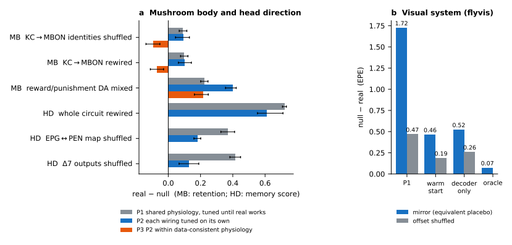
Figure 2 : The comparison protocol decides fragile claims. a, Real minus null under P1–P3 for six claims in the mushroom body (retention accuracy) and head direction (memory score); bars are bootstrap 95% intervals over parameter sets. P3 exists only where independent data constrain an unmeasured parameter. The KC→MBON claim reverses sign under P3; the other claims keep their sign.b, flyvis: null minus real validation EPE (median over members) for an exactly equivalent mirrored connectome and a spatially shuffled connectome, under P1, 2,000-iteration warm-start retraining, 2,000-iteration decoder-only retraining, and the exact oracle for the mirror.
Original paper · CC BY 4.0 · Yeyuan Liu · When Does the Real Wiring Win? Testing connectome structure-function claims against unmeasured physiology · Original paper figure · Extracted the figure area from page 9 of the original PDF.Where real-versus-null comparisons get stuck
Recent studies build a model on the measured wiring and on shuffled or rewired copies of it, then compare the two. A connectome fixes which cells connect and how many synapses they share, but it leaves open how excitable each cell type is and how fast plasticity runs. Modellers usually set those unmeasured values once, often by adjusting them until the real-wiring model performs the task.
The nulls then run with settings chosen for the real wiring, so a win can come from the tuning rather than from the wiring.
Machine learning meets the same trap as under-tuned baselines, inherited weights and the winner's curse. Choosing parameters on the real model's success conditions the comparison on that success, so the verdict depends on which parameters were kept.
Three ways to tune the shared physiology
The authors keep the wiring comparison fixed and change which physiology each protocol is allowed to use, so each protocol answers a different question. P1 tunes physiology until the real wiring works and transfers it to the nulls, averaging the paired difference over the parameter sets that meet the behavioural criterion, written as \(E_\pi[\bar{\Delta}(\theta)\mid L_R(\theta)\ge c]\).
P2 tunes each wiring on its own and compares the mean of the K = 5 best parameter sets, which removes the advantage that P1 gives the wiring it was tuned on. P3 repeats the P2 comparison only inside the physiology range that independent data allow, so it can be run only where such data exist.
Each seed gives a paired difference, the real score minus the null score, and a parameter set counts as real better when its seed-averaged difference exceeds 0.03 for mushroom-body retention. To find the parameter that decides a claim, the authors compute Spearman correlations and Sobol indices on a gradient-boosted surrogate of the difference.
Placebo nulls label one instance of a null family as real and compare it with another instance, so any gap reflects the protocol alone.
The theory explains why P1 is biased in favour of the real wiring. Proposition 1 shows that selecting on the score itself gives a non-negative expected difference under exchangeability. For selection on a separate criterion, Proposition 2 gives a Gaussian closed form in which the bias is the covariance of the difference with the criterion, scaled by the criterion's spread and an inverse Mills ratio.
Mushroom body: the KC→MBON claim flips with α′β′ share
The mushroom-body model learns 60 odours in sequence with random valence, and its score is final retention accuracy. Seven unmeasured parameters are swept over 200 θ with 10 seeds each, and each null family has 10 instances. Dopamine family segregation survives every protocol: real retention is better in 88% of plausible θ, and no θ favours the null.
P1, P2 and P3 agree on this claim at +0.22, +0.40 and +0.22, so it is a conclusion that holds across protocols.
The KC→MBON advantage over cross-subtype nulls depends on which KC subtype is active, so its sign hinges on the α′β′ share. Real retention falls as that share rises (Spearman ρ = −0.60), while both nulls stay flat (ρ = 0.13 and 0.06). At the reference share of 0.177, each subtype's share of active KCs matches its share of all KCs, so subtype organisation of outputs stops mattering to first order.
Figure 3 shows this dependence across the parameter sets, and the dopamine-segregation claim stays positive over the whole range.
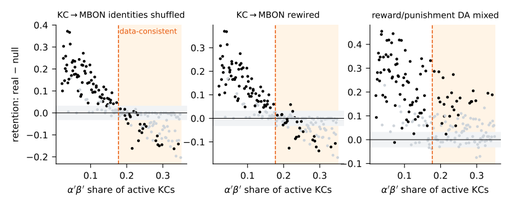
Figure 3 : One unmeasured parameter decides the KC→MBON claim.Real minus null retention for each parameter set against theα′β′ share of active KCs. Black: the real model learns (plausible). Shaded: data-consistent region (α′β′ share above its 17.7% share of cells). Grey band:|∆|< 0.03. The crossing just above the 17.7% reference point follows from the nulls mixing outputs across subtypes (see text). The dopamine-segregation claim (right) stays positive across the range.
Original paper · CC BY 4.0Tuning until the model learns selects the low-share regime, because real-model learning falls with α′β′ share (ρ = −0.64). A held-out run with new samples gave P1 +0.120 and P3 −0.070 for the identity shuffle, so the reversal held.
Chan et al. report per-odour coding levels that place the α′β′ share of active KCs near 0.44. The cross-subtype nulls learn in 34% and 28% of θ over the same range. The authors read this as a model inadequacy rather than a demonstrated deficit of the fly's wiring.
Flyvis: the mirror penalty under P1 and retraining
The flyvis test asks whether a mirrored connectome, which has a known near-real solution, still loses once retraining is allowed. The authors use the 10 best members and the package's original validation split. The original authors ranked these members on that same validation loss, so the real network's validation error is optimistically selected.
That selection favours the real wiring under P1, but it also makes the mirror comparison conservative, because it inflates the oracle gap.
The mirror reflects every offset, (du,dv) to (−du,−dv), which is a 180° rotation of the lattice. The offset shuffle, by contrast, permutes synapse counts across spatial offsets, which destroys filter shape while keeping totals. Repeating P1 on all 50 members, including the 40 unselected ones, gives the same picture.
The mirror penalty grows with member skill, with a Spearman ρ of 0.74 against 5.77 minus the real EPE. The exact oracle shows the mirror can come within 0.07 EPE of the real network, with a paired median and a range of 0.05 to 0.23. The mirror's excess over real under P1 has a median of 1.72, far above that oracle gap.
Retraining with a budget of 2,000 iterations of warm-start retraining brings the mirror to 5.71, near the zero-flow baseline of 5.77. At that budget the mirror still sits below the offset shuffle at 5.50, and decoder-only retraining gives the same picture. A ten-fold longer budget of 20,000 iterations, on five members, shrinks the mirror excess to a median of 0.24 but keeps the ranking.
Head direction: topology needed for a persistent bump
The head-direction ring attractor uses 155 FlyWire neurons, and each parameter set is scored on memory and integration across 400 θ with 10 seeds. Each EPG's angle comes from a Laplacian eigenmap of its EPG↔PEN connectivity, and a separate check uses EPG→Δ7→EPG inhibition, which the angle assignment didn't use. Memory is scored as cos(decoded minus cued angle), and it is set to 0 when the bump dies or spreads.
Under P2 the real circuit scores 0.88 for memory, compared to 0.70 for the PEN map and 0.75 for the Δ7 shuffle.
For memory, P1 inflates each effect relative to P2 by 0.11, 0.19 and 0.29, which fits the selection effect the theory predicts for a selective criterion. For integration the order reverses, with P2 above P1, because the criterion selects on memory rather than on integration. Scoring the signed correlation instead enlarges the real circuit's advantage over the PEN and Δ7 shuffles, because about half of the shuffled circuits integrate in the wrong direction.
Limitations of the flyvis and parameter-range evidence
The flyvis comparison rests on a validation split that the members were selected on, which is a central limit of the evidence. The authors read this as making their mirror comparison conservative, because the bias works against the mirror.
Selection on the real error may also shape null-versus-null comparisons, so the authors repeated P1 on all 50 members. The mirror was worse than real in 50 of 50 members, and all three shuffles lost in 49 of 50. Recomputed validation EPE matched the stored values with a mean absolute difference of 0.07.
The parameter ranges are literature-informed modelling choices, so the robustness map holds only conditionally on them.
The residual oracle gap of 0.07 median is not yet explained.
Paper info
- Authors
- Yeyuan Liu
- Venue
- arXiv · Preprint
- First published
- 2026-11-10
- Added
- 2026-11-12
- Updated
- 2026-11-10
- Version
- v1
- arXiv
- 2611.14508
- Category
- cs.LG · q-bio.NC
- Original paper terms
- CC BY 4.0
- What we show
- Paper info, commentary and permitted figures from the original paper
AI commentary is a separate explanation from the original paper and may contain errors. The original paper and figures follow each source's terms of use and any rights noted separately.
Abstract
Connectome-constrained models are often used to argue that a measured wiring diagram outperforms shuffled or rewired wiring, and hence that structure shapes function. Such comparisons can confound wiring with how the models are tuned: a connectome fixes who connects to whom, not the excitability, gains or plasticity rates the model also needs, and modellers often tune these until the real-wiring model works. We separate three estimands: physiology tuned on the real wiring and transferred to nulls (P1), each wiring tuned on its own (P2), and P2 restricted to physiology consistent with independent data (P3). The biases involved are known in machine learning (under-tuned baselines, inherited weights, winner's curse); we measure what they do to biological conclusions, using synthetic ground truth, placebo nulls and three Drosophila circuit models. Some claims survive every protocol we test: segregated reward and punishment dopamine improves learning, and head-direction topography is required for a persistent bump. Others do not. In the mushroom body, the real Kenyon-cell output wiring beats a cross-subtype identity shuffle by 0.09 under P1 and P2 but loses to it by 0.09 under P3 (95% CIs exclude zero; held-out runs confirm). The verdict is set by the share of alpha'beta' cells among active Kenyon cells, which P1 selects low; at the share implied by imaging (about 44%) the real-wiring model fails to learn, exposing a model inadequacy rather than a deficit of the fly's wiring. In flyvis, P1 penalises a mirrored connectome, which has a constructed solution within 0.07 (median) of the real error, more than a spatially shuffled one in 50 of 50 members; the ranking survives ten-fold longer retraining but depends on the checkpoint at fifty-fold. A credible structural claim needs matched optimisation, data-constrained physiology and a model that still works there.
Quote from the paper
Yeyuan Liu (2026). When Does the Real Wiring Win? Testing connectome structure-function claims against unmeasured physiology. arXiv:2611.14508v1. https://arxiv.org/abs/2611.14508v1
BibTeX
@misc{liu2026when,
  title = {{When Does the Real Wiring Win? Testing connectome structure-function claims against unmeasured physiology}},
  author = {Yeyuan Liu},
  year = {2026},
  eprint = {2611.14508},
  archivePrefix = {arXiv},
  url = {https://arxiv.org/abs/2611.14508v1}
}