Paper commentary
Procedure without Judgment: What Small Language Models Learn under an Exact Verifier
Small models learn a deletion procedure for minimal explanations but not its judgment
- Problem Explanations of blocked tool calls are usually scored against proxies, because the true minimal sufficient reasons are rarely known. Frontier models find the exact reason only about half the time with the tools alone.
- Method The authors train a small model to run the deletion algorithm's sufficiency checks. The student sees one request and one decision, and it calls the policy on altered requests within thirty turns.
- Results The 4B student scores 92% exact on its training policy but drops to 48% minimal elsewhere.
Why explanations are hard to score
A useful audit entry for a blocked tool call names the facts that forced the block and leaves out the rest. Checking such a citation is hard, because the set of facts that truly force a decision is usually unknown.
No proper subset of an MSR has that property, which is what makes it minimal. The explainer never sees the policy and can only query it, so finding the MSR becomes an experiment rather than a reading task. The explainer has thirty turns, and the paper asks which models can run that experiment well.
The explainer may call decide on any context and check on any candidate reason set, at most 30 times. It then commits to a reason set S, which the exact oracle scores without a proxy. Scoring relies on the oracle's full list of MSRs, so an explanation can be checked exactly. A decision can have several MSRs of different sizes, so the oracle enumerates all of them.
The metrics compare the committed set S against the oracle's MSR set M. Exact counts the episodes where S is one of the MSRs, which is the headline measure. Suff checks whether S is sufficient, and CPrec measures precision against the union of all MSRs. Surplus, the size of S minus the smallest MSR, separates padding from an insufficient answer.
A policy seen only through queries
The explainer works from one request and one decision, and it never sees the policy behind them. Because the context space is enumerable, every sufficiency claim is decided by evaluating the policy rather than by sampling. It has eight BLOCK rules and a final ALLOW default, and each BLOCK rule conjoins two or three literals.
The explainer's tools are decide, which returns the policy's answer on any altered request, and check, which asks whether a candidate set is sufficient. The explainer may use at most thirty turns, then commits to a final reason set. If it has not committed by then, the harness asks it once for an answer and records that outcome as forced.
A committed set is scored by Exact, the fraction of episodes where it is one of the MSRs. Suff measures the fraction of episodes where the committed set is sufficient, and CPrec measures its precision against the union of all MSRs. Surplus counts the cited features beyond the smallest MSR, so positive values mean padding and negative values mean an insufficient answer.
The deletion algorithm starts from the full feature set and removes each feature it doesn't need, returning an MSR in exactly |F| check calls.
What frontier models manage with the tools alone
Frontier explainers get the exact minimal sufficient reason about half the time when they have only the two tools and no training for this task. Haiku 4.5 reaches the exact MSR on 58% of GlassGate episodes, and Flash-Lite reaches it on 16%, a gap of 42 points (p <10 −4, paired). Sonnet 5 sits at 50%, eight points below Haiku, and that difference doesn't reach significance (p = 0.064).
The explainer's tools are the same for every model, so the spread across tiers reflects how each model uses them.
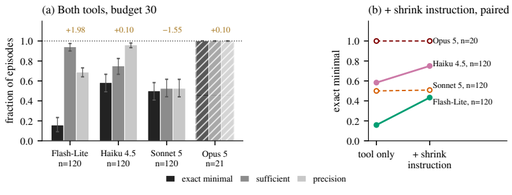
Figure 2 :Frontier models with both tools, and what one sentence changes.(a) Exact minimality, sufficiency and precision on GlassGate with both tools and no further instruction, all three models on the same 120 episodes and Opus on the 21 it did not refuse (hatched), a subset with no minimal reason above three features. The number above each group is the mean surplus of cited features over the smallest MSR; Sonnet’s is negative because 46% of its episodes end in a forced empty answer (Section 3). The dotted line is the deletion algorithm. (b) Paired within model on the episodes each model ran under both prompts (non the plot; Opus’s shrink arm has 20), with and without a one-sentence shrink instruction. Solid lines are gains of more than two points.
Original paper · CC BY 4.0 · Arunkumar V, Manoranjan Gandhudi, Gangadharan G. R., Arun Prakash, S. Senthilkumar · Procedure without Judgment: What Small Language Models Learn under an Exact Verifier · Original paper figure · Extracted the figure area from page 5 of the original PDF.Haiku and Sonnet both reach 76% on that subset, so the authors don't treat Opus's perfect score as a ceiling.
The authors read the gain as a repair of one shared failure, in which the models cite one feature too many. Haiku's sufficiency rises from 75% to 83% under the instruction, and its surplus falls. Sonnet doesn't move under the instruction, going from 50% to 51%, because it often replies in prose instead of the required JSON action.
These failures happen at turn 20 on average, and 17 of the 18 episodes whose smallest reason has four features are among the 55. The harness ends those episodes with an empty answer that scores zero on every metric, so the score reflects format compliance.
Teaching the procedure to Qwen3-4B
The question here is whether a deletion-algorithm teacher makes a better small student than frontier traces do, at matched data size. Qwen3-4B is fine-tuned with one recipe, a rank-16 LoRA trained for 600 steps, on either algorithm traces or frontier traces. The frontier traces come from Opus 5 and Sonnet 5 solving 148 episodes, and the authors keep only the trajectories that committed on their own to an exact minimal reason.
Seed variance is wide, from 69% to 97% for the algorithm seeds and from 36% to 53% for the frontier seeds. The two ranges never overlap, so the worst algorithm seed beats the best frontier seed. On all 120 GlassGate episodes the margin is 17.5 points (p = 0.006), while the stratified 64 episodes give 16 points, which is underpowered (p = 0.11).
Under the same shrink instruction, Alg-2000 is 11 points ahead of Haiku, which reaches 81%, but 64 episodes can't resolve that gap (p = 0.12). Alg-2000 uses ten check calls and no probes, compared to Haiku's 8.6 checks and 8.8 probes.
The probe and check counts show what each student learned to do with its budget. The algorithm-taught students never call decide and run one check per feature, reproducing the deletion algorithm's query pattern. Frontier-148 probes 3.5 times and checks 25.5 times per episode, mirroring its teachers' probe-then-verify order.
Whether the procedure travels to unseen policies
The GlassGate advantage could come from the procedure or from the one policy the student was trained on, so the transfer test asks which. On them, Alg-2000 keeps its answers sufficient at 94%, compared to 98% on GlassGate. Its exact minimality falls from 92% to 48% on the same move, so sufficiency travels while minimality doesn't. The gap between sufficiency and minimality opens by 46 points on the real policies, with p below 10 to the power of minus 3.
Alg-148 shows the same split, with sufficiency at 98% against 100% at home. Its exact minimality falls from 69% to 40%. The frontier-taught student is the more minimal one on the public policies in all three seeds, at 50%, 58% and 54%. The algorithm-taught students reach 40%, 56% and 44% on the same policies, while keeping sufficiency at 96% to 98%.
The authors read this as the algorithm's advantage not being general, since on cedar-streaming-service the frontier-taught student is exact on zero episodes.
The frontier models don't show this split, because Haiku and Sonnet move both quantities together. With the shrink instruction, Haiku goes from 75% to 100% exact and from 83% to 100% sufficient on all 47 episodes.
To test the reverse direction, the authors trained Alg-public on the five public policies only, with 80 trajectories and never GlassGate. Off-distribution, Alg-2000 trails instructed Haiku by 50, 38 and 73 points on the three policies, and it is behind Sonnet on two of them.
Reinforcement learning from the exact reward
The authors start RL from Frontier-148 rather than Alg-2000, because Alg-2000 already sits at the reward ceiling. Alg-2000 also gives no within-group variance, so the policy has nothing to learn from it. They train with REINFORCE and a group-relative baseline, sampling four rollouts per context on fresh contexts for 25 steps. Each run is scored on the exact oracle, so the reward carries no verifier error.
Their first reward weighted sufficiency and recall above exact minimality and precision, with small terms for answering and a cost per probe. The surplus grew from 0.5 to 2.0 features, because citing an extra feature raised sufficiency and recall and was charged less than it earned. The corrected reward makes exact minimality dominant and charges for each surplus feature, so padding scores worse than the minimal answer.
On 24 fresh training-time contexts, exact minimality under the corrected reward rose from 63% to 83%. On the 64 held-out episodes it reached 56%, against 53% for the warm start, a three-point difference with p = 0.80. After RL, the student probed zero times and ran 30 checks on every one of 112 episodes, up from 3.5 probes and 25.5 checks.
The authors read this as a policy that lost the procedure, not as reward hacking.
Limitations of the teacher-kind and transfer claims
The seed count is the first bound on the teacher-kind claim. Alg-148 and Frontier-148 have three training seeds each, while every other arm was trained once.
Opus 5 is exact on all 21 episodes it answered, but the paper doesn't treat that as a ceiling. Those 21 episodes have smaller minimal reasons, averaging 2.29 features against 3.02, so the subset is easier. Sonnet's numbers are bounded by a harness rule that ends an episode after two malformed replies. No other model triggered that rule, and a different rule would raise Sonnet without changing anything else.
The transfer claim is limited by the policies it was tested on. The oracle needs an enumerable context space, so the setting is limited to categorical policies. The conclusion keeps the algorithm-taught student's lead to the gate it was taught on.
Paper info
- Authors
- Arunkumar V, Manoranjan Gandhudi, Gangadharan G. R., Arun Prakash, S. Senthilkumar
- Venue
- arXiv · Preprint
- First published
- 2026-11-16
- Added
- 2026-11-18
- Updated
- 2026-11-16
- Version
- v1
- arXiv
- 2611.21529
- Category
- cs.AI · cs.CL · cs.LG
- Original paper terms
- CC BY 4.0
- What we show
- Paper info, commentary and permitted figures from the original paper
AI commentary is a separate explanation from the original paper and may contain errors. The original paper and figures follow each source's terms of use and any rights noted separately.
Abstract
When an authorization policy blocks an agent's tool call, the audit log should name the facts that forced the decision and nothing more. For an executable policy over an enumerable context space this minimal sufficient reason can be computed exactly, so an explanation is scored against ground truth rather than a proxy for it. We use that exactness to ask what a model can learn from a verifier that has no error in it. The explainer sees one request and one decision, never the policy, and has thirty turns in which it may call the policy on altered requests and ask whether a candidate set of facts is sufficient. Frontier models find the exact reason about half the time with the tools alone, and one sentence telling them to shrink the answer lifts Haiku 4.5 from 58% to 75%. A 4B model fine-tuned on 2000 traces of the deletion algorithm reaches 92% on the policy it was trained on. Teacher kind is what moves this: at matched data size the algorithm-taught student leads the frontier-taught one in all three training seeds, and the two arms never overlap. What the student learns is a fixed schedule of sufficiency checks, and the schedule does not travel. On three public policies it never saw, its answers stay sufficient (94%) and stop being minimal (48%), while Haiku under the same sentence is exact on all 47 episodes. Reinforcement learning from the exact reward leaves held-out accuracy where it was and inverts the strategy, from probing the policy to spending the entire budget on sufficiency checks. The oracle made the effect of training legible, but it did not make training better.
Quote from the paper
Arunkumar V, Manoranjan Gandhudi, Gangadharan G. R., Arun Prakash, S. Senthilkumar (2026). Procedure without Judgment: What Small Language Models Learn under an Exact Verifier. arXiv:2611.21529v1. https://arxiv.org/abs/2611.21529v1
BibTeX
@misc{v2026procedure,
  title = {{Procedure without Judgment: What Small Language Models Learn under an Exact Verifier}},
  author = {Arunkumar V and Manoranjan Gandhudi and Gangadharan G. R. and Arun Prakash and S. Senthilkumar},
  year = {2026},
  eprint = {2611.21529},
  archivePrefix = {arXiv},
  url = {https://arxiv.org/abs/2611.21529v1}
}