Paper commentary
AesCode: Aesthetic Code Generation with Decoupled Cross-Modal Rewards
AesCode trains code models to match a reference's design
- Problem Code models write slides and posters without seeing the canvas, so layouts look plain. Image-to-code training also copies hallucinated content from the reference image.
- Method AesCode builds a design graph from the prompt and a generated reference image. It scores content with rule checks and design with yes or no questions from a VLM judge, then trains with reinforcement learning.
- Results AesCode-32B reaches a Visual score of 77.44, compared to 55.02 for Qwen3-VL-32B with the same references.
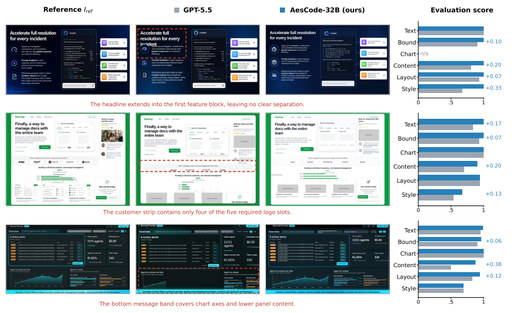
Figures from the paper Figure 3Qualitative comparisons selected by the three-rollout mean Overall gap.Each row shows the reference and outputs from GPT-5.5 and AesCode-32B. Bars report evaluation scores; red dashed boxes mark visible GPT-5.5 errors.
Original paper · CC BY 4.0 · Xin Gao, Yifan Yang, Xin Li, Pan Wang, Yan Li, Muzhao Tian, Mingxi Cheng, Bei Liu, Kai Qiu, Qi Dai, Dong Chen, Yue Dong, Leandros Tassiulas, Rex Ying, Ji Li, Chong Luo · AesCode: Aesthetic Code Generation with Decoupled Cross-Modal Rewards · Original paper figure · Extracted the figure area from page 8 of the original PDF.Why code models stall on visual design
Slides, posters and dashboards pack dense content onto one canvas, and code suits them because the output stays editable and verifiable. When a code model writes from text alone, it composes the page without seeing it, so the result often looks plain. Image generators work the other way round: they compose visually striking pages, but they misrender text, numbers and logical relations.
Their raster outputs can't be edited or verified, which rules them out as direct targets for code.
That rigid replication breaks down here, because the reference can contain hallucinated content that the code model would copy. Copying the reference also penalizes valid design variations, so the code model must satisfy the prompt while taking only layout and style from it. Simply providing the reference as an input isn't enough, since off-the-shelf VLMs entangle visual features with text semantics.
When given a noisy reference, such a model either reproduces its hallucinated content or ignores its layout entirely.
Reward design makes the gap concrete, because image-to-code RL usually rewards similarity to the input image. Holistic MLLM judges give scores that shift with prompt phrasing, and yes/no rubric questions derived from text alone can't check the reference's design. The authors respond by building a design graph from the prompt and the reference, then splitting properties between rules and a Visual Graph Rubric.
A reference image as an aesthetic prior
The key idea is to split the job: the prompt decides what the page must say, and the reference image suggests how it should look. Image-to-code methods treat the input image as an exact target, so they reproduce its hallucinated content and penalize valid design variations. Off-the-shelf VLMs don't separate these roles well, because they entangle visual features with text semantics.
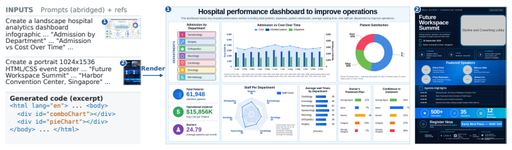
Figures from the paper Figure 1Information-rich infographics generated as code.Prompts specify content, while image-generator references offer visual design guidance. The examples show a landscape dashboard and portrait poster rendered from generated HTML/CSS.
Original paper · CC BY 4.0To make this trainable, AesCode represents the generated target as a Design Graph that separates semantic information from visual cues. The supervision target is defined as a graph Gtgt built from the prompt and the reference, with a canvas root that contains every top-level element.
The prompt specifies required information, while the reference is treated as one possible design that may be factually or structurally wrong. Because of that, the authors score prompt-derived requirements independently of the reference. The graph is parsed from the generated code and its rendering, and the candidate graph is compared with the target property by property.
The reference cues enter the reward only through fixed Boolean questions, so the policy never receives the graph as an input. Blending mixed outcomes into one score, such as correct text beside a chaotic layout, can misalign training gradients.
Turning the design graph into rewards
The generated codec is rendered, and the candidate graph Ĝ is parsed from both the code and the rendering. Ĝ is then compared with the target graph Gtgt property by property, which produces the reward signals. Six deterministic verifiers score these properties from code, the DOM, OCR, and rendered pixels. The Execution verifier checks renderability and fatal errors, and the Text verifier checks required strings.
The Boundary verifier measures canvas containment and aspect-ratio agreement. The Table/Chart verifier parses structure, subtype, and data, which prevents static substitutes from receiving credit.
Appearance properties and higher-order relations vary by sample, so they need visual judgment instead of a rule. The Visual Graph Rubric turns these properties into a sample-specific list of Boolean questions Qtrain derived from Gtgt. The score is an average of yes or no answers, so it avoids one unstable holistic rating. Reference cues enter only through these fixed questions, and the rubric is used only for training.
The seven reward channels differ in applicability, scale, sparsity, and learning difficulty, so raw rewards are not summed directly. For each prompt and reference pair, the policy samples a group of code rollouts and renders each one. Each rollout gets a score vector with one entry per channel, and a mask marks which channels apply to it.
GDPO computes the mean and standard deviation of each channel over the rollouts where that channel applies. Each channel is normalized separately, and the overall advantage averages only the applicable normalized advantages. Because irrelevant checks are excluded from both sums, they do not dilute the average for that rollout.
The evaluation protocol reuses this split but scores the artifact without a reference-based target. Rule averages the Text, Boundary, and Table/Chart checks, which verify exact content, containment, and structured data. Visual averages the Content, Layout, and Style dimensions, each answered as yes or no against a checklist derived from the prompt.
Each checklist averages 35.8 questions, and these criteria are absolute rather than pairwise comparisons.
Training in two stages: SFT, then GDPO on synthetic references
Cold-start SFT uses 3,000 demonstrations that GPT-5.5 writes from the prompt and the original human design. GPT-5.4-mini first infers a generation prompt from each sampled human design, naming required contents like text and charts without fixing layout or style. Keeping the original designs in SFT teaches the prompt-and-reference-to-code format without paying the cost of image generation.
The RL stage swaps the original human design for a reference that GPT-Image-2 generates from the same prompt. The cold-start policy samples eight rollouts on each remaining prompt, and the authors keep prompts whose pass@1 and pass@8 rates leave usable learning signal. Those retained prompts are rebalanced across CLIP clusters, so the difficulty filter doesn't concentrate the RL set in one artifact type.
Both backbones train with GDPO on the same RL file, so the 8B and 32B models differ only in capacity.
The held-out benchmark uses 300 items with no source design shared with SFT or RL. Benchmark prompts and references are built the same way as the RL data, so training and testing see matching inputs.
Benchmark results for AesCode and its backbones
The benchmark holds 300 prompts, each paired with a GPT-Image-2 reference, and each output is scored on Rule and Visual. Visual averages Content, Layout and Style, and each of these comes from fixed yes or no questions that a VLM answers from the rendering. Overall is the mean of Rule and Visual, so a model can score well on one part and still trail on the other.
With the same reference, AesCode-8B reaches 75.80 on Visual, compared to 44.72 for Qwen3-VL-8B. AesCode-32B reaches 77.44 on Visual, compared to 55.02 for Qwen3-VL-32B. These are the 31.1 and 22.4 Visual point gains that the authors highlight over their backbones.
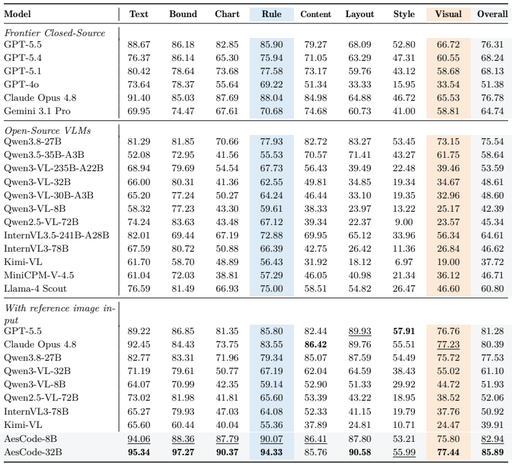
Figures from the paper Table 1Results on our infographic benchmark of 300 instances.Models in the first two blocks receive only the prompt; those in the third, including AesCode, also receive a generated reference image. Rule averages the programmatic Text, Bound, and Chart checks; Visual averages the Content, Layout, and Style scores as defined in Section 3.4. Overall is the mean of Rule and Visual. Scores (%) are averaged over three generations per prompt; higher is better. Bold and underlined values indicate the best and second-best scores in each column.
Original paper · CC BY 4.0Among closed models with references, GPT-5.5 scores 76.76 on Visual and Claude Opus 4.8 scores 77.23. The authors say AesCode-32B's visual quality is comparable to these frontier models while it makes fewer content errors. The authors tie the Table/Chart score of 90.37 to requiring HTML tables and ECharts charts. That requirement makes the output directly checkable, so the Chart score measures real structure and data.
Ablations on references and rewards
Removing the reference only at inference drops AesCode-8B's Visual score from 75.80 to 74.80.
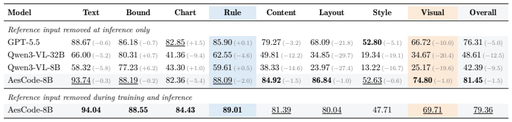
Figures from the paper Table 3Reference images during training and inference.All rows omit reference input at inference; the lower row also omits it from policy inputs during training while retaining reference-based rewards. Gray values show changes from reference-conditioned results.
Original paper · CC BY 4.0Replacing GDPO with scalar GRPO lowers the Visual score from 75.80 to 70.68. Overall rises from 77.97 under scalar aggregation to 82.94 with GDPO.
Authoring the visual questions directly, without the design graph, lowers Visual to 72.61. Rule stays at 90.05, against 90.07 for the full model. The authors say the graph accounts for part of the visual gain and leaves Rule unaffected.
Transfer and human agreement
The largest gains appear on design-sensitive measures, namely SlidesBench layout and color and GDB/lica NIMA, FID, and color harmony. On GDB/lica, NIMA rises from 3.122 for Qwen3-VL-32B to 4.932 for AesCode-32B, and FID falls from 0.522 to 0.394. The benchmarks use different scales, so the authors report each one under its own protocol, with higher values better except FID.
Design2Code is the exception on its CLIP score, where GPT-5.5 reaches 94.3 and AesCode-32B reaches 92.9. They read the transfer as coming mainly from layout and visual design rather than from reconstruction-specific similarity.
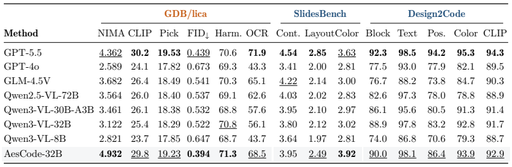
Figures from the paper Table 2Transfer to three external benchmarks.GDB/lica evaluates text-to-image generation; SlidesBench and Design2Code evaluate image-to-code reconstruction. All models output rendered HTML/CSS under each benchmark’s official protocol. SlidesBench uses a 0–5 scale; Design2Code and GDB/lica CLIP, Harm., and OCR use 0–100. Higher is better except FID.
Original paper · CC BY 4.0A blinded human study checks the automatic judges on sampled predicates, not on the full benchmark. Human-majority judgments agree with the training VGR on 89.3% of predicates. Human-majority judgments agree with the evaluation checklist on 93.3% of predicates. On content, AesCode-32B satisfies 86.50% of criteria, compared to 83.47% for GPT-5.5.
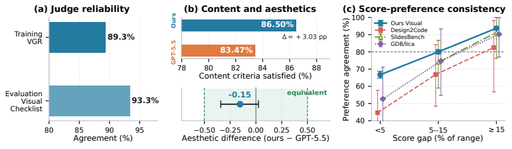
Figures from the paper Figure 4Human evaluation.(a)Agreement with training VGR and evaluation-checklist judgments.(b) Content satisfaction and aesthetic equivalence between AesCode-32B and GPT-5.5.(c)Agreement between metric rankings and human preference by normalized score gap.
Original paper · CC BY 4.0That agreement rises with larger score gaps, so the Visual score is most reliable when two outputs differ clearly. The authors also say the Visual score exceeds external metrics across comparable gap bins. Together, these checks suggest the automatic judges track human judgment well enough for the main comparison.
Where AesCode still fails
Residual failures cluster into three modes, and the authors show one example of each in Figure 5. Canvas overflow still occurs after training, though it is rare, because code generation can't reliably anticipate the final pixel geometry. The authors leave visually grounded refinement for this problem to future work. Relation-level rewards stay sparse and don't localize which edge failed, so the training signal gives little help here.
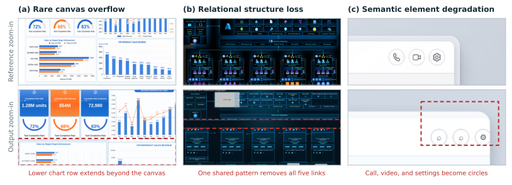
Figures from the paper Figure 5Residual failures of AesCode-32B.Reference and output zoom-ins show(a)canvas overflow, (b)lost relational structure, and(c)semantic element degradation. Dashed boxes mark affected regions; frequencies and additional cases appear in Section F.
Original paper · CC BY 4.0Semantic elements such as icons often degrade into generic marks. The authors attribute this to icons needing fine-grained SVG drawing grounded in meaning.
The human agreement figures come from sampled predicates, not from every item in the benchmark. Human judges agree with the training VGR on 89.3% of sampled predicates and with the evaluation Visual checklist on 93.3%. The benchmark uses 300 items with GPT-Image-2 references only, so other reference generators aren't tested.
Paper info
- Authors
- Xin Gao, Yifan Yang, Xin Li, Pan Wang, Yan Li, Muzhao Tian, Mingxi Cheng, Bei Liu, Kai Qiu, Qi Dai, Dong Chen, Yue Dong, Leandros Tassiulas, Rex Ying, Ji Li, Chong Luo
- Venue
- arXiv · Preprint
- First published
- 2026-10-13
- Added
- 2026-10-20
- Updated
- 2026-10-13
- Version
- v1
- arXiv
- 2610.18860
- Category
- cs.AI
- Original paper terms
- CC BY 4.0
- What we show
- Paper info, commentary and permitted figures from the original paper
AI commentary is a separate explanation from the original paper and may contain errors. The original paper and figures follow each source's terms of use and any rights noted separately.
Abstract
Generating information-rich visual artifacts such as slides, posters, and dashboards as code is appealing because the outputs are structured, editable, and verifiable. Yet code models cannot see how their choices of layout and color come together on the canvas, often limiting spatial planning and aesthetic quality. Image generators excel at visual design but can misrender requested content, making their outputs unreliable targets for direct reproduction. We therefore introduce AesCode, which generates code grounded in the content prompt while using an image generated from the same prompt as an aesthetic guidance. To do so, AesCode represents the target as a design graph that describes the whole canvas and makes each property attributable. From this graph, we derive complementary cross-modal rewards: deterministic verifiers score properties parsable from code and rendering, while a VLM judge assesses the non-parsable ones with a sample-specific Visual Graph Rubric (VGR) tied to graph elements and relations. We optimize these decoupled rewards through reinforcement learning with per-channel normalization to jointly improve spatial planning, aesthetic quality, and verifiable correctness. To evaluate this setting, we build a benchmark that scores verifiable correctness and visual quality separately, with visual scores highly consistent with human judgments. We find that reference images substantially improve the visual quality of code generated by existing models, and ablations show that AesCode benefits from references both as model input and as a source of visual rewards. Relative to same-scale Qwen3-VL baselines given the same references, AesCode-8B and AesCode-32B improve visual quality by 31.1 and 22.4 percentage points, reaching scores comparable to those of closed-source frontier models such as GPT-5.5 and Claude Opus 4.8.
Quote from the paper
Xin Gao, Yifan Yang, Xin Li, Pan Wang, Yan Li, Muzhao Tian, Mingxi Cheng, Bei Liu, Kai Qiu, Qi Dai, Dong Chen, Yue Dong, Leandros Tassiulas, Rex Ying, Ji Li, Chong Luo (2026). AesCode: Aesthetic Code Generation with Decoupled Cross-Modal Rewards. arXiv:2610.18860v1. https://arxiv.org/abs/2610.18860v1
BibTeX
@misc{gao2026aescode,
  title = {{AesCode: Aesthetic Code Generation with Decoupled Cross-Modal Rewards}},
  author = {Xin Gao and Yifan Yang and Xin Li and Pan Wang and Yan Li and Muzhao Tian and Mingxi Cheng and Bei Liu and Kai Qiu and Qi Dai and Dong Chen and Yue Dong and Leandros Tassiulas and Rex Ying and Ji Li and Chong Luo},
  year = {2026},
  eprint = {2610.18860},
  archivePrefix = {arXiv},
  url = {https://arxiv.org/abs/2610.18860v1}
}