Paper commentary
Color-Perception-Guided Display Power Reduction for Virtual Reality
Chromaticity-only shading cuts VR display power without luminance loss
- Problem Smartphone power savers dim the whole screen uniformly, which darkens VR views and is easy to see because headsets have a wide field of view. Display power is also hard to cut without that visible effect.
- Method The method changes only the chromaticity of peripheral pixels and keeps their luminance fixed. It uses a gaze-contingent color discrimination model and a display power model to pick the lowest-power color each pixel can take without a visible change.
- Results The system reduces display power by as much as 24% with little to no perceptual fidelity degradation. In a study with six panoramic videos, participants noticed artifacts in 16.7% of trials versus 63.5% for the luminance baseline.
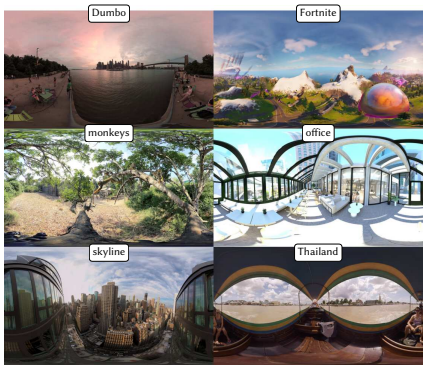
Fig. 8 . Panoramic Video Scenes. Representative panoramic frames cap- tured from 360 degree monoscopic video scenes used in the evaluation user study described in Section 7.1. Images of "Dumbo", "monkeys", and "skyline" scenes by Humaneyes Technologies, rendering of historical Two Embar- cadero Center in San Francisco, CA ("office") by Rene Rabbitt of Rabbitt Design, "Thailand" by VR Gorilla, and "Fortnite" by AmiramiX.
Original paper · CC BY 4.0 · Budmonde Duinkharjav, Kenneth Chen, Abhishek Tyagi, Jiayi He, Yuhao Zhu, Qi Sun · Color-Perception-Guided Display Power Reduction for Virtual Reality · Original paper figure · Extracted the figure area from page 13 of the original PDF.Why display power matters for untethered VR
Untethered headsets drain their batteries fast, and the display takes a large share of that drain. The authors measured an HTC Vive Pro Eye and an Oculus Quest 2 with the display on and off. The display consumed as much as half of the total power consumption in that comparison. Display power will matter even more under cloud rendering, where computation moves off the device.
That shift raises the display's contribution to the total device power.
Most display power savers were built for smartphones, where the screen is small and gaze matters little. These savers either modulate pixels uniformly across the display or act on content such as UI elements. Smartphone optimizations are gaze-agnostic because their displays have a very narrow field-of-view. A headset's wide field of view makes such uniform changes easy to see, so applying them to VR degrades visual quality.
A phone-style power saver therefore darkens a VR view without a gaze-aware reason for doing so.
Foveated rendering also uses gaze, but it reduces rendering load rather than display power. Foveated rendering doesn't directly reduce the display power, so it leaves the display side untouched. It changes only the chromaticity of the display output and keeps luminance fixed.
Shifting chromaticity while holding luminance
The core idea is to change only the chromaticity of peripheral pixels and leave their luminance as it is. The authors combine two observations: LED power varies with color even at equal luminance, and human color sensitivity drops in the periphery. The second observation also holds during active vision, which the authors tie to Cohen et al.
2020. Both observations come from prior work, and the paper builds the method on their combination.
Luminance dimming is the alternative that phone savers use, so keeping luminance fixed sets this method apart. The task becomes finding, for each pixel, a nearby color that costs less power and stays within what the viewer can't tell apart. The authors say this optimization has a closed-form solution, because of how they built the perception and power models.
Our method's optimization runs per pixel, and the authors implement it as a real-time shader.
Dropping luminance lowers the dimension of the perceptual model, which the authors say yields a convex constrained problem with a closed-form solution. So the search stays on equi-luminant planes, where the threshold model is defined. The ellipse thresholds are defined on equi-luminant color spaces, following the DKL framework. They didn't test joint luminance and chromaticity changes, which they leave to future work.
Measuring color discrimination across eccentricities
The authors measured how far a color can move before a viewer notices, using a psychophysical study with five participants. Participants wore an HTC Vive Pro Eye and sat seated while they used the keyboard to answer. Each trial showed four colored disks for 500ms in a 4AFC task, and the participant picked the disk with the calibration color.
The design covered five reference colors, three eccentricities, and four directions in the DKL plane, giving 60 staircase sequences. The procedure stopped after six reversals or 50 trials, and the authors rejected trials when gaze moved beyond 3°. The study produced 8,123 trials in total, with about 21 trials per sequence on average.
Measured thresholds shrink as eccentricity grows, so sensitivity to chromatic change drops with distance from the fovea. The authors describe the fall-off as very sharp, and the sub-threshold region at 35° can cover as much as a third of observable hues. Thresholds also differ with reference color even at the same eccentricity, yet each one appears as an ellipse.
This pattern motivates a model that takes the reference color as one of its inputs.
Participants varied from one another, so the authors kept the most conservative threshold across participants instead of an average fit. The authors argue this choice generalizes to a larger population because it carries individual variance into the model. These thresholds hold only for discrimination tasks, and the authors return to that limit later in the paper.
From thresholds to an ellipse model and a regression
The model works in an intermediate DKL-style space, which first converts LMS cone responses into cone-opponent channels. A color is then expressed as its contrast with an adaptation color, using κ(t_i; b_i) = (t_i − b_i)/b_i. The indices are L−M, S−(L+M), and L+M, so the luminance channel is the third one. Because the L+M coordinate equals the luminance, the luminance channel sits apart from the two chromatic channels.
Each threshold is an ellipse, and the authors write its boundary as the equation E(x; t, b, α) = 0. The first constraint keeps the threshold colors equi-luminant with the adaptation color, so the chromaticity moves on a fixed luminance plane. The second constraint places the threshold colors on the edge of the ellipse, whose semi-axes are α.
The semi-axes α aren't known in advance, so the authors learn them from their user study data.
The regression learns a mapping Φ from the test color's contrast κ and eccentricity e to the ellipse sizes α. The Radial Basis Function Neural Network uses a sigmoid output layer, which keeps the output smooth and in a positive, localized range. Each of the N = 5 Gaussian nodes weights its effect on the input, and the weighted sum passes through the sigmoid and a scaling factor η.
The network's fit reaches an R2 of 0.58, with an adjusted R2 of 0.51.
Since the adaptation color b is shared across all terms, the authors set a_i = α_i b_i. This turns the ellipse into E(x; t, a) = Σ_i ((x_i − t_i)/a_i)² − 1, written directly in color differences. The new form lets the shader work with differences x − t inside the i-DKL space, so the ellipse size a is a direct measure. The power model in the next part is written over the same sRGB pixels, so the shader can combine both models for each pixel.
Power model and the closed-form shift
The shader's power model treats display power as the sum of three sub-pixel powers and a fixed peripheral term. Each sub-pixel's power is taken as roughly proportional to its current, which scales with the numerical value of its channel. For a linear sRGB pixel, the model becomes P(x_srgb) = p_srgb^T x_srgb + p_circ, a dot product with a fixed unit-power vector plus a constant.
The peripheral constant p_circ is the power drawn when all pixels are black, so the LEDs don't emit light and consume no power.
The authors fit the unit-power vector by measuring 52 randomly sampled sRGB colors, including the eight cube vertices. They solve the over-determined linear system with classic linear least squares. The fitted regression reaches a mean relative error of 0.996%, which the authors read as an accurate power model. Because the method doesn't depend on this panel, it can be extended to any other three-primary display.
The optimizer picks the power-minimizing color from the colors that the threshold ellipse allows. Working in i-DKL, the shift is a closed form: x*_idkl = t_idkl + (a^2 ⊙ p) / sqrt(sum_i a_i^2 p_i^2). The vector a holds the ellipse sizes scaled by the adaptation color, and p holds the unit powers from the regression. Because the solution is closed form, the shader doesn't need an iterative solver for each pixel.
At run time, the fragment shader reads each sRGB pixel and the gaze position, then computes that pixel's eccentricity. Pixels with eccentricity below eccmin are returned unchanged, while eccentricities above eccmax are clamped to eccmax. The RBFNN parameters come from the offline regression, so at run time only the per-pixel inputs change.
The shader's per-pixel model input stacks the color contrast with the eccentricity, which feeds the network that outputs the ellipse sizes.
Perceptual quality against luminance shading
The study compares two gaze-contingent shaders on six panoramic videos, asking whether the chromaticity shader stays less visible than a luminance power saver. The baseline, LUM, applies one constant scaling factor to all peripheral pixels beyond 10 degrees eccentricity, so it works like a gaze-contingent power-saving mode. The scaling factor is set so that LUM's estimated power saving matches that of OUR.
Participants answered a scene-specific task after each trial, then a 2AFC question about whether they noticed visual artifacts. The authors showed artifact examples on a monitor rather than in the headset, so participants' retinal images differed from the study stimuli.
Participants noticed artifacts in 63.5±9.4% (STE) of trials with LUM, compared to 16.7±7.3% with OUR. Lower percentages mean less noticeable modulation, so OUR keeps the image closer to the original. A one-way repeated ANOVA found that the shading condition has a significant effect on perceptual quality, with F(1,24)=18.42 and p=.00025. Power savings were close: OUR saved 20.8±1.2% and LUM saved 18.6±1.4%, both at 95% confidence.
Since both shaders saved similar power, the gap in artifacts comes from how each one modulates the image.
Artifact rates also depend on content, so the scenes don't behave alike under OUR. The monkeys scene, with large amounts of green, had the lowest artifact share under OUR. The authors hypothesize that the higher brightness of the office scene drives its artifact rate up. Skyline saw the highest power saving under OUR, which the authors tie to the uniform distribution of blue colors.
The luminance-based comparison also points to future work, because LUM's detection threshold assumption may not be perceptually optimal.
Savings on natural images
The authors asked how much display power the shader would save on arbitrary photos, not only on the panoramic videos used in the user study. They applied the method offline to a large sample of ImageNet images, the natural image dataset used in the analysis. Each image received randomized gaze locations, so the edges of the image wouldn't be unfairly affected.
Across this set, the method saved 14% of display power on average. The authors read this average as evidence that the model generalizes to a large variety of natural scenes.
Savings depend on content, because saturated colors have little room inside the sRGB cube. Their potential chromaticity shifts get clipped by the sRGB bounds, so these colors save less power. The ImageNet histogram shows the full distribution of savings, with the best and worst image groups sampled from different quantile bands. These figures are offline estimates computed on images, and the authors didn't measure live power during use.
Limitations and open problems
The thresholds were measured only for discrimination, but the authors' preliminary detection tests showed higher color sensitivity. Detection was tested with a two-alternative forced choice task, and most participants identified the altered condition. The authors plan an adaptive model that covers detection, discrimination, and active viewing, so the color modulation can be configured for each viewing scenario.
The perceptual study used 6 panoramic video sequences and 13 participants, with active and real-world viewing as the condition. Active viewing was chosen over detection because the authors wanted to simulate head and eye movements in gaming and video-watching.
The model changes only chromaticity and keeps luminance fixed, so joint luminance and chromaticity modulation remains future work. Adding luminance would add a dimension to the perceptual model, and the level sets might not be convex. Prior literature suggests a weak eccentricity-dependent effect for absolute luminance, which the authors cite as another challenge.
The model is per pixel and ignores spatial frequency and local contrast, which the authors leave to future work.
Shader speed is limited by an atomic for-loop, so the shader can't yet reach the speed the authors want. The authors point to deferred shading as a possible fix and name one candidate solution. Chromatic adaptation to adjust the display white point is listed as a direction that doesn't need eye tracking, but the authors didn't test it. Display persistence is another direction, and the authors didn't test how reduced display periods change the power savings.
Paper info
- Authors
- Budmonde Duinkharjav, Kenneth Chen, Abhishek Tyagi, Jiayi He, Yuhao Zhu, Qi Sun
- Venue
- arXiv · Preprint
- First published
- 2022-9-15
- Added
- 2026-11-6
- Updated
- 2022-9-19
- Version
- v2
- arXiv
- 2209.07610
- DOI
- 10.1145/3550454.3555473
- Category
- cs.HC
- Original paper terms
- CC BY 4.0
- What we show
- Paper info, commentary and permitted figures from the original paper
AI commentary is a separate explanation from the original paper and may contain errors. The original paper and figures follow each source's terms of use and any rights noted separately.
Abstract
Battery life is an increasingly urgent challenge for today's untethered VR and AR devices. However, the power efficiency of head-mounted displays is naturally at odds with growing computational requirements driven by better resolution, refresh rate, and dynamic ranges, all of which reduce the sustained usage time of untethered AR/VR devices. For instance, the Oculus Quest 2, under a fully-charged battery, can sustain only 2 to 3 hours of operation time. Prior display power reduction techniques mostly target smartphone displays. Directly applying smartphone display power reduction techniques, however, degrades the visual perception in AR/VR with noticeable artifacts. For instance, the "power-saving mode" on smartphones uniformly lowers the pixel luminance across the display and, as a result, presents an overall darkened visual perception to users if directly applied to VR content. Our key insight is that VR display power reduction must be cognizant of the gaze-contingent nature of high field-of-view VR displays. To that end, we present a gaze-contingent system that, without degrading luminance, minimizes the display power consumption while preserving high visual fidelity when users actively view immersive video sequences. This is enabled by constructing a gaze-contingent color discrimination model through psychophysical studies, and a display power model (with respect to pixel color) through real-device measurements. Critically, due to the careful design decisions made in constructing the two models, our algorithm is cast as a constrained optimization problem with a closed-form solution, which can be implemented as a real-time, image-space shader. We evaluate our system using a series of psychophysical studies and large-scale analyses on natural images. Experiment results show that our system reduces the display power by as much as 24% with little to no perceptual fidelity degradation.
Figures from the paper
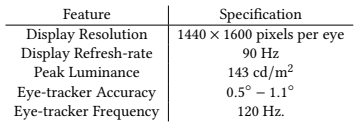
Table 2 . Relevant specifications for the HTC Vive Pro Eye
Original paper · CC BY 4.0Quote from the paper
Budmonde Duinkharjav, Kenneth Chen, Abhishek Tyagi, Jiayi He, Yuhao Zhu, Qi Sun (2022). Color-Perception-Guided Display Power Reduction for Virtual Reality. arXiv:2209.07610v2. https://doi.org/10.1145/3550454.3555473
BibTeX
@article{duinkharjav2022color,
  title = {{Color-Perception-Guided Display Power Reduction for Virtual Reality}},
  author = {Budmonde Duinkharjav and Kenneth Chen and Abhishek Tyagi and Jiayi He and Yuhao Zhu and Qi Sun},
  year = {2022},
  eprint = {2209.07610},
  archivePrefix = {arXiv},
  doi = {10.1145/3550454.3555473},
  url = {https://arxiv.org/abs/2209.07610v2}
}