Paper commentary
Fast-GANFIT: Generative Adversarial Network for High Fidelity 3D Face Reconstruction
Fast-GANFIT replaces the 3D face texture model with a GAN for sharper reconstructions
- Problem Fitted 3D faces from single images look blurry because PCA textures smooth out high-frequency detail. Existing DCNN methods still miss that detail in texture.
- Method Fast-GANFIT swaps the linear PCA texture in 3D Morphable Model fitting for a GAN generator trained on UV textures. A regression encoder predicts the latent parameters, so fitting starts closer to the answer.
- Results On MICC cooperative scenes, GANFit++ scored 0.94 mm, compared to 1.50 mm for Genova et al.
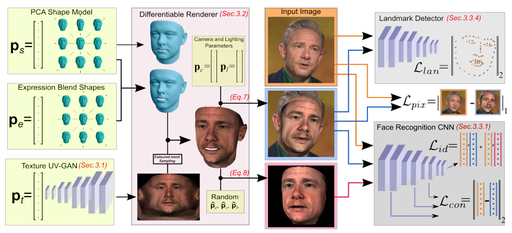
Fig. 2 : Detailed overview of the proposed approach. A 3D face reconstruction is rendered by a differentiable renderer (shown in purple). Cost functions are mainly formulated by means of identity features on a pretrained face recognition network (shown in gray) and they are optimized by flowing the error all the way back to the latent parameters ( ps,p e,p t,c,i , shown in green) with gradient descent optimization. End-to-end differentiable architecture enables us to use computationally cheap and reliable first order derivatives for optimization thus making it possible to employ deep networks as a generator ( i.e., statistical model) or as a cost function.
Original paper · CC BY 4.0 · Baris Gecer, Stylianos Ploumpis, Irene Kotsia, Stefanos Zafeiriou · Fast-GANFIT: Generative Adversarial Network for High Fidelity 3D Face Reconstruction · Original paper figure · Extracted the figure area from page 4 of the original PDF.Why single-image texture stays blurry
Single-image 3D face reconstruction has long relied on 3D Morphable Models, which Blanz and Vetter introduced about twenty years earlier. Because of its Gaussian nature, the PCA texture ends up looking blurry. Recent DCNN methods add correctives to the 3DMM, yet they still miss high-frequency detail in texture. Those methods can also let reconstructions fall outside the 3DMM space, so outliers such as glasses get baked into shape and texture.
Neural rendering networks trained by VAE produce outstanding quality textures, but each network stores only a few individuals. Building one of those networks means collecting around 20 million images in a controlled environment. This leaves a gap: a texture model with fine detail that still works from one uncontrolled photo. The authors keep the optimisation-based fit, which needs no per-person capture, and change the texture model inside it.
Their earlier GANFit approach has a weakness: it is sensitive to the initialization of the generated texture. The authors address that sensitivity later with a self-supervised regression network for initialisation.
The key idea: a GAN texture prior replaces PCA in fitting
The core move replaces the linear PCA texture model in 3DMM fitting with a GAN generator trained on UV textures. Fitting then searches the latent code of that generator for the texture that best reproduces the input image. Before, the texture was a mean texture plus a linear combination of bases, so the fit was a linear transformation. The cost changes too: it compares deep identity features from a face recognition network rather than raw RGB values or hand-crafted features.
The authors argue that PCA is powerful enough for a decent shape and texture model, but it blurs textures because of its Gaussian nature. GANs capture the sharp detail that PCA smooths out, which matters for preserving identity and photorealism. A GAN alone can lose 3D coherency when the training images are semi-aligned, so the authors train it on UV maps with per-pixel alignment.
The generator is a progressive growing GAN that models the distribution of UV representations of 10,000 high resolution textures. The generator maps a 512-dimensional latent code to an H×W×C UV map at 512 × 512 resolution. Fitting then minimizes the per-pixel Manhattan distance between the target UV texture and the generator output with respect to the latent parameter.
Every step from the texture generator to the cost is differentiable, so gradient descent can update all latent parameters together. The rendered image combines the 3DMM shape, the GAN texture sampled from the UV map, and the camera and lighting parameters. A secondary render with random expression, pose and illumination generalizes the identity parameters to those variations.
Shape, camera and lighting are updated alongside the texture, so the whole reconstruction is fitted to the image in one loop.
How one fitting pass computes its cost
Each reconstruction is a 3DMM shape textured with the generator output and projected by the differentiable renderer. The shape is a mean plus identity and expression bases, each scaled by its eigenvalues. The Large Scale Face Model supplies 158 identity parameters, and the 4DFAB expression model supplies 29 expression parameters. The rendered image depends on camera and illumination parameters, so the fit must also solve for them.
A second render uses random expression, pose and lighting, which gives the extra identity term its input.
The identity loss compares cosine distances between embeddings of the input and the render from a face recognition network. The content loss sums normalised Euclidean distances between intermediate activations of the same network on the input and the render. The intermediate layers keep mid-level cues, such as age, that the last layer discards.
The pixel loss is an L1 distance between input and render at full resolution. Images are downscaled to 112 by 112 before the identity and content losses, so the pixel loss keeps the finest detail.
The fit runs in two stages, and the first stage updates only shape, expression and camera with the landmark loss and shape regularisation. The second stage optimises all parameters together under the weighted sum of the identity, secondary identity, content, pixel and landmark losses. The authors weight the content loss most heavily at 50.0, against 2.0 for each identity term and 1.0 for pixel.
They use Adam with a 0.01 learning rate and set the landmark weight to 0.001.
A regressor that starts the fit
GANFit is sensitive to where it starts, because the generator is nonlinear and gradient descent can stop at a sub-optimal minimum. The authors train an encoder network to regress the same latent parameters from the input image, using the same image formation and loss functions. The encoder's activations replace the trainable latent parameters, so the network is trained end-to-end through the differentiable renderer.
The regressed output can be used directly as FastGANFit, or it can initialise GANFit's latent parameters, which the authors call GANFit++.
Unlike an earlier regression method that restricts features to the final layer of the face recognition network, FastGANFit uses activations from all levels. The design concatenates same-resolution activations from the ArcFace backbone, which the authors say keeps state-relevant cues such as age and facial hair. Normalised landmark locations from a pretrained landmark detector are flattened and concatenated before the final fully connected layers.
Training has two stages: first camera, shape and expression parameters with the landmark loss and shape regularisation, then the full objective.
FastGANFit gives a reconstruction in under a second, while GANFit takes around 30 seconds per image on an Nvidia GTX 1080 TI GPU. GANFit++ converges in 5 to 10 seconds, because FastGANFit starts it closer to the minimum. On MICC cooperative scenes, FastGANFit scored 1.11 mm and GANFit++ scored 0.94 mm, against 0.95 mm for a GANFit seed. The regressor therefore trades a small accuracy cost for speed, and the authors state that users can choose the balance between speed and quality.
Shape error on MICC
The MICC Florence 3D Faces dataset gives the shape test, with 3D scans of 53 subjects and short videos. The authors sample only five frames per video and fit them with multi-image support. Genova et al. and Tran et al. process every frame of each video, so the frame budgets differ. The authors align each mesh to ground truth with ICP and report the symmetric point-to-plane distance in millimetres.
GANFit++ reaches 0.94 mm on cooperative scenes, compared to 1.50 mm for Genova et al. and 1.93 mm for Tran et al. GANFit++ scores 0.92 mm indoors and 0.94 mm outdoors, with standard deviations of 0.14 and 0.19. Random starts land close to this result, with GANFit seeds 1, 2 and 3 scoring 0.95, 0.95 and 0.96 mm on cooperative scenes. Fast-GANFit, the regressor alone, scores 1.11 mm on cooperative scenes and 0.98 mm indoors.
The authors report that the absolute error improves by 36% over the two other state-of-the-art methods.
The authors describe the GANFit++ gain as slight and more stable, not as a large jump in accuracy. Dropping the landmark loss gives 0.91 mm on cooperative scenes, below the full model's 0.94 mm. The authors attribute this to landmark detector failure on low-resolution outdoor frames and extreme poses in cooperative frames. They name the strong reliance on the landmark detector as one limitation of the method.
Identity preservation on LFW
Identity preservation is tested on Labelled Faces in the Wild, where the authors ask whether rendered reconstructions keep the identity of real photos. Following Genova et al., real LFW images and rendered images of their 3D reconstructions pass through the pretrained VGG-Face network. The authors compute activations at the embedding layer and measure cosine similarity in two ways.
The first compares real images with their rendered counterparts, and the second compares renderings of same and different pairs. Both checks run against other deep 3D face reconstruction approaches, namely Genova et al. and Tran et al.
Rendering-to-photo similarity averages above 0.5 for the proposed method, compared to 0.35 for Genova et al. and 0.16 for Tran et al. The Figure 9 distributions show this gap between the methods on the same LFW pairs. VGG-Face was trained on real images, so the authors read the higher similarity as evidence of photorealism as well as identity.
Same and different pairs also separate by a threshold on cosine similarity, as Figure 10 shows. Don't read this as a test on unseen faces, since the paper reports only the LFW comparison.
Texture model choice by FID
The authors compare texture models in UV space with the Fréchet Inception Distance, where lower scores mean more photorealistic and diverse generations. The GAN scores 2.95, compared to 65.80 for PCA and 120.44 for a vanilla VAE. The NVAE variant reaches 62.98 on the same 9358 images, so it sits between PCA and the GAN. The table lists 9358 images for these rows, while the text describes the same training set as 10,000 UV textures.
The GAN also scores 7.30 on CelebA-HQ 2D images, which is the lowest among the 2D rows.
Moving from 2D images to 3D UV textures improves the GAN's FID, and the authors credit per-pixel alignment for this gain. The authors say the GAN texture looks more plausible and higher fidelity than the VAE and PCA textures in Fig. 7. They trained a vanilla VAE for this comparison because they couldn't find a simple way to fit NVAE, whose stochasticity appears at every resolution level.
For both VAE and PCA, the rest of the pipeline stays the same, with a similar regression network trained for each model.
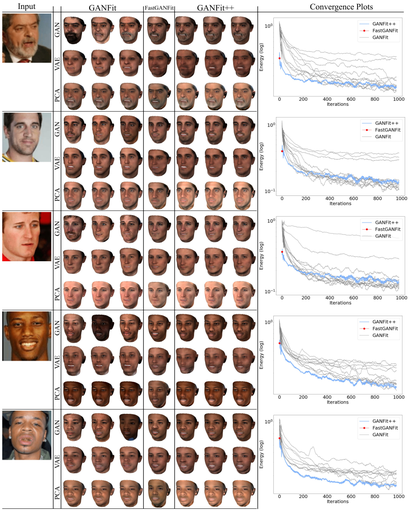
Fig. 7 : Qualitative comparison betweenGANFit, FastGANFit, GANFit++ (as mentioned in Sec. 5.2.4) and their variants with Variational Auto-Encoder (V AE) and Principal Component Analysis (PCA) (as mentioned in Sec. 5.4.2) for texture model. Convergence plots show the cost function over the iterations of GANFit (gray, 10 random initialization), GANFit++ (blue, 3 random initialization), and initialization by FastGANFit (red)
Original paper · CC BY 4.0What the leave-one-out losses change
Table 1 removes one loss term at a time, and each ablation row is compared with the GANFit seed 1 row. On the cooperative setting, GANFit seed 1 reaches 0.95 mm, and removing Lid, ˆLid and Lcon together raises the error to 1.20 mm. Removing only Lid gives 0.96 mm, and removing only Lcon gives 0.94 mm, so each identity-related term changes error much less.
Removing only ˆLid gives 1.07 mm, which is the largest single-term increase among the identity-related rows. The authors read this as the identity terms recovering for one another, while dropping all of them causes a significant drop.
Removing Llan lowers cooperative error to 0.91 mm and outdoor error to 0.93 mm, from 0.95 mm in both settings. The authors attribute this to the landmark detector failing on low-resolution outdoor frames and at extreme cooperative poses. They describe the strong reliance on the landmark detector as one limitation of their method. Removing Lpix gives 0.94 mm in cooperative and 0.93 mm in outdoor, so shape error barely moves.
The authors see the pixel loss as affecting only illumination and skin colour, which leaves shape reconstruction unchanged.
GANFit++ reaches 0.94 mm in the cooperative setting, which keeps it close to the full GANFit model. The authors ran this ablation on the MICC Florence 3D Faces dataset, using point-to-plane distance and cosine identity similarity. They didn't test a landmark detector that works well at low resolution, so the landmark trade-off stays limited to these rows.
Where GANFit and Fast-GANFit depend on fragile parts or pay a speed cost
The biggest fragility is the landmark detector, which the authors name as a limitation of their method. The landmark loss aligns the rendered geometry to landmarks from a 68-point hourglass detector, so detector errors feed straight into the fit. The authors blame the detector's failure on low resolution in the 'Outdoor' setting and on extreme poses in the 'Cooperative' setting.
In those settings, the authors found their method performed better without the landmark loss, even though the rough alignment step still includes it.
The initialization is a second weak point, because GANFit doesn't always reach a good minimum. The authors say that GANFit sometimes fails to converge to a good local minimum, as the convergence plots in Fig. 7 show. FastGANFit provides a starting point that is easier to converge from, which is why GANFit++ is initialized this way. Because the fitting is non-linear and uses first-order derivatives, the optimization is not guaranteed to find the global minimum.
Speed is the cost of the optimization route, since GANFit takes about 30 seconds per image on an Nvidia GTX 1080 TI GPU. FastGANFit runs in under a second, but its cooperative error of 1.11 mm is higher than GANFit's 0.95 mm for seed 1. So a fast path depends on FastGANFit, which trades shape accuracy for speed. GANFit++ converges after 5-10 seconds and reaches 0.94 mm cooperative error, which keeps the speed-quality trade-off in the middle.
The MoFA comparison in Fig. 6 is only qualitative, so the paper gives no table for it. The paper doesn't report a numeric comparison on MoFA, so the visual claims rest on the figure alone.
Paper info
- Authors
- Baris Gecer, Stylianos Ploumpis, Irene Kotsia, Stefanos Zafeiriou
- Venue
- arXiv · Preprint
- First published
- 2021-5-16
- Added
- 2026-11-6
- Updated
- 2021-5-16
- Version
- v1
- arXiv
- 2105.07474
- DOI
- 10.1109/tpami.2021.3084524
- Category
- cs.CV
- Original paper terms
- CC BY 4.0
- What we show
- Paper info, commentary and permitted figures from the original paper
AI commentary is a separate explanation from the original paper and may contain errors. The original paper and figures follow each source's terms of use and any rights noted separately.
Abstract
A lot of work has been done towards reconstructing the 3D facial structure from single images by capitalizing on the power of Deep Convolutional Neural Networks (DCNNs). In the recent works, the texture features either correspond to components of a linear texture space or are learned by auto-encoders directly from in-the-wild images. In all cases, the quality of the facial texture reconstruction is still not capable of modeling facial texture with high-frequency details. In this paper, we take a radically different approach and harness the power of Generative Adversarial Networks (GANs) and DCNNs in order to reconstruct the facial texture and shape from single images. That is, we utilize GANs to train a very powerful facial texture prior \edit{from a large-scale 3D texture dataset}. Then, we revisit the original 3D Morphable Models (3DMMs) fitting making use of non-linear optimization to find the optimal latent parameters that best reconstruct the test image but under a new perspective. In order to be robust towards initialisation and expedite the fitting process, we propose a novel self-supervised regression based approach. We demonstrate excellent results in photorealistic and identity preserving 3D face reconstructions and achieve for the first time, to the best of our knowledge, facial texture reconstruction with high-frequency details.
Quote from the paper
Baris Gecer, Stylianos Ploumpis, Irene Kotsia, Stefanos Zafeiriou (2021). Fast-GANFIT: Generative Adversarial Network for High Fidelity 3D Face Reconstruction. arXiv:2105.07474v1. https://doi.org/10.1109/tpami.2021.3084524
BibTeX
@article{gecer2021fast,
  title = {{Fast-GANFIT: Generative Adversarial Network for High Fidelity 3D Face Reconstruction}},
  author = {Baris Gecer and Stylianos Ploumpis and Irene Kotsia and Stefanos Zafeiriou},
  year = {2021},
  eprint = {2105.07474},
  archivePrefix = {arXiv},
  doi = {10.1109/tpami.2021.3084524},
  url = {https://arxiv.org/abs/2105.07474v1}
}