論文解説
Sentiment Analysis Based on Deep Learning: A Comparative Study
深層学習に基づく感情分析:比較研究
- 課題 ソーシャルメディアの感情分析では、深層学習モデルを信頼性と処理時間の両面から比較する必要があります。
- 手法 DNN、CNN、RNNをword embeddingとTF-IDFの入力と組み合わせ、複数のデータセットでk=10の交差検証により比較します。
- 結果 word embeddingの入力は、ほとんどの指標でTF-IDFを上回りました。RNNはword embeddingと組み合わせたときに精度が最も高く、CNNは処理時間と精度のバランスが最も良いと結論づけられています。
感情分析研究の比較面での空白
ソーシャルメディア上の意見を分析する感情分析は、自然言語処理の難しさから、精度と効率が制約されています。既存の比較研究の多くは、精度やF-scoreといった信頼性の指標に集中しており、処理時間は扱っていません。評価に使ったデータセットも少数でした。この論文は、この空白を埋めるために、複数のデータセットで深層学習モデルを比較し、信頼性の指標と処理時間を合わせて検討します。
論文では、研究課題を、さまざまな種類と規模のデータセットで優れた手法を示せるかどうかとして設定しています。この問いは、単一データセットでの最高性能ではなく、データの条件が変わっても一貫して良い手法があるかを問うものです。
DNN、CNN、RNNと2つの入力表現
この研究は、DNN、CNN、RNNの3つの深層学習モデルを選んで比較します。入力は、Word2vecで学習したword embeddingと、scikit-learnのvectorizerで計算したTF-IDFの2種類です。そのため、アルゴリズムごとに2種類の入力ベクトルに対して1つずつモデルが作られます。
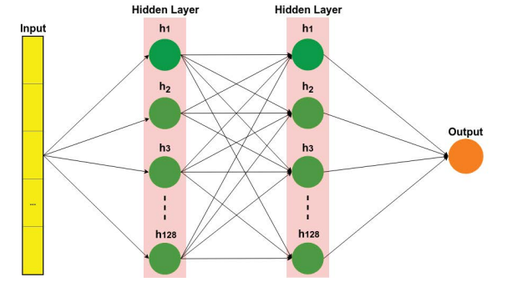
Figure 2 . Deep neural network (DNN).
出典 · CC BY 4.0 · Nhan Cach Dang, María N. Moreno-García, Fernando De la Prieta · Sentiment Analysis Based on Deep Learning: A Comparative Study · 論文の図を引用 · 元のPDFの4ページ目から図の部分を抽出しています。前処理では、RT、@、#、リンク、数字、英語のストップワードと句読点を除去し、小文字化と見出し語化を行います。評価指標は精度、再現率、F-score、AUCで、k=10の交差検証を用います。
CNNの例では、embedding層の後に、カーネルサイズ3の1D畳み込み層を複数配置し、最大プーリングと平均プーリングを経て、シグモイド出力層で肯定と否定を予測します。この細かい構造は本論文のCNN実験の説明に当たるもので、他のモデルやデータセットにそのまま適用できるとは見なせません。
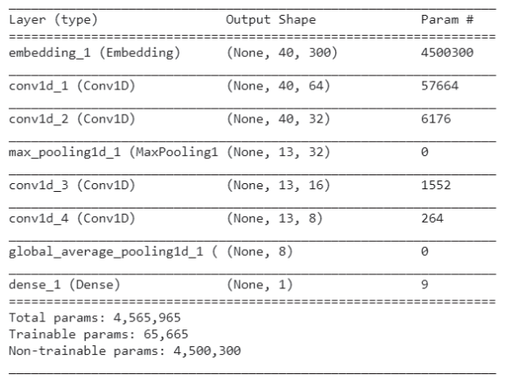
Figure 9 . The details of the CNN model, which was set up for the experiment.
出典 · CC BY 4.0 · Nhan Cach Dang, María N. Moreno-García, Fernando De la Prieta · Sentiment Analysis Based on Deep Learning: A Comparative Study · 論文の図を引用 · 元のPDFの17ページ目から図の部分を抽出しています。Sentiment140の部分集合と全データの比較
まず、Sentiment140データを10%から100%までのさまざまな割合の部分集合に分けて実験しました。この段階では、word embeddingの入力を使ったモデルが、複数の指標でTF-IDFの入力よりも良い結果を示しました。特にRNNは、word embeddingと組み合わせたときに最も高い精度を示し、TF-IDFと組み合わせたときは最も低い結果でした。
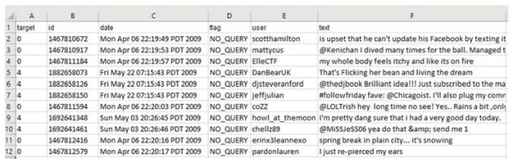
Figure 6 . Examples of the Sentiment140 dataset.
出典 · CC BY 4.0 · Nhan Cach Dang, María N. Moreno-García, Fernando De la Prieta · Sentiment Analysis Based on Deep Learning: A Comparative Study · 論文の図を引用 · 元のPDFの15ページ目から図の部分を抽出しています。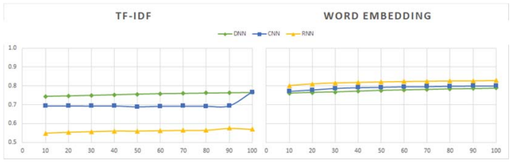
Figure 10 . Accuracy values of deep-learning models with TF-IDF and word embedding for different numbers of tweets (percentage of the dataset).
出典 · CC BY 4.0 · Nhan Cach Dang, María N. Moreno-García, Fernando De la Prieta · Sentiment Analysis Based on Deep Learning: A Comparative Study · 論文の図を引用 · 元のPDFの18ページ目から図の部分を抽出しています。全Sentiment140データでは、RNNとword embeddingの精度は0.82819948と報告されています。同じ表では、CNNとword embeddingは0.80060849、DNNとword embeddingは0.78816761です。著者らは、データ量がword embeddingの結果に与える影響は小さいと解釈しています。
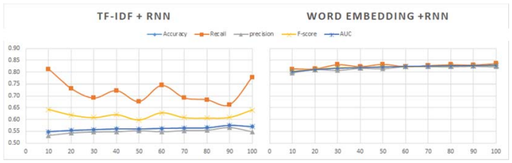
Figure 15 . Comparison of all measures for RNN with TF-IDF (left) and word embedding (right).
出典 · CC BY 4.0 · Nhan Cach Dang, María N. Moreno-García, Fernando De la Prieta · Sentiment Analysis Based on Deep Learning: A Comparative Study · 論文の図を引用 · 元のPDFの20ページ目から図の部分を抽出しています。複数のデータセットにおけるモデルの比較
Sentiment140、Tweets Airline、Tweets SemEval、IMDB Movie Reviews、Cornell Movie Reviews、Book Reviews、Music Reviewsなど、複数のデータセットで同じモデル比較を行いました。全体としては、RNNとword embeddingの組み合わせが最も良い結果を示しました。ただし、Book ReviewsとMusic Reviewsでは、DNNとTF-IDFの指標がRNNとword embeddingをわずかに上回りました。Book Reviewsでは、CNNとword embeddingが精度、再現率、F-score、AUCで最も高くなりました。

Figure 8 . Word cloud view of the topics of the datasets.
出典 · CC BY 4.0 · Nhan Cach Dang, María N. Moreno-García, Fernando De la Prieta · Sentiment Analysis Based on Deep Learning: A Comparative Study · 論文の図を引用 · 元のPDFの17ページ目から図の部分を抽出しています。この結果は、この論文で用いた特定のデータセットとモデル設定で得られたものであり、他のデータセットや他のモデルに一般化できるわけではありません。
処理時間と精度のバランス
処理時間は、GPU環境で測定したCPU時間として報告されています。TF-IDFは、概してword embeddingより長い計算時間を要しました。RNNは、両方の入力方式で最も長くかかりました。
論文は、CNNが処理時間と精度の間で最も良いバランスを示すと結論づけています。RNNはword embeddingと組み合わせたときに精度が最も高いものの、処理時間はCNNより約10倍長いと説明されています。この比較は、この論文のGPU環境と当該データセットの条件に基づいて解釈すべきです。
結果の適用範囲
著者らは、結果がデータセットの特性によって変わりうると述べています。したがって、この論文の結論は、使用した8つのデータセット、3つのモデル、2つの入力表現に限定して読む必要があります。論文では、より多くのデータセットで手法を検証する必要があると提案されています。
論文情報
- 著者
- Nhan Cach Dang, María N. Moreno-García, Fernando De la Prieta
- 学会・ジャーナル
- arXiv · プレプリント
- 公開日
- 2020年6月5日
- 登録日
- 2026年11月6日
- 更新日
- 2020年6月5日
- バージョン
- v1
- arXiv
- 2006.03541
- DOI
- 10.3390/electronics9030483
- カテゴリ
- cs.CL · cs.IR · cs.LG
- ライセンス
- CC BY 4.0
- 掲載内容
- 論文情報・解説・論文の図
この解説は、Refivuの韓国語解説をAIで翻訳したものです。不正確な翻訳や誤りが含まれる可能性があります。論文と図の利用条件は各出典に従います。
アブストラクト
The study of public opinion can provide us with valuable information. The analysis of sentiment on social networks, such as Twitter or Facebook, has become a powerful means of learning about the users' opinions and has a wide range of applications. However, the efficiency and accuracy of sentiment analysis is being hindered by the challenges encountered in natural language processing (NLP). In recent years, it has been demonstrated that deep learning models are a promising solution to the challenges of NLP. This paper reviews the latest studies that have employed deep learning to solve sentiment analysis problems, such as sentiment polarity. Models using term frequency-inverse document frequency (TF-IDF) and word embedding have been applied to a series of datasets. Finally, a comparative study has been conducted on the experimental results obtained for the different models and input features
この論文を引用
Nhan Cach Dang, María N. Moreno-García, Fernando De la Prieta (2020). Sentiment Analysis Based on Deep Learning: A Comparative Study. arXiv:2006.03541v1. https://doi.org/10.3390/electronics9030483
BibTeX
@article{dang2020sentiment,
  title = {{Sentiment Analysis Based on Deep Learning: A Comparative Study}},
  author = {Nhan Cach Dang and María N. Moreno-García and Fernando De la Prieta},
  year = {2020},
  eprint = {2006.03541},
  archivePrefix = {arXiv},
  doi = {10.3390/electronics9030483},
  url = {https://arxiv.org/abs/2006.03541v1}
}