論文解説
Grasping the Future: Joint 3D Hand-Object Forecasting From Internet Videos
Grasping the Future:インターネット動画からの3D手-物体の同時予測
- 課題 手と物体の3D運動を1つの生成モデルで予測・補完し、インターネット動画から抽出した軌道で学習データを拡張する問題を扱います。
- 手法 マスク付きの時空間補完とflow matchingで、手、物体、手-物体の関係トークンを同時に生成し、接触損失とサンプル集合のスコアで復号した軌道を補正します。
問題設定:手と物体が同時に動く未来予測
物体とインタラクトするには、物体がどう動くかと、手がその動きにどう合わせて動くべきかを同時に予測する必要があります。この論文では、手首の動き、指の関節、物体の位置と向きを含む3D手-物体の運動を、1つの生成モデルで扱う問題を設定しています。人の動画にはこうした関係が豊富に含まれていますが、大規模なインターネット動画には3Dの教師データが直接与えられていません。そのため学習には、完了した相互作用から運動を復元する段階と、その運動をもとに部分観測の後の進行を学習する段階の両方が必要です。
マスク付きの時空間補完と表現方法
Grasping the Futureは、相互作用を手と物体のエンティティの行と、フレームの列からなるトークン格子として表現します。観測されたセルは与えられ、観測されていないセルはノイズから始まります。各タスクは、どのセルを観測するかを決めるマスクで区別されます。たとえば未来予測では最初の0.5秒を観測して残りを生成し、時間補間では中間区間を隠します。手と物体の関係を直接出力するために、各手-物体ペアに関係トークンを置いています。このトークンは、物体座標系での手首の姿勢と、5本の指先から物体表面までの距離を保持します。姿勢の変化は∆-codecで、最初の状態の絶対値と、その後の単位時間あたりの変化量として符号化されます。
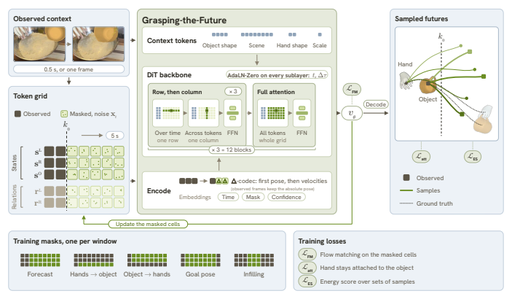
Figure 2 :Model overview.An interaction is represented as a grid of tokens, with rows indicat- ing statessand relationsr, and one column per frame. Observed cells are given, and unobserved cells are initialized to noise. A transformer attends to rows, columns and across the grid to predict the flow velocity of the noise cells (with the context tokens (blue) as additional keys/values). The noise is decoded into a sample by ten Euler steps, producing hand and object trajectories. Multiple samples for the same input vs. ground truth (dashed). The bottom row is used for training. An observation mask is sampled per window during training so the same model trains on all tasks (but with a different set of observed cells). Flow matching is used for velocity supervision and auxiliary losses are applied to decoded trajectories.
出典 · CC BY 4.0 · Rustin Soraki, Matthew Wallingford, Ryan Aby, Brandon Chee, Jason Ren, Ali Farhadi, Homanga Bharadhwaj, Roozbeh Mottaghi · Grasping the Future: Joint 3D Hand-Object Forecasting From Internet Videos · 論文の図を引用 · 元のPDFの4ページ目から図の部分を抽出しています。Flow matchingの学習とサンプリング
マスクされたトークンはflow matchingで学習されます。クリーンな符号化値x1、ガウスノイズϵ、x_t = (1 − t)ϵ + t x1を置き、ネットワークv_θは速度x1 − ϵを回帰します。観測されたトークンはノイズなしで入力されます。推論では、マスクされたトークンをガウスノイズから始め、予測速度を10段階のEulerステップで積分してサンプルを得ます。Transformerは時間方向とトークン方向のアテンションを交互に使い、インターネット動画から得た軌道は信頼度入力で区別されて、モデルがノイズのあるラベルへの依存を抑えるようにしています。
復号した軌道に対する接触損失とサンプルスコア
Flow matchingだけでは、フレームごとの小さな誤差が蓄積し、手が物体から離れることがあります。そこで、1回の速度予測からクリーンな軌道を推定して復号し、接触フレームで手首の位置・姿勢と指先の位置が参照の相対運動に従うようにするattachment損失を適用します。複数のサンプルを評価するため、M = 3本の軌道を生成し、平均誤差からサンプル間距離を引いたenergy scoreを最小化します。このスコアは、精度と多様性を同時に報いるように設計されています。
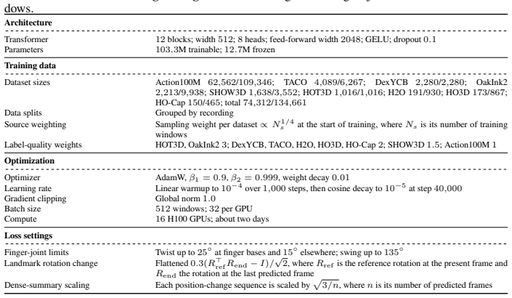
Table 5 :Training loss weights.The flow-matching weights combine the six components ofL FM, and the other weights scale the auxiliary losses. Flow matching Decoded trajectory Contact and samples
出典 · CC BY 4.0 · Rustin Soraki, Matthew Wallingford, Ryan Aby, Brandon Chee, Jason Ren, Ali Farhadi, Homanga Bharadhwaj, Roozbeh Mottaghi · Grasping the Future: Joint 3D Hand-Object Forecasting From Internet Videos · 論文の図を引用 · 元のPDFの19ページ目から図の部分を抽出しています。
Table 11 :Energy score with matched spread.The best baseline of Table 1, alone and with Gaus- sian noise matching our samples’ spread in each window, against our energy score. Rigid carry is not tested.
出典 · CC BY 4.0 · Rustin Soraki, Matthew Wallingford, Ryan Aby, Brandon Chee, Jason Ren, Ali Farhadi, Homanga Bharadhwaj, Roozbeh Mottaghi · Grasping the Future: Joint 3D Hand-Object Forecasting From Internet Videos · 論文の図を引用 · 元のPDFの28ページ目から図の部分を抽出しています。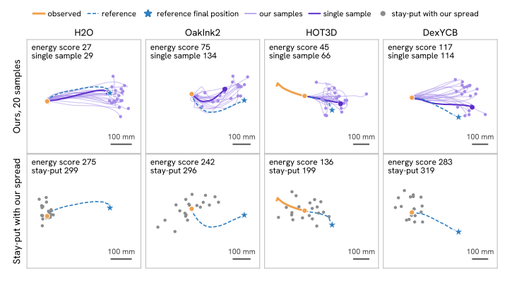
Figure 6 :What the energy score rewards.Examples for Table 11. Forecast object paths of our 20samples (top) and of stay-put with noise matching their spread (bottom), in the plane of largest motion. The windows are clear cases where our score is lower, which holds in65%of forecasting windows with at least50mm of object motion. Numbers are in millimeters.
出典 · CC BY 4.0 · Rustin Soraki, Matthew Wallingford, Ryan Aby, Brandon Chee, Jason Ren, Ali Farhadi, Homanga Bharadhwaj, Roozbeh Mottaghi · Grasping the Future: Joint 3D Hand-Object Forecasting From Internet Videos · 論文の図を引用 · 元のPDFの28ページ目から図の部分を抽出しています。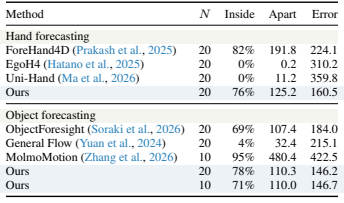
Table 12 :Reference inside the samples.Forecasting at the final position on the windows of Table 2, with both wrists averaged for hand methods. Ours is scored on the same windows and with the same number of samples as the methods in its group. Inside is the percentage of windows with the reference inside the samples, ideally95%forN=20and91%forN=10. Apart is the mean distance between two samples and Error the mean distance from a sample to the reference, both in millimeters.
出典 · CC BY 4.0 · Rustin Soraki, Matthew Wallingford, Ryan Aby, Brandon Chee, Jason Ren, Ali Farhadi, Homanga Bharadhwaj, Roozbeh Mottaghi · Grasping the Future: Joint 3D Hand-Object Forecasting From Internet Videos · 論文の図を引用 · 元のPDFの29ページ目から図の部分を抽出しています。インターネット動画からの軌道抽出
インターネット動画の軌道は、Action100Mから候補クリップを選び、事前学習済みの手推定、物体追跡とメッシュ復元、カメラ運動推定を組み合わせて得られます。その後、バンドル調整と同時最適化で手と物体の姿勢を揃え、整合性チェックを通過した軌道だけを使います。抽出した軌道は学習とインターネット動画評価の基準軌道として使われ、注釈付きデータセットとともに共通の3D表現で学習されます。
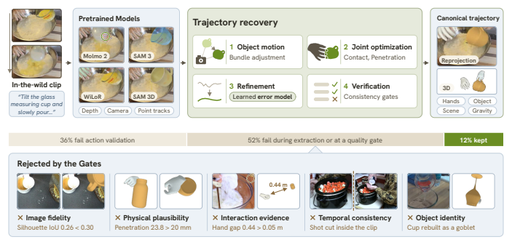
Figure 3 : Extraction pipeline. Using four refinement steps, we combine pretrained estimates of hands, objects, depth, and camera motion into a canonical trajectory (green). We only keep clips that pass all consistency checks. The bottom row displays examples rejected by each check, and the bar displays the number of clips we discard across stages.
出典 · CC BY 4.0 · Rustin Soraki, Matthew Wallingford, Ryan Aby, Brandon Chee, Jason Ren, Ali Farhadi, Homanga Bharadhwaj, Roozbeh Mottaghi · Grasping the Future: Joint 3D Hand-Object Forecasting From Internet Videos · 論文の図を引用 · 元のPDFの6ページ目から図の部分を抽出しています。タスクごとの予測結果とベースラインの比較
表1は、7つのタスクで単一サンプル、20サンプルのenergy score、そして参照を使った最良サンプルを比較しています。ただし未来予測では、単一サンプルがstay-putより2–8%高い誤差になりました。この比較は、注釈付きデータセットとインターネット動画が同じ評価設定で測定された結果であり、平均を取るために2つのデータ元を同じ重みで扱っています。
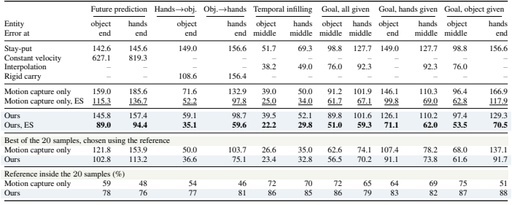
Table 1 :Prediction across seven tasks.Position errors are in millimeters, and hand errors average the left and right wrists. The row “Error at” shows whether a column scores the last frame or, when the final pose is given as input, the middle of the generated frames. “Motion capture only” is our model trained without the trajectories extracted from internet videos. For both models, we report the error of a single sample, the energy score of the20samples, and the error of the best of the20 samples (Section 4.1). Because the energy score subtracts the distance between samples, it is not the error of any one trajectory and can be lower than the best-of-20error. The best of20is chosen using the reference, so it has its own block and is left out when marking the best (bold) and second-best (underlined) results. The last block shows the percentage of windows in which the reference lies within the20samples, ideally95%.
出典 · CC BY 4.0 · Rustin Soraki, Matthew Wallingford, Ryan Aby, Brandon Chee, Jason Ren, Ali Farhadi, Homanga Bharadhwaj, Roozbeh Mottaghi · Grasping the Future: Joint 3D Hand-Object Forecasting From Internet Videos · 論文の図を引用 · 元のPDFの9ページ目から図の部分を抽出しています。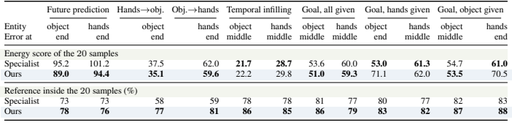
Table 13 :Comparison with task specialists.In each column, the specialist is the model trained only for that task, and one goal specialist covers all three goal patterns. Bold marks the better of the two models in each block. Notation follows Table 1.
出典 · CC BY 4.0 · Rustin Soraki, Matthew Wallingford, Ryan Aby, Brandon Chee, Jason Ren, Ali Farhadi, Homanga Bharadhwaj, Roozbeh Mottaghi · Grasping the Future: Joint 3D Hand-Object Forecasting From Internet Videos · 論文の図を引用 · 元のPDFの29ページ目から図の部分を抽出しています。公開された予測モデルとの比較
表2は、公開されている手と物体の予測手法と比較しています。そのため、平均誤差だけで運動予測の質を判断するのは難しいです。
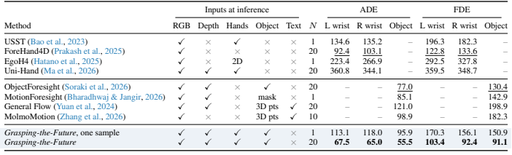
Table 2 :Comparison with different forecasting approaches.ADE and FDE in millimeters with the listed inputs. Methods withNsamples are scored with the energy score of all samples, which equals the error whenN=1. Our model uses estimated depth here. Bold and underline mark the best and second-best results.
出典 · CC BY 4.0 · Rustin Soraki, Matthew Wallingford, Ryan Aby, Brandon Chee, Jason Ren, Ali Farhadi, Homanga Bharadhwaj, Roozbeh Mottaghi · Grasping the Future: Joint 3D Hand-Object Forecasting From Internet Videos · 論文の図を引用 · 元のPDFの10ページ目から図の部分を抽出しています。ロボットによる再ターゲティングで見る物理的妥当性
予測された軌道の物理的妥当性は、シミュレーション上のロボットハンドへの再ターゲティングで確認します。SPIDERでロボット制御を動的に最適化すると、成功率は73.8%でした。この結果は、予測が特定のロボット設定とシミュレータの動力学のもとで再現されたことを意味するものであり、実機のロボット実験の代わりになるものではありません。
アブレーション実験と構成要素の役割
アブレーション実験では、物理損失のセット、関係トークン、シーンエンコーダ、姿勢とフレームレートの拡張をそれぞれ取り除きます。物理損失と関係トークンを取り除くと、接触F1と分離フレームの割合が悪化し、拡張を取り除くと手の分離率と関節制限違反が増加します。この結果は、該当の構成要素を維持したときの効果を示すものであり、取り除いた設定の改善の余地を一般的に否定するものではありません。
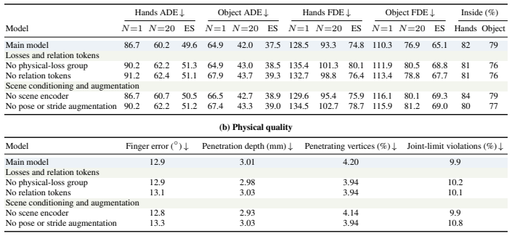
Table 10 :Interaction quality of the ablations.Means over the20samples of each window and over all seven tasks. Tip error is the fingertip error during contact, and held, slipping, and detached are percentages of reference-grasp frames. For every ablation, the95%confidence interval of its difference from the main model excludes zero for tip error, contact F1, and detached frames. Model Tip error (mm)↓
出典 · CC BY 4.0 · Rustin Soraki, Matthew Wallingford, Ryan Aby, Brandon Chee, Jason Ren, Ali Farhadi, Homanga Bharadhwaj, Roozbeh Mottaghi · Grasping the Future: Joint 3D Hand-Object Forecasting From Internet Videos · 論文の図を引用 · 元のPDFの26ページ目から図の部分を抽出しています。抽出誤差と適用範囲
インターネット動画の軌道は、単眼深度推定と検出モデルの誤りをそのまま引き継ぎます。著者らは、深度バイアスはクリップ単位の定数オフセットでほぼ相殺されると解釈していますが、一部のドリフトと短くなった運動は評価スコアに影響しうると説明しています。また、抽出パイプラインは多くの候補を捨てるため、大規模な抽出にはかなりの計算コストがかかります。この限界はインターネット動画に基づく評価と学習データの精度に関するものであり、注釈付きデータセットの結果と同程度の精度を保証するものではありません。
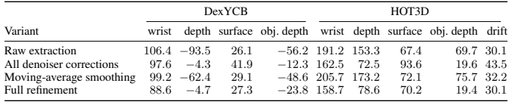
Table 6 :Refinement results.Median errors in millimeters, except object rotation drift in degrees. Hand metrics use the right hand, and surface is the hand vertex error after aligning the wrists. Depth errors are signed and best at zero.
出典 · CC BY 4.0 · Rustin Soraki, Matthew Wallingford, Ryan Aby, Brandon Chee, Jason Ren, Ali Farhadi, Homanga Bharadhwaj, Roozbeh Mottaghi · Grasping the Future: Joint 3D Hand-Object Forecasting From Internet Videos · 論文の図を引用 · 元のPDFの22ページ目から図の部分を抽出しています。論文情報
- 著者
- Rustin Soraki, Matthew Wallingford, Ryan Aby, Brandon Chee, Jason Ren, Ali Farhadi, Homanga Bharadhwaj, Roozbeh Mottaghi
- 学会・ジャーナル
- arXiv · プレプリント
- 公開日
- 2026年11月9日
- 登録日
- 2026年11月11日
- 更新日
- 2026年11月9日
- バージョン
- v1
- arXiv
- 2611.12879
- カテゴリ
- cs.CV
- ライセンス
- CC BY 4.0
- 掲載内容
- 論文情報・解説・論文の図
この解説は、Refivuの韓国語解説をAIで翻訳したものです。不正確な翻訳や誤りが含まれる可能性があります。論文と図の利用条件は各出典に従います。
アブストラクト
To interact with an object, we need to anticipate both how it will move and how our hands should move with it. Human videos capture these relationships across everyday activities, offering a natural source for learning to predict future interactions. Learning from them requires recovering motion from completed interactions and using it to anticipate what could happen next. We present $\textit{Grasping-the-Future}$, a unified generative model of joint 3D hand-object motion, including wrist motion, finger articulation, and object position and orientation. Through masked spatiotemporal completion and flow matching, we train a single model for several prediction tasks: forecasting future interactions, predicting hand motion given object motion or vice versa, generating both trajectories toward a desired final object pose, and completing partially observed interactions. We explicitly model hand-object relations and incorporate contact constraints to help preserve grasp relationships during motion. To obtain 3D supervision from internet videos, we develop a scalable pipeline that combines pretrained perception models with joint geometric optimization to reconstruct completed interactions. We combine these recovered trajectories with annotated interaction datasets as training data for all tasks. We demonstrate strong performance across all tasks, outperforming released forecasters on datasets with 3D annotations. Moreover, we show geometric and physical plausibility of the predicted trajectories by retargeting them to a robotic embodiment. Videos are available at https://grasping-the-future.github.io.
この論文を引用
Rustin Soraki, Matthew Wallingford, Ryan Aby, Brandon Chee, Jason Ren, Ali Farhadi, Homanga Bharadhwaj, Roozbeh Mottaghi (2026). Grasping the Future: Joint 3D Hand-Object Forecasting From Internet Videos. arXiv:2611.12879v1. https://arxiv.org/abs/2611.12879v1
BibTeX
@misc{soraki2026grasping,
  title = {{Grasping the Future: Joint 3D Hand-Object Forecasting From Internet Videos}},
  author = {Rustin Soraki and Matthew Wallingford and Ryan Aby and Brandon Chee and Jason Ren and Ali Farhadi and Homanga Bharadhwaj and Roozbeh Mottaghi},
  year = {2026},
  eprint = {2611.12879},
  archivePrefix = {arXiv},
  url = {https://arxiv.org/abs/2611.12879v1}
}