論文解説
Goal Encoding in LLMs
LLMにおける目標エンコーディング
- 課題 LLMがコード生成の途中で、次の下位目標を行動より前に内部表現として持っているかを確認するのは難しいです。
- 手法 Qwen-2.5-Coder-32B-Instructのアテンションヘッドから122個を目標ヘッドとして見つけ、その出力を注入して次の下位目標を自然言語で読み取るGOALSCOPEを使います。
行動の前に目標を持つか
大規模言語モデルが目標を持つかどうかは、行動を説明する方法と内部表現を区別して考える必要がある問題です。この論文では、複数の下位タスクを持つコード生成を統制された環境として使い、次の下位目標が実装の開始前に内部から読み取れるか、別の言語に移しても同じ動作を引き起こすか、実行中も保たれるかを確認しています。著者らは、この3つの基準をBratmanの計画理論から取り入れました。
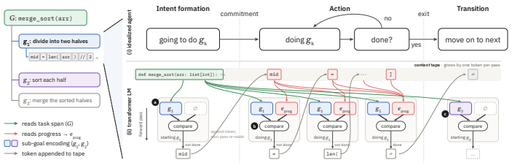
Figure 1 :Goal pursuit and its non-recurrent implementation in a transformer LM.A goal such as implementing merge sort (G) decomposes into sub-goals g1, g2, g3, each realized as a sequence of tokens (left). (i) An idealized agent commits to a sub-goal gk, keeps it active while pursuing it, and moves on once it is done. (ii) A transformer LM cannot persist a state across long sequence of tokens without running out of layers.(a)The intent to pursue gk =“divide into two halves”is nonethelesspre-committed: it is already readable at the indent token, multiple tokens before its implementation.(b)Because this commitment cannot be carried forward, the LM compensates with frequent re-computation: the LM frequently re-encodes the current sub-goal gk by reading the task span, and the progress-so-far eprog from the growing context tape, and compares the two to produce the next token (thesub-sub-goal). Different levels of goal hierarchy are maintained in the same way. (c)Once the sub-goalg k is complete, the LM moves on to the next sub-goalg k+1.
出典 · CC BY 4.0 · Arnab Sen Sharma, Eric Todd, Sheridan Feucht, Andy Arditi, Rohit Gandikota, Natalie Shapira, Gabriele Sarti, Constanza Fierro, Lisa Schut, David Bau · Goal Encoding in LLMs · 論文の図を引用 · 元のPDFの2ページ目から図の部分を抽出しています。目標ヘッドとGOALSCOPEによる読み取り
研究チームは、Qwen-2.5-Coder-32B-Instructで、ソース実行のアテンションヘッドの出力をターゲット実行に移し、スパースマスクを学習して、ソースのタスクを移し先の言語で引き起こすヘッドを探しました。主要な設定で選ばれた122個のヘッドを目標ヘッドと呼びます。GOALSCOPEは、これらのヘッドが出した出力を1つのベクトルにまとめて別の実行に注入し、次の下位目標を自然言語で説明させるプローブです。この手法はPATCHSCOPEを基にしています。
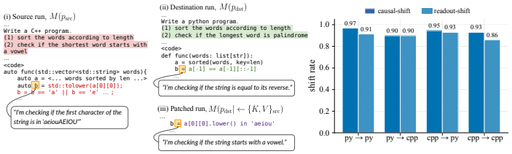
Figure 5 :Goal heads frequently re-read the goal from the task span.The source prompt (i) and the destination prompts (ii) have different tasks, but they share a common initial sub-tasks which can be prefilled in until the eq pivot. In the patched run, at the pivot (and onwards), the goal heads read from the KV-states of the
出典 · CC BY 4.0 · Arnab Sen Sharma, Eric Todd, Sheridan Feucht, Andy Arditi, Rohit Gandikota, Natalie Shapira, Gabriele Sarti, Constanza Fierro, Lisa Schut, David Bau · Goal Encoding in LLMs · 論文の図を引用 · 元のPDFの7ページ目から図の部分を抽出しています。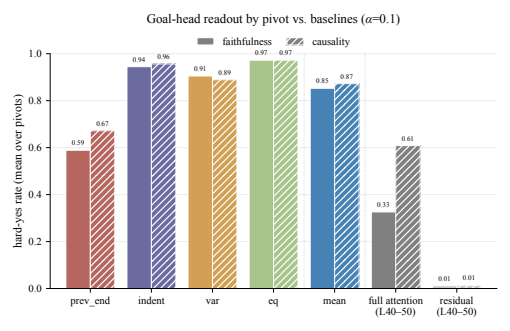
Figure 12 :Comparison of readout sources.We compare the readout quality of the encoding captured with the goal-heads vs full attention outputs and residual states. Across different encoding sources, we use the same hparams: additive_norm steering with α= 0.1 , at layers 35–45. Each bar shows the average readout score over the four pre-implementation pivots, across the same 253 specifications (out of total 1012 points). Goal heads consistently give better readout performance compared to the larger representations.
出典 · CC BY 4.0 · Arnab Sen Sharma, Eric Todd, Sheridan Feucht, Andy Arditi, Rohit Gandikota, Natalie Shapira, Gabriele Sarti, Constanza Fierro, Lisa Schut, David Bau · Goal Encoding in LLMs · 論文の図を引用 · 元のPDFの25ページ目から図の部分を抽出しています。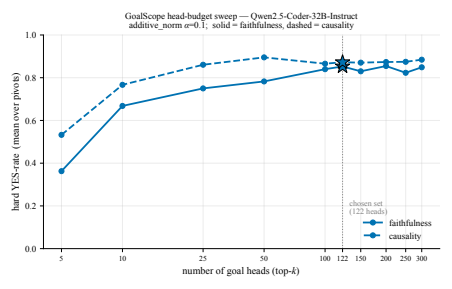
Figure 13 :GoalScope readout vs. head budget.Faithfulness (solid) and causality (dashed) readout success rate (y-axis) vs the number of goal heads (x-axis). The scores are averaged over the four pre-implementation pivots (additive_norm steering with α= 0.1 ). The core configuration with 122 heads is marked with star. Even 25 heads can give effective readout, and adding heads beyond ∼100 does not monotonically improve performance.
出典 · CC BY 4.0 · Arnab Sen Sharma, Eric Todd, Sheridan Feucht, Andy Arditi, Rohit Gandikota, Natalie Shapira, Gabriele Sarti, Constanza Fierro, Lisa Schut, David Bau · Goal Encoding in LLMs · 論文の図を引用 · 元のPDFの25ページ目から図の部分を抽出しています。目標ヘッドへのアクセスの十分性と必要性
十分性の実験では、レイヤー20以上の他のアテンションヘッドがタスク区間を見られないようにし、目標ヘッドだけがアクセスを保つようにしました。このとき122個のヘッドの設定での成功率は0.806で、clean実行の0.925に近い値を保ちました。著者らは、122個のヘッドは別の経路によって補われる可能性があると解釈しています。
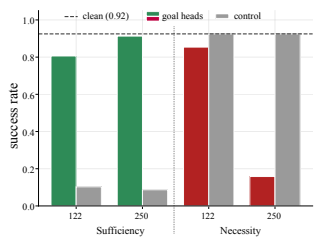
Figure 4 :Goal heads mediate implementa- tion.“Sufficiency” ablation preserves the selected heads’ access to the description of the next sub- goal and blinds all the other attention heads in layers 20–63. “Necessity” ablation blinds only the selected heads by sinking their attention to the first token, while other heads operate as usual. Bars show LM’s success rate of implementing the next sub-goal with the ablation. Only 122 goal heads can sustain LM performance, but it drops sharply when 250 goal heads are blinded.
出典 · CC BY 4.0 · Arnab Sen Sharma, Eric Todd, Sheridan Feucht, Andy Arditi, Rohit Gandikota, Natalie Shapira, Gabriele Sarti, Constanza Fierro, Lisa Schut, David Bau · Goal Encoding in LLMs · 論文の図を引用 · 元のPDFの5ページ目から図の部分を抽出しています。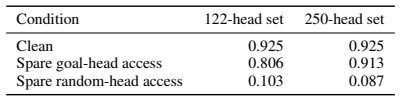
Table 4 : We perform the intervention from Figure 20 at every generation positions and check if the LM can still implement the next sub-goal with this impairment. We see that even with just 122 heads the LM’s ability to implement the target sub-goal is largely preserved (0.806 vs the 0.925 in clean run). When a broader set of 250 goal heads can see the full context, the LM performance nearly matches the clean run performance.
出典 · CC BY 4.0 · Arnab Sen Sharma, Eric Todd, Sheridan Feucht, Andy Arditi, Rohit Gandikota, Natalie Shapira, Gabriele Sarti, Constanza Fierro, Lisa Schut, David Bau · Goal Encoding in LLMs · 論文の図を引用 · 元のPDFの30ページ目から図の部分を抽出しています。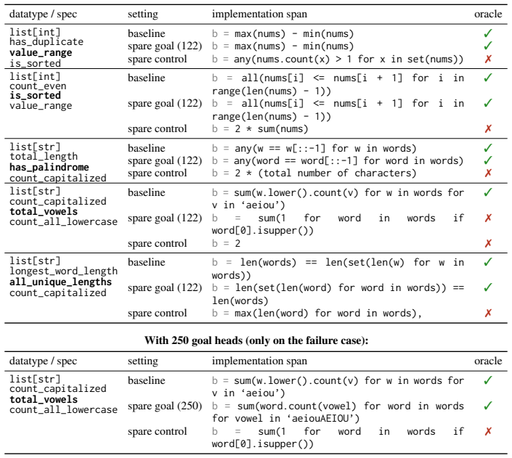
Table 5 :Qualitative examples with the sufficiency ablation.For each condition we prefilled the implementation up to the eq pivot (...b =). Then, we greedy-decode the LM’s generation under three settings.Baseline: no ablation.Spare goal: only the goal heads keep access to the task span (all other heads in layers ≥20 are blinded).Spare control: a matched number of random heads from later-half layers are spared instead. ✓/✗ mark whether an oracle judges the LM generation to be a successful implementation of the target sub-goal gk (markedboldin the spec). Results for 122 goal head set is shown on top. The single failure case (total_vowels) gets recovered when a broader set of 250 goal heads are spared.
出典 · CC BY 4.0 · Arnab Sen Sharma, Eric Todd, Sheridan Feucht, Andy Arditi, Rohit Gandikota, Natalie Shapira, Gabriele Sarti, Constanza Fierro, Lisa Schut, David Bau · Goal Encoding in LLMs · 論文の図を引用 · 元のPDFの31ページ目から図の部分を抽出しています。別の言語に移した符号化の引き起こし
事前コミットメントと可塑性の検証では、ピボット位置で読み取った符号化をC++の文脈に移して確かめました。この符号化は、indent位置の後でC++でも同じ演算を96%のケースで引き起こし、indentで比べると平均成功率は約87%でした。著者らは、この符号化は何をするかは決めるが、どのようにするかは決めないと解釈しています。
KV転送とクエリ転送の結果
250個の目標ヘッドが、ピボット以後にソース実行のタスク区間のKV状態を読むように変えると、ターゲット実行はソースの次の下位目標に対して約94%のcausal-shiftを示しました。この効果は複数のデータ型と言語の方向にまたがって見られました。一方、クエリ状態を移す実験では、NRGSが予測した対象タスクが約57%のケースで選ばれ、同じ転送をランダムな後半のヘッドに適用すると約3%にとどまりました。著者らは、クエリ転送だけではメカニズムの全体は説明できないと述べています。
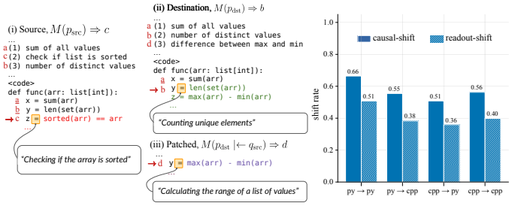
Figure 6 :The progress encoding carried in goal head query dictates the selection of next operation.In the destination run with prompt (pdst : abd→b ), where the first sub-task a is prefilled, the LM picks up the next sub-task in the sequence b. When the query states of the goal heads at the pivot token are replaced with corresponding states from a source run (psrc : acb →c ), it transfers the source progress. This transfer causes the LM to selectd, the first task in destination task-list ({a,b,d}) which hasn’t been completed in source{a,b}.
出典 · CC BY 4.0 · Arnab Sen Sharma, Eric Todd, Sheridan Feucht, Andy Arditi, Rohit Gandikota, Natalie Shapira, Gabriele Sarti, Constanza Fierro, Lisa Schut, David Bau · Goal Encoding in LLMs · 論文の図を引用 · 元のPDFの8ページ目から図の部分を抽出しています。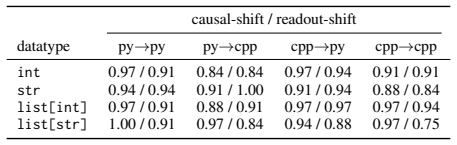
Table 7 : Full breakdown of KV transfer intervention, across datatypes and cross-language transfer. Results reported in the format “{causal-shift} / {readout-shift}”.n= 32per cell.
出典 · CC BY 4.0 · Arnab Sen Sharma, Eric Todd, Sheridan Feucht, Andy Arditi, Rohit Gandikota, Natalie Shapira, Gabriele Sarti, Constanza Fierro, Lisa Schut, David Bau · Goal Encoding in LLMs · 論文の図を引用 · 元のPDFの33ページ目から図の部分を抽出しています。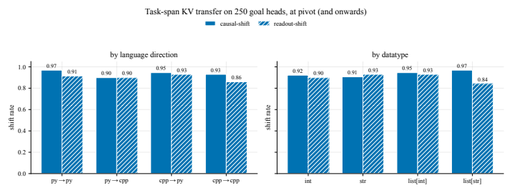
Figure 22 : Results when 250 goal heads read from the source task span key-value states, at pivot and every generated token after. Grouped bars show causal-shift (solid) and readout-shift (striped), broken down by language direction (left; mean over four datatypes) and by datatype (right; mean over four language directions). Full grid in Table 7.
出典 · CC BY 4.0 · Arnab Sen Sharma, Eric Todd, Sheridan Feucht, Andy Arditi, Rohit Gandikota, Natalie Shapira, Gabriele Sarti, Constanza Fierro, Lisa Schut, David Bau · Goal Encoding in LLMs · 論文の図を引用 · 元のPDFの34ページ目から図の部分を抽出しています。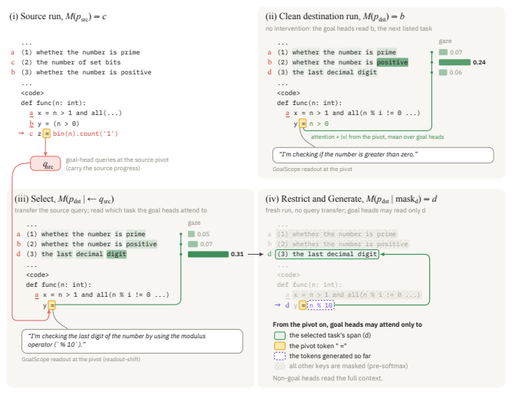
Figure 25 :Query transfer setup for multi-token generation.(i) From the source run (here with prompt psrc : acb →c ), we cache the query states of the goal heads at the pivot. (ii) In the clean run with the destination prompt pdst : abd→b , the goal heads concentrate their attention (gaze) on the next sub-goal’s description in the task span. The bar-plot on the right shows the mean value-weighted attention score over the tokens of a task-span. (iii) At the eq pivot, transferring the query states from the source run transfers the source progress (a and b are done), redirecting the goal heads to change their gaze tod’s description, and the readout at pivot also changes accordingly. (iv) For multi-token generation we restrict the goal heads’ attention to the task-span that received most gaze after the query transfer. The non-goal attention heads see the full context as usual.
出典 · CC BY 4.0 · Arnab Sen Sharma, Eric Todd, Sheridan Feucht, Andy Arditi, Rohit Gandikota, Natalie Shapira, Gabriele Sarti, Constanza Fierro, Lisa Schut, David Bau · Goal Encoding in LLMs · 論文の図を引用 · 元のPDFの37ページ目から図の部分を抽出しています。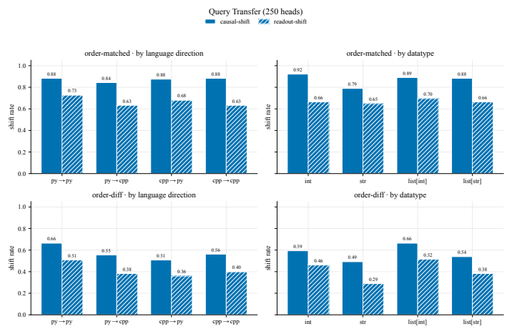
Figure 26 : Query transfer (250 heads, α= 2 ): causal- and readout-shift. Top row shows the order- matched scores, bottom row order-diff scores. Left column by language direction and right column by datatype. Grouped bars for causal-shift (solid) and readout-shift (striped).
出典 · CC BY 4.0 · Arnab Sen Sharma, Eric Todd, Sheridan Feucht, Andy Arditi, Rohit Gandikota, Natalie Shapira, Gabriele Sarti, Constanza Fierro, Lisa Schut, David Bau · Goal Encoding in LLMs · 論文の図を引用 · 元のPDFの38ページ目から図の部分を抽出しています。論文情報
- 著者
- Arnab Sen Sharma, Eric Todd, Sheridan Feucht, Andy Arditi, Rohit Gandikota, Natalie Shapira, Gabriele Sarti, Constanza Fierro, Lisa Schut, David Bau
- 学会・ジャーナル
- arXiv · プレプリント
- 公開日
- 2026年11月12日
- 登録日
- 2026年11月14日
- 更新日
- 2026年11月12日
- バージョン
- v1
- arXiv
- 2611.17297
- カテゴリ
- cs.CL · cs.AI · cs.LG
- ライセンス
- CC BY 4.0
- 掲載内容
- 論文情報・解説・論文の図
この解説は、Refivuの韓国語解説をAIで翻訳したものです。不正確な翻訳や誤りが含まれる可能性があります。論文と図の利用条件は各出典に従います。
アブストラクト
We investigate whether and how LLMs encode goals: internal neural representations that precede and guide action, and that are flexible enough to be realized through many different execution paths. We construct a coding setting with multiple sub-tasks that allows us to evaluate goal-seeking behavior and the selection of sub-goals. In this setting, we localize an encoding of the next sub-goal in the outputs of a sparse set of attention heads. The same heads can be used to decode the LM's future actions in natural language (e.g., "I'm checking if a word is a palindrome"). We verify that this encoding is causal for next action and is plastic: transplanting it into a different environment, e.g., another programming language, triggers the same operation realized with a different sequence of tokens. The LM also sustains the encoding throughout the action's execution, which is puzzling because a transformer LM without recurrence cannot carry a state forward for more tokens than it has layers left. We propose that it does not need to. Under a non-recurrent goal-seeking (NRGS) account, the LM frequently re-reads the goal from the task specification, compares it with the progress visible in the growing context, and pursues what remains. We test the predictions of this account with targeted causal interventions.
この論文を引用
Arnab Sen Sharma, Eric Todd, Sheridan Feucht, Andy Arditi, Rohit Gandikota, Natalie Shapira, Gabriele Sarti, Constanza Fierro, Lisa Schut, David Bau (2026). Goal Encoding in LLMs. arXiv:2611.17297v1. https://arxiv.org/abs/2611.17297v1
BibTeX
@misc{sharma2026goal,
  title = {{Goal Encoding in LLMs}},
  author = {Arnab Sen Sharma and Eric Todd and Sheridan Feucht and Andy Arditi and Rohit Gandikota and Natalie Shapira and Gabriele Sarti and Constanza Fierro and Lisa Schut and David Bau},
  year = {2026},
  eprint = {2611.17297},
  archivePrefix = {arXiv},
  url = {https://arxiv.org/abs/2611.17297v1}
}