論文解説
Disturbance-Aware Informative Planning in Spatiotemporal Environments
時空間環境における外乱を考慮した情報計画
- 課題 外乱を推定する費用とモニタリング性能の両立は難しいです。
- 手法 モニタリング関連の経路に沿って外乱の測定を優先して集めたあと、学習した外乱の信念をMBDの軌道最適化に入力します。
外乱が未知の状態での情報収集計画
ロボットが環境を継続的にモニタリングするとき、風のような外乱はロボットの実際の運動を変えます。公称動力学で計画した軌道は、実行中に期待どおりの情報を得られないことがあります。環境全体の外乱をすべて推定するとコストは大きくなりますが、モニタリング軌道とほとんど重ならない領域の外乱がモニタリング性能に与える影響は限定的です。この論文は、この2つの事実のあいだの緊張関係を扱います。
この論文は、時空間環境において quantity of interest の情報獲得と減少を同時に考慮しながら、空間的に変化するが時間によって変化しない未知の外乱を学習し、その信念を軌道最適化に入力する問題を扱います。ここでclarityは、スカラーのガウス信念の微分エントロピーを正規化した値であり、目標clarityに対するセルごとの不足分の平均であるmean-deficit関数 q_dがモニタリング損失を表します。
2段階アプローチの構造
提案手法は2段階で構成されます。第1段階では、幾何学的な経路に沿ってclarityの不足分が予測される位置を見つけ、その経路の近くにあるセルに重みを付けて外乱の不確実性を計算します。第2段階では、学習した外乱の信念をサンプリングし、Model-Based Diffusionで軌道を最適化します。MBDは、スコアに基づく逆拡散によって候補解を繰り返し改善する、ゼロ次のサンプリング手法です。
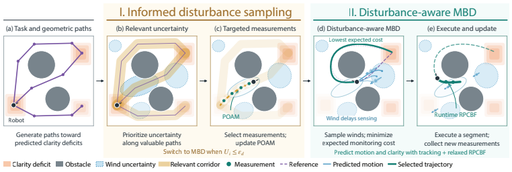
Figure 1 :Overview of monitoring-informed disturbance estimation and disturbance-aware informative planning.
出典 · CC BY 4.0 · Kaleb Ben Naveed, Haejoon Lee, Anouck Girard, Dimitra Panagou · Disturbance-Aware Informative Planning in Spatiotemporal Environments · 論文の図を引用 · 元のPDFの6ページ目から図の部分を抽出しています。第1段階の測定選択は、重み付き外乱の不確実性U_iを減らす方向で行われます。候補位置zに対する期待分散減少G_i(z)を移動距離ペナルティで割った値が最大になる位置を選び、U_iが閾値ε_d以下になった時点で専用の学習を終えます。第2段階のコストは、外乱サンプルのもとで予測された運動と、RPCBFフィルタの介入を含む累積clarity不足分です。
4つのシナリオでの比較結果
4つのシナリオで、提案手法をB1からB4までのベースラインと比較しました。各シナリオは単一実行の結果として報告されています。
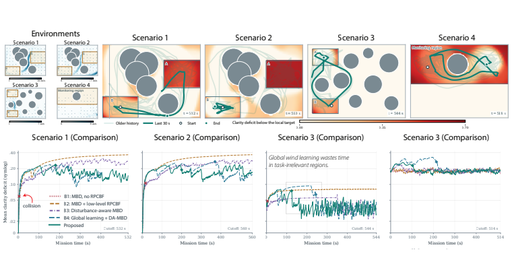
Figure 2 :Monitoring across four scenarios. Top: environments and proposed trajectories; bottom: mean clarity-deficit histories for all methods. Comparison durations are532,560,544, and514 sfor Scenarios 1–4, respectively.
出典 · CC BY 4.0 · Kaleb Ben Naveed, Haejoon Lee, Anouck Girard, Dimitra Panagou · Disturbance-Aware Informative Planning in Spatiotemporal Environments · 論文の図を引用 · 元のPDFの10ページ目から図の部分を抽出しています。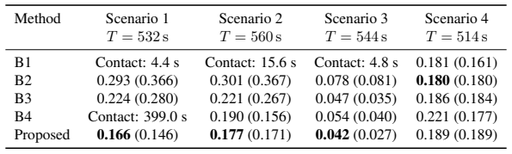
Table 1 :Monitoring performance:D T , with final deficitD(T)in parentheses. Bold indicates the lowestD T among completed runs; contact times are reported for terminated runs.
出典 · CC BY 4.0 · Kaleb Ben Naveed, Haejoon Lee, Anouck Girard, Dimitra Panagou · Disturbance-Aware Informative Planning in Spatiotemporal Environments · 論文の図を引用 · 元のPDFの17ページ目から図の部分を抽出しています。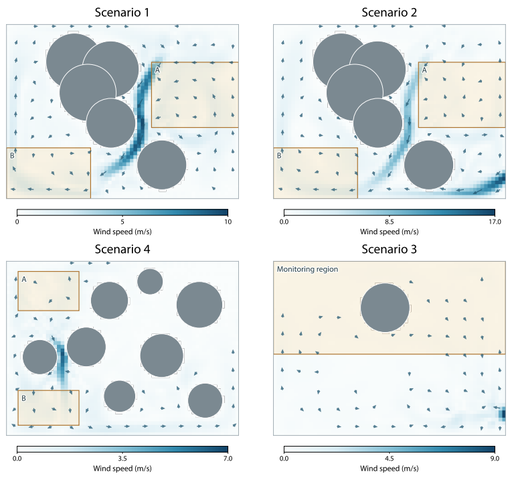
Figure 3 :The four evaluation environments. Scenarios 1 and 2 test alternative passages under opposing wind; Scenario 3 has two monitoring regions within a larger workspace; Scenario 4 has a largely calm monitoring region. The lower-left and lower-right panels correspond to Scenarios 3 and 4 in the main text; their embedded labels are reversed.
出典 · CC BY 4.0 · Kaleb Ben Naveed, Haejoon Lee, Anouck Girard, Dimitra Panagou · Disturbance-Aware Informative Planning in Spatiotemporal Environments · 論文の図を引用 · 元のPDFの19ページ目から図の部分を抽出しています。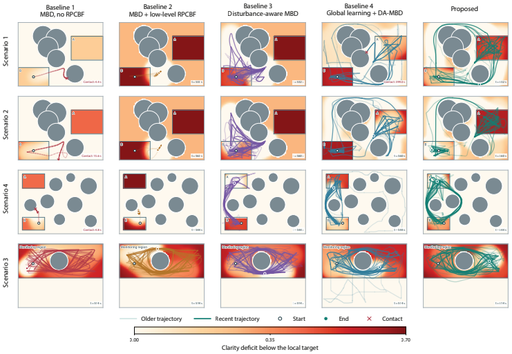
Figure 4 :Trajectories of the proposed method and baselines, with rows corresponding to Scenarios 1–4 in the main text. The embedded labels in the final two rows are reversed. Runs ending in contact are terminated, not completed comparisons; Table 1 reports the numerical results.
出典 · CC BY 4.0 · Kaleb Ben Naveed, Haejoon Lee, Anouck Girard, Dimitra Panagou · Disturbance-Aware Informative Planning in Spatiotemporal Environments · 論文の図を引用 · 元のPDFの20ページ目から図の部分を抽出しています。著者らは、この場合は専用の外乱学習が不要になる可能性があると解釈しています。結果は単一実行によるものなので、保証された衝突回避や統計的な頑健性を確定するものではありません。
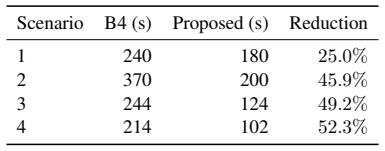
Table 2 :Dedicated wind-estimation time.
出典 · CC BY 4.0 · Kaleb Ben Naveed, Haejoon Lee, Anouck Girard, Dimitra Panagou · Disturbance-Aware Informative Planning in Spatiotemporal Environments · 論文の図を引用 · 元のPDFの17ページ目から図の部分を抽出しています。論文情報
- 著者
- Kaleb Ben Naveed, Haejoon Lee, Anouck Girard, Dimitra Panagou
- 学会・ジャーナル
- arXiv · プレプリント
- 公開日
- 2026年11月13日
- 登録日
- 2026年11月16日
- 更新日
- 2026年11月13日
- バージョン
- v1
- arXiv
- 2611.18505
- カテゴリ
- cs.RO
- ライセンス
- CC BY 4.0
- 掲載内容
- 論文情報・解説・論文の図
この解説は、Refivuの韓国語解説をAIで翻訳したものです。不正確な翻訳や誤りが含まれる可能性があります。論文と図の利用条件は各出典に従います。
アブストラクト
Autonomous robots are widely used for persistent monitoring of spatiotemporal environments, where quantities of interest (QoI) change across space and time and require repeated measurements. In practice, robot motion can be affected by external disturbances that vary across the environment. When such external disturbances are not considered in trajectory optimization, it can lead to inaccurate predictions of robot motion and, consequently, the information acquired about the QoI during execution. However, estimating disturbances throughout the environment can be inefficient, as disturbances in regions with little overlap with monitoring trajectories have limited impact on monitoring performance. We therefore propose a two-stage informative planning framework for unknown, spatially varying but time-invariant disturbances, combining informed disturbance sampling with disturbance-aware trajectory optimization. First, we identify where QoI measurements are needed and generate alternative paths to these locations using the environment geometry. We then prioritize disturbance measurements based on their expected reduction of disturbance uncertainty along these paths. Second, rather than optimizing information acquisition based on nominal robot motion, we incorporate the learned disturbance belief into trajectory optimization to account for its effects on robot motion and information acquisition. Across four simulation scenarios, the proposed method reduces disturbance-learning time by 25.0--52.3 percent compared with environment-wide estimation and identifies paths that appear costly under nominal dynamics but become preferable when disturbances are considered.
この論文を引用
Kaleb Ben Naveed, Haejoon Lee, Anouck Girard, Dimitra Panagou (2026). Disturbance-Aware Informative Planning in Spatiotemporal Environments. arXiv:2611.18505v1. https://arxiv.org/abs/2611.18505v1
BibTeX
@misc{naveed2026disturbance,
  title = {{Disturbance-Aware Informative Planning in Spatiotemporal Environments}},
  author = {Kaleb Ben Naveed and Haejoon Lee and Anouck Girard and Dimitra Panagou},
  year = {2026},
  eprint = {2611.18505},
  archivePrefix = {arXiv},
  url = {https://arxiv.org/abs/2611.18505v1}
}