論文解説
CoilStellaration: A Dataset and Benchmark for Engineering-Aware Stellarator Coilset Generation
CoilStellaration:工学を考慮したステラレーターのコイルセット生成のためのデータセットとベンチマーク
- 課題 ステラレーターのコイルセットを目標のプラズマ境界と工学的な要求条件から設計する問題は逆問題であり、最適化に大きく依存します。CoilStellarationは、これを学習モデルで扱うためのデータセットとベンチマークです。
- 手法 目標境界と要求条件を入力として、コイルセットを一度の順伝播で予測します。予測結果はDESCパイプラインで再評価し、soft-feasibilityスコアで採点します。
- 結果 基準モデルは厳密な実現可能性が低く、磁場の精度が主な失敗要因です。学習されたコイルセットは、予算の限られた最適化において初期の進みを速める結果を示しています。
研究課題と既存の限界
ステラレーターのコイルセットは、目標プラズマ平衡の磁場を再現しつつ、工学的な制約を満たす必要があります。しかし、目標磁場からコイルの形状を逆に求める問題は非線形の逆問題であり、解が閉じた形では与えられません。そのため従来は最適化を繰り返す方法が主に使われてきましたが、設計空間を素早く探索するのは難しい状況でした。CoilStellarationは、ConStellarationのプラズマ境界を固定の目標として採用し、177,000個の最適化されたフィラメントコイルセットを工学的要求条件とともに提供します。また、一度の順伝播でコイルセットを予測するベンチマークを提案しています。この研究の範囲は目標境界上でのフィラメントコイルの生成であり、自由境界平衡の検証は含みません。
データセット構築パイプライン
各目標境界について、工学的要求条件を事前に定めた範囲からサンプリングします。最小のコイル-プラズマ距離、最小のコイル-コイル距離、最大曲率がその範囲に含まれます。初期のコイルセットはREGCOILで表面電流ポテンシャルを正則化して作り、その後DESCの制約付き最適化で洗練します。この最適化では、コイル-コイル、コイル-プラズマ、曲率の制約を明示的な制約として課し、目的関数はコイル長と正規化された法線磁場残差の重み付き結合です。洗練後のコイルセットは主半径1 mに正規化され、電流は平均軸上磁場が1 Tになるように再調整されます。最終的なデータセットには、266,549個のサンプルのうち177,341個のDESCコイルセットが含まれます。
品質フィルタは、コイル-プラズマ誤差、コイル-コイル誤差、曲率誤差に対して適用され、磁場誤差には適用されません。
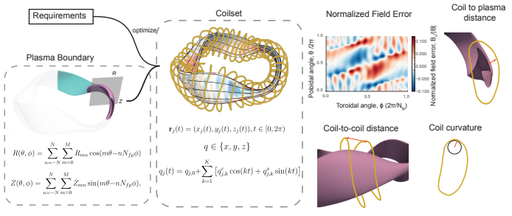
Figure 1 : Left: The target plasma boundary, parameterized as a truncated Fourier surface in θ and ϕ. Center: The generated coilset. Each filamentary coil is modeled as a closed 3D curve using a Fourier series int, a parameter that runs along the curve. Solid black lines on the stellarator surface trace the equilibrium magnetic field lines, which are tangent to the boundary. Right: Key evaluation metrics. The heatmap displays the normalized magnetic field error across one plasma field period. The diagrams below illustrate the three physical engineering constraints used in this work: minimum coil-to-plasma distance, coil-to-coil spacing, and maximum coil curvature.
出典 · CC BY 4.0 · Jan-Hendrik Ewers, Santiago A. Cadena, Nicolò Foppiani, Andrea Merlo · CoilStellaration: A Dataset and Benchmark for Engineering-Aware Stellarator Coilset Generation · 論文の図を引用 · 元のPDFの3ページ目から図の部分を抽出しています。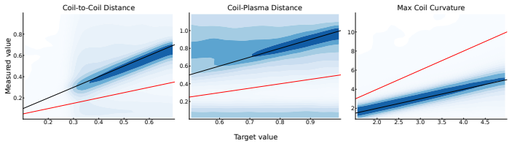
Figure 3 : Measured vs. target values for the three geometric constraints. Colour scale is logarithmic. Black line: requirement equals measured. Red line: selection cut threshold.
出典 · CC BY 4.0 · Jan-Hendrik Ewers, Santiago A. Cadena, Nicolò Foppiani, Andrea Merlo · CoilStellaration: A Dataset and Benchmark for Engineering-Aware Stellarator Coilset Generation · 論文の図を引用 · 元のPDFの6ページ目から図の部分を抽出しています。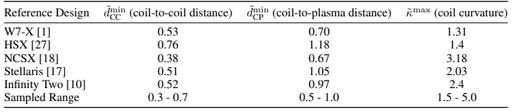
Table 6 : Reference stellarators from which the requirements sampling range was informed.
出典 · CC BY 4.0 · Jan-Hendrik Ewers, Santiago A. Cadena, Nicolò Foppiani, Andrea Merlo · CoilStellaration: A Dataset and Benchmark for Engineering-Aware Stellarator Coilset Generation · 論文の図を引用 · 元のPDFの16ページ目から図の部分を抽出しています。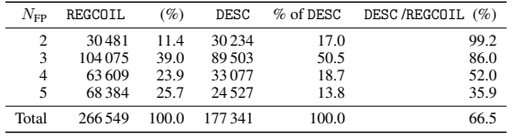
Table 7 : Dataset composition by number of field periods (NFP). DESC % ofDESC is the fraction of each NFP group within all DESC coilsets. DESC /REGCOIL is the completion rate of the DESC opti- mization perN FP.
出典 · CC BY 4.0 · Jan-Hendrik Ewers, Santiago A. Cadena, Nicolò Foppiani, Andrea Merlo · CoilStellaration: A Dataset and Benchmark for Engineering-Aware Stellarator Coilset Generation · 論文の図を引用 · 元のPDFの16ページ目から図の部分を抽出しています。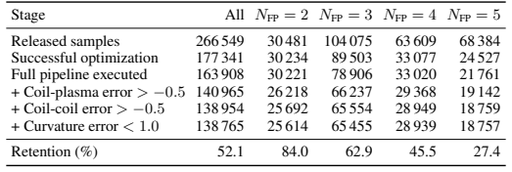
Table 8 : Cumulative selection cut flow, overall and by field periods. Retention is relative to the released samples in each column at the time of submission.
出典 · CC BY 4.0 · Jan-Hendrik Ewers, Santiago A. Cadena, Nicolò Foppiani, Andrea Merlo · CoilStellaration: A Dataset and Benchmark for Engineering-Aware Stellarator Coilset Generation · 論文の図を引用 · 元のPDFの17ページ目から図の部分を抽出しています。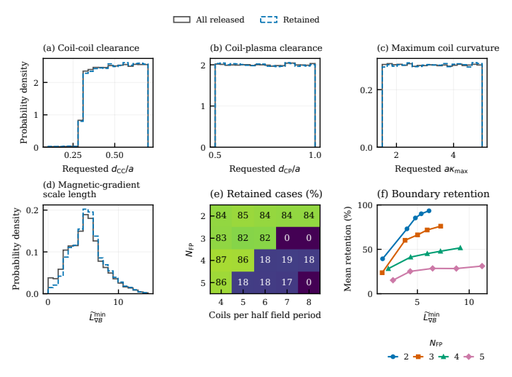
Figure 9 : Selection effects. (a–c) Probability densities of requested coil–coil clearance, coil–plasma clearance, and maximum coil curvature for released and retained samples. Maximum absolute differences between the corresponding empirical cumulative distribution functions (CDFs) are 0.61, 0.38, and 0.40 percentage points, respectively. (d) Probability density of the minimum normalized magnetic-gradient scale length over unique boundaries; a retained boundary has at least one retained coilset. Panels (a–d) use 20 shared equal-width bins per panel and unit-area normalization for each population. (e) Retained fraction of released samples for each NFP and coil count. (f) Mean per-boundary retention in five scale-length quantile bins per NFP, with equal weight per boundary and points at the mean scale length of each bin.
出典 · CC BY 4.0 · Jan-Hendrik Ewers, Santiago A. Cadena, Nicolò Foppiani, Andrea Merlo · CoilStellaration: A Dataset and Benchmark for Engineering-Aware Stellarator Coilset Generation · 論文の図を引用 · 元のPDFの18ページ目から図の部分を抽出しています。ベンチマークの課題とスコア体系
ベンチマークでは、目標プラズマ境界 b と要求条件ベクトル r=(最小コイル-コイル距離, 最小コイル-プラズマ距離, 最大曲率, 最大フィールド誤差) を入力として、モデル f(b,r) がコイルセットを一度の順伝播で出力することを求めます。予測されたコイルセットはDESCフィラメントパイプラインで再評価され、前の2つの要求条件は下限、後ろの2つの要求条件は上限として適用されます。各指標の正規化された違反量 v_i は0以上で、許容値 α_i を基準に s_i=exp(-v_i/α_i) へ変換されます。4つの指標のスコアは幾何平均 S=(∏ s_i)^(1/4) で統合されるため、ある指標のスコアが0に近いと、全体のスコアも一緒に下がります。
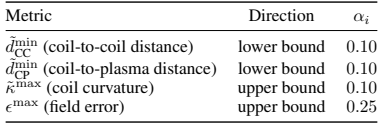
Table 9 : Per-metric tolerances αi in the soft-feasibility score (Eq. 4). A relative violation of αi reduces si to 1/e ≈ 0.37; a 2αi violation reduces it to ≈ 0.14.
出典 · CC BY 4.0 · Jan-Hendrik Ewers, Santiago A. Cadena, Nicolò Foppiani, Andrea Merlo · CoilStellaration: A Dataset and Benchmark for Engineering-Aware Stellarator Coilset Generation · 論文の図を引用 · 元のPDFの20ページ目から図の部分を抽出しています。基準モデルと固定形状の結果
基準モデルは、MLPとResMLP、およびそれぞれの5メンバーのアンサンブルです。ResMLPは、事前正規化の残差ブロックと、分離された幾何出力ヘッドおよび電流ヘッドを使用します。この最高値は、ほとんどが最も緩い要求条件の区間から出ており、tight区間では、どの基準モデルも厳密に実現可能なコイルセットを作れませんでした。失敗の主な原因は正規化された磁場誤差の項で、2つのアンサンブルはコイル-プラズマ距離と曲率で中央値のスコアが1に近いものの、すべてのモデルがコイル-コイル間隔で正の違反を示しました。
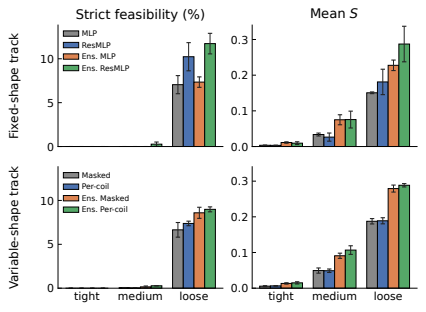
Figure 5 : Strict feasibility (%) and mean score S by require- ment tier (tight / medium / loose), for the fixed-shape track (top) and the variable-shape track (bottom). Each track shows its own four architectures. Bars are the mean over three train- ing seeds with ±1σ error bars. Across both tracks and all architectures, strict feasibility is 0% on the tight tier and near- zero on the medium tier: nearly all strictly feasible coilsets fall in the loose tier. Strict feasibility uses the benchmark tolerancev i ≤1×10 −3.
出典 · CC BY 4.0 · Jan-Hendrik Ewers, Santiago A. Cadena, Nicolò Foppiani, Andrea Merlo · CoilStellaration: A Dataset and Benchmark for Engineering-Aware Stellarator Coilset Generation · 論文の図を引用 · 元のPDFの8ページ目から図の部分を抽出しています。可変形状トラック
可変形状トラックでは、NFP∈{2,3,4,5}、NC∈{4,...,8}の全分布を1つのモデルで扱えるかを確認します。MaskedMLPは最大8個のコイルスロットを一度に出力し、要求されたNCを超えるスロットをマスクします。PerCoilMLPは、重みを共有するMLPを各コイルスロットに適用し、スロットのインデックスと相対位置を条件として入力します。8,058個のインスタンスでは、EnsemblePerCoilMLPの平均スコアは0.137、厳密な実現可能性は3.1%でした。同じモデルを固定形状の部分集合で評価すると、NFP=3、NC=5で平均スコア0.18となり、専用の固定形状基準モデルと同等か、それ以上だったと著者らは報告しています。
ただし、これはこの部分集合での観察です。
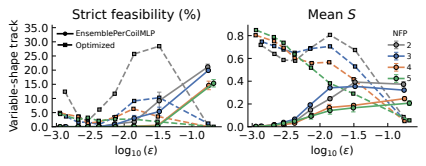
Figure 6 : Strict feasibility (left) and mean score S (right), grouped by reference mean normalized field error and field periods. Solid: EnsemblePerCoilMLP, mean ± one standard deviation across three training seeds. Dashed: DESC coilsets. DESC uses the three original geometric bounds; the model uses all four reference-achieved requirements.
出典 · CC BY 4.0 · Jan-Hendrik Ewers, Santiago A. Cadena, Nicolò Foppiani, Andrea Merlo · CoilStellaration: A Dataset and Benchmark for Engineering-Aware Stellarator Coilset Generation · 論文の図を引用 · 元のPDFの9ページ目から図の部分を抽出しています。
Table 11 : Spearman correlations between reference-coilset metrics and prediction performance for EnsemblePerCoilMLP on the variable-shape evaluation set. Values are the mean correlation ± one standard deviation across three independently trained seeds.
出典 · CC BY 4.0 · Jan-Hendrik Ewers, Santiago A. Cadena, Nicolò Foppiani, Andrea Merlo · CoilStellaration: A Dataset and Benchmark for Engineering-Aware Stellarator Coilset Generation · 論文の図を引用 · 元のPDFの20ページ目から図の部分を抽出しています。学習済みコイルセットによる最適化のウォームスタート
学習されたEnsemblePerCoilMLPの一度の順伝播による予測を、DESC最適化の出発点として使い、同じ最適化をREGCOILの出発点で実行して比較しました。対象は可変形状評価分割のtight階層にある1,289個のインスタンスです。300反復までは、学習された出発点の方がより高い平均スコアを示し、大部分のインスタンスで勝りました。100反復における学習済み出発点の平均スコアは、REGCOIL出発点の200反復のスコアを上回りました。200反復では厳密な実現可能性が22%で、REGCOILの500反復の18%より高くなりました。500反復ではREGCOIL出発点の平均スコアの方が高く(0.83対0.76)、1000反復では厳密な実現可能性の差は有意ではありませんでした(26%対25%)。
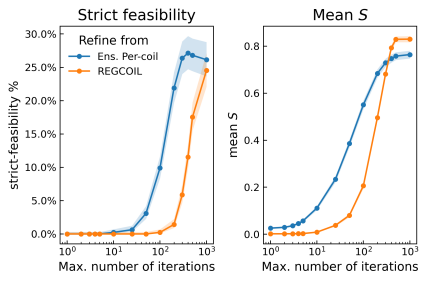
Figure 7 : Strict-feasibility rate (left) and mean scoreS (right) against the iteration budget, for the REGCOIL and learned (per-coil ensemble) starts. Each instance uses its dataset metrics as targets; the instances comprise up to 100 per (NFP, NC) pair. Markers show the tested budgets. Shaded bands are instance-level 95% confidence intervals (Wilson for feasibility, Student- t for S); they do not account for shared boundaries.
出典 · CC BY 4.0 · Jan-Hendrik Ewers, Santiago A. Cadena, Nicolò Foppiani, Andrea Merlo · CoilStellaration: A Dataset and Benchmark for Engineering-Aware Stellarator Coilset Generation · 論文の図を引用 · 元のPDFの10ページ目から図の部分を抽出しています。適用範囲と残る限界
現在のデータセットは、フィラメントコイルと限られた工学的制約を用いており、評価は目標境界上で行われます。したがって、結果が自由境界平衡や実際の設計の完成度を直接保証するものではありません。生成されたコイルセットは最適化と検証の出発点であり、最終的な設計として使うべきではありません。また、学習された出発点は限られた予算では有利ですが、コイル-コイル間隔は反復が増えるにつれてREGCOIL出発点に遅れを取る要求条件として残っています。磁場の精度は依然として最大の障害として報告されており、この結果はこの論文が評価したモデルと設定の範囲に限られます。
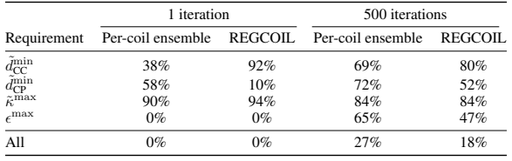
Table 4 : Fraction of runs meeting each requirement, and all of them (strict feasibility), after 1 and 500 iterations, over the instances with results from both starts. At 500 iterations, every difference except curvature is significant (exact McNemar test,p <10 −8; curvaturep= 0.88).
出典 · CC BY 4.0 · Jan-Hendrik Ewers, Santiago A. Cadena, Nicolò Foppiani, Andrea Merlo · CoilStellaration: A Dataset and Benchmark for Engineering-Aware Stellarator Coilset Generation · 論文の図を引用 · 元のPDFの14ページ目から図の部分を抽出しています。論文情報
- 著者
- Jan-Hendrik Ewers, Santiago A. Cadena, Nicolò Foppiani, Andrea Merlo
- 学会・ジャーナル
- arXiv · プレプリント
- 公開日
- 2026年11月9日
- 登録日
- 2026年11月11日
- 更新日
- 2026年11月9日
- バージョン
- v1
- arXiv
- 2611.12689
- カテゴリ
- cs.LG · physics.plasm-ph
- ライセンス
- CC BY 4.0
- 掲載内容
- 論文情報・解説・論文の図
この解説は、Refivuの韓国語解説をAIで翻訳したものです。不正確な翻訳や誤りが含まれる可能性があります。論文と図の利用条件は各出典に従います。
アブストラクト
Stellarators are fusion devices that use externally generated, three-dimensional magnetic fields to confine hot plasma and offer a promising route to commercial fusion. Their electromagnetic coils pose a challenging design problem: they must reproduce the target magnetic field while satisfying engineering constraints and remaining practical and cost-effective to manufacture. Finding suitable geometries is a highly nonlinear inverse problem that generally has neither a closed-form nor a unique solution. This problem lies at the heart of stellarator design. We introduce CoilStellaration, a dataset and benchmark for learning the mapping between coil geometries from target plasma magnetic fields and engineering requirements. The dataset contains 177,000 optimized filamentary coilsets targeting plasma equilibria from ConStellaration, with sampled engineering requirements and achieved geometric and magnetic-field metrics. It spans multiple coil counts and field-period numbers, supporting studies of both specialized and shared models across configurations. The benchmark asks models to predict coils conditioned on a target equilibrium and requirements on coil-coil and coil-plasma spacing, curvature, and magnetic-field error. We show that magnetic-field accuracy remains the main challenge, with learned models rarely satisfying all requirements simultaneously. However, using learned predictions to initialize conventional coil optimization can accelerate early progress. We release baseline models and evaluation code to support reproducible research on both direct coil generation and learned optimization initializations. By lowering the barrier for machine learning and optimization researchers to engage with stellarator coil design, we aim to accelerate progress toward practical, cost-effective stellarator power plants.
この論文を引用
Jan-Hendrik Ewers, Santiago A. Cadena, Nicolò Foppiani, Andrea Merlo (2026). CoilStellaration: A Dataset and Benchmark for Engineering-Aware Stellarator Coilset Generation. arXiv:2611.12689v1. https://arxiv.org/abs/2611.12689v1
BibTeX
@misc{ewers2026coilstellaration,
  title = {{CoilStellaration: A Dataset and Benchmark for Engineering-Aware Stellarator Coilset Generation}},
  author = {Jan-Hendrik Ewers and Santiago A. Cadena and Nicolò Foppiani and Andrea Merlo},
  year = {2026},
  eprint = {2611.12689},
  archivePrefix = {arXiv},
  url = {https://arxiv.org/abs/2611.12689v1}
}