論文解説
U-shape Transformer for Underwater Image Enhancement
水中画像強調のためのU-shape Transformer
- 課題 水中画像は光の吸収と散乱により色の歪みや霞みが生じます。既存のデータ駆動型UIEは、大規模な実画像の基準データが必要な点と、色チャンネルや空間領域ごとの不均一な減衰を反映しにくい点に限界があります。
- 手法 U-shape Transformerは、チャンネル方向のCMSFFTと空間方向のSGFMTを生成器に組み込みます。学習にはRGB、LAB、LCHの各色空間の損失を組み合わせます。
- 結果 LSUIで学習し、Test-L400とTest-U90で評価したところ、提案手法はPSNRとSSIMで比較手法を上回る値を報告しています。
水中画像強調の課題と既存手法の限界
水中画像は、水中の不純物による光の吸収と散乱のため、色かぶり、色のアーティファクト、ぼやけた細部が現れます。従来の視覚事前知識に基づく手法は、コントラスト、明るさ、彩度の観点でピクセル値を修正しますが、物理的な劣化過程は考慮しません。物理モデルに基づく手法は、媒質の透過率と複数のパラメータを同時に推定する必要があるため複雑で、多様な実環境では制約を受けます。データ駆動型の手法は性能が高い一方、既存のデータセットは画像数が少なかったり、シーンが限られていたり、実環境のものではなかったりする場合がありました。また、色チャンネルや空間領域ごとに減衰が異なるという事実は、単一のフレームワークの中で十分に扱われてきませんでした。
本論文は、大規模な実データの不足と、不均一な減衰の反映という2つの問題を合わせて扱います。
U-shape Transformerの構造と2つのモジュール
提案手法のU-shape Transformerは、生成器と識別器で構成されます。生成器のエンコーダでは、入力画像を3回ダウンサンプリングし、各スケールを畳み込みブロックに通して4つの特徴を作ります。CMSFFTは生成器のスキップ接続を置き換え、エンコーダの出力をチャンネル方向のマルチヘッドアテンションで融合してデコーダに渡します。SGFMTは生成器のボトルネック層を置き換え、特徴マップを系列に展開したあと、4つの標準Transformer層で空間の自己アテンションにより大域的な特徴をモデル化します。識別器はマルチスケール接続によって生成器と勾配の流れを共有し、学習を安定させます。
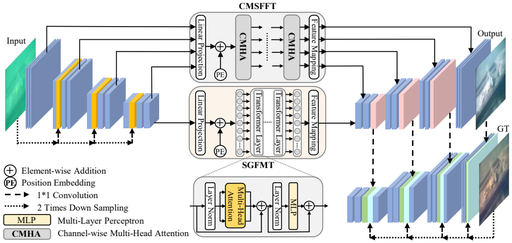
Fig. 4 . The network structure of U-shape Transformer. CMSFFT and SGFMT modules specially designed for UIE tasks reinforce the network’s attention to the more severely attenuated color channels and spatial regions. The multi-scale connections of the generator and the discriminator make the gradient flow freely between the generator and the discriminator, therefore making the training process more stable.
出典 · CC BY 4.0 · Lintao Peng, Chunli Zhu, Liheng Bian · U-shape Transformer for Underwater Image Enhancement · 論文の図を引用 · 元のPDFの5ページ目から図の部分を抽出しています。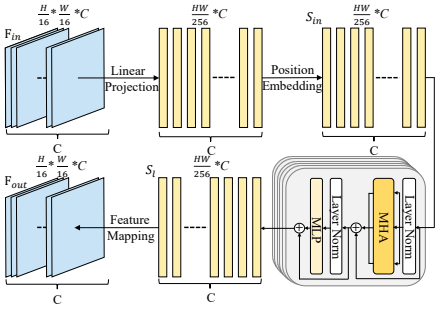
Fig. 5 . Data flow diagram of the SGFMT module. Based on the prior that underwater images are not uniformly degraded in different spatial regions, we designed a novel spatial-wise global feature modeling transformer (SGFMT) based on the spatial self-attention mechanism to replace the original bottleneck layer of the generator. It can accurately model the global feature of underwater images and reinforce the network’s attention to the space areas with more serious attenuation, thus achieving uniform UIE.
出典 · CC BY 4.0 · Lintao Peng, Chunli Zhu, Liheng Bian · U-shape Transformer for Underwater Image Enhancement · 論文の図を引用 · 元のPDFの5ページ目から図の部分を抽出しています。多色空間損失関数
学習の損失は、GAN損失に、LAB空間の損失、LCH空間の損失、RGBのL2損失、知覚損失を加えたものです。LABとLCHの損失では、生成画像と基準画像をそれぞれの色空間に変換してから比較します。論文の式では、LABの損失に明度と色座標の差の二乗とともに、量子化演算子Qに関する対数項が含まれます。LCHの損失にも同じ形式の対数項と、彩度と色相の差の二乗が含まれます。論文では、損失の重みα、β、γ、µをそれぞれ0.001、1、0.1、100に設定したと報告されています。これらの値は本論文の実験設定であり、他の実装にそのまま一般化できるとは限りません。
LSUIデータセットの構築と分割
LSUIは、収集した8018枚の画像を出発点とし、基準画像を2回の主観評価で選んだ実水中画像データセットです。第1段階では、18個の既存UIE手法で処理した結果をUIQMとUCIQEでスコア化し、上位3つを選びました。その後、20人の参加者が5つの基準で評価しました。最終的に、4279組の画像ペアと意味分割マップ、媒質透過率マップが提供されます。学習にはLSUIから分割したTrain-Lの3879枚を使い、評価にはTest-L400の400枚を使います。
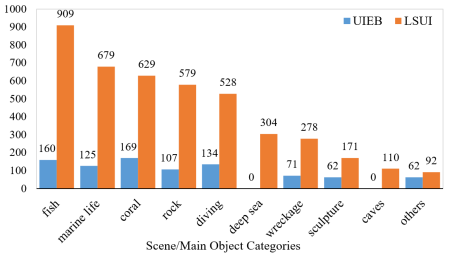
Fig. 2 . Statistics of our LSUI dataset and the existing underwater dataset UIEB [28].
出典 · CC BY 4.0 · Lintao Peng, Chunli Zhu, Liheng Bian · U-shape Transformer for Underwater Image Enhancement · 論文の図を引用 · 元のPDFの3ページ目から図の部分を抽出しています。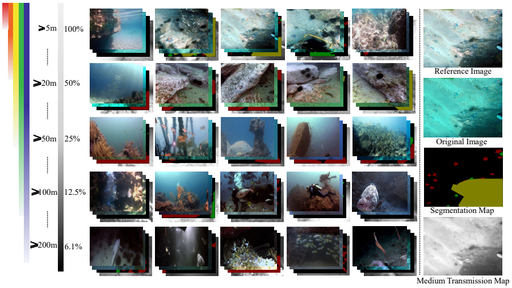
Fig. 3 . Example images in the LSUI dataset. Our LSUI dataset contains 4279 real-world underwater images with more abundant underwater scenes (water types, lighting conditions and target categories) than existing underwater datasets [32], [28], [26], [22], and the corresponding clear images are generated as comparison references. We also provide the semantic segmentation map and medium transmission map for each raw underwater image. The top of each image group is the clear reference image, followed by the raw underwater image, semantic segmentation map, and medium transmission map.
出典 · CC BY 4.0 · Lintao Peng, Chunli Zhu, Liheng Bian · U-shape Transformer for Underwater Image Enhancement · 論文の図を引用 · 元のPDFの4ページ目から図の部分を抽出しています。完全参照評価と比較結果
Test-L400とTest-U90では、提案手法をPSNRとSSIMで評価します。表IIIでは、提案手法はTest-L400でPSNR 24.16、SSIM 0.93、Test-U90でPSNR 22.91、SSIM 0.91を記録しています。同じ表で、Ucolorは Test-L400でPSNR 22.91、SSIM 0.89を記録していますが、Test-U90ではPSNR 20.78、SSIM 0.87です。この比較は他の手法と同じTest分割で得られた値であり、論文では2dB以上の優位性が報告されています。評価方法は、参照画像との近さを測るPSNRとSSIMを基準にしているため、視覚品質全体を直接測定したものではありません。
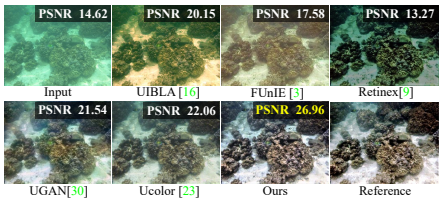
Fig. 1 . Compared with the existing UIE methods, the image produced by our U-shape Transformer has the highest PSNR[5] score and best visual quality.
出典 · CC BY 4.0 · Lintao Peng, Chunli Zhu, Liheng Bian · U-shape Transformer for Underwater Image Enhancement · 論文の図を引用 · 元のPDFの1ページ目から図の部分を抽出しています。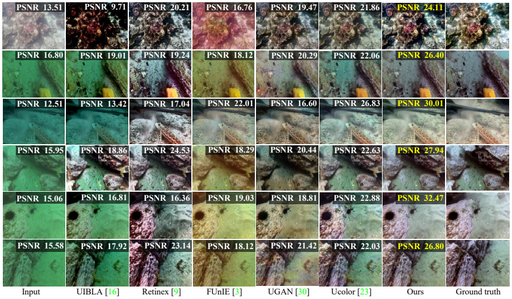
Fig. 8 . Visual comparison of enhancement results sampled from the Test-L400(LSUI) and Test-U90(UIEB[28]) dataset. From left to right are raw underwater images, results of UIBLA[16], Retinex based[9], FUnIE[3], UGAN[30], Ucolor[23], our U-shape Transformer and the reference image (recognized as ground truth (GT)). The highest PSNR value of each raw is marked in yellow.
出典 · CC BY 4.0 · Lintao Peng, Chunli Zhu, Liheng Bian · U-shape Transformer for Underwater Image Enhancement · 論文の図を引用 · 元のPDFの10ページ目から図の部分を抽出しています。非参照評価の結果と解釈
UIEBのTest-U60とSQUIDでの非参照評価では、PS、UIQM、UCIQE、NIQEを用います。論文では、提案手法はPSとNIQEで最も高いスコアを得たと報告されています。SQUIDにおける提案手法のPSは3.23です。ただし論文は、UCIQEとUIQMは色アーティファクトや色かぶりに鈍感なため、絶対的な根拠としては使いにくいと述べています。また、深層学習ベースの手法は、この2つの指標では物理モデルベースの手法より低く出ると説明しています。
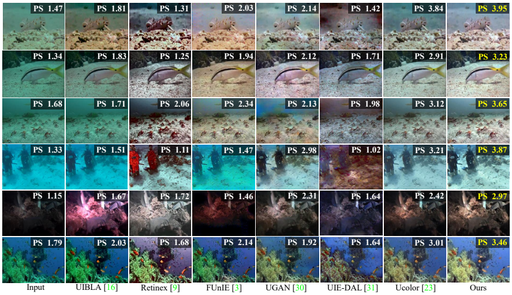
Fig. 9 . Visual comparison of the non-reference evaluation sampled from the Test-U60(UIEB [28]) dataset. From left to right are raw underwater images, results of UIBLA [16], Retinex based [9], FUnIE [3], UGAN [30], UIE-DAL [31], Ucolor [23] and our U-shape Transformer. The score in the upper right corner of each image is the perception score(PS), and the highest PS value of each raw is marked in yellow.
出典 · CC BY 4.0 · Lintao Peng, Chunli Zhu, Liheng Bian · U-shape Transformer for Underwater Image Enhancement · 論文の図を引用 · 元のPDFの11ページ目から図の部分を抽出しています。色空間選択の実験
色空間選択の実験では、単一の色空間損失と他の損失を組み合わせて、U-shape TransformerをTrain-Lで学習させました。続いて、Test-L400とTest-U90でPSNRを測定しました。その結果、LAB、LCH、RGBが両方のテストセットで上位3つのPSNRを得ました。著者らは、この3つの色空間を多色空間損失の構成として選んだと説明しています。
アブレーション実験と構成要素の役割
アブレーション実験では、ベースラインモデルBLに、CMSFFT、SGFMT、MSG、MCSLをそれぞれ加えた変種と、フルモデルを同じTrain-Lの条件で比較します。フルモデルはTest-L400でPSNR 24.16、SSIM 0.93を得て、BLはPSNR 19.34、SSIM 0.79を得ています。BL+CMSFFTはTest-L400でPSNRが22.47、BL+SGFMTは21.78です。論文は、MSGが局所的な細部の描写を助けると説明し、MCSLを除いた変種では局所領域に不均一な分布とアーティファクトが現れると報告しています。この結果は各要素を残した場合の効果を示すものであり、他の構成要素の寄与を一般的に証明するものではありません。
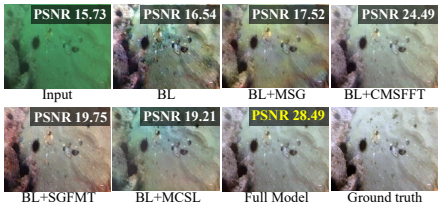
Fig. 11 . Visual comparison of the ablation study sampled from the Test-L400 dataset.
出典 · CC BY 4.0 · Lintao Peng, Chunli Zhu, Liheng Bian · U-shape Transformer for Underwater Image Enhancement · 論文の図を引用 · 元のPDFの12ページ目から図の部分を抽出しています。適用範囲と限界
本論文は、LSUI、UIEB、SQUIDなど限られた水中データセットで評価を行っています。著者らは、深海の低照度シーンのように複雑なあらゆるシーンの画像を収集することは不可能だと述べ、低照度の強調手法を今後の課題として挙げています。UCIQEとUIQMは色アーティファクトや色かぶりに鈍感なため、単独の判断根拠としては使いにくいです。
論文情報
- 著者
- Lintao Peng, Chunli Zhu, Liheng Bian
- 学会・ジャーナル
- arXiv · プレプリント
- 公開日
- 2021年11月23日
- 登録日
- 2026年11月6日
- 更新日
- 2022年6月12日
- バージョン
- v6
- arXiv
- 2111.11843
- DOI
- 10.1109/tip.2023.3276332
- カテゴリ
- cs.CV · eess.IV
- ライセンス
- CC BY 4.0
- 掲載内容
- 論文情報・解説・論文の図
この解説は、Refivuの韓国語解説をAIで翻訳したものです。不正確な翻訳や誤りが含まれる可能性があります。論文と図の利用条件は各出典に従います。
アブストラクト
The light absorption and scattering of underwater impurities lead to poor underwater imaging quality. The existing data-driven based underwater image enhancement (UIE) techniques suffer from the lack of a large-scale dataset containing various underwater scenes and high-fidelity reference images. Besides, the inconsistent attenuation in different color channels and space areas is not fully considered for boosted enhancement. In this work, we constructed a large-scale underwater image (LSUI) dataset including 5004 image pairs, and reported an U-shape Transformer network where the transformer model is for the first time introduced to the UIE task. The U-shape Transformer is integrated with a channel-wise multi-scale feature fusion transformer (CMSFFT) module and a spatial-wise global feature modeling transformer (SGFMT) module, which reinforce the network's attention to the color channels and space areas with more serious attenuation. Meanwhile, in order to further improve the contrast and saturation, a novel loss function combining RGB, LAB and LCH color spaces is designed following the human vision principle. The extensive experiments on available datasets validate the state-of-the-art performance of the reported technique with more than 2dB superiority.
この論文を引用
Lintao Peng, Chunli Zhu, Liheng Bian (2021). U-shape Transformer for Underwater Image Enhancement. arXiv:2111.11843v6. https://doi.org/10.1109/tip.2023.3276332
BibTeX
@article{peng2021shape,
  title = {{U-shape Transformer for Underwater Image Enhancement}},
  author = {Lintao Peng and Chunli Zhu and Liheng Bian},
  year = {2021},
  eprint = {2111.11843},
  archivePrefix = {arXiv},
  doi = {10.1109/tip.2023.3276332},
  url = {https://arxiv.org/abs/2111.11843v6}
}